
Number System - Notes
Maths - Notes
Number System
Numbers are the basic tools of Mathematics. A Number System is a way of representing and expressing numbers using a set of symbols and rules. The study of the number system enables us to classify numbers into distinct groups and comprehend their properties.
In mathematics, numbers are broadly divided into:
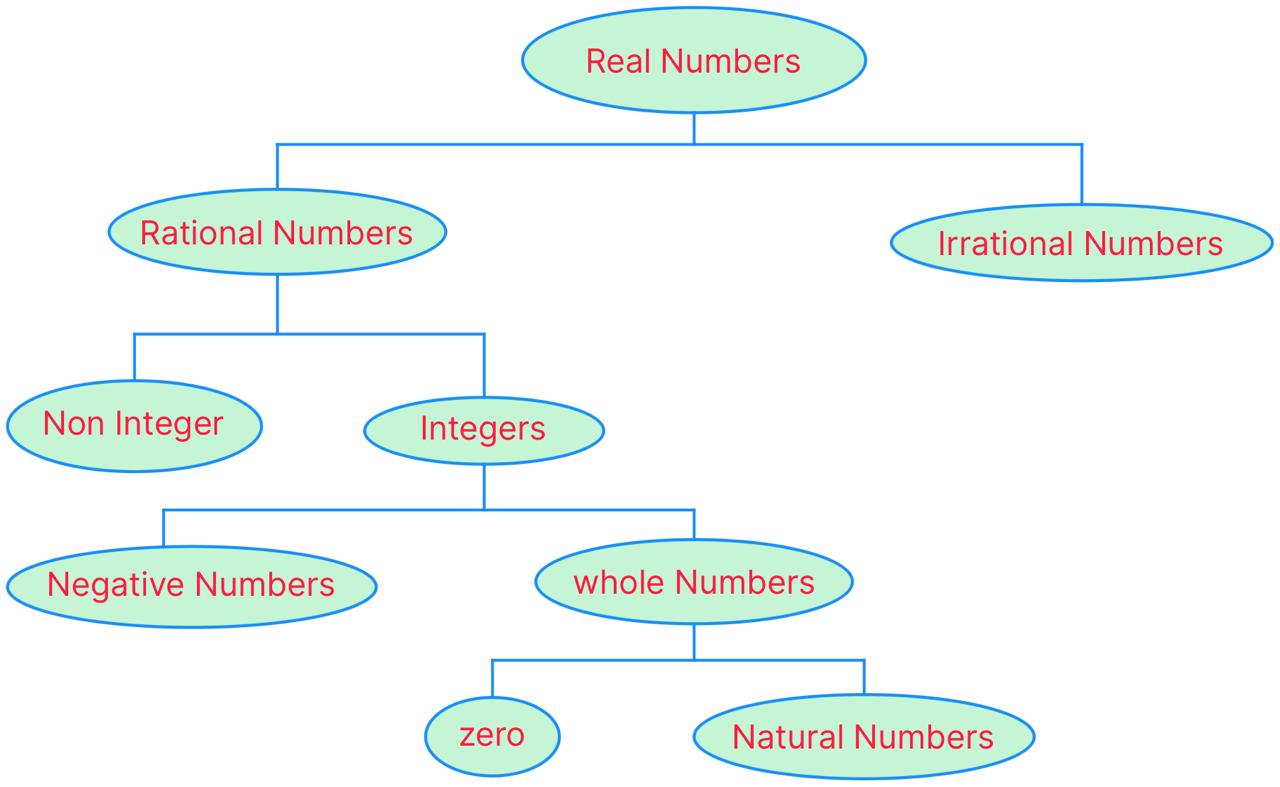
- Natural Numbers \(\mathbb{(N)}\): Counting numbers starting from 1, 2, 3, …
- Whole Numbers \(\mathbb{(W)}\): All natural numbers along with 0.
- Integers \(\mathbb{(Z)}\): All whole numbers and their negatives (…, -3, -2, -1, 0, 1, 2, 3, …).
- Rational Numbers \(\mathbb{(Q)}\): Numbers that can be written in the form p/q, where p and q are integers and q ≠ 0.
- Irrational Numbers: Numbers that cannot be written in the form p/q (like √2, π, etc.).
- Real Numbers \(\mathbb{(R)}\): The set of all rational and irrational numbers.
Natural Numbers \((\mathbb{N})\)
- Definition: The numbers that we use for counting objects are called Natural Numbers. Example: 1, 2, 3, 4, 5, …
- Symbol: The set of natural numbers is denoted by \((\mathbb{N})\).
- Important Points:
- Natural numbers start from 1 and go on endlessly.
- 0 is not a natural number.
- Every natural number has a successor (next number), but no natural number has a predecessor (previous number).
Whole Number
whole number is a number without fractions or decimals. It includes 0 and all natural numbers (1, 2, 3, 4, …).
In short:- Whole Numbers \(\mathbb{(W)}\) = {0, 1, 2, 3, 4, …}
- They do not include negative numbers, fractions, or decimals.
Integer \(\mathbb{(Z)}\)
An Integer is a number that can be positive, negative, or zero, but it
cannot be a fraction or a decimal.
Set of integers:
\[\scriptsize Integers \mathbb{(Z)}=\left\{\cdots, -3, -2, -1, 0, 1, 2, 3,\cdots \right\}\]
- Positive Integers: 1, 2, 3, 4, …
- Negative Integers: -1, -2, -3, -4, …
- Zero (0) is also an integer.
Rational Number\(\mathbb{(Q)}\)
The collection of rational numbers is denoted by \(\mathbb{Q}\).
‘Rational’ comes from the word ‘ratio’,
and Q comes from
the word ‘quotient’.
A number ‘r’ is called a rational number if it can be written in the form
\(\frac{p}{q}\), where p and q are integers and \(q \neq
0\).
Examples:
Fractions: \(\frac{1}{2}, \frac{-3}{4},
\frac{5}{1}\)
Integers: (since they can be written as \(\frac{n}{1})\): -3, 0,
5
Repeating Decimals: \(0.333\cdots = \frac{1}{3},
0.142857\cdots\frac{1}{7}\)
Terminating Decimals: \(0.5 = \frac{1}{2}, 1.25 =
\frac{5}{4}\)
Key Points:
- All integers are rational numbers.
- Every terminating or repeating decimal is a rational number.
- Denominator can never be zero.
Note: There are infinitely many rational
numbers between any two given rational
numbers
Irrational Number
An irrational number is a real number that cannot be expressed as a ratio of two integers; it cannot be
written
in the form \(\frac{p}{q}\), where p and q are integers and \(q\neq 0\).
Key Features of Irrational Numbers:
Their decimal expansion is non-terminating and non-repeating.

- They cannot be expressed as fractions of integers.
- They lie on the number line just like rational numbers, but they “fill the gaps” left by rationals
- \(\pi = 3.141592\cdots\) (non-repeating, non-terminating)
- \(\sqrt{2} = 1.414213\cdots\)
- \(e=2.718281\cdots\)
Important Points:
- A number r is called a rational number, if it can be written in the form \(\frac{p}{q}\) , where p and q are integers and (qne 0).
- A number s is called a irrational number, if it cannot be written in the form (frac{p}{q}), where p and q are integers and \(q\ne 0).
- All the rational and irrational numbers make up the collection of real numbers.
- If r is rational and s is irrational, then r + s and r – s are irrational numbers, and rs and \(\frac{r}{s}\) are irrational numbers, \(r\ne 0\).
- For positive real numbers a & b, the following identities holds:
- \(\sqrt{ab}=\sqrt{a}\sqrt{b}\)
- \(\sqrt{a\over b}={\sqrt{a}\over \sqrt{b}}\)
- \((\sqrt{a} + \sqrt{b}) - (\sqrt{a} - \sqrt{b})=a-b\)
- \((a + \sqrt{b})(a - \sqrt{b})=a^2 - b\)
- \((\sqrt{a} + \sqrt{b})^2 = a + 2\sqrt{ab} +b\)
- To Rationalize the Denominator of \(\frac{1}{\sqrt{a} +b}\), we multiply this by \(\frac{\sqrt{a} -b}{\sqrt{a} -b}\) where a & b are integers.
- Let (agt 0) be real number and p and q be rational number then
- \(a^p . a^p = a^{(p+q)}\)
- \({(a^p)}^q = a^{pq}\)
- \(\frac{a^p}{a^q}=a^{p-q}\)
- \(a^p . b^p = (ab)^p\)
- The decimal expansion of a rational number is either terminating or nonterminating recurring. Moreover, a number whose decimal expansion is terminating or non-terminating recurring is rational.
- The decimal expansion of an irrational number is non-terminating non-recurring. Moreover, a number whose decimal expansion is non-terminating non-recurring is irrational.
Heros Contribution
Archimedes
The Greek genius Archimedes was the first to compute digits in the decimal system. expansion of π. He showed 3.140845< π < 3.142857.
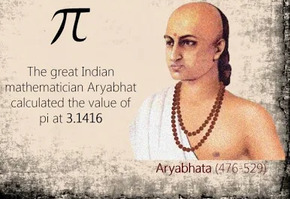
AryaBhatta
Aryabhatta (476 – 550 C.E.), the great Indian mathematician and astronomer, found the value of π correct to four decimal places (3.1416).