Ch 3  ·  Q–
0%
Class 10 Mathematics Exercise 3.1 NCERT Solutions Olympiad Board Exam
Chapter 3

PAIR OF LINEAR EQUATIONS IN TWO VARIABLES

Step-by-step NCERT solutions with stress–strain analysis and exam-oriented hints for Boards, JEE & NEET.

7 Questions
20-25 min Ideal time
Q1 Now at
Q1
NUMERIC3 marks
Form the pair of linear equations and find their solutions graphically.

Concept Before Solving

  • A pair of linear equations in two variables represents two straight lines.
  • The solution of the system is the point where both lines intersect.
  • Algebraically: Solve equations simultaneously.
  • Graphically: Plot both equations → intersection point = solution.

Solution Roadmap (Exam Strategy)

  1. Assign variables clearly.
  2. Convert statements into equations.
  3. Solve using substitution/elimination.
  4. Verify by substituting values.
  5. Interpret final answer in context.

Solution (i)

Step 1: Let variables

Let number of girls = \(x\)
Let number of boys = \(y\)

Step 2: Form equations

Girls are 4 more than boys:

$$\begin{align}x = y + 4 \tag{1}\end{align}$$

Total students = 10:

$$\begin{align}x + y = 10 \tag{2}\end{align}$$

Step 3: Substitute equation (1) into (2)

$$\begin{aligned} x + y &= 10 \\ (y + 4) + y &= 10 \\ y + 4 + y &= 10 \\ 2y + 4 &= 10 \\ 2y &= 10 - 4 \\ 2y &= 6 \\ y &= \frac{6}{2} \\ y &= 3 \end{aligned}$$

Step 4: Find value of \(x\)

$$\begin{aligned} x &= y + 4 \\ x &= 3 + 4 \\ x &= 7 \end{aligned}$$

Final Answer:
Number of girls = 7
Number of boys = 3

Verification

$$7 + 3 = 10 \quad \text{✔ correct}$$
Ex 3.1 (i)

Solution (ii)

Step 1: Let variables

Cost of one pencil = \(x\)
Cost of one pen = \(y\)

Step 2: Form equations

$$\begin{align5x + 7y = 50 \tag{1}\end{align}$$ $$\begin{align7x + 5y = 46 \tag{2}\end{align}$$

Step 3: Elimination method

Multiply (1) by 7 and (2) by 5: $$\begin{align} 35x + 49y &= 350 \tag{3}\\ 35x + 25y &= 230 \tag{4} \end{align}$$

Subtract (4) from (3):

$$\begin{aligned} (35x + 49y) - (35x + 25y) &= 350 - 230 \\ 35x + 49y - 35x - 25y &= 120 \\ 24y &= 120 \\ y &= \frac{120}{24} \\ y &= 5 \end{aligned}$$

Step 4: Substitute \(y = 5\) in equation (1)

$$\begin{aligned} 5x + 7y &= 50 \\ 5x + 7(5) &= 50 \\ 5x + 35 &= 50 \\ 5x &= 50 - 35 \\ 5x &= 15 \\ x &= \frac{15}{5} \\ x &= 3 \end{aligned}$$

Final Answer:
Cost of one pencil = ₹3
Cost of one pen = ₹5

Verification

$$5(3) + 7(5) = 15 + 35 = 50 \quad \text{✔}$$ $$7(3) + 5(5) = 21 + 25 = 46 \quad \text{✔}$$
Ex 3.1 (i)

Why This Question is Important

  • Directly tests formation of equations from real-life situations.
  • Very common in CBSE Board Exams (3–4 marks guaranteed type).
  • Strengthens algebraic modelling (used in higher mathematics).
  • Forms base for coordinate geometry and graph interpretation.

Competitive Exam Relevance

  • Frequently asked in NTSE, Olympiads, and foundation exams.
  • Improves speed in solving linear systems (important for JEE basics).
  • Helps in word-problem translation — a key aptitude skill.
↑ Top
1 / 7  ·  14%
Q2 →
Q2
NUMERIC3 marks
On comparing the ratios \(\frac{a_1}{a_2},\ \frac{b_1}{b_2} \text{ and }\frac{c_1}{c_2}\) , find out whether the lines representing the following pairs of linear equations intersect at a point, are parallel or coincident:

Concept Before Solving

  • For a pair of linear equations:
    \(a_1x + b_1y + c_1 = 0\)
    \(a_2x + b_2y + c_2 = 0\)
  • Compare ratios:

\[ \frac{a_1}{a_2}, \quad \frac{b_1}{b_2}, \quad \frac{c_1}{c_2} \]

  • If \(\frac{a_1}{a_2} \ne \frac{b_1}{b_2}\) → Lines intersect → Unique solution
  • If \(\frac{a_1}{a_2} = \frac{b_1}{b_2} \ne \frac{c_1}{c_2}\) → Parallel → No solution
  • If \(\frac{a_1}{a_2} = \frac{b_1}{b_2} = \frac{c_1}{c_2}\) → Coincident → Infinite solutions

Solution Strategy

  1. Write coefficients clearly.
  2. Find all three ratios carefully.
  3. Compare ratios properly (avoid sign mistakes).
  4. State conclusion with solution type.

Solution (i)

$$\begin{aligned} 5x - 4y + 8 &= 0 \\ 7x + 6y - 9 &= 0 \end{aligned}$$

Step 1: Identify coefficients

\(a_1 = 5,\ b_1 = -4,\ c_1 = 8\)
\(a_2 = 7,\ b_2 = 6,\ c_2 = -9\)

Step 2: Find ratios

$$\begin{aligned} \frac{a_1}{a_2} &= \frac{5}{7} \\ \frac{b_1}{b_2} &= \frac{-4}{6} = \frac{-2}{3} \end{aligned}$$

Step 3: Compare

$$\frac{5}{7} \ne \frac{-2}{3}$$

Conclusion:
Lines intersect at one point → Unique solution

Solution (ii)

$$\begin{aligned} 9x + 3y + 12 &= 0 \\ 18x + 6y + 24 &= 0 \end{aligned}$$

Step 1: Identify coefficients

\(a_1 = 9,\ b_1 = 3,\ c_1 = 12\)
\(a_2 = 18,\ b_2 = 6,\ c_2 = 24\)

Step 2: Find ratios

$$\begin{aligned} \frac{a_1}{a_2} &= \frac{9}{18} = \frac{1}{2} \\ \frac{b_1}{b_2} &= \frac{3}{6} = \frac{1}{2} \\ \frac{c_1}{c_2} &= \frac{12}{24} = \frac{1}{2} \end{aligned}$$

Step 3: Compare

\[\frac{a_1}{a_2} = \frac{b_1}{b_2} = \frac{c_1}{c_2}\]

Conclusion:
Lines are coincident → Infinite number of solutions

Solution (iii)

$$\begin{aligned}\ 6x - 3y + 10 &= 0 \\ 2x - y + 9 &= 0 \end{aligned}$$

Step 1: Identify coefficients

\(a_1 = 6,\ b_1 = -3,\ c_1 = 10\)
\(a_2 = 2,\ b_2 = -1,\ c_2 = 9\)

Step 2: Find ratios

$$\begin{aligned} \frac{a_1}{a_2} &= \frac{6}{2} = 3 \\ \frac{b_1}{b_2} &= \frac{-3}{-1} = 3 \\ \frac{c_1}{c_2} &= \frac{10}{9} \end{aligned}$$

Step 3: Compare

\[3 = 3 \ne \frac{10}{9}\]

Conclusion:
Lines are parallel → No solution


Board Exam Importance

  • Very frequently asked 2–3 mark direct question.
  • Concept-based → easy scoring if ratios are handled correctly.
  • Common mistake: ignoring signs in ratios.

Competitive Exam Relevance

  • Builds foundation for coordinate geometry.
  • Important for graphical interpretation in higher maths.
  • Used in elimination logic in aptitude and algebra problems.
← Q1
2 / 7  ·  29%
Q3 →
Q3
NUMERIC3 marks
On comparing the ratios \(\frac{a_1}{a_2},\ \frac{b_1}{b_2} \text{ and }\frac{c_1}{c_2}\), find out whether the following pair of linear equations are consistent, or inconsistent.

Concept Before Solving

For a pair of linear equations:

\(a_1x + b_1y + c_1 = 0\)
\(a_2x + b_2y + c_2 = 0\)

Compare ratios:

\[ \frac{a_1}{a_2}, \quad \frac{b_1}{b_2}, \quad \frac{c_1}{c_2} \]
  • If \(\frac{a_1}{a_2} \ne \frac{b_1}{b_2}\) → Consistent (unique solution)
  • If \(\frac{a_1}{a_2} = \frac{b_1}{b_2} \ne \frac{c_1}{c_2}\) → Inconsistent (no solution)
  • If \(\frac{a_1}{a_2} = \frac{b_1}{b_2} = \frac{c_1}{c_2}\) → Consistent (infinite solutions)

Solution Strategy

  1. Convert equations into standard form.
  2. Extract coefficients carefully.
  3. Handle fractions properly (very important).
  4. Compare ratios and conclude.

Solution (i)

$$\begin{aligned} 3x + 2y - 5 &= 0\\ 2x - 3y - 7 &= 0 \end{aligned}$$

Coefficients:

\(a_1=3,\ b_1=2,\ c_1=-5\)
\(a_2=2,\ b_2=-3,\ c_2=-7\) $$\begin{aligned} \frac{a_1}{a_2} &= \frac{3}{2}\\ \frac{b_1}{b_2} &= \frac{2}{-3} = -\frac{2}{3} \end{aligned}$$ \[\frac{3}{2} \ne -\frac{2}{3}\]

Conclusion: Consistent (unique solution)

Solution (ii)

$$\begin{aligned} 2x - 3y - 8 &= 0\\ 4x - 6y - 9 &= 0 \end{aligned}$$

Coefficients:

\(a_1=2,\ b_1=-3,\ c_1=-8\)
\(a_2=4,\ b_2=-6,\ c_2=-9\) $$\begin{aligned} \frac{a_1}{a_2} &= \frac{1}{2}\\ \frac{b_1}{b_2} &= \frac{-3}{-6} = \frac{1}{2}\\ \frac{c_1}{c_2} &= \frac{-8}{-9} = \frac{8}{9} \end{aligned}$$ \[\frac{1}{2} = \frac{1}{2} \ne \frac{8}{9}\]

Conclusion: Inconsistent (parallel lines, no solution)

Solution (iii)

$$\begin{aligned} \frac{3}{2}x + \frac{5}{3}y - 7 &= 0\\ 9x - 10y - 14 &= 0 \end{aligned}$$

Step: Clear fractions (important)

Multiply first equation by 6: $$\begin{aligned} 9x + 10y - 42 &= 0\\ 9x - 10y - 14 &= 0 \end{aligned}$$

Coefficients:

\(a_1=9,\ b_1=10,\ c_1=-42\)
\(a_2=9,\ b_2=-10,\ c_2=-14\) $$\begin{aligned} \frac{a_1}{a_2} &= 1\\ \frac{b_1}{b_2} &= \frac{10}{-10} = -1 \end{aligned}$$ \[1 \ne -1\]

Conclusion: Consistent (unique solution)

Solution (iv)

$$\begin{aligned} 5x - 3y - 11 &= 0\\ -10x + 6y + 22 &= 0 \end{aligned}$$

Coefficients:

\(a_1=5,\ b_1=-3,\ c_1=-11\)
\(a_2=-10,\ b_2=6,\ c_2=22\) $$\begin{aligned} \frac{a_1}{a_2} &= -\frac{1}{2}\\ \frac{b_1}{b_2} &= -\frac{1}{2}\\ \frac{c_1}{c_2} &= -\frac{1}{2} \end{aligned}$$

Conclusion: Consistent (infinite solutions, coincident lines)

Solution (v)

$$\begin{aligned} \frac{4}{3}x + 2y - 8 &= 0\\ 2x + 3y - 12 &= 0 \end{aligned}$$

Step: Clear fraction

Multiply first equation by 3: \[4x + 6y - 24 = 0\]

Coefficients:

\(a_1=4,\ b_1=6,\ c_1=-24\)
\(a_2=2,\ b_2=3,\ c_2=-12\) $$\begin{aligned} \frac{a_1}{a_2} &= 2\\ \frac{b_1}{b_2} &= 2\\ \frac{c_1}{c_2} &= 2 \end{aligned}$$

Conclusion: Consistent (infinite solutions)


Board Exam Importance

  • Very common conceptual question (2–4 marks).
  • Tests ratio logic and sign accuracy.
  • Fractions-based questions are frequently asked.

Competitive Exam Relevance

  • Important for linear system classification.
  • Helps in graphical reasoning problems.
  • Strengthens algebraic manipulation speed.

← Q2
3 / 7  ·  43%
Q4 →
Q4
NUMERIC3 marks
Which of the following pairs of linear equations are consistent/inconsistent? If consistent, obtain the solution graphically:

Concept Before Solving

  • If two equations represent same line → infinite solutions.
  • If lines intersect → unique solution.
  • If lines are parallel → no solution.
  • Graphically, solution = point of intersection.

Solution Strategy

  1. Convert into standard form if needed.
  2. Compare ratios.
  3. If consistent and unique → solve algebraically.
  4. Verify solution.

Solution (i)

$$\begin{aligned} x + y - 5 &= 0\\ 2x + 2y - 10 &= 0 \end{aligned}$$

Coefficients:

\(a_1=1,\ b_1=1,\ c_1=-5\)
\(a_2=2,\ b_2=2,\ c_2=-10\) $$\begin{aligned} \frac{a_1}{a_2} &= \frac{1}{2}\\ \frac{b_1}{b_2} &= \frac{1}{2}\\ \frac{c_1}{c_2} &= \frac{-5}{-10} = \frac{1}{2} \end{aligned}$$

Conclusion:
Consistent → coincident lines → infinite solutions

Solution (ii)

$$\begin{aligned} x - y - 8 &= 0\\ 3x - 3y - 16 &= 0 \end{aligned}$$

Coefficients:

\(a_1=1,\ b_1=-1,\ c_1=-8\)
\(a_2=3,\ b_2=-3,\ c_2=-16\) $$\begin{aligned} \frac{a_1}{a_2} &= \frac{1}{3}\\ \frac{b_1}{b_2} &= \frac{-1}{-3} = \frac{1}{3}\\ \frac{c_1}{c_2} &= \frac{-8}{-16} = \frac{1}{2} \end{aligned}$$

Conclusion:
Parallel lines → Inconsistent → No solution

Solution (iii)

$$\begin{aligned} 2x + y - 6 &= 0\\ 4x - 2y - 4 &= 0 \end{aligned}$$

Step 1: Check consistency

$$\begin{aligned} \frac{a_1}{a_2} &= \frac{2}{4} = \frac{1}{2}\\ \frac{b_1}{b_2} &= \frac{1}{-2} = -\frac{1}{2} \end{aligned}$$ \[\frac{1}{2} \ne -\frac{1}{2}\]

Conclusion: Intersecting → unique solution

Step 2: Solve algebraically

From (1): \[y = 6 - 2x\] Substitute into (2): $$\begin{aligned} 4x - 2(6 - 2x) - 4 &= 0\\ 4x - 12 + 4x - 4 &= 0\\ 8x - 16 &= 0\\ 8x &= 16\\ x &= 2 \end{aligned}$$ $$\begin{aligned} y &= 6 - 2(2)\\ y &= 6 - 4\\ y &= 2 \end{aligned}$$

Solution point: (2, 2)

Verification:

\[2(2)+2=6 \quad ✔\] \[4(2)-2(2)-4=0 \quad ✔\]
Ex 3.1.4 (iii)

Solution (iv)

$$\begin{aligned} 2x - 2y - 2 &= 0\\ 4x - 4y - 5 &= 0 \end{aligned}$$

Coefficients:

\(a_1=2,\ b_1=-2,\ c_1=-2\)
\(a_2=4,\ b_2=-4,\ c_2=-5\) $$\begin{aligned} \frac{a_1}{a_2} &= \frac{1}{2}\\ \frac{b_1}{b_2} &= \frac{1}{2}\\ \frac{c_1}{c_2} &= \frac{-2}{-5} = \frac{2}{5} \end{aligned}$$

Conclusion:
Parallel lines → Inconsistent → No solution


Board Exam Importance

  • Highly important 3–4 mark question combining concept + solving.
  • Tests both classification and algebraic solving.
  • Graph-based questions frequently asked.

Competitive Exam Relevance

  • Important for graphical interpretation problems.
  • Builds strong foundation for coordinate geometry.
  • Used in elimination-based aptitude problems.
← Q3
4 / 7  ·  57%
Q5 →
Q5
NUMERIC3 marks
Half the perimeter of a rectangular garden, whose length is 4 m more than its width, is 36 m. Find the dimensions of the garden.

Concept Before Solving

  • Perimeter of a rectangle = \(2(\text{length} + \text{width})\)
  • Half of the perimeter = \(\text{length} + \text{width}\)
  • Translate word statements carefully into equations.

Solution Strategy

  1. Assume variables clearly.
  2. Convert given conditions into equations.
  3. Solve using substitution method.
  4. Verify final answer.

Solution

Step 1: Let variables

Let width of the garden = \(x\) m
Length of the garden = \(y\) m

Step 2: Form equation from given condition

Length is 4 m more than width: $$\begin{align}y = x + 4 \tag{1}\end{align}$$

Step 3: Use perimeter relation

Half perimeter = length + width: $$\begin{align}x + y = 36 \tag{2}\end{align}$$

Step 4: Substitute equation (1) into (2)

$$\begin{aligned} x + y &= 36 \\ x + (x + 4) &= 36 \\ x + x + 4 &= 36 \\ 2x + 4 &= 36 \\ 2x &= 36 - 4 \\ 2x &= 32 \\ x &= \frac{32}{2} \\ x &= 16 \end{aligned}$$

Step 5: Find length

$$\begin{aligned} y &= x + 4 \\ y &= 16 + 4 \\ y &= 20 \end{aligned}$$

Final Answer:
Width = 16 m
Length = 20 m

Verification

$$\begin{aligned} x + y &= 16 + 20 = 36 \quad ✔ \\ 2(x+y) &= 2(36) = 72 \text{ m (full perimeter)} ✔ \end{aligned}$$
Length = y Width = x

Board Exam Importance

  • Common word problem (3 marks).
  • Tests translation of geometry into algebra.
  • Easy scoring if equation formation is correct.

Competitive Exam Relevance

  • Important for aptitude-based algebra problems.
  • Used in mensuration + algebra combined questions.
  • Builds modelling skills for real-life scenarios.
← Q4
5 / 7  ·  71%
Q6 →
Q6
NUMERIC3 marks
Given the linear equation 2x + 3y – 8 = 0, write another linear equation in two variables such that the geometrical representation of the pair so formed is:
(i) intersecting lines
(ii) parallel lines
(iii) coincident lines

Concept Before Solving

  • For two lines:
    \(a_1x + b_1y + c_1 = 0\)
    \(a_2x + b_2y + c_2 = 0\)
  • Intersecting: \(\frac{a_1}{a_2} \ne \frac{b_1}{b_2}\)
  • Parallel: \(\frac{a_1}{a_2} = \frac{b_1}{b_2} \ne \frac{c_1}{c_2}\)
  • Coincident: \(\frac{a_1}{a_2} = \frac{b_1}{b_2} = \frac{c_1}{c_2}\)

Given Equation

\[2x + 3y - 8 = 0\]

Here: \(a_1 = 2,\ b_1 = 3,\ c_1 = -8\)

(i) Intersecting Lines

Condition:

\[\frac{a_1}{a_2} \ne \frac{b_1}{b_2}\]

Choose another equation:

\[5x + 6y - 7 = 0\]

Check:

$$\begin{aligned} \frac{a_1}{a_2} &= \frac{2}{5} \\ \frac{b_1}{b_2} &= \frac{3}{6} = \frac{1}{2} \end{aligned}$$ \[\frac{2}{5} \ne \frac{1}{2}\]

Conclusion: Lines intersect → unique solution

(ii) Parallel Lines

Condition:

\[\frac{a_1}{a_2} = \frac{b_1}{b_2} \ne \frac{c_1}{c_2}\]

Choose another equation:

\[2x + 3y + 5 = 0\]

Check:

$$\begin{aligned} \frac{a_1}{a_2} &= \frac{2}{2} = 1 \\ \frac{b_1}{b_2} &= \frac{3}{3} = 1 \\ \frac{c_1}{c_2} &= \frac{-8}{5} \end{aligned}$$ \[1 = 1 \ne \frac{-8}{5}\]

Conclusion: Parallel → no solution

(iii) Coincident Lines

Condition:

\[\frac{a_1}{a_2} = \frac{b_1}{b_2} = \frac{c_1}{c_2}\]

Choose equation (multiple of given):

\[4x + 6y - 16 = 0\]

Check:

$$\begin{aligned} \frac{a_1}{a_2} &= \frac{2}{4} = \frac{1}{2} \\ \frac{b_1}{b_2} &= \frac{3}{6} = \frac{1}{2} \\ \frac{c_1}{c_2} &= \frac{-8}{-16} = \frac{1}{2} \end{aligned}$$

Conclusion: Coincident → infinite solutions


Board Exam Importance

  • Tests conceptual clarity of ratio conditions.
  • Common 2–3 mark question.
  • Students often lose marks due to wrong ratio condition.

Competitive Exam Relevance

  • Important for understanding slope and line relations.
  • Used in coordinate geometry and system classification.
  • Strengthens conceptual algebra.
← Q5
6 / 7  ·  86%
Q7 →
Q7
NUMERIC3 marks
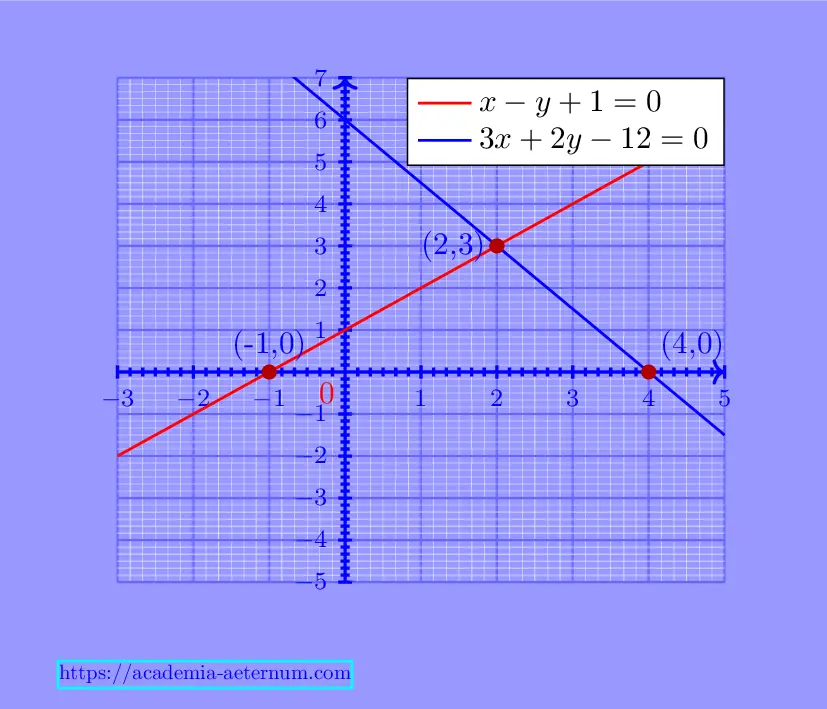
Draw the graphs of the equations x – y + 1 = 0 and 3x + 2y – 12 = 0. Determine the coordinates of the vertices of the triangle formed by these lines and the x-axis, and shade the triangular region.

Concept Before Solving

  • Each linear equation represents a straight line.
  • Triangle is formed by intersection of:
    • Line 1
    • Line 2
    • x-axis (y = 0)
  • Vertices = points of intersection.

Solution

Given equations:

\[\begin{align}x - y + 1 = 0 \tag{1}\end{align}\] \[\begin{align}3x + 2y - 12 = 0 \tag{2}\end{align}\]

Step 1: Convert to slope form

$$\begin{aligned} (1):\ y &= x + 1 \\ (2):\ 2y &= 12 - 3x \\ y &= 6 - \frac{3}{2}x \end{aligned}$$

Step 2: Find intersection with x-axis (y = 0)

For (1): \[x + 1 = 0 \Rightarrow x = -1\] Point = (-1, 0)

For (2): \[3x - 12 = 0 \Rightarrow x = 4\] Point = (4, 0)

Step 3: Find intersection of two lines

$$\begin{aligned} x + 1 &= 6 - \frac{3}{2}x \\ x + \frac{3}{2}x &= 6 - 1 \\ \frac{5}{2}x &= 5 \\ x &= 2 \end{aligned}$$ \[y = x + 1 = 2 + 1 = 3\] Point = (2, 3)

Step 4: Vertices of triangle

  • (-1, 0)
  • (4, 0)
  • (2, 3)

Final Answer:
Triangle vertices = (-1,0), (4,0), (2,3)

Ex 3.1.7

Board Exam Importance

  • Very important 4-mark graphical question.
  • Tests graph plotting + intersection concept.
  • Common mistake: skipping intersection calculation.

Competitive Exam Relevance

  • Important for coordinate geometry basics.
  • Used in area and graph-based reasoning problems.
  • Strengthens visualization skills.
← Q6
7 / 7  ·  100%
↑ Back to top
🎓

Chapter Complete!

All 7 solutions for PAIR OF LINEAR EQUATIONS IN TWO VARIABLES covered.

↑ Review from the top
📚
ACADEMIA AETERNUM तमसो मा ज्योतिर्गमय · Est. 2025
Sharing this chapter
NCERT Class 10 Maths Ex 3.1 Solutions (Step-by-Step Guide)
NCERT Class 10 Maths Ex 3.1 Solutions (Step-by-Step Guide) — Complete Notes & Solutions · academia-aeternum.com
🎓 Class 10 📐 Mathematics 📖 NCERT ✅ Free Access 🏆 CBSE · JEE
Share on
academia-aeternum.com/class-10/mathematics/pair-of-linear-equations/exercises/exercise-3.1/ Copy link
💡
Exam tip: Sharing chapter notes with your study group creates a reinforcement loop. Teaching a concept is the fastest path to mastering it.

Warning: include_once(../../../../includes/footer.php): Failed to open stream: No such file or directory in /home/u159659565/domains/academia-aeternum.com/public_html/class-10/mathematics/pair-of-linear-equations/exercises/exercise-3.1/index.php on line 1131

Warning: include_once(): Failed opening '../../../../includes/footer.php' for inclusion (include_path='.:/opt/alt/php82/usr/share/pear:/opt/alt/php82/usr/share/php:/usr/share/pear:/usr/share/php') in /home/u159659565/domains/academia-aeternum.com/public_html/class-10/mathematics/pair-of-linear-equations/exercises/exercise-3.1/index.php on line 1131