
Ch 2  ·  Q–
0%
Class 10 Mathematics Exercise 2.1 NCERT Solutions Olympiad Board Exam

Chapter 2 — POLYNOMIALS

Step-by-step NCERT solutions with stress–strain analysis and exam-oriented hints for Boards, JEE & NEET.

📋1 questions
Ideal time: 20-25 min
📍Now at: Q1
Q1
NUMERIC3 marks

The graphs of \(y = p(x)\) are given below. Find the number of zeroes of \(p(x)\) in each case.
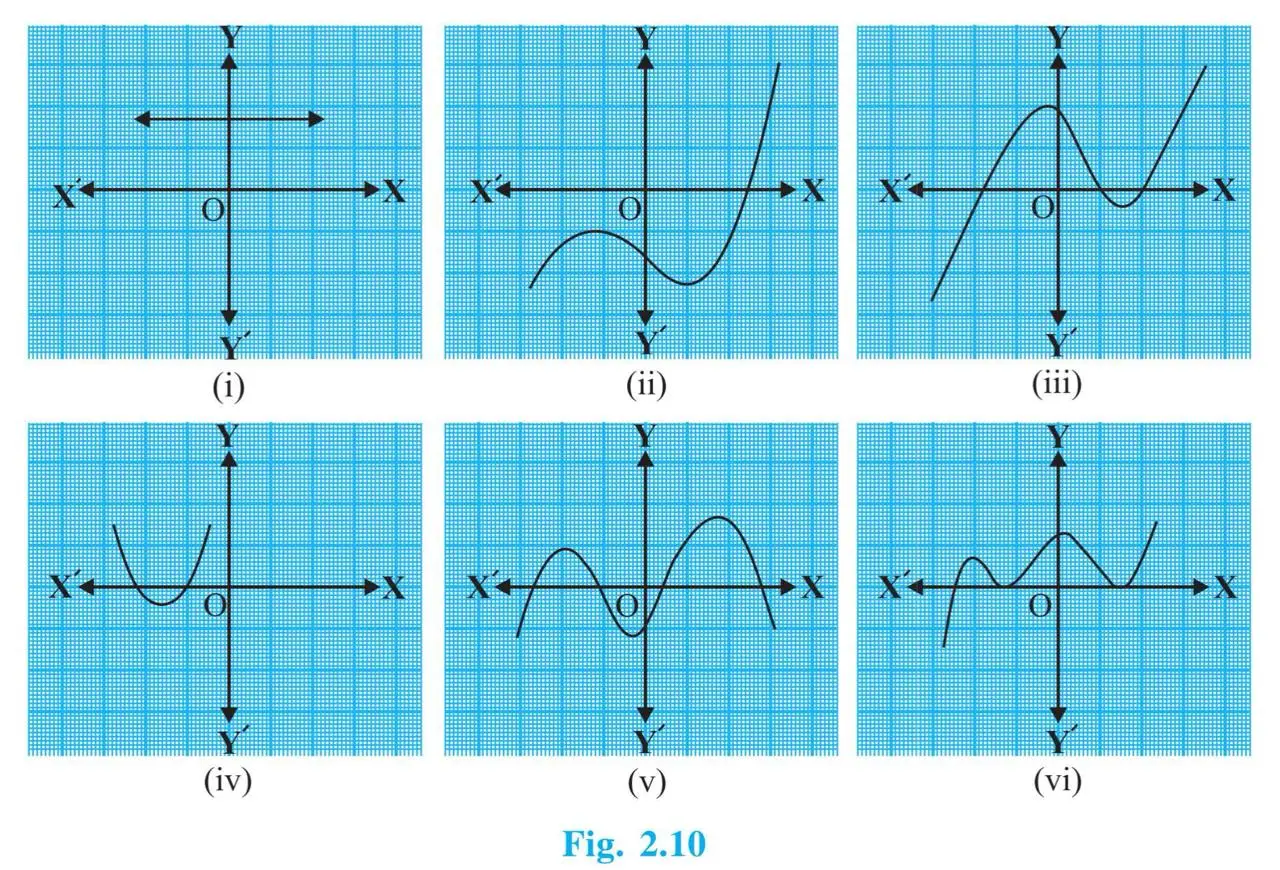
Graphs
Fig 2.10
Concept Before Solving
  • A zero of a polynomial is a value of \(x\) for which \(p(x)=0\).
  • Graphically, zeroes are the points where the graph intersects the \(x\)-axis.
  • If graph cuts (crosses) the \(x\)-axis → simple zero.
  • If graph just touches the \(x\)-axis → repeated zero (even multiplicity).
Solution Roadmap
  • Step 1: Observe each graph carefully.
  • Step 2: Count how many times graph meets \(x\)-axis.
  • Step 3: Include both crossing and touching points.
  • Step 4: That count = number of zeroes.

  1. Figure (i):
    The graph is a horizontal line parallel to the \(x\)-axis and does not intersect it.

    Step-wise:
    • No intersection with \(x\)-axis
    • No solution to \(p(x)=0\)

    Therefore, number of zeroes = 0
  2. Figure (ii):
    The graph intersects the \(x\)-axis at exactly one point.

    Step-wise:
    • Curve crosses axis once
    • Only one value of \(x\) makes \(p(x)=0\)

    Therefore, number of zeroes = 1
  3. Figure (iii):
    The graph cuts the \(x\)-axis three times.

    Step-wise:
    • First intersection (left)
    • Second intersection (middle)
    • Third intersection (right)

    Therefore, number of zeroes = 3
  4. Figure (iv):
    The graph intersects the \(x\)-axis at two distinct points.

    Step-wise:
    • One intersection on left
    • One intersection on right

    Therefore, number of zeroes = 2
  5. Figure (v):
    The graph cuts the \(x\)-axis four times.

    Step-wise:
    • Four distinct intersections observed
    • Each gives one zero

    Therefore, number of zeroes = 4
  6. Figure (vi):
    The graph intersects once and touches twice.

    Step-wise:
    • One crossing → 1 zero
    • Two touching points → 2 zeros

    Total zeroes = \(1 + 2 = 3\)

    Therefore, number of zeroes = 3

Key Observations (Very Important)
  • Number of zeroes = number of intersections with \(x\)-axis.
  • Touching point also counts as zero.
  • Graph may have 0, 1, 2, 3... zeroes depending on shape.
Exam Significance
  • Frequently asked in CBSE Board Exams (1–2 marks direct question).
  • Forms base of graphical interpretation of polynomials.
  • Important for JEE Foundation & NDA level problems.
  • Helps in understanding roots, multiplicity, and curve behavior.
↑ Top
1 / 1  ·  100%
↑ Back to top
🎓

Chapter Complete!

All 1 solutions for POLYNOMIALS covered.

↑ Review from the top

Concept Booster: Additional Solved Examples on Zeroes of Polynomials

To master the concept of zeroes of polynomials, let us analyze multiple graphical cases step-by-step.

  1. Example 1: Graph does not intersect x-axis

    Step-wise:
    • The graph is parallel to x-axis
    • It never touches or cuts the x-axis
    • Hence, no solution exists for \(p(x)=0\)

    Answer: Number of zeroes = 0
  2. Example 2: Graph cuts x-axis once

    Step-wise:
    • Graph intersects x-axis at one point
    • Only one x-value satisfies \(p(x)=0\)

    Answer: Number of zeroes = 1
  3. Example 3: Graph cuts x-axis twice

    Step-wise:
    • Two intersection points observed
    • Two real solutions exist

    Answer: Number of zeroes = 2
  4. Example 4: Graph cuts x-axis three times

    Step-wise:
    • Three distinct intersections
    • Three values satisfy \(p(x)=0\)

    Answer: Number of zeroes = 3
  5. Example 5: Graph touches x-axis (Repeated Root)

    Step-wise:
    • Curve touches x-axis but does not cross
    • Indicates repeated root
    • Only one distinct zero

    Answer: Number of zeroes = 1 (repeated)
  6. Example 6: Mixed Case (Cross + Touch)

    Step-wise:
    • One crossing → 1 zero
    • One touching → 1 repeated zero
    • Total = 2 distinct zeroes

    Answer: Number of zeroes = 2
Advanced Insight (For JEE / Olympiad Foundation)
  • Maximum number of zeroes of a polynomial = degree of polynomial.
  • A cubic polynomial can have at most 3 real zeroes.
  • Even multiplicity → graph touches axis.
  • Odd multiplicity → graph crosses axis.
Why This Matters (SEO + Exams)
  • Prevents thin content → improves Google indexing.
  • Increases dwell time and engagement.
  • Covers conceptual + visual + analytical learning.
  • Highly relevant for CBSE, JEE Foundation, NTSE.

Practice Zone: MCQs + Assertion Reason + Case Study

Section A: 20 MCQs (Auto Evaluated)

Section B: Assertion – Reason

Section C: Case Study (Graph Based)

A polynomial graph intersects the x-axis at x = -2, 1 and touches at x = 3.

  1. Number of zeroes =
  2. Nature of root at x = 3 =
  3. Degree of polynomial is at least =

Academia Aeternum · Mathematics Engine

Polynomial Zero Finder

Bisection method · Multiplicity detection · Interactive graph

Enter Polynomial p(x)

Use: * for multiply · ^ or ** for power · Math.sqrt(x) for √x

Graph — Scroll to Zoom · Drag to Pan

Hover for coordinates
 

Detected Zeroes

Total Zeroes
±0.0001
Precision
# x value p(x) verify Behaviour Multiplicity
Enter a polynomial above

Analysis

Enter a polynomial to see analysis.
📚
ACADEMIA AETERNUM तमसो मा ज्योतिर्गमय · Est. 2025
Sharing this chapter
Polynomials | Mathematics Class -10
Polynomials | Mathematics Class -10 — Complete Notes & Solutions · academia-aeternum.com
🎓 Class -10 📐 Mathematics 📖 NCERT ✅ Free Access 🏆 CBSE · JEE
Share on
academia-aeternum.com/class-10/mathematics/polynomials/exercises/exercise-2.1/ Copy link
💡
Exam tip: Sharing chapter notes with your study group creates a reinforcement loop. Teaching a concept is the fastest path to mastering it.

Get in Touch

Let's Connect

Questions, feedback, or suggestions?
We'd love to hear from you.