AD/DB AE/EC DE ∥ BC A B C
Chapter 6  ·  Class X Mathematics

Similarity, Congruence & the Pythagorean World

Triangles

Similar Figures, Profound Theorems — The Gateway to Geometry

Chapter Snapshot

11Concepts
8Formulae
10–12%Exam Weight
5–6Avg Q's
Moderate-HighDifficulty

Why This Chapter Matters for Exams

CBSE BoardNTSEState BoardsOlympiad

Triangles is a major chapter in Class X contributing 10–12 marks. Theorem-based proof questions (Basic Proportionality Theorem, Pythagoras Theorem) are 5-mark questions in CBSE Boards. NTSE Geometry section heavily draws from similarity and ratio concepts. Olympiad problems frequently involve elegant triangle similarity arguments.

Key Concept Highlights

Similar Figures
Similarity of Triangles
Basic Proportionality Theorem (Thales)
Converse of BPT
Criteria for Similarity (AA, SSS, SAS)
Areas of Similar Triangles
Pythagoras Theorem
Converse of Pythagoras Theorem
Proof Techniques
Applications of Similarity
Right Triangle Properties

Important Formula Capsules

$\text{BPT: If DE} \parallel \text{BC, then } AD/DB = AE/EC$
$\text{If } \triangle ABC \sim \triangle PQR:\ AB/PQ = BC/QR = CA/RP$
$\text{Ratio of areas} = (\text{ratio of sides})^2$
$AB^2 = AC^2 + BC^2\ \text{(Pythagoras)}$
$\text{Converse: If } AB^2 = AC^2+BC^2\ \Rightarrow\ \angle C = 90°$

What You Will Learn

Navigate to Chapter Resources

🏆 Exam Strategy & Preparation Tips

Learn to write formal proofs for BPT and Pythagoras — these are 5-mark questions. For similarity problems, always state the criterion used. Practice "prove that triangles are similar then find the unknown" problems. CBSE 5-mark questions follow predictable proof + application patterns.

Chapter 6 · CBSE Class X
Triangles
Complete Theory, Methods & Examples
📘 Definition

Definition

Two geometric figures are said to be similar if they have the same shape but not necessarily the same size. This means: Two geometric figures are said to be similar if they have the same shape but not necessarily the same size. This means:

All congruent figures are similar, but all similar figures are not congruent.

All congruent figures are similar, but all similar figures are not congruent.

  • All corresponding angles are equal.
  • All corresponding sides are proportional.
🎨 SVG Diagram

Visual Understanding

△ABC △DEF Similar Shape
🔢 Formula

Important Formula

  • \( \dfrac{AB}{DE} = \dfrac{BC}{EF} = \dfrac{AC}{DF} \)
  • \( \dfrac{\text{Area of } \triangle ABC}{\text{Area of } \triangle DEF} = \left( \dfrac{AB}{DE} \right)^2 \)
📌 Note

Core Properties

  • Ratio of corresponding sides is constant (called scale factor).
  • Corresponding angles are equal.
  • Ratio of perimeters = ratio of sides.
  • Ratio of areas = square of ratio of sides.
📄 Examples

Solved Example

Example 1
If two triangles are similar and the ratio of their corresponding sides is 3:5, find the ratio of their areas.
Using area property:
  1. \( \text{Ratio of areas} = \left(\dfrac{3}{5}\right)^2 = \dfrac{9}{25} \)
  2. Final Answer: 9 : 25

🔬 Proof

Derivation Insight

  1. When two similar triangles are scaled by a factor k, their corresponding sides become k times. Since area depends on square of dimensions:
  2. \( \text{Area} \propto (\text{side})^2 \Rightarrow \text{Area ratio} = k^2 \)

📌 Note

Exam Tip

  • Always write corresponding sides in correct order
  • Use similarity criteria (AA, SAS, SSS) before applying ratios.
  • Area questions are frequently asked (2–3 marks).
  • Diagram-based reasoning gives step marks.
⚠️ Warning

Common Mistakes

  • Mixing up corresponding sides.
  • Using linear ratio instead of squared ratio for area.
  • Assuming similarity without proving criteria.
  • Incorrect labeling of triangles.
📋 Case Study

CBSE Case Study (HOTS)

A model of a tower is made such that its height is 1.5 m, while the actual tower is 30 m high. If the base area of the model is 200 cm², find the base area of the actual tower.
  1. Scale factor = \( \dfrac{30}{1.5} = 20 \)
  2. Area scale factor = \( 20^2 = 400 \)
  3. Actual area = \( 200 \times 400 = 80,000 \, \text{cm}^2 \)
  4. Answer: 80,000 cm²

Similarity of Triangles
📘 Definition

Similarity of Triangles

Two triangles are said to be similar if:

  • Their corresponding angles are equal.
  • Their corresponding sides are in the same ratio (proportional).
\[ Symbolically: \triangle ABC \sim \triangle DEF \]
📄 Visual

Visual Understanding

Visual Representation
△ABC △DEF Same Shape
🔢 Formula

Key Results & Formulas

  • \( \dfrac{AB}{DE} = \dfrac{BC}{EF} = \dfrac{AC}{DF} \)
  • Ratio of areas = square of ratio of sides
  • \( \dfrac{\text{Area}_1}{\text{Area}_2} = \left( \dfrac{Side_1}{Side_2} \right)^2 \)
📄 Examples

Solved Example

Example 1
In triangles ABC and DEF, ∠A = ∠D and ∠B = ∠E. Prove similarity.
  1. Since two angles are equal:
  2. \( \triangle ABC \sim \triangle DEF \) (AA criterion)
  3. Conclusion: Triangles are similar.

📌 Note

Exam Tip

  • Always state the criterion (AA/SAS/SSS) clearly.
  • Maintain correct order while writing similarity: ABC ~ DEF.
  • Diagram labeling must match written correspondence.
  • Proof-based questions carry 2–4 marks frequently.
⚠️ Warning

Common Mistakes

  • Wrong correspondence (e.g., mixing A with E instead of D).
  • Using SSS without checking proportionality properly.
  • Skipping justification of similarity criterion.
  • Confusing similarity with congruence.
📋 Case Study

CBSE Case Study (HOTS)

A shadow of a tree and a pole are observed at the same time. The tree casts a 10 m shadow, while a 2 m pole casts a 1 m shadow. Find the height of the tree.
  1. By similarity:
  2. \( \dfrac{\text{Height of tree}}{2} = \dfrac{10}{1} \)
  3. Height = \( 20 \, m \)
  4. Answer: 20 m

🌟 Importance

Importance for Board Exams

  • Core foundation of entire chapter (appears in almost every question).
  • Used in proofs, constructions, and applications.
  • Direct link to Basic Proportionality Theorem.
  • High scoring with predictable patterns.
Thales' Theorem
🖼️ Figure

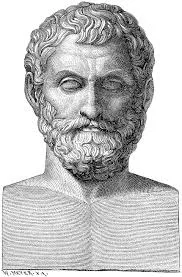
Thales of Miletus

Thales Theorem Class 10 Maths
Thales (640 – 546 B.C.) – Origin of Proportional Geometry
📘 Definition

Basic Proportionality Theorem (BPT) / Thales' Theorem

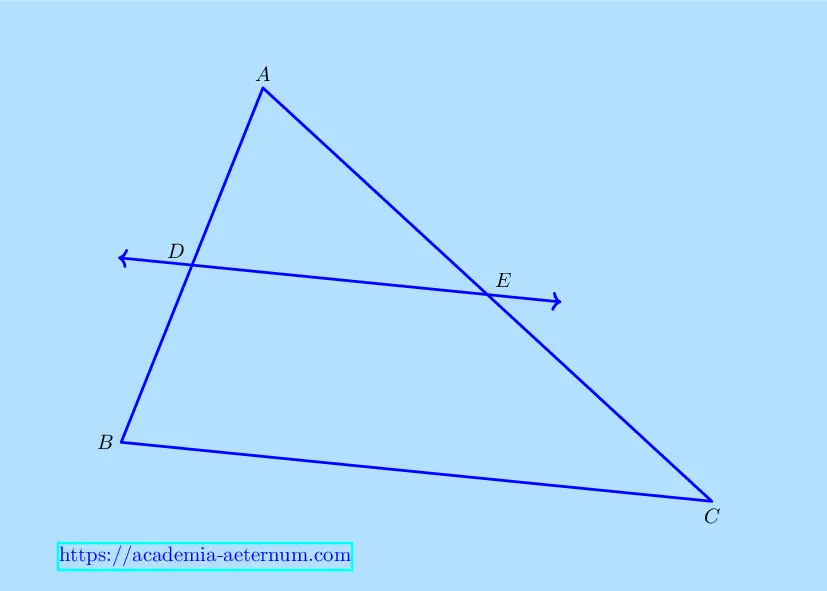
If a line is drawn parallel to one side of a triangle to intersect the other two sides in distinct points, then the other two sides are divided in the same ratio.

🎨 SVG Diagram

Diagram — BPT Triangle

A B C D E DE ∥ BC
Basic Proportionality Theorem (BPT)
🔢 Formula

Mathematical Form

  • In △ABC, if DE ∥ BC, then:
  • \( \dfrac{AD}{DB} = \dfrac{AE}{EC} \)
💡 Concept

Concept Simplified

A line parallel to one side ensures that the triangle is divided into two smaller triangles that are similar to the original triangle. Due to similarity, corresponding sides maintain equal ratios.

🔬 Proof

Derivation Insight

  1. In △ABC, DE ∥ BC:

  2. \(\angle ADE = \angle ABC (alternate interior angles)\)
  3. \(\angle AED = \angle ACB\)
  4. \(\Rightarrow \triangle ADE \sim \triangle ABC (AA similarity)\)
  5. \(\Rightarrow \dfrac{AD}{AB} = \dfrac{AE}{AC} \)
  6. \(\Rightarrow \dfrac{AD}{DB} = \dfrac{AE}{EC} \)
✏️ Example

Solved Example

Example 2
In a triangle, a line parallel to one side divides the other two sides in the ratio 2:3. If one segment is 4 cm, find the other segment.
  1. Let ratio = 2 : 3
  2. If smaller part = 4 cm ⇒ scale factor = 2
  3. Larger part = \( 3 \times 2 = 6 \) cm
  4. Answer: 6 cm
📌 Note

Exam Tip

  • Always mention DE ∥ BC before applying BPT.
  • Use similarity before writing proportionality.
  • Steps must include reason (angles, similarity, ratio).
  • Frequently asked in 2–3 mark proof questions.
⚠️ Warning

Common Mistakes

  • Applying BPT without checking parallel condition.
  • Writing incorrect ratios (wrong order).
  • Skipping similarity step in proofs.
  • Confusing with converse theorem.
📋 Case Study

CBSE Case Study (HOTS)

A road cuts two sides of a triangular field parallel to the third side. It divides one side in ratio 3:5. Find the ratio in which the other side is divided.
  1. By BPT:
  2. Same ratio applies ⇒ 3 : 5
  3. Answer: 3 : 5
🌟 Importance

Importance for Board Exams

  • Foundation for triangle similarity and constructions.
  • Used in coordinate geometry and real-life scaling problems.
  • Very high probability in CBSE exams.
  • Direct concept-based scoring (easy marks if understood).
Theorem 1: Basic Proportionality Theorem
📘 Definition

Theorem 1: Basic Proportionality Theorem (Proof)

If a line is drawn parallel to one side of a triangle to intersect the other two sides in distinct points, then the other two sides are divided in the same ratio.
🔬 Proof

Derivation Insight

  1. Given

    In △ABC, DE ∥ BC, where D lies on AB and E lies on AC.
  2. To Prove
  3. \[\dfrac{AD}{DB} = \dfrac{AE}{EC}\]
  4. Construction
  5. Join BE and CD.
  6. Draw DM ⟂ AC and EN ⟂ AB.
  7. Proof
  8. Area of triangle ADE:
  9. \[ar(ADE) = \dfrac{1}{2} \times AD \times EN\]
  10. Area of triangle BDE:
  11. \[ar(BDE) = \dfrac{1}{2} \times BD \times EN\]
  12. \[\dfrac{ar(ADE)}{ar(BDE)} = \dfrac{AD}{DB} \tag{1}\]
  13. Also, using altitude DM:
  14. \[ar(ADE) = \dfrac{1}{2} \times AE \times DM\]
  15. \[ar(DEC) = \dfrac{1}{2} \times EC \times DM\]
  16. Dividing
  17. \[\dfrac{ar(ADE)}{ar(DEC)} = \dfrac{AE}{EC} \tag{2}\]
  18. Triangles BDE and DEC lie on the same base DE and between the same parallels BC and DE.
  19. \[ar(BDE) = ar(DEC) \tag{3}\]
  20. From (1), (2), and (3):
  21. \[\boxed{\bbox[indigo,5pt]{\dfrac{AD}{DB} = \dfrac{AE}{EC}}}\]
🌟 Importance

Key Insight

The proof relies on the principle that triangles on the same base and between the same parallels have equal areas. This bridges area geometry with proportional reasoning.
📌 Note

Exam Tip

  • Always mention same base & same parallels ⇒ equal areas.
  • Tag equations (1), (2), (3) for clarity and marks.
  • Diagram labeling must match steps exactly.
  • This proof is frequently asked for 3–4 marks.
⚠️ Warning

Common Mistakes

  • Writing \( \dfrac{AE}{AC} \) instead of \( \dfrac{AE}{EC} \).
  • Skipping construction (DM ⟂ AC, EN ⟂ AB).
  • Not justifying equal areas of triangles.
  • Improper step linking between equations.
Theorem 2: Converse of Basic Proportionality Theorem
📘 Definition

Theorem 2: Converse of Basic Proportionality Theorem

If a line divides any two sides of a triangle in the same ratio, then the line is parallel to the third side.
🖼️ Figure

Converse of BPT Diagram

Converse of BPT Diagram
Fig. 6.12 – Converse of BPT
🔬 Proof

Derivation

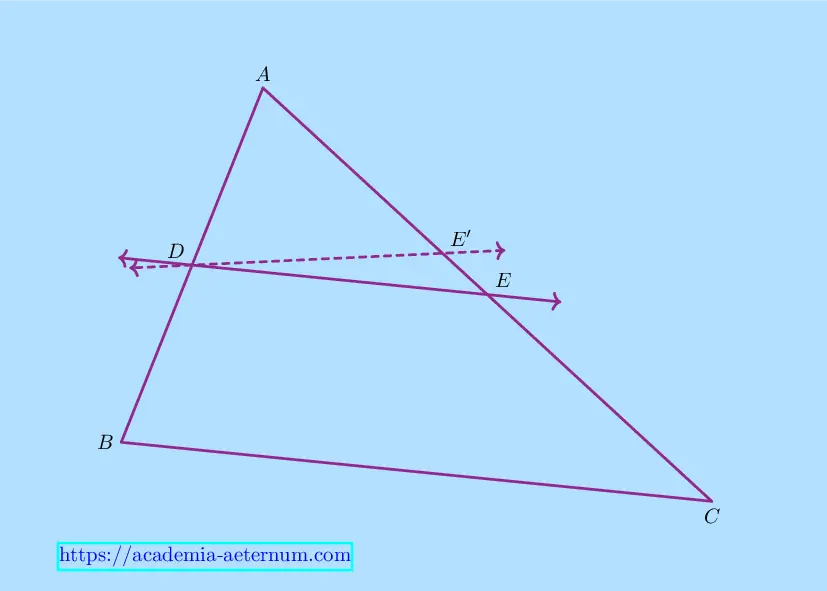
  1. In \(\triangle \)ABC, points D and E lie on AB and AC respectively such that: \[ \dfrac{AD}{DB} = \dfrac{AE}{EC} \tag{1} \]
  2. To Prove
  3. \[DE \parallel BC\]
  4. Construction
  5. Through point D, draw a line parallel to BC intersecting AC at E.
  6. Proof
  7. Since \( DE' \parallel BC \), by Basic Proportionality Theorem:
  8. \[\dfrac{AD}{DB} = \dfrac{AE'}{E'C} \tag{2}\]
  9. From (1) and (2):
  10. \[\dfrac{AE}{EC} = \dfrac{AE'}{E'C} \tag{3}\]
  11. Adding 1 to both sides:
  12. \[\dfrac{AE + EC}{EC} = \dfrac{AE' + E'C}{E'C}\]
  13. \[\Rightarrow \dfrac{AC}{EC} = \dfrac{AC}{E'C}\]
  14. This is possible only when:
  15. \[EC = E'C\]
  16. Hence, point E coincides with E'. Therefore, the line DE is the same as DE'.
🌟 Importance

Key Insight

The proof uses the method of contradiction and uniqueness of division point. If two ratios are equal, the division point on a line is unique, forcing parallelism.
📌 Note

Exam Tip

  • Always construct a parallel line (DE').
  • Apply BPT first, then compare ratios.
  • Clearly state “E coincides with E'”.
  • This theorem is frequently asked with reasoning steps (3–4 marks).
⚠️ Warning

Common Mistakes

  • Skipping construction of E'.
  • Not proving uniqueness of point.
  • Jumping directly to conclusion without ratio comparison.
  • Incorrect algebra while adding ratios.
✏️ Example

Quick Example

Example 3
  1. If a line divides sides of a triangle in ratio 4:5 on both sides, then the line is parallel to the third side.
  2. Conclusion: Converse of BPT applies ⇒ line is parallel.
Example 4
✏️ Example

Solved Example

Example 4
If a line intersects sides \(AB\) and \(AC\) of a triangle \(ABC\) at points \(D\) and \(E\) respectively and is parallel to \(BC\), prove that:
\[ \dfrac{AD}{AB} = \dfrac{AE}{AC} \]
🖼️ Figure

Fig. 6.13

BPT Example Diagram Class 10 Maths
Fig. 6.13 – DE ∥ BC
🔬 Proof

To Prove \[\dfrac{AD}{AB} = \dfrac{AE}{AC}\]

Proof

Given
In △ABC, D lies on AB and E lies on AC such that: \[DE \parallel BC\]
  1. Since \( DE \parallel BC \), by Basic Proportionality Theorem:
  2. \[\dfrac{AD}{DB} = \dfrac{AE}{EC}\]
  3. Taking reciprocal:
  4. \[\dfrac{DB}{AD} = \dfrac{EC}{AE} \tag{1}\]
  5. Adding 1 to both sides of (1):
  6. \[\dfrac{DB}{AD} + 1 = \dfrac{EC}{AE} + 1\]
  7. \[\Rightarrow \dfrac{DB + AD}{AD} = \dfrac{EC + AE}{AE}\]
  8. Using segment addition:
  9. \[DB + AD = AB \quad \text{and} \quad EC + AE = AC\]
  10. \[\Rightarrow \dfrac{AB}{AD} = \dfrac{AC}{AE}\]
  11. Taking reciprocal:
  12. \[\boxed{\bbox[indigo,5pt]{\dfrac{AD}{AB} = \dfrac{AE}{AC}}}\]
🌟 Importance

Key Insight

This result is a derived proportional form of BPT. It shows that ratios can be manipulated algebraically to match required proof formats.
📌 Note

Exam Tip

  • Always start with BPT before transforming ratios.
  • Clearly show “taking reciprocal” and “adding 1” steps.
  • Use segment addition explicitly (AB = AD + DB).
  • Final step must match exactly what is asked.
⚠️ Warning

Common Mistakes

  • Skipping reciprocal step.
  • Incorrect addition of segments.
  • Jumping directly to final result.
  • Writing wrong final ratio order.
Example 5
✏️ Example

Solved Example : BPT in a Trapezium

Example 5
ABCD is a trapezium with \( AB \parallel DC \). Points E and F lie on AD and BC respectively such that \( EF \parallel AB \). Show that:
\[ \dfrac{AE}{ED} = \dfrac{BF}{FC} \]
📖 Theory

Theory + Roadmap (How to Think)

Core Strategy: Diagonal + Parallel Lines ⇒ Apply BPT twice ⇒ Equate ratios
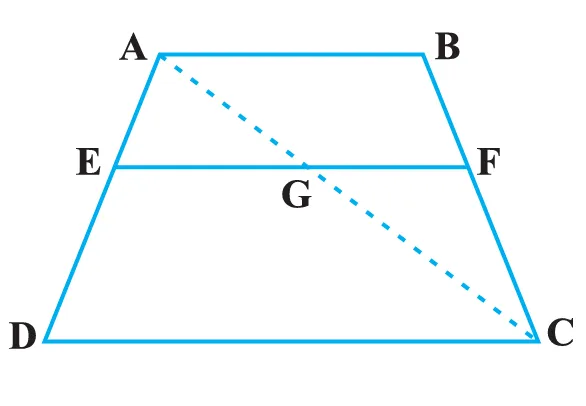
  • When a trapezium is involved → draw diagonal AC
  • Parallel lines suggest → use Basic Proportionality Theorem (BPT)
  • Break figure into two triangles:
    • \( \triangle ADC \)
    • \( \triangle ABC \)
  • Find a common ratio (AG/GC) using both triangles.
  • Equate results → get required proof.
🖼️ Figure

Fig. 6.14

BPT Trapezium Example Diagram Class 10 Maths
Fig. 6.14 – EF ∥ AB ∥ DC
🔬 Proof

To Prove

\[ \dfrac{AE}{ED} = \dfrac{BF}{FC} \]
🔬 Proof

Given

\[ AB \parallel DC,\quad EF \parallel AB \]
🔬 Proof

Construction

Join diagonal AC. Let EF intersect AC at point G.
🔬 Proof

Proof

  1. In \( \triangle ADC \):
  2. Since \( EG \parallel DC \) (as \( EF \parallel DC \)), by BPT:
  3. \[\dfrac{AE}{ED} = \dfrac{AG}{GC} \tag{1}\]
  4. In \( \triangle ABC \):
  5. Since \( GF \parallel AB \) (as \( EF \parallel AB \)), by BPT:
  6. \[\dfrac{BF}{FC} = \dfrac{AG}{GC} \tag{2}\]
  7. From (1) and (2):
  8. \[\boxed{\bbox[indigo,5pt]{\dfrac{AE}{ED} = \dfrac{BF}{FC}}}\]
🌟 Importance

Key Insight

The diagonal \( AC \) acts as a bridge connecting two triangles where BPT can be applied. This is a standard CBSE technique for trapezium problems.
📌 Note

Exam Tip

  • Always draw diagonal when dealing with trapezium.
  • Identify two triangles where BPT can be applied.
  • Clearly mention parallel lines before applying BPT.
  • Equate common ratios (AG/GC) to conclude.
⚠️ Warning

Common Mistakes

  • Not defining point G (intersection on AC).
  • Writing incorrect final ratio (AE/AD instead of AE/ED).
  • Confusing which lines are parallel.
  • Skipping triangle identification step.
Criteria for Similarity of Triangles (AA, SAS, SSS)
📘 Definition

Criteria for Similarity of Triangles (AA, SAS, SSS)

Example 6
Questions (Exam Pattern)
  • In two triangles, two angles are equal. Prove that the triangles are similar.
  • Two sides of two triangles are proportional and the included angle is equal. Are the triangles similar?
  • The sides of two triangles are in the ratio 2:3, 4:6, and 6:9. Check similarity.
  • Identify which similarity criterion (AA, SAS, SSS) applies in each case.
📖 Theory

Theory + Roadmap (How to Decide Criterion)

  • Angles given? → Use AA
  • Two sides + included angle? → Use SAS
  • All sides proportional? → Use SSS
  • Decision Shortcut: Count known elements → Match pattern → Apply correct criterion

🎨 SVG Diagram

Visual Understanding

∠A ∠D ∠B ∠E AA SAS SSS
💡 Concept

Similarity Criteria Explained

  • AA (Angle–Angle):
    If two angles of one triangle are equal to two angles of another triangle, then triangles are similar.
    Reason: Third angle automatically becomes equal.
  • SAS (Side–Angle–Side):
    If two sides are proportional and the included angle is equal, then triangles are similar.
  • SSS (Side–Side–Side):
    If all three corresponding sides are proportional, then triangles are similar.
✏️ Example
Example 5
Solved

Solutions

Q1: Two angles equal ⇒ AA similarity ⇒ Triangles are similar.

Q2: Two sides proportional + included angle equal ⇒ SAS similarity.

Q3: Ratios:

\[ \dfrac{2}{3} = \dfrac{4}{6} = \dfrac{6}{9} \]

⇒ All sides proportional ⇒ SSS similarity.

Q4: Identify based on given data using roadmap above.

⚡ Exam Tip

Exam Tips

  • Always state the criterion name (AA, SAS, SSS).
  • Maintain correct order of vertices.
  • Justification step is compulsory for full marks.
  • AA is most frequently used in proofs.
⚠️ Warning

Common Mistakes

  • Using SAS without included angle.
  • Incorrect ratio comparison in SSS.
  • Not checking correspondence order.
  • Forgetting to mention criterion name.
Theorem 3: AA Similarity Criterion
📘 Definition

Question

AA Similarity Criterion
In two triangles, if corresponding angles are equal, prove that their corresponding sides are proportional and hence the triangles are similar.
📖 Theory

Theory + Roadmap

  • Given angles equal → think AA similarity
  • Construct a triangle equal in size using given sides.
  • Use congruency (SAS) to match triangles.
  • Then apply BPT to prove proportionality.

Strategy: Equal angles → Construct equal sides → Use congruency → Apply BPT → Get ratios
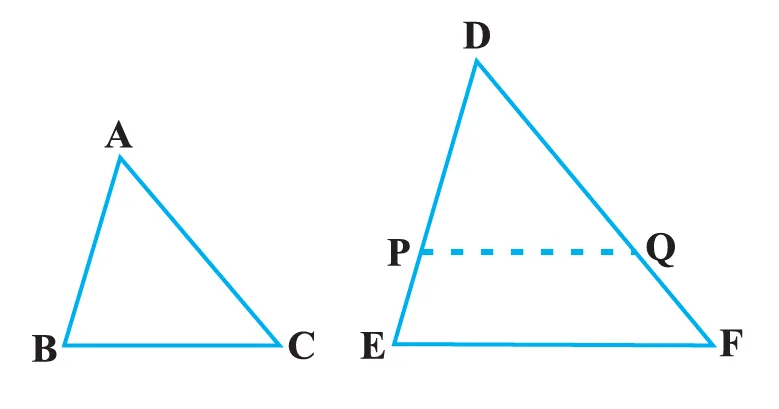
🖼️ Figure

AA Similarity Theorem Diagram

AA Similarity Theorem Diagram Class 10 Maths
AA Similarity Theorem Diagram
🔬 Proof

Given

In triangles ABC and DEF:
\[ \angle A = \angle D,\quad \angle B = \angle E,\quad \angle C = \angle F \]
🔬 Proof

To Prove

\[ \begin{aligned}\dfrac{AB}{DE} = \dfrac{BC}{EF} &= \dfrac{AC}{DF}\quad\text{ and hence}\\\\ \triangle ABC &\sim \triangle DEF\end{aligned} \]
🔬 Proof

Construction

  • On DE, mark point P such that \( DP = AB \).
  • On DF, mark point Q such that \( DQ = AC \).
  • Join PQ.
🔬 Proof

Proof

⇒ \( \triangle ABC \cong \triangle DPQ \) (SAS)

⇒ \( \angle B = \angle P,\quad \angle C = \angle Q \) (CPCT)

Step 2: Parallel Lines

Given \( \angle B = \angle E \), and from above \( \angle B = \angle P \),

⇒ \( \angle P = \angle E \)

Similarly, \( \angle Q = \angle F \)

⇒ \( PQ \parallel EF \)

Step 3: Apply BPT

In triangle DEF, since \( PQ \parallel EF \):

\[ \dfrac{DP}{PE} = \dfrac{DQ}{QF} \]

Substituting \( DP = AB \) and \( DQ = AC \):

\[ \dfrac{AB}{DE} = \dfrac{AC}{DF} \]

Similarly,

\[ \dfrac{AB}{DE} = \dfrac{BC}{EF} \]

Hence,

\[ \boxed{\dfrac{AB}{DE} = \dfrac{BC}{EF} = \dfrac{AC}{DF}} \]

⇒ \( \triangle ABC \sim \triangle DEF \)

Congruency
In \(\triangle\) ABC and \(\triangle\) DPQ:
  • \(DP = AB \) (construction)
  • \(DQ = AC \) (construction)
  • \(\angle PDQ = \angle A \)
📄 Important

Key Insight

This proof shows that angle equality alone guarantees shape similarity. Side proportionality is a consequence, not a requirement.
⚡ Exam Tip

Exam Tips

  • AA is the most used similarity criterion in CBSE.
  • Always justify parallel lines using equal angles.
  • Clearly mention SAS and BPT steps.
  • Maintain correct triangle correspondence order.
⚠️ Warning

Common Mistakes

  • Skipping construction steps.
  • Not proving parallelism before BPT.
  • Incorrect correspondence of vertices.
  • Jumping directly to similarity without ratios.
📄 Result

If two angles of one triangle are equal to two angles of another triangle, then the triangles are similar (AA Similarity Criterion).

Theorem 4: SSS Similarity Criterion
📄 Label

Question

If in two triangles, the corresponding sides are proportional, prove that their corresponding angles are equal and hence the triangles are similar.
📖 Theory

Theory + Roadmap

  • Given all three sides proportional → think SSS similarity
  • Create a triangle with equal sides using construction.
  • Use congruency (SSS) to match shapes.
  • Then compare angles → prove similarity.

Strategy: Proportional sides → Construct equal triangle → Use congruency → Conclude similarity
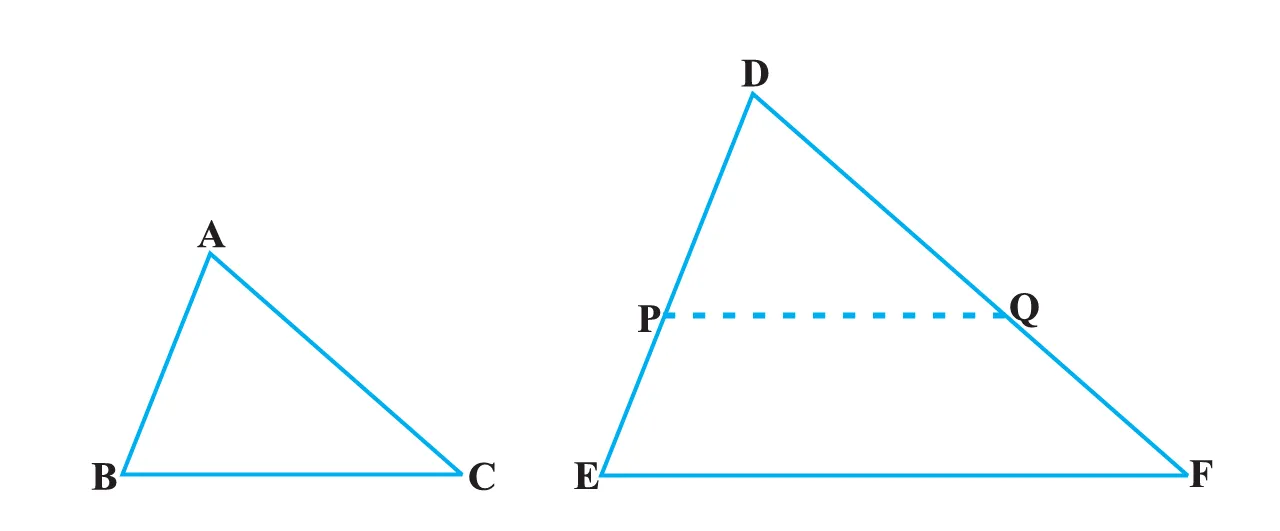
🖼️ Figure

SSS Similarity Theorem Diagram

SSS Similarity Theorem Diagram Class 10 Maths
SSS Similarity Theorem Diagram
🔬 Proof

Given

In triangles ABC and DEF:
\[ \begin{aligned}\angle A = \angle D,\ \angle B &= \angle E,\ \angle C = \angle F\\\\ \Rightarrow \triangle ABC &\sim \triangle DEF\end{aligned} \]
🔬 Proof

To Prove

\[ \begin{aligned}\angle A = \angle D,\ \angle B &= \angle E,\ \angle C = \angle F\\\\ \Rightarrow \triangle ABC &\sim \triangle DEF\end{aligned} \]
🔬 Proof
  • On DE, mark point P such that \( DP = AB \).
  • On DF, mark point Q such that \( DQ = AC \).
  • Join PQ.
🔬 Proof

Proof

Step 1: Use Given Ratios

Given:

\[ \dfrac{AB}{DE} = \dfrac{AC}{DF} \]

Substitute \( DP = AB \) and \( DQ = AC \):

\[ \dfrac{DP}{DE} = \dfrac{DQ}{DF} \]

⇒ \( \dfrac{DP}{DE} = \dfrac{DQ}{DF} \)

⇒ By Converse of BPT, \( PQ \parallel EF \)

Step 2: Angle Equality

Since \( PQ \parallel EF \):

  • \( \angle DPQ = \angle E \)
  • \( \angle DQP = \angle F \)

Step 3: Compare Triangles

In triangles ABC and DPQ:

  • \( DP = AB \)
  • \( DQ = AC \)
  • \( \angle PDQ = \angle A \)

⇒ \( \triangle ABC \cong \triangle DPQ \) (SAS)

⇒ \( \angle A = \angle D,\ \angle B = \angle E,\ \angle C = \angle F \)

⇒ \( \triangle ABC \sim \triangle DEF \)

📌 Note

Key Insight

📄 Tips

Exam Tips

  • Always start with given ratios.
  • Use Converse of BPT carefully.
  • Clearly justify parallel lines.
  • Write final similarity statement explicitly.
⚠️ Warning

Common Mistakes

  • Using BPT instead of Converse of BPT.
  • Incorrect substitution of constructed lengths.
  • Skipping parallel proof step.
  • Confusing congruency and similarity.
📄 Result

Final Result

If the corresponding sides of two triangles are proportional, then the triangles are similar (SSS Similarity Criterion).
Theorem 5: SAS Similarity Criterion
📄 Label

Question

If one angle of a triangle is equal to one angle of another triangle and the sides including these angles are proportional, prove that the two triangles are similar.
📖 Theory

Theory + Roadmap

  • Given: one angle equal + two sides proportional → think SAS similarity.
  • Construct equal sides to form a comparable triangle.
  • Use congruency (SAS) to match triangles.
  • Then extend result to full triangle → prove similarity.

Strategy: Proportional sides + included angle → Construct → Congruency → Extend → Similarity
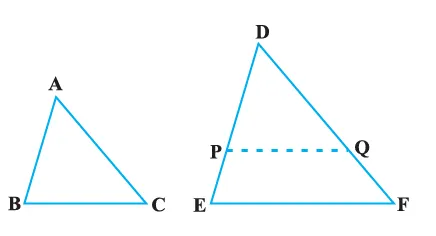
🖼️ Figure

SAS Similarity Theorem Diagram

SAS Similarity Theorem Diagram Class 10 Maths
SAS Similarity Theorem Diagram
🔬 Proof

Given

In triangles ABC and DEF:
\[ \dfrac{AB}{DE} = \dfrac{AC}{DF}, \quad \angle A = \angle D \]
🔬 Proof

To Prove

\[ \triangle ABC \sim \triangle DEF \]
🔬 Proof
  • On DE, mark point P such that \( DP = AB \).
  • On DF, mark point Q such that \( DQ = AC \).
  • Join PQ.
🔬 Proof

Proof

Step 1: Use Given Ratio

\[ \dfrac{AB}{DE} = \dfrac{AC}{DF} \]

Substitute \( DP = AB \), \( DQ = AC \):

\[ \dfrac{DP}{DE} = \dfrac{DQ}{DF} \]

⇒ By Converse of BPT, \( PQ \parallel EF \)

Step 2: Angle Equality

Since \( PQ \parallel EF \):

  • \( \angle DPQ = \angle E \)
  • \( \angle DQP = \angle F \)

Step 3: Congruency

In triangles ABC and DPQ:

  • \( DP = AB \)
  • \( DQ = AC \)
  • \( \angle PDQ = \angle A \)

⇒ \( \triangle ABC \cong \triangle DPQ \) (SAS)

⇒ \( \angle B = \angle P,\ \angle C = \angle Q \)

Step 4: Final Comparison

From above:

  • \( \angle B = \angle E \)
  • \( \angle C = \angle F \)

⇒ All corresponding angles equal, therfore

\[ \boxed{\bbox[indigo,5pt]{\triangle ABC \sim \triangle DEF}} \]
📌 Note

Key Insight

📄 Tips

Exam Tips

  • Always verify the angle is included angle
  • Use Converse of BPT carefully.
  • Clearly mention parallel lines before angle comparison.
  • SAS is often used in coordinate geometry applications.
⚠️ Warning

Common Mistakes

  • Using non-included angle.
  • Skipping construction step.
  • Wrong use of BPT instead of Converse.
  • Incorrect angle correspondence.
📄 Result

Final Result

If one angle is equal and the including sides are proportional, then triangles are similar (SAS Similarity Criterion).
Example 7: Parallel Lines & Triangle Similarity
📄 Label

Question

In Fig. 6.29, if \( PQ \parallel RS \), prove that:
\[ \triangle POQ \sim \triangle SOR \]
📖 Theory

Theory + Roadmap

  • Parallel lines → think alternate interior angles
  • Intersecting lines → give vertically opposite angles
  • Two equal angles are enough → use AA similarity

Strategy: Parallel lines → angle equality → apply AA similarity
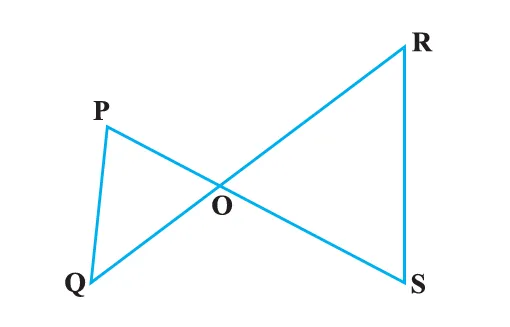
🖼️ Figure

Parallel Lines Triangle Similarity Diagram

Parallel Lines Triangle Similarity Diagram Class 10 Maths
Parallel Lines Triangle Similarity Diagram
🔬 Proof

Solution

Given

\[ PQ \parallel RS \]
🔬 Proof

To Prove

\[ \triangle POQ \sim \triangle SOR \]
🔬 Proof

Proof

In triangles \( \triangle POQ \) and \( \triangle SOR \):

  • \( \angle OPQ = \angle OSR \) (Alternate interior angles, since \( PQ \parallel RS \))
  • \( \angle OQP = \angle ORS \) (Alternate interior angles)
  • \( \angle POQ = \angle SOR \) (Vertically opposite angles)

Since corresponding angles are equal:

\[ \triangle POQ \sim \triangle SOR \quad \text{(AA similarity criterion)} \]
📌 Note

Key Insight

📄 Tips

Exam Tips

  • Always name angles properly (e.g., \( \angle OPQ \), not just \( \angle P \))
  • Two angles are sufficient → no need to prove all three.
  • Always mention AA similarity explicitly.
⚠️ Warning

Common Mistakes

  • Writing incomplete angles (like ∠P instead of ∠OPQ).
  • Not mentioning reason (alternate / vertically opposite).
  • Skipping similarity criterion name.
Important Points – Triangles (Quick Revision Sheet)
📄 Label

Quick Check (Exam Revision)

  • When are two figures similar?
  • What is the difference between similarity and congruence?
  • Which conditions define similarity of polygons?
  • When can BPT and its converse be applied?
  • How do AA, SAS, and SSS criteria differ?
📖 Theory

Concept Roadmap

  • Shape same → Similarity
  • Shape + size same → Congruence
  • Parallel lines → BPT
  • Angles equal → AA
  • Sides proportional → SSS
  • Sides + included angle → SAS
📄 Label

Core Theoretical Points

  • Two figures having the same shape but not necessarily the same size are called similar figures.
  • All congruent figures are similar, but similar figures are not necessarily congruent.
  • Two polygons are similar if:
    • Corresponding angles are equal
    • Corresponding sides are proportional
  • Basic Proportionality Theorem (BPT):
    A line parallel to one side of a triangle divides the other two sides in the same ratio.
  • Converse of BPT:
    If a line divides two sides in the same ratio, then it is parallel to the third side.
  • SSS (Side–Side–Side) Similarity:
    All corresponding sides proportional ⇒ triangles are similar.
  • SAS (Side–Angle–Side) Similarity:
    Two sides proportional + included angle equal ⇒ triangles are similar.
🔢 Formula

Important Formulas

  • \( \dfrac{AB}{DE} = \dfrac{BC}{EF} = \dfrac{AC}{DF} \)
  • \( \dfrac{\text{Area}_1}{\text{Area}_2} = \left(\dfrac{\text{Side}_1}{\text{Side}_2}\right)^2 \)
📄 Tips

Exam Tips

  • Always mention the similarity criterion name
  • Check correspondence order carefully
  • Use diagrams for better clarity and step marks.
  • BPT and similarity are frequently linked in questions.
⚠️ Warning

Common Mistakes

  • Confusing similarity with congruence.
  • Using SAS without included angle.
  • Applying BPT without parallel condition.
  • Incorrect ratio formation.
⚡ Exam Tip

Final Tip

AI Engine
💡 Concept
NCERT Mathematics · Class X · Chapter 6

Triangles — AI Engine

Solve problems · Master concepts · Build intuition with interactive modules

AI-Powered Step-by-Step Solver
📐
Key Formulas & Theorems
💡
Smart Tips & Tricks
⚠️
Common Mistakes to Avoid
📝
Concept-Building Questions
🎮
Interactive Learning Modules

Recent posts

    TRIANGLES – Learning Resources

    Get in Touch

    Let's Connect

    Questions, feedback, or suggestions?
    We'd love to hear from you.