A student accidentally touches a heated iron rod and immediately withdraws his hand. However, after a few seconds, he realizes the pain and says "It is very hot!"
Working Mechanism (Stepwise)
-
1Stimulus is detected by receptors.
-
2Information is transmitted to control centres (brain/spinal cord or hormones).
-
3Processing and decision-making occurs.
-
4Instructions are sent to effectors.
-
5Response is generated.
Types of Control and Coordination
- Nervous System (fast, electrical signals)
- Endocrine System (slow, chemical hormones)
- Growth movements (tropisms)
- Hormonal control (auxins, gibberellins)
Daily Life)
Touching a hot object leads to immediate withdrawal of the hand. This is a reflex action controlled by the spinal cord.
Example 2 (Plants)
A plant bends towards light. This is known as phototropism and is controlled by plant hormones.
Concept-Based Question
Why do we blink when an object suddenly approaches our eyes?
Solution: It is a protective reflex action controlled by the nervous system to prevent injury.
Concept Flow (Stimulus-Response Pathway)
- Start with basic definitions and components.
- Understand nervous system and endocrine system separately.
- Study plant hormones and tropisms.
- Practice diagrams and NCERT questions.
- Revise with case-based and HOTS questions.
Main Functions
Working Mechanism
Types of Nervous System
- Brain: Responsible for thinking, memory, emotions, intelligence, and voluntary actions.
- Spinal Cord: Carries nerve impulses between the brain and the rest of the body and controls reflex actions.
-
Cranial Nerves:
- 12 pairs arising from the brain.
- Control sensory functions (vision, smell, hearing), motor actions, and mixed functions. -
Spinal Nerves:
- 31 pairs arising from the spinal cord.
- Carry sensory and motor signals between CNS and body parts.
Neuron (Structural and Functional Unit)
Reflex Action and Reflex Arc
Reflex action is a quick, automatic, and involuntary response to a stimulus without conscious thinking.
Reflex Arc Pathway:
\[ \text{Stimulus} \rightarrow \text{Receptor} \rightarrow \text{Sensory Neuron} \rightarrow \text{Spinal Cord} \rightarrow \text{Motor Neuron} \rightarrow \text{Effector} \]
Example: Withdrawal of hand on touching a hot object.
Link with Endocrine System
- Pituitary: Master gland that regulates other endocrine glands.
- Thyroid: Controls metabolism, growth, and development.
- Adrenal: Produces hormones involved in stress response and metabolism.
- Pancreas: Regulates blood glucose levels through insulin and glucagon.
- Hypothalamus: Connects the nervous and endocrine systems and controls the pituitary gland.
A person touches a sharp object and quickly pulls back the hand. Later, the brain recognizes the pain.
- Which part acts first?
- Why is the brain involved later?
Answer:
- Spinal cord initiates reflex action.
- Brain processes pain sensation after receiving signals.
- Understand neuron structure first
- Learn CNS and PNS differences
- Practice reflex arc diagrams
- Revise NCERT questions thoroughly
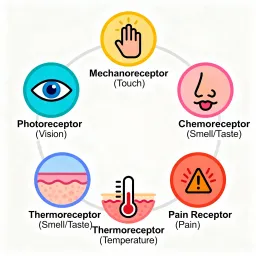
Types of Stimuli
Associated Components
Stimulus–Response Pathway<
- Initiates all control and coordination processes
- Helps organisms survive by responding to environmental changes
- Maintains internal balance (homeostasis)
- Essential for reflex and voluntary actions
A person suddenly withdraws their hand after touching a hot pan, and later realizes the pain.
- Identify the stimulus and response.
- Which organ detects the stimulus?
Answer:
- Stimulus: Heat from the pan; Response: Withdrawal of hand
- Receptors in the skin detect the stimulus
Study Roadmap
- Start with definition and types of stimuli
- Understand receptor-effector mechanism
- Practice diagrams and pathways
- Revise examples for application-based questions
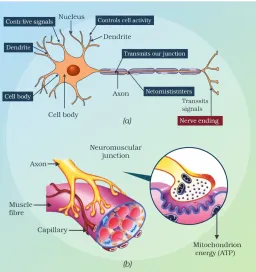
Structure of Neuron
- Cell Body (Cyton) Contains nucleus and organelles like mitochondria, Golgi apparatus, and endoplasmic reticulum; responsible for metabolic activities.
- Dendrites Short, branched projections that receive signals from other neurons or receptors.
- Axon Long, cylindrical structure that conducts nerve impulses away from the cell body
- Myelin Sheath (if present) Insulating layer that increases speed of impulse transmission.
- Axon Terminals End branches that release neurotransmitters to pass signals to the next cell.
Electrical impulses travel in one direction only. At synapses (junctions between neurons), the signal is transmitted chemically using neurotransmitters.
Types of Neurons
Sensory neurons transmit signals from sense organs such as the eyes, skin, nose, tongue, and ears to the brain or spinal cord. They help detect stimuli like light, heat, pain, pressure, sound, and chemicals.
Motor neurons transmit commands from the brain or spinal cord to muscles or glands, producing actions such as movement, secretion, or other responses.
Interneurons are found entirely within the central nervous system. They link sensory and motor neurons, process incoming information, and help in decision-making and coordination.
Structure of Motor Neuron
- Multipolar in structure (one axon, multiple dendrites)
- Cell body (soma) contains nucleus
- Axon carries impulses away from CNS
- Dendrites receive signals from other neurons
Types of Motor Neurons
Functions of Neurons
Neurogenesis
Synapse
- Enables rapid communication within the body
- Controls reflex and voluntary actions
- Essential for thinking, learning, and memory
- Maintains coordination and balance
- Explain why impulse transmission is affected.
- Which property of neurons is lost?
Answer:
- Myelin sheath enables fast conduction; its damage slows impulse transmission.
- Insulation and rapid conduction property is lost.
- Start with neuron structure and diagram
- Understand impulse transmission mechanism
- Learn types of neurons
- Practice NCERT diagrams and questions
Reflex Arc Pathway
Types of Reflex Actions
A person steps on a sharp object and immediately lifts the foot before realizing the pain.
- Which part of the nervous system controls this action?
- Why is the brain involved later?
Answer:
- Spinal cord controls the reflex action.
- Brain processes the sensation after receiving signals.
Reflex Arc - Animation
Visualization of impulse flow during reflex action.
- Understand reflex arc components
- Memorize pathway sequence
- Practice diagrams
- Solve NCERT and case-based questions
- Cerebrum: Largest part of the brain responsible for voluntary actions, intelligence, memory, reasoning, speech, emotions, and sensory perception.
- Thalamus: Acts as a relay centre, directing sensory impulses to appropriate regions of cerebrum.
- Hypothalamus: Maintains homeostasis by regulating hunger, thirst, body temperature, and sleep; also links nervous system with endocrine system.
- Controls reflex movements of head, neck, and eyes.
- Processes visual and auditory information.
- Plays a role in motor coordination.
- Cerebellum: Maintains balance, posture, and coordination of muscular activities (e.g., walking, cycling).
- Pons: Regulates breathing cycle and sleep; acts as a bridge between different parts of the brain.
- Medulla Oblongata: Controls involuntary actions such as heartbeat, blood pressure, breathing, salivation, and vomiting.
A person loses balance while walking and has difficulty maintaining posture.
- Which part of the brain is affected?
- What function is impaired?
Answer:
- Cerebellum is affected.
- Balance and coordination are impaired.
- Understand division of brain
- Learn functions of each part
- Practice diagrams
- Revise NCERT questions thoroughly
Types of Plant Movements
- Growth-dependent movements
- Directional response with respect to stimulus
- Permanent and irreversible
- Found in all plants
- Slow response
- Growth-independent movements
- Non-directional response
- Temporary and reversible
- Found in specialized plants (e.g., Mimosa pudica)
- Quick response
Tropic vs Nastic Movements
| Feature | Tropic Movement | Nastic Movement |
|---|---|---|
| Dependence on Growth | Growth-dependent | Growth-independent |
| Direction | Directional | Non-directional |
| Speed | Slow | Fast |
| Reversibility | Irreversible | Reversible |
Types of Tropic Movements
| Type | Stimulus Response | Example |
|---|---|---|
| Phototropism | Towards/away from light | Shoot bends towards light |
| Geotropism (Gravitropism) | Towards/away from gravity | Roots grow downward |
| Hydrotropism | Towards water | Roots grow towards moisture |
| Chemotropism | Towards chemicals | Pollen tube grows towards ovule |
| Thigmotropism | Response to touch | Tendrils coil around support |
Plant Hormones (Phytohormones)
- Promotes cell elongation in shoots and young stems.
- Controls phototropism and gravitropism.
- Helps in root initiation and fruit development.
- Prevents premature falling of leaves and fruits in some plants.
- Stimulate stem elongation and overall plant growth.
- Promote seed germination by breaking dormancy.
- Enhance flowering and fruit growth.
- Help in bolting and overcoming dwarfism in plants.
- Promote cell division and growth.
- Delay ageing (senescence) of leaves and flowers.
- Promote lateral bud growth and shoot formation.
- Work together with auxins to regulate plant development.
- Induces stomatal closure during water stress.
- Maintains dormancy in seeds and buds.
- Slows down growth under unfavorable conditions.
- Helps plants survive drought and other stress conditions.
- Promotes fruit ripening.
- Causes leaf, flower, and fruit fall.
- Involved in ageing processes.
- Helps in response to mechanical stress and senescence.
A plant kept in a dark room bends towards a small window through which light enters.
- Identify the type of movement.
- Which hormone is responsible?
Answer:
- Phototropism
- Auxin
Study Roadmap
- Understand plant movement types
- Learn all tropisms with examples
- Memorize hormones and functions
- Practice NCERT and case-based questions
Types of Animal Hormones
Examples: Testosterone, Estrogen, Progesterone, Cortisol, Aldosterone
Examples: Insulin, Growth Hormone (GH), Thyroid-Stimulating Hormone (TSH), ADH, Oxytocin
Important Hormones and Functions
Major Endocrine Glands
A person shows symptoms of high blood sugar levels and fatigue.
- Which hormone is likely deficient?
- Which gland produces it?
Answer:
- Insulin
- Pancreas
Study Roadmap
- Understand types of hormones
- Learn major glands and functions
- Revise examples like insulin and adrenaline
- Practice NCERT and case-based questions
Chapter 6 — Control & Coordination
A complete AI-powered study engine covering nervous system, hormones, reflex arcs, and plant coordination.
Core Concepts
Organised concept-by-concept explanations with examples, mechanisms, and exam insights.
All living organisms need to respond to changes in their environment — these changes are called stimuli. The response involves cells, tissues, and organs working together in a coordinated manner.
- →Cell body (Cyton/Soma): Contains nucleus and cytoplasm; metabolic centre.
- →Dendrites: Short, branched projections that receive signals from other neurons.
- →Axon: Long fibre that conducts impulses away from cell body. Ends in axon terminals.
- →Myelin sheath: Insulating covering of the axon, speeds up impulse transmission.
The junction between two neurons is called a synapse. Electrical impulses cannot cross this gap directly.
A reflex action is a sudden, involuntary response to a stimulus that does not involve the conscious brain. It is a protective mechanism. The pathway is called the reflex arc.
| Region | Parts | Key Functions |
|---|---|---|
| Forebrain (Prosencephalon) | Cerebrum, Hypothalamus | Thinking, reasoning, memory, voluntary movements, smell, sight; regulates hunger, thirst, temperature |
| Midbrain (Mesencephalon) | Tectum, Tegmentum | Relay of visual & auditory information; eye movement control |
| Hindbrain (Rhombencephalon) | Cerebellum, Pons, Medulla | Cerebellum: balance, posture, precision movement; Pons: respiration regulation; Medulla: involuntary actions (heartbeat, breathing) |
| Feature | CNS | PNS |
|---|---|---|
| Includes | Brain + Spinal cord | All nerves outside brain & spinal cord |
| Role | Processing centre; integration | Carry signals to/from CNS |
| Divisions | — | Somatic NS + Autonomic NS |
| Autonomic division | — | Sympathetic (fight/flight) + Parasympathetic (rest/digest) |
The endocrine system uses hormones — chemical messengers secreted by ductless glands directly into the bloodstream — to regulate body functions. This is slower but longer-lasting than nervous coordination.
| Gland | Hormone(s) | Target / Function |
|---|---|---|
| Hypothalamus | Releasing / Inhibiting hormones | Controls pituitary gland secretions |
| Pituitary (Master gland) | GH, TSH, FSH, LH, ADH, Oxytocin | Growth; controls other endocrine glands; water reabsorption; uterine contraction |
| Thyroid | Thyroxine (T₄), T₃ | Metabolic rate; growth; development (requires iodine) |
| Parathyroid | PTH (Parathormone) | Calcium & phosphate balance in blood |
| Adrenal (cortex) | Cortisol, Aldosterone | Stress response; Na⁺/K⁺ balance |
| Adrenal (medulla) | Adrenaline (Epinephrine) | Emergency hormone: heart rate ↑, blood flow to muscles ↑, breathing ↑, digestion ↓ |
| Pancreas (Islets of Langerhans) | Insulin (β cells), Glucagon (α cells) | Insulin: blood sugar ↓; Glucagon: blood sugar ↑ |
| Gonads (Testes) | Testosterone | Male secondary sexual characteristics; sperm production |
| Gonads (Ovaries) | Oestrogen, Progesterone | Female secondary sexual characteristics; menstrual cycle; pregnancy |
| Pineal | Melatonin | Sleep-wake cycle (circadian rhythm) |
| Thymus | Thymosin | Immunity — maturation of T-lymphocytes |
Plants have no nervous system. They coordinate using phytohormones (plant hormones) and show movements in response to stimuli.
| Hormone | Site of Production | Key Effects |
|---|---|---|
| Auxin (IAA) | Shoot tips (apical meristem) | Cell elongation (one side); phototropism; apical dominance; delays abscission |
| Gibberellin (GA) | Seeds, roots, young leaves | Stem elongation; seed germination; fruit development without fertilisation (parthenocarpy) |
| Cytokinin | Roots, developing fruits/seeds | Cell division; delays senescence (ageing); promotes lateral bud growth |
| Abscisic Acid (ABA) | Leaves, seeds, roots | Stress hormone; stomata closure; seed dormancy; inhibits growth — "stress hormone" |
| Ethylene | Ripening fruits, nodes | Fruit ripening; leaf fall; horizontal growth; senescence |
Tropic (tropistic) movements are directional growth movements in plants in response to directional stimuli. They are caused by differential cell elongation due to unequal distribution of auxin.
| Type | Stimulus | Example | Organ Response |
|---|---|---|---|
| Phototropism | Light | Shoot bending toward light | Shoot: +ve; Root: −ve |
| Geotropism | Gravity | Root grows downward | Root: +ve; Shoot: −ve |
| Hydrotropism | Water | Root bends toward water | Root: +ve |
| Thigmotropism | Touch | Tendrils coiling around support | Tendrils: +ve |
| Chemotropism | Chemical | Pollen tube grows toward ovule | +ve toward chemical |
Nastic movements are non-directional plant responses (direction does not depend on stimulus direction). They occur due to changes in turgor pressure, not cell growth.
Mimosa pudica (touch-me-not) folds its leaves on touch. Caused by rapid loss of water from pulvinus cells → turgor decreases → leaflets fold.
Opening and closing of flowers in response to light intensity (e.g., dandelion opens in sunlight, closes at night). Due to differential turgor in petals.
| Feature | Nervous System | Endocrine System |
|---|---|---|
| Speed | Very fast (milliseconds) | Slow (seconds to days) |
| Messenger | Electrical impulse + neurotransmitter | Hormones (chemical) |
| Medium | Neurons | Blood |
| Effect duration | Brief | Long-lasting |
| Specificity | Very specific pathway | Targets specific cells via receptors |
| Memory | Can form memory | No memory formation |
Hormone secretion is regulated by negative feedback: when hormone level rises to normal, the signal for its secretion is inhibited.
Key Terms & Concepts
Precise scientific definitions, relationships, and conceptual formulas for quick revision.
Step-by-Step AI Solver
Select a problem type and get a fully worked, exam-perfect solution with reasoning at each step.
Concept Questions
Rich, concept-building questions with full step-by-step solutions — organised by concept, no textbook repetition.
-
1The synaptic cleft is a fluid-filled gap — electricity cannot travel across a fluid medium efficiently.
-
2Neurotransmitters allow for signal modulation — the receiving neuron can decide whether to fire based on the combined input from many synapses (summation).
-
3This ensures one-directional transmission: neurotransmitters are only stored in the pre-synaptic terminal, preventing backward signals.
-
4It also allows for pharmacological control — drugs can block or mimic neurotransmitters, enabling treatment of neurological conditions.
-
1Correct: Both carry electrical signals; both have a specific direction of current flow; both connect components in the body/circuit.
-
2Misleading: Neurons are NOT passive conductors. The signal is an electrochemical impulse (action potential), not a simple electrical current.
-
3Misleading: Signal strength does NOT decrease with distance in neurons (unlike wire resistance). The signal is regenerated at each node of Ranvier.
-
4Misleading: Neurons can integrate multiple signals (summation), 'think' partially, and adapt — wires cannot.
-
1The medulla oblongata controls all vital involuntary functions: cardiac rhythm, respiratory rate, blood pressure, and swallowing.
-
2These functions are non-negotiable for survival — stopping them even briefly causes death.
-
3The cerebrum controls voluntary actions, thinking, and memory. These can be compensated for partially (unconscious reflex activity continues).
-
4Conclusion: Medulla damage = loss of life-maintaining functions. Cerebrum damage = loss of higher cognitive functions, but survival is possible with medical support.
-
1Hypothesis: Reflex actions are processed in the spinal cord independently of the brain.
-
2Procedure: Use an animal model (frog). Destroy the brain (pith the frog) while keeping the spinal cord intact.
-
3Observation: When the leg is pinched, the frog still withdraws its leg reflexively.
-
4Conclusion: Since the brain is absent yet reflex occurs, the spinal cord alone is sufficient for reflex action.
-
5Extension: Now sever the spinal cord and repeat — the reflex disappears, confirming the spinal cord's role.
-
1Adrenaline binds to specific receptors on target cells. Different organs have different receptor subtypes (α and β adrenergic receptors).
-
2Heart: β1 receptors → increased heart rate and force of contraction.
-
3Bronchi: β2 receptors → dilation of airways (more oxygen intake).
-
4Digestive system: Mainly α receptors → decreased blood flow, slowed peristalsis.
-
5Key Principle: It is not the hormone alone, but the receptor type on the target cell that determines the response. Same hormone, different lock → different effect.
-
1Endocrine glands lack ducts (tubes). They secrete hormones directly into the surrounding capillaries → bloodstream.
-
2Exocrine glands (e.g., sweat, salivary) use ducts to deliver secretions to specific surfaces.
-
3Advantage 1: Blood acts as a universal carrier → hormones can reach any organ in the body, not just nearby tissues.
-
4Advantage 2: Enables systemic (whole-body) coordination from a single gland.
-
5Advantage 3: Enables rapid concentration adjustment through feedback mechanisms.
-
1Day 1–2: Light enters from one direction. Auxin (produced at shoot tip) begins migrating to the shaded side.
-
2Day 2–3: Shaded side has higher auxin concentration → cells on shaded side elongate faster than illuminated side.
-
3Day 4–5: The shoot visibly bends toward the light source (positive phototropism).
-
4Mechanism: Differential growth (not turgor change) due to auxin gradient is the cause.
-
5If shoot tip is removed: No auxin produced → no bending, regardless of light direction (confirms auxin's role).
-
1Thigmotropism (tendrils): Movement direction DEPENDS on the direction of touch. The tendril wraps toward the support = directional. Caused by differential growth (auxin-driven cell elongation). Irreversible.
-
2Seismonasty (Mimosa): Movement direction does NOT depend on where the stimulus comes from. Leaves fold regardless of touch direction. Caused by rapid change in turgor pressure in pulvinus cells (water flows out). Reversible in minutes.
-
3Classification rule: Tropic = directional growth. Nastic = non-directional turgor change.
-
1Nervous system: Signal travels at up to 100 m/s via electrical impulses. Response in milliseconds.
-
2Advantage: Essential when speed is critical. Example: Jerking hand away from fire, blinking when something approaches the eye, catching a falling object.
-
3Hormonal system: Hormones travel via blood. Response in seconds to hours.
-
4Advantage: For sustained, long-term changes. Example: Puberty changes (months), menstrual cycle regulation (days), growth (years), stress adaptation (hours).
-
5Conclusion: Nervous = fast but brief. Hormonal = slow but sustained. Both work together for complete coordination.
-
1Argument FOR hypothalamus as master: The hypothalamus controls the pituitary by releasing releasing-hormones and inhibiting-hormones (TRH, GnRH, etc.).
-
2Without hypothalamus signals, the pituitary cannot secrete its tropic hormones (TSH, FSH, LH, GH, etc.).
-
3The hypothalamus also connects the nervous and endocrine systems — it receives signals from the brain and translates them into hormonal responses.
-
4Counter-argument: The pituitary physically governs 7+ endocrine glands simultaneously and is often the point of pathology (e.g., pituitary tumours cause gigantism/Cushing's).
-
5Conclusion: The hypothalamus–pituitary axis is a hierarchy. Hypothalamus = supreme commander; pituitary = field commander. Neither operates independently.
Tips, Tricks & Common Mistakes
Curated exam-level tips and frequent errors students make in Chapter 6.
Correct: Reflex arcs are completed at the spinal cord level. The brain gets the signal AFTER the response. (Except cranial reflexes like blinking, which use brainstem.)
Correct: Auxin migrates to the SHADED side. More auxin → more elongation on shaded side → bending TOWARD light (not away from auxin).
Correct: Tropic = directional (growth-based). Nastic = non-directional (turgor-based). Mimosa is NASTIC, not tropic.
Correct: Pituitary is controlled by the hypothalamus through releasing and inhibiting hormones. It is NOT fully independent.
Correct: Hormones only act on specific TARGET cells/organs that have the matching receptor proteins. A hormone without a receptor = no effect.
Correct: Plants respond using phytohormones and show both tropic (growth-based) and nastic (turgor-based) movements. They are highly responsive to their environment.
Correct: Dendrites → receive signals (toward cell body). Axon → sends signals away from cell body. Memory: Dendrites = 'D for 'Deliver to'; Axon = 'A for Away'.
MCQ Quiz
15 carefully crafted questions. Instant feedback with explanation for every answer.
Match It
Click a term on the left, then its matching description on the right. Match all 8 pairs!
Fill in the Blanks
Complete each sentence with the correct scientific term. Press Check to verify.
Interactive Diagrams
Annotated SVG diagrams of key structures. Click labels to reveal information.
Concept Map
Click any branch node to explore its details. Build a mental map of the chapter.
Recent posts
Life Processes — Learning Resources
Get in Touch
Let's Connect
Questions, feedback, or suggestions?
We'd love to hear from you.