
Structure of Atom Class 11 NCERT Notes

Updated for 2026 Boards • JEE • NEET

Structure of Atom Class 11 MCQs (NCERT Chapter 2) – JEE & NEET Practice

These MCQs test every key idea of modern atomic theory, from classical experiments to quantum mechanical concepts. They help you apply formulas, interpret data, and avoid common traps used in competitive exams.

Last Updated: February 2026 | Practice Set – Instant Feedback

Chapter-wise MCQ set with past-exam patterns, assertion–reason, numerical-based questions, and concept boosters aligned with NCERT.

Academia Aeternum Editorial Team

Reviewed by Subject Experts • Updated Feb 2026

Why Structure of Atom MCQs Matter for JEE & NEET

MCQs from this chapter frequently check ideas like quantum numbers, electronic configuration, and spectral lines in a time-bound format. Regular practice improves speed, accuracy, and your grip on conceptual traps.

Exam Trend Analysis • Updated 2026

How Structure of Atom MCQs Appear in JEE & NEET 2026

Recent papers emphasise multi‑concept MCQs linking Bohr’s model, de Broglie relation, and quantum numbers in a single question. Many items are NCERT‑based but framed with tricky options and calculation‑heavy data.

🎯 Knowledge Check

Chemistry — Structure Of Atom

50 Questions Class 11 MCQs
1
The smallest particle of an element that retains its chemical properties is called
(Board – Easy)
2
Which particle carries a negative charge?
(Board – Easy)
3
The mass of an electron is approximately
(Board – Easy)
4
The charge to mass ratio of electron is nearly
(Board – Easy)
5
Canal rays consist mainly of
(Board – Easy)
6
Which subatomic particle has no charge?
(Board – Easy)
7
The nucleus of atom contains
(Board – Easy)
8
Atomic number represents
(Board – Easy)
9
Mass number equals
(Board – Easy)
10
Isotopes differ in
(Board – Easy)
11
Maximum electrons in shell n is
(Board – Moderate)
12
Which quantum number defines orbital shape?
(Board – Moderate)
13
For n = 3, maximum number of orbitals is
(Board – Moderate)
14
Number of orbitals in p-subshell is
(Board – Moderate)
15
Which subshell has spherical shape?
(Board – Moderate)
16
Spin quantum number can be
(Board – Moderate)
17
Degenerate orbitals are those having
(Board – Moderate)
18
Which transition gives Lyman series?
(Board – Moderate)
19
Radius of hydrogen atom in ground state is
(Board – Moderate)
20
Energy of electron in first orbit of hydrogen is
(Board – Moderate)
21
Heisenberg uncertainty principle relates
(Advanced)
22
de Broglie wavelength is given by
(Advanced)
23
Number of nodes in 3p orbital is
(Advanced)
24
Radial nodes in 3p orbital
(Advanced)
25
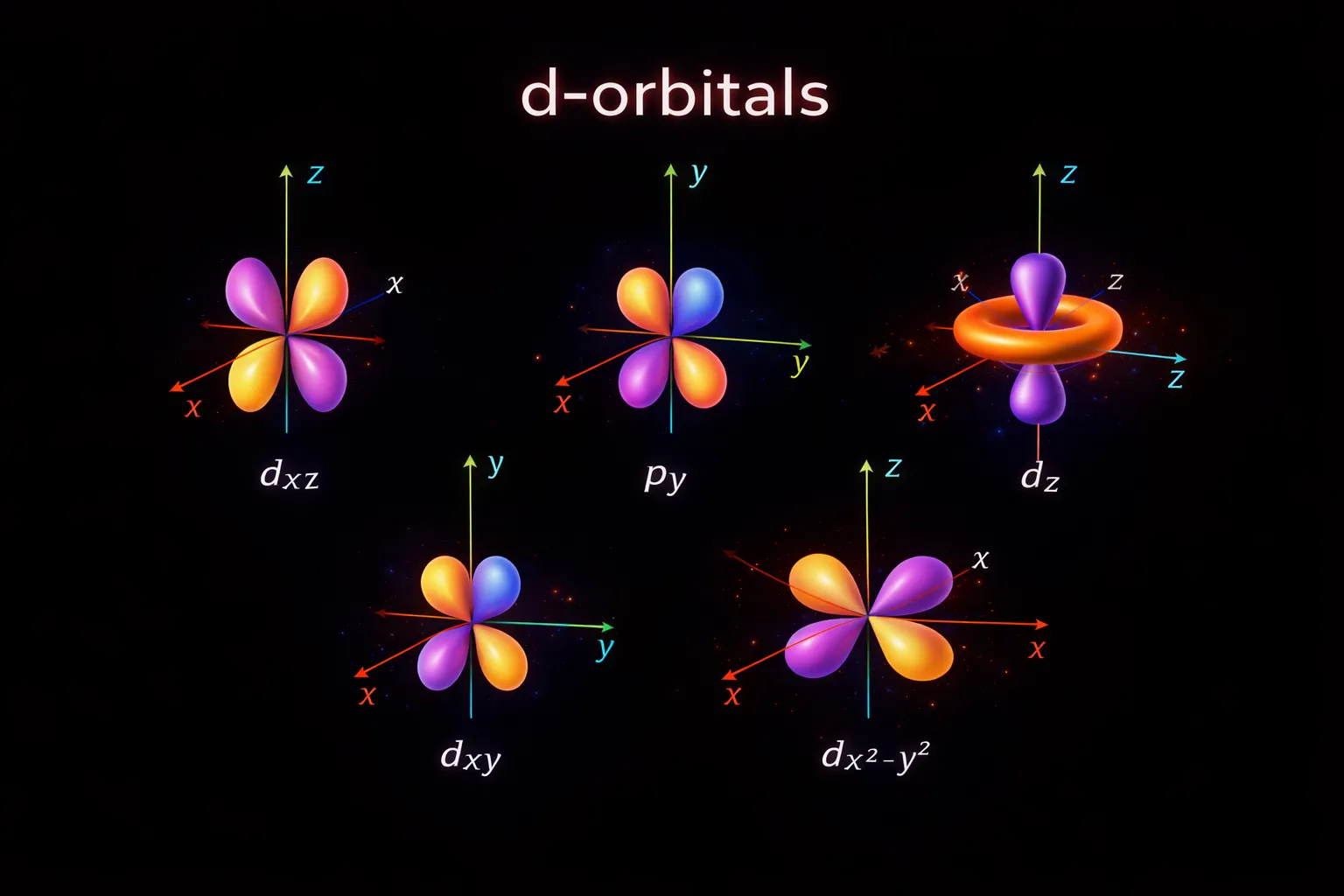
Angular nodes in d-orbital
(Advanced)
26
Total number of orbitals in fourth shell is
(Advanced)
27
Which set of quantum numbers is NOT permissible?
(Advanced)
28
Number of electrons with n=3 is
(Advanced)
29
Which orbital has highest penetrating power?
(Advanced)
30
The spectral lines of hydrogen arise due to
(Advanced)
31
Which series lies in visible region?
(Advanced)
32
If velocity of electron doubles, its de Broglie wavelength becomes
(Advanced)
33
Which statement is correct for Aufbau principle?
(Advanced)
34
Pauli exclusion principle states
(Advanced)
35
Hund’s rule relates to
(Advanced)
36
Number of nodal planes in p-orbital is
(Advanced)
37
Which orbital has two angular nodes?
(Advanced)
38
The probability of finding electron is zero at nodes because
(Advanced)
39
Which quantum number decides orbital orientation?
(Advanced)
40
Value of l for f-subshell is
(Advanced)
41
Total angular nodes in 4f orbital
(Advanced)
42
Which particle shows dual nature?
(Advanced)
43
Energy of electron in nth orbit varies as
(JEE Level)
44
Radius of nth orbit varies as
(JEE Level)
45
Number of radial nodes in 4d orbital
(JEE Level)
46
Which has shortest wavelength?
(JEE Level)
47
If uncertainty in position decreases, momentum uncertainty
(JEE Level)
48
Which orbital has maximum energy in same shell?
(JEE Level)
49
Which rule explains half-filled stability?
(JEE Level)
50
Minimum uncertainty corresponds to
(Olympiad Level)
📚
ACADEMIA AETERNUM तमसो मा ज्योतिर्गमय · Est. 2025
Sharing this chapter
Structure Of Atom | Chemistry Class 11 | Academia Aeternum
Structure Of Atom | Chemistry Class 11 | Academia Aeternum — Complete Notes & Solutions · academia-aeternum.com
These multiple-choice questions are carefully designed to strengthen conceptual clarity and analytical thinking in the chapter Structure of Atom. Beginning with fundamental ideas such as subatomic particles, atomic models, and basic quantum concepts, the set gradually progresses to advanced topics including quantum numbers, electronic configuration, spectral series, wave–particle duality, and uncertainty principle. Each question is accompanied by concise explanations to help learners understand…
🎓 Class 11 📐 Chemistry 📖 NCERT ✅ Free Access 🏆 CBSE · JEE
Share on
academia-aeternum.com/class-11/chemistry/structure-of-atom/mcqs/ Copy link
💡
Exam tip: Sharing chapter notes with your study group creates a reinforcement loop. Teaching a concept is the fastest path to mastering it.

Frequently Asked Questions

Academia Aeternum is an online educational platform providing NCERT based notes, MCQs, quizzes, and conceptual explanations for students from Class 9 to Class 12 and competitive exam aspirants.

The platform provides structured learning resources for Mathematics, Physics, Chemistry, Biology, and Computer Science aligned with the NCERT curriculum.

Yes. Many MCQs are designed in patterns similar to JEE, NEET, and other entrance exams to improve analytical thinking and exam readiness.

Yes. Most study materials are derived directly from NCERT textbooks to ensure alignment with school curriculum and board examination requirements.

Yes. Students can access learning materials, MCQs, and revision resources freely without subscription.

MCQs improve accuracy, speed, and conceptual clarity while helping students practice objective questions commonly asked in exams.

Yes. Each question is accompanied by a clear explanation to help students understand the reasoning behind the correct answer.

Yes. Teachers can use the questions and explanations for classroom discussions, worksheets, and quick revision exercises.

Yes. The structured format and clear explanations make it ideal for independent learning.

Yes. Concise notes and MCQ practice sets allow students to revise important concepts quickly.

Yes. Explanations are written in clear student friendly language for easy understanding.

Yes. Questions range from basic conceptual understanding to advanced application based problems.

New chapters, questions, and quizzes are regularly added to expand the learning resources.

Yes. Consistent practice improves concept retention, problem solving ability, and exam confidence.

Regular objective practice helps students identify weak areas, improve speed, and prepare effectively for competitive examinations.

Recent Posts


    --:-- ⏱ Time
    ⚡ Progress 0 / 50 answered

    Structure of atom — Learning Resources

    📄 Detailed Notes
    ✔️ True / False
    📌 Exercise
    🎯 Advance MCQs
    📝 Exercises
    Structure of atom-Exercises

    Get in Touch

    Let's Connect

    Questions, feedback, or suggestions?
    We'd love to hear from you.