
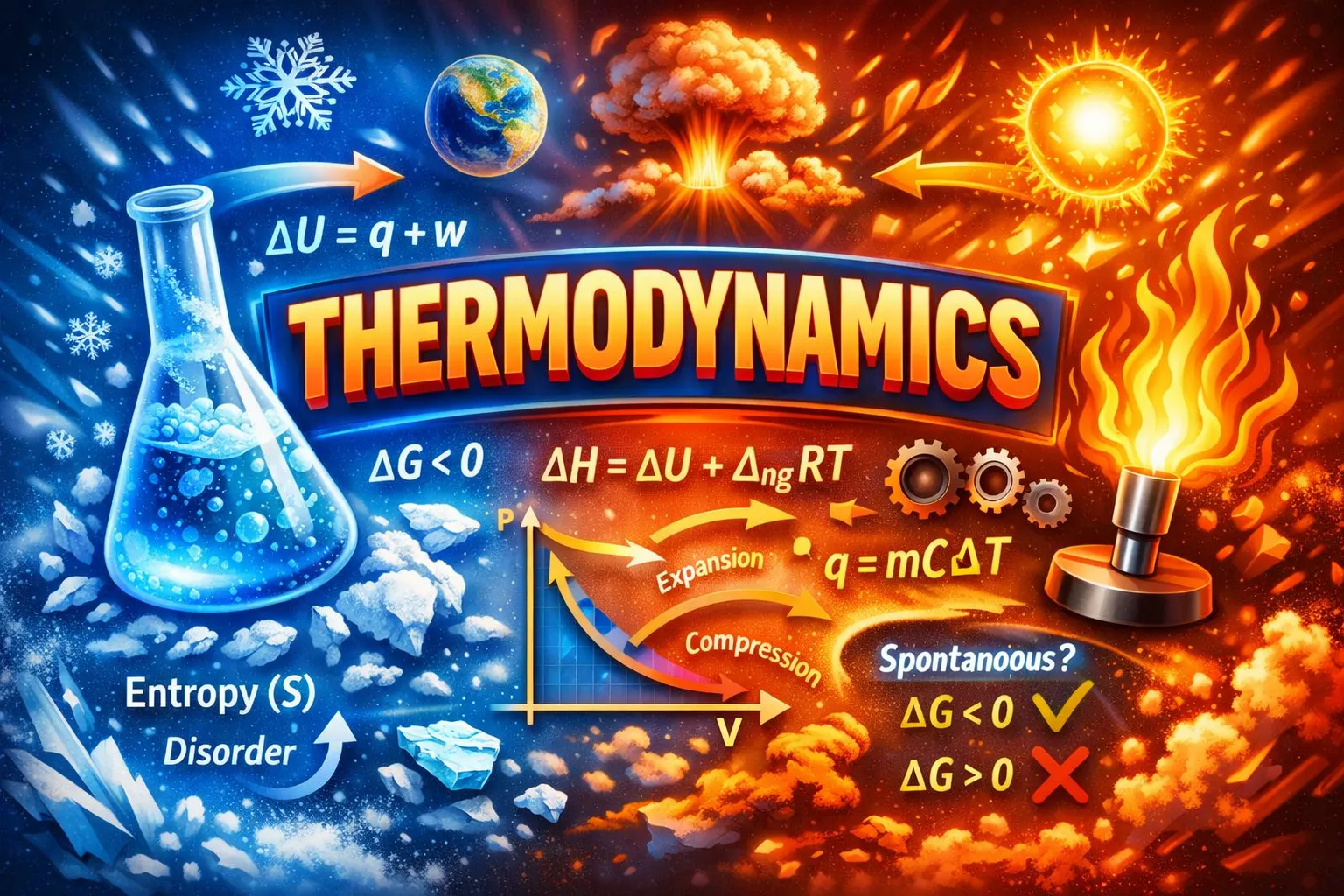
Thermodynamics isn't just another chapter — it's the rulebook for why anything happens in chemistry at all. Once you understand it, reactions stop being mysterious and start making sense.
Heat flows, engines run, ice melts, and cells produce energy — all of it follows the same elegant set of principles. In NCERT Class XI Chemistry Chapter 5, you step beyond simple "heat concepts" and into the laws that physicists, chemists, and engineers rely on every single day. This chapter is your gateway to physical chemistry, and mastering it will give you an edge not just in exams but in how you understand the natural world.
What This Chapter Covers
You begin with the foundational language: systems, surroundings, and state functions. These are the vocabulary that let scientists describe any process precisely.
From there, the First Law of Thermodynamics establishes something profound — energy is never created or destroyed, only transformed. This single idea underpins all of chemistry.
The chapter then introduces thermodynamic quantities — internal energy (U), enthalpy (H), and heat capacity — and shows you how Hess's Law lets you calculate energy changes that you can't measure directly.
The climax of the chapter is the Second Law and the concept of entropy: the universe's tendency toward disorder. Combined with Gibbs free energy (ΔG), you gain the power to predict whether a reaction will actually happen on its own.
Key Takeaways
How to Study This Chapter
Lock in the language first — system vs. surroundings, state vs. path functions, and critically, sign conventions. Every calculation error in this chapter traces back to sign confusion, not hard maths.
Work done, internal energy change, enthalpy — these are the bread and butter numericals. NCERT solved examples are non-negotiable. Do them twice. Then do the exercises.
Write out ΔU = q + w, ΔH = ΔU + ΔnRT, and ΔG = ΔH − TΔS by hand. Revisit it daily. Familiarity with these relations removes hesitation in exams.
High-weightage and concept-heavy — these topics reward thinkers, not memorisers. For every process, ask yourself: "Is this spontaneous? Why?" Walk through the ΔG logic every time.
Thermodynamics feels hard until it suddenly feels obvious. That shift happens the moment sign conventions click. Invest time there first, and the rest of the chapter falls into place remarkably fast.
Ready to go deeper?
Everything you need to master Thermodynamics — from first read to exam day.