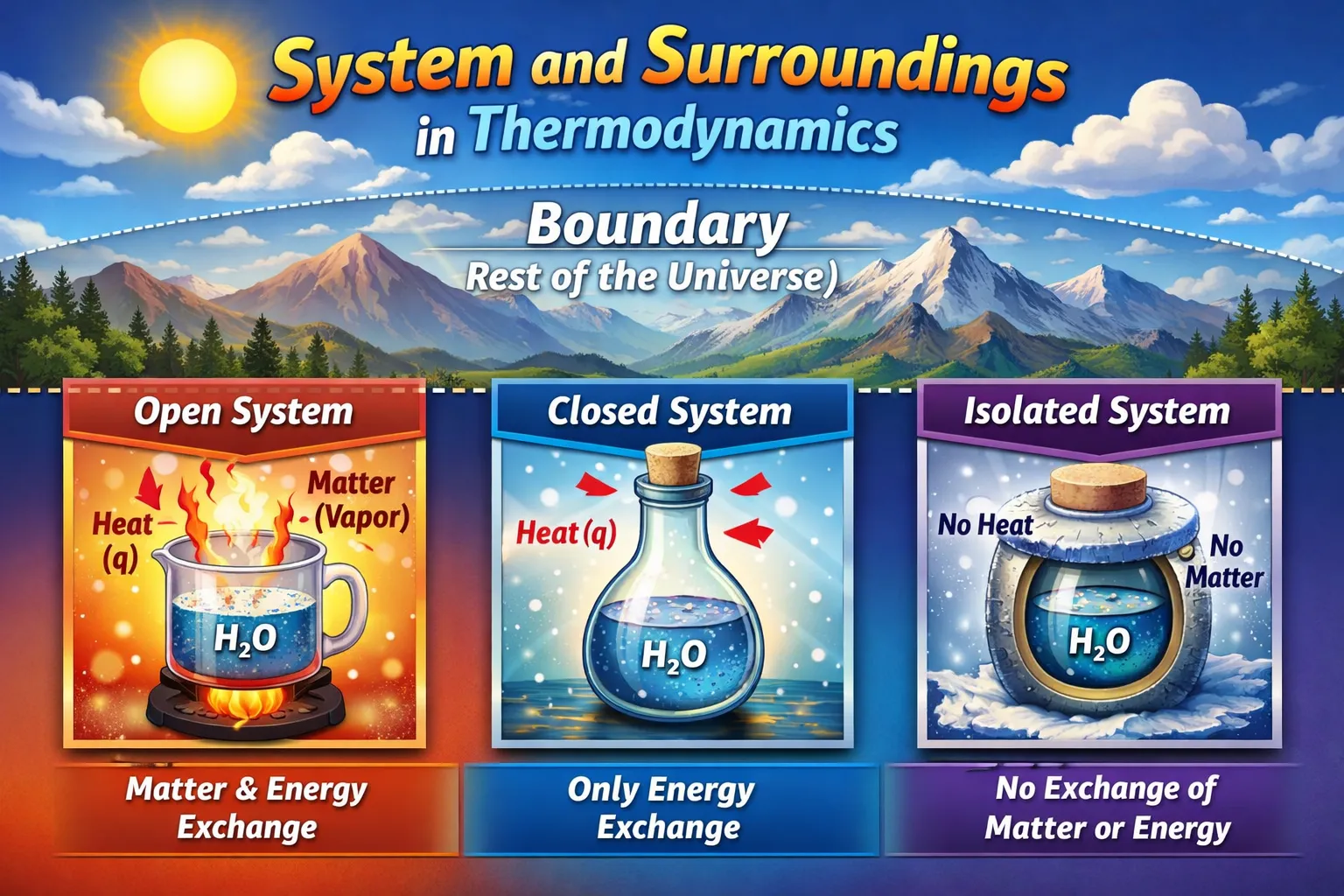
System and surroundings — Thermodynamics Class 11 MCQs />
🧪 NCERT Class 11 • Chapter 5

Thermodynamics MCQs
JEE & NEET 2026

Enthalpy • Entropy • Gibbs Free Energy • Hess’s Law • Born–Haber Cycle
50 expert-level questions with detailed answers & explanations

Start Practising ↓
50MCQs
3Difficulty Levels
2026Exam Aligned
NEET+JEECovered
2026 Boards JEE Mains JEE Advanced NEET

Thermodynamics Class 11 MCQs (NCERT Chapter 5) – JEE & NEET Practice

50 Questions  ·  Increasing Difficulty

Enthalpy, entropy, spontaneity — three words that decide marks in every major exam. This chapter hides its difficulty behind familiar formulas, then punishes students who memorised without understanding. These MCQs expose exactly those gaps: sign-convention traps, ΔG vs ΔH confusion, Born–Haber cycle calculations, and Second Law reasoning that separates 650-scorers from 720-scorers in NEET.

🗓 Last Updated: February 2026  |  Practice Set – Instant Feedback
Academia Aeternum Editorial Team Reviewed by Subject Experts  ·  Updated Feb 2026
Why Practice These MCQs

Why Thermodynamics MCQs Matter for JEE & NEET

Thermodynamics is a non-negotiable high-weightage chapter in both NEET and JEE Mains. Questions regularly blend multiple concepts — pairing Gibbs free energy with equilibrium constants, or Hess’s Law with bond enthalpies, inside a single item. Students who practise only isolated formulas consistently lose marks on these hybrid questions. Structured MCQ practice rebuilds your thinking from concept to calculation in one fluid motion.

Exam Trend Analysis · Updated 2026

How Thermodynamics MCQs Appear in JEE & NEET 2026

Recent papers show a sharp rise in calculation-based items linking ΔG° to equilibrium constants and spontaneity predictions across temperature ranges. NCERT concepts are retained but reframed with trap options targeting sign errors and unit mismatches. Thermodynamic reasoning — not mere recall — is what exams now reward.

Board NEET JEE Mains HOTS JEE Advanced
🎯 Knowledge Check

Chemistry — THERMODYNAMICS

50 Questions Class 11 MCQs
1
BoardThermodynamics deals with:
2
BoardA system that can exchange both energy and matter with its surroundings is called a:
3
BoardInternal energy \(U\) of an ideal gas depends on:
4
BoardThe First Law of Thermodynamics is a statement of:
5
BoardFor a process carried out at constant pressure, the heat exchanged is equal to:
6
BoardWork done by the system during expansion against a constant external pressure \(p_{ext}\) is:
7
BoardAn exothermic reaction is one in which:
8
BoardHess's Law is a consequence of which thermodynamic principle?
9
NEETWhich of the following is NOT a state function?
10
BoardThe standard enthalpy of formation of an element in its most stable form is:
11
NEETThe relationship between \(\Delta H\) and \(\Delta U\) for a gaseous reaction is:
12
BoardEntropy is a measure of:
13
BoardThe Second Law of Thermodynamics states that for a spontaneous process:
14
NEETGibbs free energy is defined as:
15
BoardAt equilibrium, the Gibbs free energy change \(\Delta G\) is:
16
NEETFor the reaction \(\text{N}_2(g) + 3\text{H}_2(g) \rightarrow 2\text{NH}_3(g)\), the value of \(\Delta n_g\) is:
17
NEETThe bond dissociation enthalpy of \(\text{H}_2\) is \(436\) kJ/mol and that of \(\text{Cl}_2\) is \(242\) kJ/mol. The bond enthalpy of \(\text{H–Cl}\) is \(431\) kJ/mol. The \(\Delta_f H^\circ\) of \(\text{HCl}(g)\) is:
18
NEETWhich of the following processes has a positive \(\Delta S\)?
19
JEE Mains. For a reaction that is spontaneous at all temperatures, the signs of \(\Delta H\) and \(\Delta S\) must be:
20
NEET. The enthalpy of combustion of carbon to \(\text{CO}_2\) is \(-393.5\) kJ/mol and of CO to \(\text{CO}_2\) is \(-283\) kJ/mol. Using Hess's law, the enthalpy of formation of CO is:
21
JEE Mains In a bomb calorimeter experiment at 27°C, the heat evolved for the combustion of 1 mol of a substance is 3000 kJ. If \(\Delta n_g = -2\), then \(\Delta H\) of combustion is: (\(R = 8.314\) J mol\(^{-1}\) K\(^{-1}\))
22
NEETThe enthalpy of neutralisation of a strong acid by a strong base is \(-57.1\) kJ/mol. The enthalpy of neutralisation of a weak acid by a strong base will be:
23
JEE Mains Which condition makes a non-spontaneous process at low temperature spontaneous at high temperature?
24
NEETFor the reaction \(\text{C}_{(graphite)} \rightarrow \text{C}_{(diamond)}\), which statement is correct?
25
JEE AdvancedThe free energy change \(\Delta G^\circ\) for a reaction at 298 K is \(-114\) kJ/mol. The equilibrium constant \(K\) for this reaction is: (\(R = 8.314\) J mol\(^{-1}\) K\(^{-1}\))
26
NEET For which of the following reactions is the standard enthalpy of reaction equal to the bond dissociation enthalpy of \(\text{H}_2\)?
27
JEE MainsFor an adiabatic free expansion of an ideal gas:
28
JEE Mains The lattice enthalpy of NaCl can be determined using the:
29
NEETAt the transition temperature, for a phase change process:
30
JEE Mains The enthalpy of vaporisation of water is 44 kJ/mol at 298 K. The entropy of vaporisation at 298 K is approximately:
31
JEE MainsWhich of the following has the highest standard molar entropy at 298 K?
32
JEE MainsFor the reaction \(A \rightleftharpoons B\) at 500 K, \(\Delta H = -10\) kJ/mol and \(\Delta S = -20\) J mol\(^{-1}\) K\(^{-1}\). Which statement is correct?
33
HOTSFor a reaction, \(\Delta G^\circ = +10\) kJ/mol at 298 K. This means:
34
JEE Advanced One mole of an ideal gas is compressed isothermally and reversibly at 300 K from 1 L to 0.1 L. The work done on the gas is: (\(R = 8.314\) J mol\(^{-1}\) K\(^{-1}\))
35
HOTSIn a reaction, if \(\Delta H = 0\) and \(\Delta S > 0\), then the reaction:
36
JEE AdvancedConsider the reaction: \(2\text{Mg}(s) + \text{O}_2(g) \rightarrow 2\text{MgO}(s)\). Given \(\Delta_f H^\circ[\text{MgO}] = -601.6\) kJ/mol. The heat released in kJ when 48 g of Mg burns completely is:
37
JEE AdvancedThe resonance energy of benzene is approximately \(-152\) kJ/mol. This implies that the actual benzene molecule:
38
HOTS For a reversible process, which of the following is true?
39
JEE AdvancedGiven: \(\Delta_f H^\circ[\text{CO}_2(g)] = -393.5\) kJ/mol, \(\Delta_f H^\circ[\text{H}_2\text{O}(l)] = -285.8\) kJ/mol, \(\Delta_c H^\circ[\text{C}_2\text{H}_5\text{OH}(l)] = -1366.5\) kJ/mol. The \(\Delta_f H^\circ\) of ethanol is:
40
HOTSA reaction is exothermic and entropy decreases. The reaction will be spontaneous:
41
JEE AdvancedFor the process \(\text{H}_2\text{O}(l, 25°\text{C}) \rightarrow \text{H}_2\text{O}(g, 25°\text{C})\), the correct statement is:
42
JEE AdvancedThe standard Gibbs energy of formation of \(\text{NO}(g)\) is \(+86.6\) kJ/mol. The equilibrium constant for \(\text{N}_2(g) + \text{O}_2(g) \rightleftharpoons 2\text{NO}(g)\) at 298 K is approximately: (\(R = 8.314 \times 10^{-3}\) kJ mol\(^{-1}\) K\(^{-1}\))
43
HOTS Which of the following correctly explains why dissolution of \(\text{NH}_4\text{NO}_3\) in water is spontaneous even though it is endothermic?
44
JEE AdvancedThe work done in an irreversible expansion of 1 mol ideal gas from 10 L to 20 L against a constant external pressure of 1 atm at 300 K is: (1 L·atm = 101.3 J)
45
HOTSFor a process at constant temperature and volume, the criterion of spontaneity is:
46
JEE Advanced The bond enthalpy of C–H is 413 kJ/mol and C–C is 348 kJ/mol. The lattice enthalpy can be estimated from which of the following approaches for an ionic compound?
47
JEE AdvancedThe standard entropy change \(\Delta S^\circ\) of the reaction \(\text{N}_2(g) + 3\text{H}_2(g) \rightarrow 2\text{NH}_3(g)\) is \(-198.7\) J mol\(^{-1}\) K\(^{-1}\) and \(\Delta H^\circ = -92.4\) kJ/mol. At what temperature does the reaction switch from spontaneous to non-spontaneous?
48
HOTS For the Born–Haber cycle of NaCl, the correct sequence of steps for the formation cycle is:
49
JEE Advanced The standard Gibbs free energy change for a reaction is related to the equilibrium constant by \(\Delta G^\circ = -RT\ln K\). If \(K = 1\) for a reaction at 298 K, then:
50
JEE Advanced The Trouton's rule states that the molar entropy of vaporisation at the normal boiling point is approximately \(88\) J mol\(^{-1}\) K\(^{-1}\) for many liquids. A liquid boils at 400 K. Its approximate molar enthalpy of vaporisation is:

Recent Posts


    --:-- ⏱ Time
    ⚡ Progress 0 / 50 answered
    NCERT Class XI Chemistry | Chapter 5 – Thermodynamics
    50 MCQs  |  Covers Board, NEET, JEE Mains & JEE Advanced levels
    MathJax-rendered equations  |  Detailed explanations for every question

    THERMODYNAMICS – Learning Resources

    Get in Touch

    Let's Connect

    Questions, feedback, or suggestions?
    We'd love to hear from you.