Ch 10  ·  Q–
0%
Class 11 Mathematics Misc Exercise NCERT Solutions JEE Mains NEET Board Exam

Chapter 10 — CONIC SECTIONS

Step-by-step NCERT solutions with detailed proofs and exam-oriented hints for Boards, JEE & NEET.

📋8 questions
Ideal time: 25-30 min
📍Now at: Q1
Q1
NUMERIC3 marks

If a parabolic reflector is 20 cm in diameter and 5 cm deep, find the focus.

Theory

A parabola is the set of all points equidistant from a fixed point (focus) and a fixed line (directrix). The standard equation of a parabola opening towards the right is: \[ y^2 = 4ax \] where the vertex is at \((0,0)\) and the focus is at \((a,0)\).

In practical problems like reflectors, dishes, and antennas, the parabola represents a cross-section. Any incoming parallel rays reflect through the focus, which makes locating the focus extremely important.

Solution Roadmap

  • Assume vertex at origin and axis along x-axis
  • Use standard parabola equation
  • Identify boundary point using diameter and depth
  • Substitute to find \(a\)
  • Write focus using definition

Solution

Let the parabola have vertex at origin and open towards the positive \(x\)-axis. Its equation is: \[ y^2 = 4ax \]

Diameter of reflector = \(20\text{ cm}\) ⇒ radius = \(10\text{ cm}\)
Depth = \(5\text{ cm}\)

So the rim point is: \[ (x, y) = (5, 10) \]

Substituting: \[ \begin{aligned} y^2 &= 4ax \\ 10^2 &= 4a(5) \\ 100 &= 20a \\ a &= 5 \end{aligned} \]

Therefore, the focus is: \[ (5, 0) \]
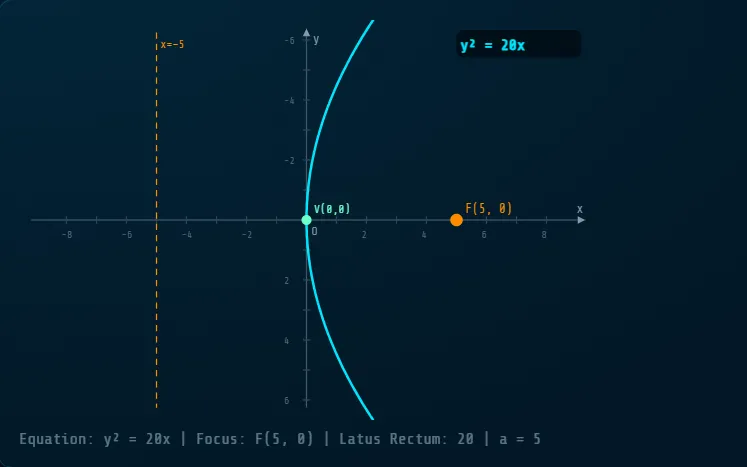
fig-10-cs-me-q1

Final Answer

Focus = \((5,0)\), i.e., \(5\text{ cm}\) from the vertex.

Exam Significance

  • Direct application of standard parabola equation
  • Frequently asked in CBSE board exams (case-based questions)
  • Important for JEE Main (geometry + modelling problems)
  • Builds understanding of real-life applications of conics
↑ Top
1 / 8  ·  13%
Q2 →
Q2
NUMERIC3 marks

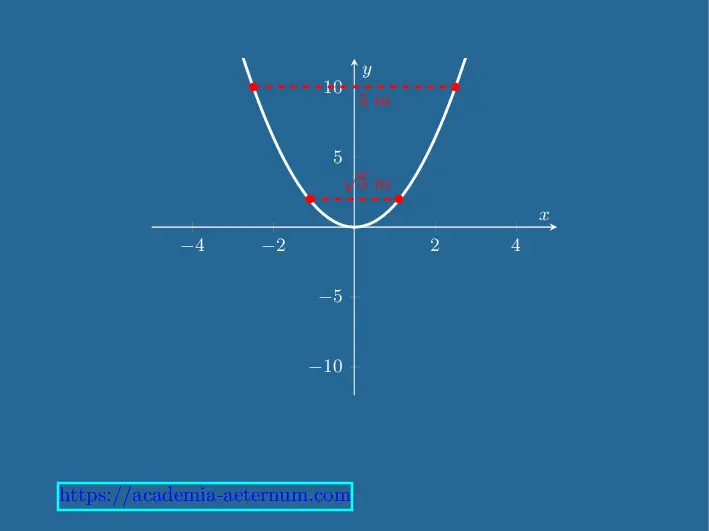
An arch is in the form of a parabola with its axis vertical. The arch is 10 m high and 5 m wide at the base. How wide is it 2 m from the vertex of the parabola?

Theory

A parabola with vertical axis and vertex at origin has standard equation: \[ x^2 = 4ay \] where the vertex is at \((0,0)\) and the parabola opens upwards.

Due to symmetry about the y-axis, width at any height \(y\) is: \[ \text{Width} = 2x \]

Solution Roadmap

  • Place vertex at origin and assume vertical axis
  • Use base width to determine parameter \(a\)
  • Substitute required height into equation
  • Compute x and double it to get width

Solution

Let the vertex be at origin and axis along positive \(y\)-axis. Equation: \[ x^2 = 4ay \]

Given:
Height = \(10\text{ m}\) ⇒ base at \(y = 10\)
Width at base = \(5\text{ m}\) ⇒ \(x = \pm 2.5\)

Substituting: \[ \begin{aligned} (2.5)^2 &= 4a(10) \\ 6.25 &= 40a \\ a &= \frac{5}{32} \end{aligned} \]

At \(y = 2\): \[ \begin{aligned} x^2 &= 4ay \\ x^2 &= 4 \cdot \frac{5}{32} \cdot 2 \\ x^2 &= \frac{5}{4} \\ x &= \frac{\sqrt{5}}{2} \end{aligned} \]

Width = \(2x = \sqrt{5}\text{ m}\)

conic-section-ms-q2

Final Answer

Width at 2 m from vertex = \(\sqrt{5}\text{ m}\)

Exam Significance

  • Classic modelling problem of parabola (very important for CBSE boards)
  • Tests symmetry + substitution skills
  • Frequently appears in JEE Main in slightly modified form
  • Builds strong intuition for real-life structures (arches, bridges)
← Q1
2 / 8  ·  25%
Q3 →
Q3
NUMERIC3 marks

The cable of a uniformly loaded suspension bridge hangs in the form of a parabola. The roadway which is horizontal and 100 m long is supported by vertical wires attached to the cable, the longest wire being 30 m and the shortest being 6 m. Find the length of a supporting wire attached to the roadway 18 m from the middle.

Theory

In a uniformly loaded suspension bridge, the cable takes the shape of a parabola. If the midpoint of the bridge is taken as origin, the parabola is symmetric about the y-axis and can be written as: \[ y = ax^2 + c \]

Here, \(y\) represents the length of the vertical supporting wire at distance \(x\) from the center. The minimum wire length occurs at the center (vertex).

Solution Roadmap

  • Take midpoint of bridge as origin
  • Use vertex form \(y = ax^2 + c\)
  • Use shortest wire to find \(c\)
  • Use endpoint data to find \(a\)
  • Substitute required distance to compute wire length

Solution

Let the midpoint of the bridge be the origin. The wire length is minimum at center, so vertex is: \[ (0, 6) \]

Equation: \[ y = ax^2 + 6 \]

Bridge length = \(100\text{ m}\) ⇒ ends at \(x = \pm 50\)
Longest wire = \(30\text{ m}\)

Using point \((50,30)\): \[ \begin{aligned} 30 &= a(50)^2 + 6 \\ 30 &= 2500a + 6 \\ 24 &= 2500a \\ a &= \frac{24}{2500} \end{aligned} \]

At \(x = 18\): \[ \begin{aligned} y &= \frac{24}{2500}(18)^2 + 6 \\ y &= \frac{24}{2500} \cdot 324 + 6 \\ y &= 3.1104 + 6 \\ y &\approx 9.11 \end{aligned} \]

Hence, required wire length ≈ \(9.11\text{ m}\)

6 m 30 m ? Center 18 m

Final Answer

Length of supporting wire ≈ \(9.11\text{ m}\)

Exam Significance

  • Very important real-life application of parabola (NCERT + Boards)
  • Frequently appears in JEE Main as modelling + substitution problem
  • Strengthens understanding of vertex form \(y = ax^2 + c\)
  • Bridges physics (uniform load) with coordinate geometry
← Q2
3 / 8  ·  38%
Q4 →
Q4
NUMERIC3 marks

An arch is in the form of a semi-ellipse. It is 8 m wide and 2 m high at the centre. Find the height of the arch at a point 1.5 m from one end.

Theory

The standard equation of an ellipse centered at origin with major axis along x-axis is: \[ \frac{x^2}{a^2} + \frac{y^2}{b^2} = 1 \] where \(a\) is semi-major axis and \(b\) is semi-minor axis.

A semi-ellipse (upper half) represents structures like arches. The height at any point is obtained by solving for \(y\) using the ellipse equation.

Solution Roadmap

  • Place center of ellipse at origin
  • Determine \(a\) and \(b\) from given width and height
  • Convert “distance from end” into coordinate from center
  • Substitute into ellipse equation
  • Compute positive value of \(y\)

Solution

Width = \(8\text{ m}\) ⇒ \(a = 4\)
Height at center = \(2\text{ m}\) ⇒ \(b = 2\)

Equation of ellipse: \[ \frac{x^2}{16} + \frac{y^2}{4} = 1 \]

The point is \(1.5\text{ m}\) from one end. Since ends are at \(x = \pm 4\), the coordinate is: \[ x = 4 - 1.5 = 2.5 \]

Substituting: \[ \begin{aligned} \frac{(2.5)^2}{16} + \frac{y^2}{4} &= 1 \\ \frac{6.25}{16} + \frac{y^2}{4} &= 1 \\ \frac{y^2}{4} &= \frac{9.75}{16} \\ y^2 &= \frac{39}{16} \\ y &= \frac{\sqrt{39}}{4} \end{aligned} \]

Height ≈ \(1.56\text{ m}\)

2 m 4 m ? 1.5 m from end

Final Answer

Height = \(\frac{\sqrt{39}}{4}\text{ m} \approx 1.56\text{ m}\)

Exam Significance

  • Very important NCERT-based ellipse application problem
  • Tests coordinate shifting (end → center conversion)
  • Frequently appears in CBSE boards in similar modelling form
  • Concept reused in JEE (ellipse geometry + substitution)
← Q3
4 / 8  ·  50%
Q5 →
Q5
NUMERIC3 marks

A rod of length 12 cm moves with its ends always touching the coordinate axes. Determine the equation of the locus of a point P on the rod, which is 3 cm from the end in contact with the x-axis.

Theory

If a line segment of fixed length slides between the coordinate axes, its endpoints \((a,0)\) and \((0,b)\) satisfy: \[ a^2 + b^2 = \text{(constant)}^2 \]

When a point divides such a segment in a fixed ratio, its locus is generally an ellipse. This is a standard locus problem combining geometry and algebra.

Solution Roadmap

  • Assume endpoints \((a,0)\), \((0,b)\)
  • Use length condition of rod
  • Apply section formula for point \(P\)
  • Express \(a, b\) in terms of \(x, y\)
  • Substitute and simplify to get locus

Solution

Let the rod touch axes at: \[ A(a,0), \quad B(0,b) \]

Length of rod = \(12\text{ cm}\): \[ a^2 + b^2 = 144 \]

Given \(AP = 3\), total length = 12 ⇒ \(PB = 9\)
So, \(P\) divides \(AB\) internally in ratio \(1:3\)

Using section formula: \[ \begin{aligned} P &= \left(\frac{3a + 0}{4}, \frac{b}{4}\right)\\ &= \left(\frac{3a}{4}, \frac{b}{4}\right) \end{aligned} \]

Let \(P(x,y)\), then: \[ a = \frac{4x}{3}, \quad b = 4y \]

Substituting: \[ \begin{aligned} \left(\frac{4x}{3}\right)^2 + (4y)^2 &= 144 \\ \frac{16x^2}{9} + 16y^2 &= 144 \\ \frac{x^2}{9} + y^2 &= 9 \end{aligned} \]

This is the equation of an ellipse.

A(a,0) B(0,b) P 3 9

Final Answer

Locus of \(P\): \[ \frac{x^2}{9} + y^2 = 9 \]

Exam Significance

  • Classic NCERT locus problem (very high probability in boards)
  • Tests section formula + substitution accuracy
  • Frequently asked in JEE Main in modified form
  • Builds strong foundation for ellipse derivations
← Q4
5 / 8  ·  63%
Q6 →
Q6
NUMERIC3 marks

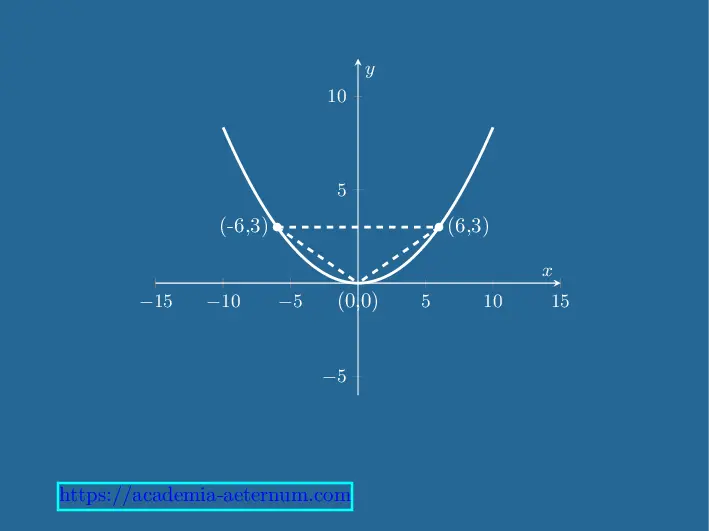
Find the area of the triangle formed by the lines joining the vertex of the parabola \(x^2 = 12y\) to the ends of its latus rectum.

Theory

The standard equation of a parabola opening upwards is: \[ x^2 = 4ay \] where the vertex is at \((0,0)\) and the focus is at \((0,a)\).

The latus rectum is a line segment passing through the focus and perpendicular to the axis. Its endpoints are: \[ (\pm 2a,\, a) \] and its length is \(4a\).

Solution Roadmap

  • Compare with standard form to find \(a\)
  • Determine endpoints of latus rectum
  • Form triangle using vertex and endpoints
  • Compute base and height geometrically
  • Apply area formula

Solution

Given: \[ x^2 = 12y \Rightarrow 4a = 12 \Rightarrow a = 3 \]

Endpoints of latus rectum: \[ (6,3), \quad (-6,3) \]

Triangle is formed by points: \[ (0,0), \quad (6,3), \quad (-6,3) \]

Base = distance between endpoints: \[ = 12 \]

Height = perpendicular distance from \((0,0)\) to line \(y = 3\): \[ = 3 \]

Area: \[ \frac{1}{2} \times 12 \times 3 = 18 \]

conic-section-ms-q6

Final Answer

Area = \(18\) square units

Exam Significance

  • Direct concept of latus rectum (very important for JEE)
  • Frequently appears in CBSE board exams
  • Tests geometric visualization of parabola
  • Useful in coordinate geometry + area-based problems
← Q5
6 / 8  ·  75%
Q7 →
Q7
NUMERIC3 marks

A man running a racecourse notes that the sum of the distances from the two flag posts from him is always 10 m and the distance between the flag posts is 8 m. Find the equation of the posts traced by the man.

Theory

An ellipse is defined as the set of all points such that the sum of distances from two fixed points (foci) is constant.

Standard form of ellipse with center at origin: \[ \frac{x^2}{a^2} + \frac{y^2}{b^2} = 1 \] where:
\(2a\) = constant sum of distances
\(2c\) = distance between foci
\(b^2 = a^2 - c^2\)

Solution Roadmap

  • Use ellipse definition (sum of distances = constant)
  • Find \(a\) from total distance
  • Find \(c\) from distance between foci
  • Compute \(b^2 = a^2 - c^2\)
  • Write standard equation

Solution

Distance between flag posts = \(8\text{ m}\): \[ \begin{aligned} 2c &= 8 \\ \Rightarrow c &= 4 \end{aligned} \]

Sum of distances = \(10\text{ m}\): \[ \begin{aligned} 2a &= 10 \\ \Rightarrow a &= 5 \end{aligned} \]

Using relation: \[ \begin{aligned} b^2 &= a^2 - c^2 \\&= 25 - 16 \\&= 9 \end{aligned} \]

Equation of ellipse: \[ \frac{x^2}{25} + \frac{y^2}{9} = 1 \]

F₁ F₂ P 2c = 8 2a = 10

Final Answer

Required equation: \[ \frac{x^2}{25} + \frac{y^2}{9} = 1 \]

Exam Significance

  • Direct application of ellipse definition (very high weightage)
  • Frequently asked in CBSE board exams
  • Very common in JEE Main (parameter identification)
  • Builds core understanding of \(a, b, c\) relationship
← Q6
7 / 8  ·  88%
Q8 →
Q8
NUMERIC3 marks

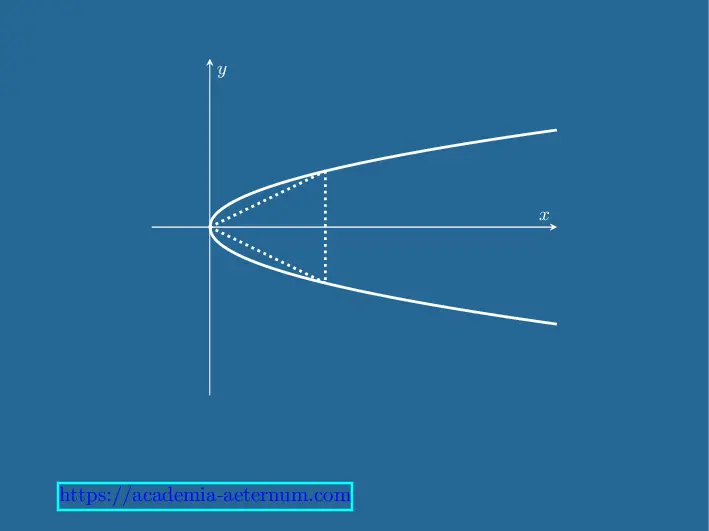
An equilateral triangle is inscribed in the parabola \(y^2 = 4 ax\), where one vertex is at the vertex of the parabola. Find the length of the side of the triangle.

Theory

The standard parabola \(y^2 = 4ax\) is symmetric about the x-axis. Any two symmetric points on it are of the form \((x, y)\) and \((x, -y)\).

In an equilateral triangle, all sides are equal. Using symmetry simplifies coordinate geometry problems significantly.

Solution Roadmap

  • Take symmetric points on parabola
  • Express side lengths using distance formula
  • Use equilateral triangle condition
  • Substitute into parabola equation
  • Compute side length

Solution

Vertex of parabola: \((0,0)\)

Let other two vertices be: \[ (x, y), \quad (x, -y) \]

Distance between these two points: \[ = 2y \]

Distance from vertex to \((x,y)\): \[ \sqrt{x^2 + y^2} \]

Since triangle is equilateral: \[ \sqrt{x^2 + y^2} = 2y \]

Squaring: \[ \begin{aligned} x^2 + y^2 &= 4y^2 \\\Rightarrow x^2 &= 3y^2 \end{aligned} \]

Substitute in parabola \(y^2 = 4ax\): \[ \begin{aligned} y^2 &= 4a(\sqrt{3}y)\\ \Rightarrow y &= 4a\sqrt{3} \end{aligned} \]

Side length: \[ = 2y = 8a\sqrt{3} \]

conic-section-ms-q8

Final Answer

Side length = \(8a\sqrt{3}\)

Exam Significance

← Q7
8 / 8  ·  100%
↑ Back to top
🎓

Chapter Complete!

All 8 solutions for CONIC SECTIONS covered.

↑ Review from the top
Conic Engine

Circle · Parabola · Ellipse · Hyperbola — multi-parameter analyser
Conic type
Circle — input mode
Radius r
Diameter d
Area Ar = √(A/π)
Three points on circle
P₁.x
P₁.y
P₂.x
P₂.y
P₃.x
P₃.y
Finds circumscribed circle (origin-centred assumed not required)
Parabola — input mode
Focal length pdistance from vertex to focus
Orientation
Directrix x=for horiz; y= for vert
Orientation
p = |directrix value|, vertex at origin
Latus rectum= 4p
Orientation
Point x
Point y
Orientation
Vertex at origin — solves for p from the point
Ellipse — input mode
Semi-major a
Semi-minor b
Orientation
Focal dist. c
Vertex aa > c
Orientation
Focal dist. c
Point x
Point y
Orientation
F₁ x
F₂ x
P.x
P.y
Semi-major a
Eccentricity e0 < e < 1
Orientation
Semi-major a
Directrix |x₀|> a
Orientation
Hyperbola — input mode
Semi-transverse a
Semi-conjugate b
Orientation
Focal dist. cc > a
Vertex a
Orientation
Focal dist. c
Point x
Point y
Orientation
F₁ x
F₂ x
P.x
P.y
Semi-transverse a
Eccentricity ee > 1
Orientation
Slope m (±m)
Semi-transverse a
Orientation
📚
ACADEMIA AETERNUM तमसो मा ज्योतिर्गमय · Est. 2025
Sharing this chapter
Conic Sections | Mathematics Class -11
Conic Sections | Mathematics Class -11 — Complete Notes & Solutions · academia-aeternum.com
🎓 Class -11 📐 Mathematics 📖 NCERT ✅ Free Access 🏆 CBSE · JEE
Share on
academia-aeternum.com/class-11/mathematics/conic-sections/exercises/miscellaneous-exercise/ Copy link
💡
Exam tip: Sharing chapter notes with your study group creates a reinforcement loop. Teaching a concept is the fastest path to mastering it.

Get in Touch

Let's Connect

Questions, feedback, or suggestions?
We'd love to hear from you.