Theory and Concept
›
A function \(f(x)\) is said to be increasing on an interval if, for any two numbers \(x_1\) and \(x_2\) in that interval,
In other words, whenever the value of \(x\) increases, the corresponding value of \(f(x)\) also increases. Graphically, an increasing function rises from left to right.
For a differentiable function, another important test for increasing behaviour is
In this question, we will use the definition of an increasing function, which gives a direct proof.
Step-by-step Plan
›
Take any two real numbers \(x_1\) and \(x_2\).
Assume \(x_1 < x_2\).
Multiply the inequality by the positive number \(3\). The direction of the inequality remains unchanged.
Add \(17\) to both sides.
Recognise the resulting expressions as \(f(x_1)\) and \(f(x_2)\).
Conclude from the definition that \(f(x)\) is increasing on \(\mathbb{R}\).
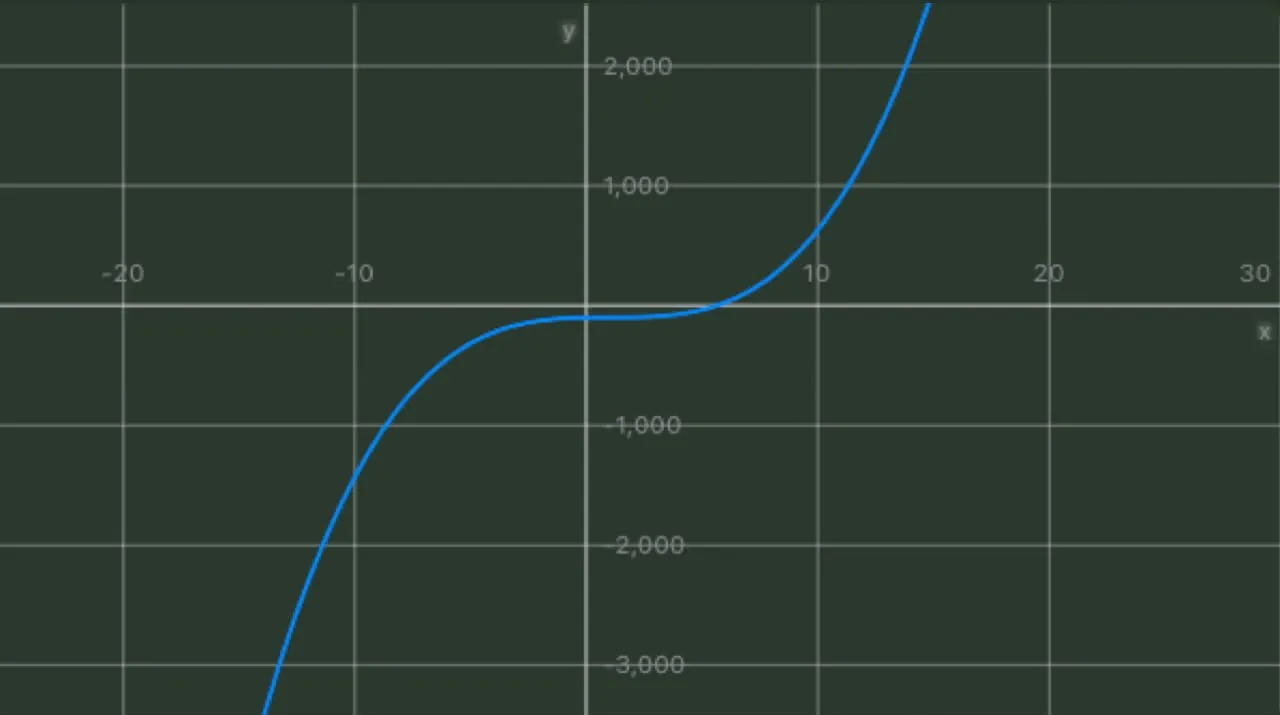
Graph / Figure
›
Complete Solution
›
-
Given — \[f(x)=3x+17\]
- Let \(x_1\) and \(x_2\) be any two real numbers such that\[x_1 < x_2\].
- Since \(3\) is a positive number, multiplying both sides of the inequality by \(3\) does not change the direction of the inequality:\[3x_1 < 3x_2\]
- Adding \(17\) to both sides gives\[3x_1+17 < 3x_2+17\]
- Now, from the definition of the function,\[f(x_1)=3x_1+17\]and\[f(x_2)=3x_2+17\]
- Therefore,\[f(x_1) < f(x_2)\]
- Hence,\[x_1 < x_2\Rightarrow f(x_1) < f(x_2)\]
- This satisfies the definition of an increasing function. Therefore,\[\boxed{f(x)=3x+17\text{ is increasing on }\mathbb{R}.}\]
Final Answer
›
The function \(f(x)=3x+17\) is increasing on \(\mathbb{R}\) because for any two real numbers \(x_1\) and \(x_2\) such that \(x_1 < x_2\), we have
This conclusion is drawn directly from the definition of an increasing function, and it is also supported by the fact that the derivative \(f'(x)=3>0\) for all \(x\in\mathbb{R}\).
Exam Significance
›
This question tests the fundamental concept of increasing functions, which is an important part of the Applications of Derivatives chapter. In board examinations, such questions can be used to test whether a student understands the mathematical definition of increasing behaviour rather than merely applying a derivative formula.
A complete answer should explicitly state
The derivative method is also important because questions may ask students to determine intervals of increase and decrease for more complicated functions. The central criterion is
Significance for Competitive Entrance Examinations
For JEE Main, JEE Advanced and other entrance examinations, the concept of monotonicity is frequently used in problems involving derivatives, inequalities, number of roots, extrema and the behaviour of functions.
For a linear function
Therefore, recognising that the coefficient of \(x\) is positive can provide a very quick solution in objective and multiple-choice questions.
Common Mistakes
›
When multiplying an inequality by a number, always check its sign. Here, \(3>0\), so
Another common mistake is to write
Key Takeaways
›
-
An increasing function satisfies \(x_1 < x_2\Rightarrow f(x_1) < f(x_2)\).
-
For \(f(x)=3x+17\), the coefficient of \(x\) is positive.
-
The derivative is \(f'(x)=3\).
-
Since \(f'(x)>0\) for every \(x\in\mathbb{R}\), the function is strictly increasing on \(\mathbb{R}\).
-
The graph of an increasing function rises from left to right.
-
For a linear function \(ax+b\), \(a>0\) implies increasing behaviour and \(a<0\) implies decreasing behaviour.
-
The definition-based proof is especially useful for establishing the fundamental meaning of monotonicity.
-
The derivative test provides a faster method for more complex functions encountered in board and competitive examinations.
![Graph of function \(y=\left[x(x-2)\right]^2\)](/images/maths/ex-6.2-q8.webp)