Ch 6  ·  Q–
0%
Chapter 6 Miscellaneous Exercise Solutions

Application of Derivatives

Step-by-Step Solutions to the NCERT Class 12 Mathematics Chapter 6 Miscellaneous Exercise

Class 12 Mathematics Miscellaneous Exercise NCERT Solutions Application of Derivatives Class 12 Mathematics Chapter 6 CBSE Board Exam JEE Main JEE Advanced CUET Rate of Change Increasing and Decreasing Functions Local Maxima and Minima Absolute Maximum and Minimum Optimization Problems Maximum and Minimum Values First Derivative Test Second Derivative Test Related Rates Maximum Volume Minimum and Maximum Area
16 Questions
35–50 min Ideal time
Q1 Now at
Q1
LONG ANSWER4 marks
Show that the function \[f(x)=\frac{\log x}{x}\] has a maximum at \(x=e\).
📘 Concept & Theory
Theory and Concept
›

The first derivative of a differentiable function helps us identify its critical points and determine the intervals on which the function increases or decreases. The second derivative test helps us classify a stationary point as a local maximum or a local minimum.

For a function \(f(x)\), the necessary condition for a stationary point is

\[ f'(x)=0 \]

If \(f'(a)=0\) and \(f''(a)<0\), then \(f(x)\) has a local maximum at \(x=a\), provided the second derivative exists there.

In this question,

\[ f(x)=\frac{\log x}{x} \]

Here, \(\log x\) denotes the natural logarithm \(\ln x\), as is customary in calculus when the logarithm appears without an explicitly stated base. The domain of the function is \(x>0\).

We will first find the stationary point by differentiating the function and then use the second derivative test to establish that the function has a maximum at \(x=e\). We will also determine the maximum value of the function.

🗺️ Solution Roadmap
Step-by-step Plan
›
  1. Identify the domain of the given function.

  2. Differentiate the function using the product rule or quotient rule.

  3. Equate the first derivative to zero to find the stationary point.

  4. Calculate the second derivative carefully.

  5. Evaluate the second derivative at the stationary point.

  6. Use the second derivative test to establish the maximum.

  7. Calculate the maximum value of the function.

📊 Graph / Figure
Graph / Figure
›

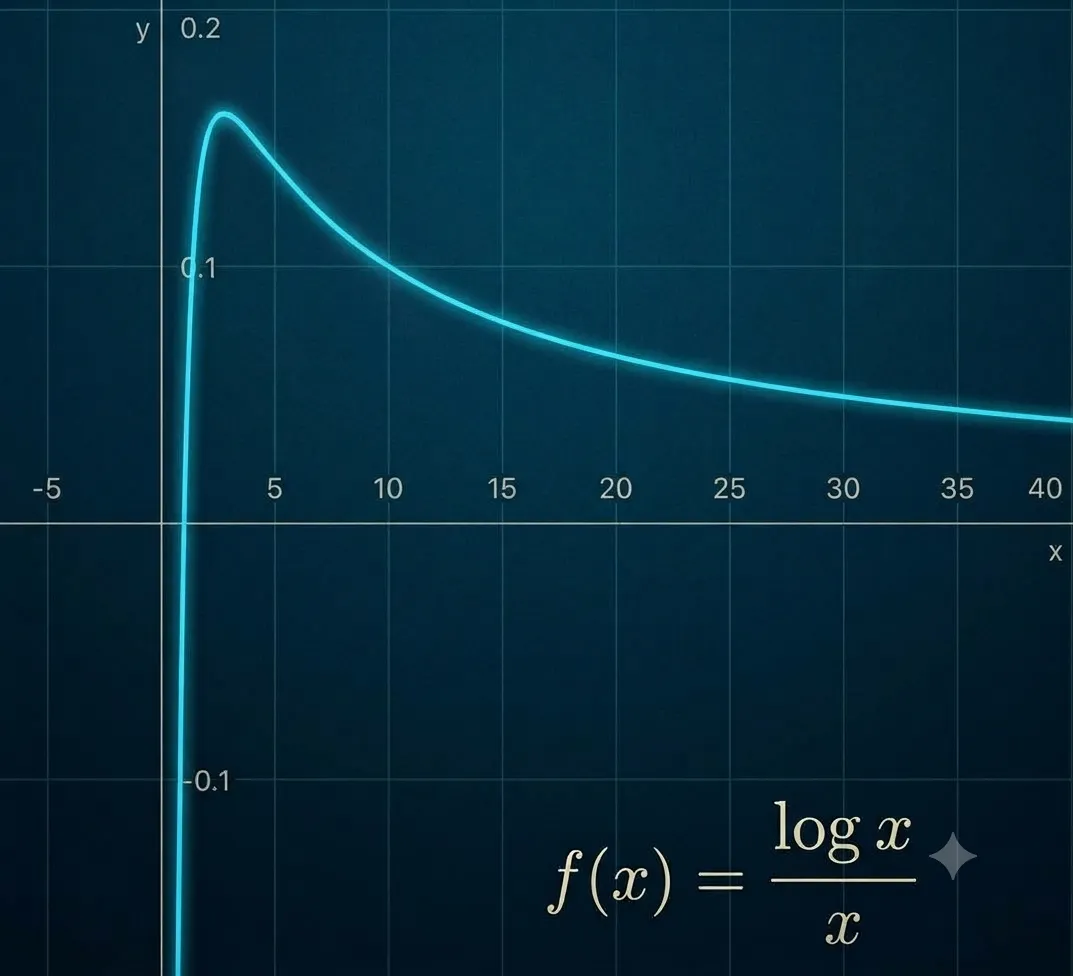
The graph of \(f(x)=\dfrac{\log x}{x}\) provides a visual interpretation of the maximum. The function increases for \(0e\). Its maximum point is \(\left(e,\dfrac{1}{e}\right)\).

The function reaches its maximum at \(x=e\), where \(f(e)=1/e\)
The function reaches its maximum at \(x=e\), where \(f(e)=1/e\).
Graphical Interpretation
✏️ Solution
Complete Solution
›
Step-by-step Solution  ·  25 steps
  1. Write the given function and determine its domain.
  2. Given —
    \[f(x)=\frac{\log x}{x}\]
  3. Since the logarithm is defined only for positive real numbers, we require
    \[x>0\]
    Therefore, the domain of the function is \((0,\infty)\).
  4. Find the first derivative.
  5. Rewrite the function using the laws of exponents:
    \[f(x)=(\log x)x^{-1}\]
  6. Using the product rule,
    \[\frac{d}{dx}[u(x)v(x)]=u'(x)v(x)+u(x)v'(x)\]
  7. Take
    \[u(x)=\log x,\qquad v(x)=x^{-1}\]
  8. Their derivatives are
    \[u'(x)=\frac{1}{x}\]
    \[v'(x)=-x^{-2}=-\frac{1}{x^2}\]
  9. Applying the product rule, we obtain
    \[ \begin{aligned} f'(x) &=\frac{1}{x}\cdot x^{-1} +(\log x)(-x^{-2})\\[6pt] &=x^{-2}-(\log x)x^{-2}\\[6pt] &=\frac{1}{x^2}-\frac{\log x}{x^2}\\[6pt] &=\frac{1-\log x}{x^2} \end{aligned} \]
  10. Hence, the first derivative is
    \[\boxed{f'(x)=\frac{1-\log x}{x^2}}\]
  11. Find the stationary point.
  12. For a stationary point, set the first derivative equal to zero:
    \[f'(x)=0\]
  13. Substituting the derivative,
    \[\frac{1-\log x}{x^2}=0\]
  14. Since \(x>0\), the denominator \(x^2\) is strictly positive and cannot be zero. Therefore, the numerator must be zero:
    \[1-\log x=0\]
  15. Rearranging,
    \[\log x=1\]
  16. Taking the natural logarithm into exponential form gives
    \[x=e^1\]
  17. Therefore, the only stationary point is
    \[\boxed{x=e}\]
  18. Find the second derivative.
  19. We have already obtained
    \[f'(x)=\frac{1-\log x}{x^2}\]
  20. Rewrite this expression as
    \[f'(x)=(1-\log x)x^{-2}\]
  21. Differentiate using the product rule:
    \[ \begin{aligned} f''(x) &=\frac{d}{dx}(1-\log x)\cdot x^{-2}\\ &\quad +(1-\log x)\frac{d}{dx}(x^{-2}) \end{aligned} \]
  22. Now,
    \[\frac{d}{dx}(1-\log x)=-\frac{1}{x}\]
    and
    \[\frac{d}{dx}(x^{-2})=-2x^{-3}\]
  23. Substituting these derivatives,
    \[ \begin{aligned} f''(x) &=\left(-\frac{1}{x}\right)x^{-2} +(1-\log x)(-2x^{-3})\\[6pt] &=-x^{-3}-2(1-\log x)x^{-3}\\[6pt] &=-\frac{1}{x^3} -\frac{2-2\log x}{x^3}\\[6pt] &=\frac{-1-2+2\log x}{x^3}\\[6pt] &=\frac{2\log x-3}{x^3} \end{aligned} \]
  24. Thus, the correct second derivative is
    \[\boxed{f''(x)=\frac{2\log x-3}{x^3}}\]
  25. Apply the second derivative test at \(x=e\).
  26. We found the stationary point \(x=e\). Substituting \(x=e\) into the second derivative,
    \[f''(e)=\frac{2\log e-3}{e^3}\]
  27. Since \(\log e=1\),
    \[ \begin{aligned} f''(e) &=\frac{2(1)-3}{e^3}\\[6pt] &=\frac{2-3}{e^3}\\[6pt] &=-\frac{1}{e^3} \end{aligned} \]
  28. As \(e^3>0\), we have
    \[f''(e)=-\frac{1}{e^3} < 0\]
  29. Therefore, by the second derivative test, the function has a local maximum at \(x=e\)
    \[\boxed{\text{The function has a maximum at }x=e}\]
  30. Find the maximum value.
  31. To calculate the maximum value, substitute \(x=e\) into the original function:
    \[f(e)=\frac{\log e}{e}\]
  32. Since \(\log e=1\),
    \[f(e)=\frac{1}{e}\]
  33. Hence, the maximum value of the function is
    \[\boxed{f_{\max}=\frac{1}{e}}\]
💡 Answer
Final Answer
›
The function has a maximum at \(x=e\), and its maximum value is
\[ \boxed{\frac{1}{e}} \]
🎯 Exam Significance
Exam Significance
›
  • Application of derivatives: This problem tests the use of derivatives to determine the maximum of a function.
  • Differentiation skills: It assesses the product rule and the differentiation of logarithmic and power functions.
  • Second derivative test: Students must demonstrate that a stationary point is a maximum by showing that the second derivative is negative at that point.
  • Stepwise presentation: Writing the first derivative, solving \(f'(x)=0\), calculating \(f''(x)\), and substituting the critical point makes the proof complete and easier to evaluate.
  • Maximum value versus maximum point: The point occurs at \(x=e\), while the maximum function value is \(1/e\). Distinguishing these two quantities avoids a common examination error.
Significance for Competitive Entrance Examinations
  • JEE Main and Advanced: The problem reinforces stationary points, logarithmic differentiation, monotonicity, and the classification of extrema. Similar techniques can appear in questions involving parameter values or inequalities.
  • Other engineering entrance examinations: The first derivative test can be useful for identifying increasing and decreasing intervals without calculating the second derivative.
  • Objective problem-solving: Recognising that \(x^2\) is positive throughout the domain makes the sign analysis of \(f'(x)\) faster and more reliable.
  • Advanced applications: The same optimisation procedure is applicable to functions involving logarithms, exponentials, rational expressions, and products of elementary functions.
🔑 Key Takeaways
Key Takeaways
›
Key Takeaways  ·  7 points
  1. The domain of \(f(x)=\dfrac{\log x}{x}\) is \(x>0\).

  2. The first derivative is \(\displaystyle f'(x)=\frac{1-\log x}{x^2}\).

  3. Setting \(f'(x)=0\) gives the stationary point \(x=e\).

  4. The correct second derivative is \(\displaystyle f''(x)=\frac{2\log x-3}{x^3}\).

  5. Since \(\displaystyle f''(e)=-\frac{1}{e^3}<0\), the second derivative test establishes a local maximum at \(x=e\).

  6. The first derivative changes from positive to negative at \(x=e\), proving that this is also the global maximum on \((0,\infty)\).

  7. The maximum point is \(\displaystyle \left(e,\frac{1}{e}\right)\), and the maximum value is \(\displaystyle \frac{1}{e}\).
↑ Top
1 / 16  ·  6%
Q2 →
Q2
LONG ANSWER4 marks
Two equal sides of an isosceles triangle with a fixed base \(b\) are decreasing at the rate of \(3\text{ cm/s}\). How fast is the area decreasing when the two equal sides are equal to the base?
📘 Concept & Theory
Theory and Concept
›

This problem is based on related rates, an important application of derivatives. In related-rate problems, two or more quantities change with time, and differentiation is used to determine the rate of change of one quantity in terms of the rate of change of another.

Let the length of each equal side of the isosceles triangle be \(x\), and let its fixed base be \(b\). Since the equal sides are decreasing at \(3\text{ cm/s}\), the rate of change of \(x\) with respect to time is negative:

\[ \boxed{\frac{dx}{dt}=-3\text{ cm/s}} \]

The negative sign indicates that the side length is decreasing.

The area of a triangle is

\[ A=\frac{1}{2}\times\text{base}\times\text{height} \]

To express the area in terms of \(x\), we use the Pythagorean theorem. Drawing a perpendicular from the vertex opposite the base bisects the base into two equal parts, each of length \(b/2\). Thus, the height \(h\) satisfies

\[ x^2=h^2+\left(\frac{b}{2}\right)^2 \]

Therefore,

\[ h=\sqrt{x^2-\frac{b^2}{4}} \]

Consequently, the area is

\[ A=\frac{b}{2}\sqrt{x^2-\frac{b^2}{4}} \]

Since \(b\) is constant, differentiating this expression with respect to time will give the required relationship between the rate of change of the area and the rate of change of the equal sides.

🗺️ Solution Roadmap
Step-by-step Plan
›
  1. Let each equal side be \(x\) and the fixed base be \(b\).

  2. Use the Pythagorean theorem to find the height of the triangle.

  3. Express the area \(A\) as a function of \(x\), keeping \(b\) constant.

  4. Differentiate the area with respect to time using the chain rule.

  5. Substitute the given rate \(\frac{dx}{dt}=-3\text{ cm/s}\).

  6. Use the condition \(x=b\) to calculate the instantaneous rate of change of the area.

  7. Interpret the sign and state the final answer with correct units.

📊 Graph / Figure
Graph / Figure
›
Isosceles triangle with equal sides x and fixed base b An isosceles triangle has two equal sides labelled x, a horizontal base labelled b, and a perpendicular height h drawn from the top vertex to the midpoint of the base. The base is split into two equal segments labelled b over 2. x x b h b/2 b/2 A C B Base AB = b (fixed)
Geometry used to relate the changing side length to the triangle's height and area. The diagram is designed for a deep sea blue page theme.
Diagram: Isosceles Triangle with Fixed Base
✏️ Solution
Complete Solution
›
Step-by-step Solution  ·  23 steps
  1. Define the variables
  2. Let \(x\) be the length of each equal side, \(b\) be the fixed base, \(h\) be the perpendicular height, and \(A\) be the area of the isosceles triangle.
  3. Given —
    \[\frac{dx}{dt}=-3\text{ cm/s}\]
  4. We need to find \(\frac{dA}{dt}\) at the instant when \(x=b\)
  5. Find the height using the Pythagorean theorem.
  6. The perpendicular drawn from the vertex to the base divides the isosceles triangle into two congruent right-angled triangles. In each right triangle, the hypotenuse is \(x\), one leg is \(b/2\), and the other leg is \(h\).
    \[x^2=h^2+\left(\frac{b}{2}\right)^2\]
  7. Rearranging,
    \[ \begin{aligned} h^2&=x^2-\left(\frac{b}{2}\right)^2\\[5pt] &=x^2-\frac{b^2}{4} \end{aligned} \]
  8. Taking the positive square root because the height is positive,
    \[\boxed{h=\sqrt{x^2-\frac{b^2}{4}}}\]
  9. Express the area in terms of \(x\).
  10. The area of the triangle is
    \[A=\frac{1}{2}bh\]
  11. Substituting the expression for \(h\),
    \[A=\frac{1}{2}b\sqrt{x^2-\frac{b^2}{4}}\]
  12. Hence, the area as a function of the equal side \(x\) is
    \[\boxed{A=\frac{b}{2}\sqrt{x^2-\frac{b^2}{4}}}\]
    Notice that \(b\) is constant, whereas \(x\), \(h\), and \(A\) vary with time.
  13. Differentiate the area with respect to time.
  14. Starting with
    \[A=\frac{b}{2}\left(x^2-\frac{b^2}{4}\right)^{1/2}\]
  15. Differentiate both sides with respect to \(t\). Since \(b\) is constant, we use the chain rule:
    \[ \begin{aligned} \frac{dA}{dt} &=\frac{b}{2}\cdot\frac{1}{2} \left(x^2-\frac{b^2}{4}\right)^{-1/2} \frac{d}{dt}\left(x^2-\frac{b^2}{4}\right) \end{aligned} \]
  16. Now,
    \[ \frac{d}{dt}\left(x^2-\frac{b^2}{4}\right) =2x\frac{dx}{dt} \]
    because \(b\) is constant and \(x\) depends on time.
  17. Substituting this derivative,
    \[ \begin{aligned} \frac{dA}{dt} &=\frac{b}{4} \left(x^2-\frac{b^2}{4}\right)^{-1/2} \cdot 2x\frac{dx}{dt}\\[6pt] &=\frac{bx}{2} \left(x^2-\frac{b^2}{4}\right)^{-1/2} \frac{dx}{dt} \end{aligned} \]
  18. Using the positive square-root form, we obtain
    \[ \boxed{ \frac{dA}{dt} =\frac{bx}{2\sqrt{x^2-\frac{b^2}{4}}} \frac{dx}{dt} } \]
  19. Substitute the given rate of decrease.
  20. The equal sides decrease at \(3\text{ cm/s}\), so
    \[\frac{dx}{dt}=-3\text{ cm/s}\]
  21. Therefore,
    \[ \frac{dA}{dt} =\frac{bx}{2\sqrt{x^2-\frac{b^2}{4}}}(-3) \]
  22. Thus,
    \[ \boxed{ \frac{dA}{dt} =-\frac{3bx}{2\sqrt{x^2-\frac{b^2}{4}}} } \]
  23. Evaluate the rate when the equal sides are equal to the base.
  24. At the required instant, \(x=b\)
  25. Substituting \(x=b\) into the rate equation,
    \[ \left.\frac{dA}{dt}\right|_{x=b} =-\frac{3b(b)}{2\sqrt{b^2-\frac{b^2}{4}}} \]
  26. Simplifying the expression inside the square root,
    \[ \begin{aligned} b^2-\frac{b^2}{4} &=\frac{4b^2-b^2}{4}\\[5pt] &=\frac{3b^2}{4} \end{aligned} \]
  27. Therefore,
    \[ \left.\frac{dA}{dt}\right|_{x=b} =-\frac{3b^2}{2\sqrt{\frac{3b^2}{4}}} \]
  28. Since \(b\) represents a positive length, \(b>0\), and hence
    \[\sqrt{\frac{3b^2}{4}}=\frac{b\sqrt{3}}{2}\]
  29. Substituting,
    \[ \begin{aligned} \left.\frac{dA}{dt}\right|_{x=b} &=-\frac{3b^2}{2\left(\frac{b\sqrt{3}}{2}\right)}\\[7pt] &=-\frac{3b^2}{b\sqrt{3}}\\[7pt] &=-\frac{3b}{\sqrt{3}}\\[7pt] &=-\sqrt{3}\,b \end{aligned} \]
  30. Therefore, the instantaneous rate of change of the area is
    \[\boxed{\frac{dA}{dt}=-\sqrt{3}\,b\text{ cm}^2/\text{s}}\]
    The negative sign indicates that the area is decreasing. Thus, the rate of decrease of the area
💡 Answer
Final Answer
›

When the two equal sides of the isosceles triangle are equal to its fixed base \(b\), the area decreases at the rate

\[ \boxed{\sqrt{3}\,b\text{ cm}^2/\text{s}} \]
🎯 Exam Significance
Exam Significance
›
  • Related rates: This problem tests the application of differentiation to quantities that vary with time.
  • Geometrical modelling: Students must use the Pythagorean theorem to express the height in terms of the equal side and the fixed base.
  • Chain rule: Differentiating with respect to time requires the factor \(\frac{dx}{dt}\), since \(x\) is a function of time.
  • Sign convention: A decreasing side length has a negative derivative. Consequently, the area derivative must also be negative while the triangle remains non-degenerate.
  • Units: The final rate of change of area must be expressed in \(\text{cm}^2/\text{s}\), not \(\text{cm}/\text{s}\).
  • Algebraic accuracy: Correct simplification of the square root is essential to obtain the factor \(\sqrt{3}\).
Significance for Competitive Entrance Examinations
  • JEE Main and Advanced: Related-rate questions combine geometry, the chain rule, and algebraic simplification. This example provides practice in all three.
  • Mathematical modelling: The key skill is converting a geometric constraint into an equation before differentiating.
  • Sign-based reasoning: Distinguishing a rate of change from a rate of decrease prevents sign errors in numerical and multiple-choice questions.
  • Generalisation: The same method applies to changing areas of circles, expanding or contracting solids, and other geometric quantities.
  • Dimensional analysis: Checking that the final units are area per unit time is a useful way to identify mistakes.
🔑 Key Takeaways
Key Takeaways
›
Key Takeaways  ·  7 points
  1. The equal side length is \(x\), the fixed base is \(b\), and the height is \(h=\sqrt{x^2-\frac{b^2}{4}}\).

  2. The correct area formula is \(\displaystyle A=\frac{b}{2}\sqrt{x^2-\frac{b^2}{4}}\).

  3. The side length is decreasing, so \(\displaystyle \frac{dx}{dt}=-3\text{ cm/s}\).

  4. Differentiating with respect to time gives \(\displaystyle \frac{dA}{dt}=\frac{bx}{2\sqrt{x^2-\frac{b^2}{4}}}\frac{dx}{dt}\).

  5. At the instant \(x=b\), the signed rate of change is \(\displaystyle -\sqrt{3}b\text{ cm}^2/\text{s}\).

  6. The positive rate of decrease of the area is \(\displaystyle \sqrt{3}b\text{ cm}^2/\text{s}\).

  7. The negative sign describes the direction of change; the magnitude describes how fast the area is decreasing.

← Q1
2 / 16  ·  13%
Q3 →
Q3
LONG ANSWER4 marks
Find the intervals in which the function \(f(x)=\frac{4\sin x-2x-x\cos x}{2+\cos x}\) is
  1. Increasing
  2. Decreasing
📘 Concept & Theory
Theory and Concept
›

A function is increasing on an interval if its derivative is non-negative throughout that interval, and decreasing if its derivative is non-positive throughout that interval. In particular, the sign of the first derivative determines the intervals of strict increase and strict decrease when the derivative is strictly positive or strictly negative, respectively.

The first derivative tests are summarised as follows:

  • If \(f'(x)>0\), the function is strictly increasing.
  • If \(f'(x)<0\), the function is strictly decreasing.
  • If \(f'(x)=0\) at isolated points, these points may separate intervals of increase and decrease.

For the given function, we will use the quotient rule:

\[ \left(\frac{u}{v}\right)' =\frac{vu'-uv'}{v^2},\quad v\ne 0 \]

After differentiating, the main task is to simplify \(f'(x)\) and determine its sign. Notice that

\[ 2+\cos x\ge 2-1=1>0 \]

Therefore, the denominator of the original function is always positive, and the function is defined for every real number. This observation also ensures that the denominator \( (2+\cos x)^2 \) in the derivative is always positive. Hence, the sign of \(f'(x)\) is determined entirely by the numerator of the simplified derivative.

🗺️ Solution Roadmap
Step-by-step Plan
›
  1. Identify the numerator and denominator of the given function.

  2. Differentiate both using the product rule and standard trigonometric derivatives.

  3. Apply the quotient rule to find \(f'(x)\).

  4. Simplify the derivative carefully, using trigonometric identities.

  5. Determine the sign of the simplified derivative.

  6. State the intervals of increase and decrease.

📊 Graph / Figure
Graph / Figure
›
Sign pattern for the derivative of the function The derivative is positive between minus pi over two and pi over two, negative between pi over two and three pi over two, and positive again between three pi over two and five pi over two. Sign of f′(x) Positive Negative Positive −π/2 π/2 3π/2 5π/2 f′(x) > 0: increasing f′(x) < 0: decreasing Repeat the pattern every 2π.
Derivative sign pattern for one period and its neighbouring intervals. The endpoints are stationary points and are excluded from the open intervals of strict increase and decrease.
Sign Pattern of the Derivative
✏️ Solution
Complete Solution
›
Step-by-step Solution  ·  30 steps
  1. Given —
    \[f(x)=\frac{4\sin x-2x-x\cos x}{2+\cos x}\]
  2. Let
    \[u=4\sin x-2x-x\cos x\]
    and
    \[v=2+\cos x\]
  3. Differentiate the numerator.
  4. We have
    \[u=4\sin x-2x-x\cos x\]
  5. Differentiating term by term,
    \[u'=4\cos x-2-\frac{d}{dx}(x\cos x)\]
  6. Using the product rule,
    \[ \frac{d}{dx}(x\cos x) =x(-\sin x)+\cos x \]
  7. Therefore,
    \[ \begin{aligned} u' &=4\cos x-2-(-x\sin x+\cos x)\\[5pt] &=4\cos x-2+x\sin x-\cos x\\[5pt] &=3\cos x+x\sin x-2 \end{aligned} \]
  8. Thus,
    \[\boxed{u'=3\cos x+x\sin x-2}\]
  9. Differentiate the denominator.
    \[v=2+\cos x\]
  10. Hence,
    \[\boxed{v'=-\sin x}\]
  11. Apply the quotient rule
  12. Using
    \[f'(x)=\frac{vu'-uv'}{v^2}\]
  13. we obtain
    \[ f'(x)= \frac{(2+\cos x)(3\cos x+x\sin x-2) -(4\sin x-2x-x\cos x)(-\sin x)} {(2+\cos x)^2} \]
  14. Since subtracting a negative expression is equivalent to adding the corresponding positive expression,
    \[ f'(x)= \frac{(2+\cos x)(3\cos x+x\sin x-2) +(4\sin x-2x-x\cos x)\sin x} {(2+\cos x)^2} \]
  15. Expand and simplify the numerator
  16. First, expand the product:
    \[ \begin{aligned} &(2+\cos x)(3\cos x+x\sin x-2)\\[5pt] &=6\cos x+2x\sin x-4\\ &\quad+3\cos^2 x+x\sin x\cos x-2\cos x\\[5pt] &=4\cos x+2x\sin x-4\\ &\quad+3\cos^2 x+x\sin x\cos x \end{aligned} \]
  17. Next, expand the remaining product:
    \[ \begin{aligned} &(4\sin x-2x-x\cos x)\sin x\\[5pt] &=4\sin^2 x-2x\sin x-x\sin x\cos x \end{aligned} \]
  18. Adding the two expressions, the terms \(2x\sin x\) and \(-2x\sin x\) cancel. Similarly, the terms \(x\sin x\cos x\) and \(-x\sin x\cos x\) cancel.
  19. \[ \begin{aligned} &4\cos x+2x\sin x-4 +3\cos^2 x+x\sin x\cos x\\ &\quad+4\sin^2 x-2x\sin x-x\sin x\cos x\\[5pt] &=4\cos x-4+3\cos^2 x+4\sin^2 x \end{aligned} \]
  20. Using the identity
    \[\sin^2 x=1-\cos^2 x\]
  21. we get
    \[ \begin{aligned} &4\cos x-4+3\cos^2 x+4\sin^2 x\\[5pt] &=4\cos x-4+3\cos^2 x+4(1-\cos^2 x)\\[5pt] &=4\cos x-4+3\cos^2 x+4-4\cos^2 x\\[5pt] &=4\cos x-\cos^2 x \end{aligned} \]
  22. Factorising,
    \[ 4\cos x-\cos^2 x =\cos x(4-\cos x) \]
  23. Therefore, the derivative simplifies to
    \[ \boxed{ f'(x)=\frac{\cos x(4-\cos x)}{(2+\cos x)^2} }\]
  24. Determine the sign of the derivative.
  25. We have
    \[f'(x)=\frac{\cos x(4-\cos x)}{(2+\cos x)^2}\]
  26. Since \(-1\le \cos x\le 1\),
    \[3\le 4-\cos x\le 5\]
  27. Hence,
    \[4-\cos x>0\]
  28. Also,
    \[(2+\cos x)^2>0\]
  29. Consequently, the sign of \(f'(x)\) depends only on the sign of \(\cos x\).
  30. Case (i): Increasing intervals
  31. The function is strictly increasing wherever \(f'(x)>0\). Since the other factors in the derivative are positive, this condition becomes
    \[\cos x>0\]
  32. The cosine function is positive in the intervals
    \[ -\frac{\pi}{2}+2n\pi < x < \frac{\pi}{2}+2n\pi,\quad n\in\mathbb Z \]
  33. Therefore, the function is strictly increasing on
    \[ \boxed{ \left(-\frac{\pi}{2}+2n\pi,\, \frac{\pi}{2}+2n\pi\right), \quad n\in\mathbb Z } \]
  34. Case (ii): Decreasing intervals
  35. The function is strictly decreasing wherever \(f'(x) < 0\). This condition becomes
    \[\cos x < 0\]
  36. The cosine function is negative in the intervals
    \[ \frac{\pi}{2}+2n\pi < x < \frac{3\pi}{2}+2n\pi,\quad n\in\mathbb Z \]
  37. Therefore, the function is strictly decreasing on
    \[ \boxed{ \left(\frac{\pi}{2}+2n\pi,\, \frac{3\pi}{2}+2n\pi\right), \quad n\in\mathbb Z }\]
💡 Answer
Final Answer
›

(i) Increasing:

\[ \boxed{ \left(-\frac{\pi}{2}+2n\pi,\, \frac{\pi}{2}+2n\pi\right), \quad n\in\mathbb Z } \]

(ii) Decreasing:

\[ \boxed{ \left(\frac{\pi}{2}+2n\pi,\, \frac{3\pi}{2}+2n\pi\right), \quad n\in\mathbb Z } \]

where \(n\) is any integer.

🎯 Exam Significance
Exam Significance
›
  • Quotient rule: The question assesses the ability to differentiate a quotient of trigonometric expressions correctly.
  • Product rule: Differentiating \(x\cos x\) requires the product rule, which is a common source of errors.
  • Trigonometric simplification: Cancellation of terms and the identity \(\sin^2 x+\cos^2 x=1\) reduce a complicated derivative to a simple expression.
  • Increasing and decreasing intervals: Students must use the sign of the derivative to obtain the intervals, not merely solve \(f'(x)=0\).
  • Periodic intervals: Expressing the answer using \(n\in\mathbb Z\) captures all intervals on the real line.
Significance for Competitive Entrance Examinations
  • JEE Main and Advanced: The question combines differentiation, trigonometric identities, and interval analysis, making it useful practice for function-behaviour problems.
  • Efficient sign analysis: Once \(4-\cos x>0\) and \((2+\cos x)^2>0\) are established, only the sign of \(\cos x\) needs to be considered.
  • Periodic reasoning: Correct use of integer multiples of \(2\pi\) prevents answers from being restricted unnecessarily to one period.
  • Error prevention: Careful handling of the negative sign in the quotient rule and the derivative of \(x\cos x\) is essential for obtaining the correct result.
🔑 Key Takeaways
Key Takeaways
›
Key Takeaways  ·  7 points
  1. The function is defined for every real \(x\), because \(2+\cos x\ge 1\).

  2. The quotient rule gives the derivative, which simplifies to \(\displaystyle f'(x)=\frac{\cos x(4-\cos x)}{(2+\cos x)^2}\).

  3. The factor \(4-\cos x\) is always positive.

  4. The denominator \((2+\cos x)^2\) is always positive.

  5. Thus, the sign of \(f'(x)\) is determined solely by \(\cos x\).

  6. The function is increasing where \(\cos x>0\) and decreasing where \(\cos x<0\).

  7. The pattern repeats every \(2\pi\).

← Q2
3 / 16  ·  19%
Q4 →
Q4
LONG ANSWER4 marks
Find the intervals in which the function \(f(x)=x^3+\frac{1}{x^3},\qquad x\ne 0\)
📘 Concept & Theory
Theory and Concept
›

The first derivative of a function helps determine the intervals on which the function is increasing or decreasing. A differentiable function is strictly increasing on an interval if its derivative is positive throughout that interval. Similarly, it is strictly decreasing if its derivative is negative throughout the interval.

The relevant conditions are:

\[ \begin{aligned} f'(x)&>0 &&\Rightarrow \text{Increasing}\\ f'(x)&<0 &&\Rightarrow \text{Decreasing} \end{aligned} \]

For the given function, the domain is

\[ (-\infty,0)\cup(0,\infty) \]

We must exclude \(x=0\), where the function is undefined. We will find the first derivative, determine its critical points, and examine its sign on the intervals separated by those points and by \(x=0\).

Important concept: A point where \(f'(x)=0\) is a stationary point, but it is not automatically a maximum or minimum. To determine increasing and decreasing intervals, we must examine the sign of the first derivative on each relevant interval.

🗺️ Solution Roadmap
Step-by-step Plan
›
  1. Write the function and identify its domain.

  2. Differentiate using the power rule.

  3. Set \(f'(x)=0\) to find the stationary points.

  4. Divide the domain at the stationary points and the point \(x=0\).

  5. Determine the sign of \(f'(x)\) on each interval.

  6. State the intervals of increase and decrease.

📊 Graph / Figure
Graph / Figure
›
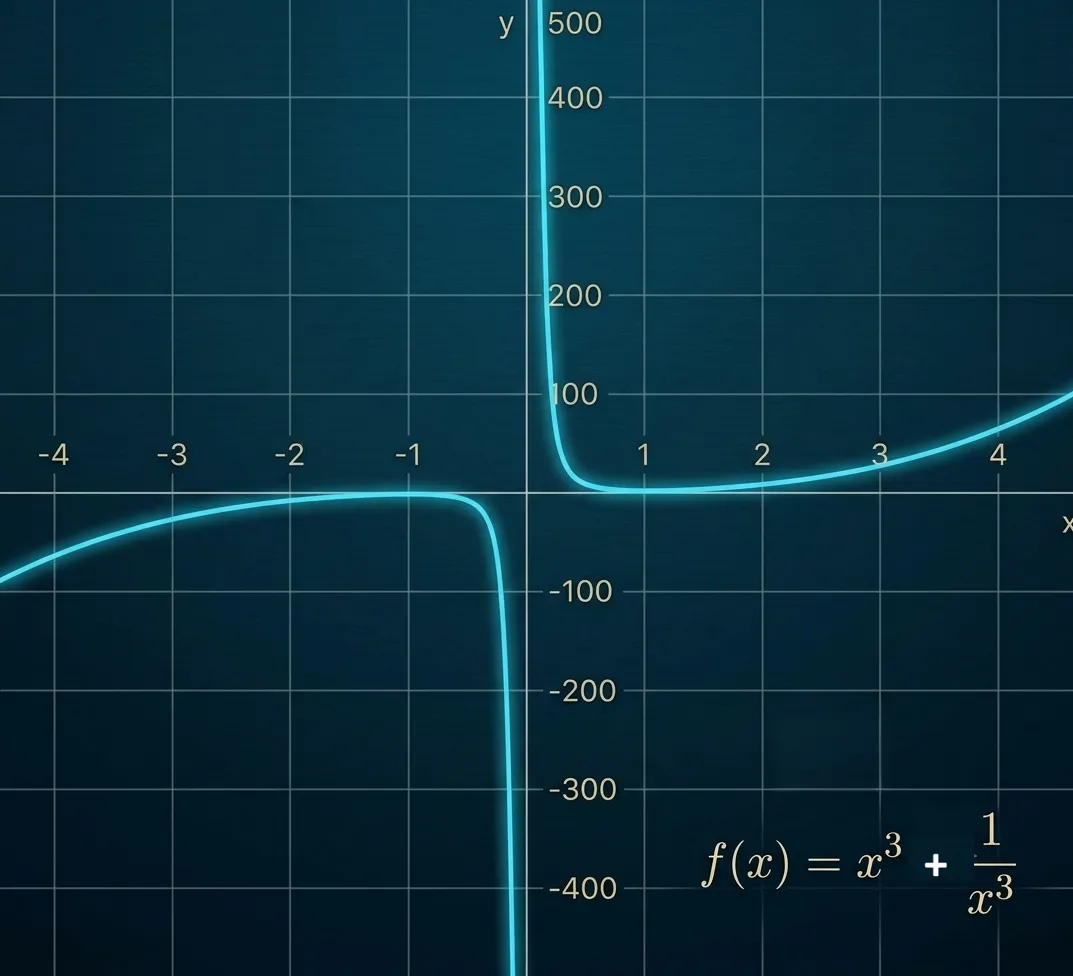
The function reaches its maximum at \(x=e\), where \(f(e)=1/e\)
The function reaches its maximum at \(x=e\), where \(f(e)=1/e\).
Graphical Interpretation
✏️ Solution
Complete Solution
›
Step-by-step Solution  ·  33 steps
  1. Given —
    \[f(x)=x^3+\frac{1}{x^3}\]
  2. Expressing the reciprocal term using a negative exponent,
    \[f(x)=x^3+x^{-3},\qquad x\ne 0\]
  3. Find the first derivative.
  4. Using the power rule,
    \[\frac{d}{dx}(x^n)=nx^{n-1}\]
  5. we obtain
    \[ \begin{aligned} f'(x) &=\frac{d}{dx}(x^3+x^{-3})\\[5pt] &=3x^2-3x^{-4}\\[5pt] &=3x^2-\frac{3}{x^4} \end{aligned} \]
  6. Taking \(3\) as a common factor
    \[\boxed{f'(x)=3\left(x^2-\frac{1}{x^4}\right)}\]
  7. Combining the terms over a common denominator gives
    \[ \begin{aligned} f'(x) &=3\left(\frac{x^6-1}{x^4}\right)\\[5pt] &=\frac{3(x^6-1)}{x^4} \end{aligned} \]
  8. Thus,
    \[\boxed{f'(x)=\frac{3(x^6-1)}{x^4}}\]
  9. Find the stationary points
  10. For stationary points, set
    \[f'(x)=0\]
  11. Therefore,
    \[\frac{3(x^6-1)}{x^4}=0\]
  12. Since \(x\ne 0\), the denominator \(x^4\) is positive and non-zero. Hence, the numerator must be zero:
    \[3(x^6-1)=0\]
  13. Dividing both sides by \(3\),
    \[x^6-1=0\]
    \[x^6=1\]
  14. Taking the real sixth roots,
    \[x=\pm 1\]
  15. Thus, the stationary points occur at
    \[\boxed{x=-1,\quad x=1}\]
  16. Identify the intervals to be tested.
  17. The domain excludes \(x=0\), and the stationary points are \(x=-1\) and \(x=1\). These points divide the domain into four intervals:
    \[(-\infty,-1),\quad (-1,0),\quad(0,1),\quad (1,\infty)\]
  18. Analyse the sign of the first derivative.
  19. Recall that
    \[f'(x)=\frac{3(x^6-1)}{x^4}\]
  20. For every \(x\ne 0\),
    \[x^4>0\]
  21. Also, \(3>0\). Therefore, the sign of \(f'(x)\) depends only on \(x^6-1\).
  22. Case I: When \(x < -1\)
  23. If \(x < -1\), then \(|x|>1\), so
    \[x^6>1\]
  24. Consequently,
    \[x^6-1>0\]
  25. Therefore,
    \[f'(x)>0\]
  26. Hence, the function is strictly increasing on
    \[\boxed{(-\infty,-1)}\]
  27. Case II: When \(-1 < x < 0\)
  28. If \(-1 < x < 0\), then \(|x| < 1\), so
    \[0 < x^6 < 1\]
  29. Therefore,
    \[x^6-1 < 0\]
  30. Consequently,
    \[f'(x) < 0\]
  31. Hence, the function is strictly decreasing on
    \[\boxed{(-1,0)}\]
  32. Case III: When \(0
  33. If \(0 < x < 1\), then
    \[0 < x^6 < 1\]
  34. Thus,
    \[x^6-1 < 0\]
  35. Therefore,
    \[f'(x) < 0\]
  36. Hence, the function is strictly decreasing on
    \[\boxed{(0,1)}\]
  37. Case IV: When \(x>1\)
  38. If \(x>1\), then
    \[x^6>1\]
  39. Therefore,
    \[x^6-1>0\]
  40. Consequently,
    \[f'(x)>0\]
  41. Hence, the function is strictly increasing on
    \[\boxed{(1,\infty)}\]
  42. First Derivative Sign Table
  43. Interval Sign of \(f'(x)\) Behaviour
    \((-\infty,-1)\) Positive Increasing
    \((-1,0)\) Negative Decreasing
    \((0,1)\) Negative Decreasing
    \((1,\infty)\) Positive Increasing
  44. Increasing and decreasing intervals of x cubed plus one over x cubed The function increases on the interval from negative infinity to negative one, decreases from negative one to zero and from zero to one, and increases from one to infinity. First derivative sign chart f′(x) = 3(x⁶ − 1)/x⁴ Increasing Decreasing Decreasing Increasing −1 0 excluded 1 f′(x) > 0: function increases f′(x) < 0: function decreases Analyse the negative and positive parts of the domain separately.
    Sign chart for the derivative, showing the four intervals separated by \(x=-1\), \(x=0\), and \(x=1\).
💡 Answer
Final Answer
›
🎯 Exam Significance
Exam Significance
›
Significance for Board Examinations
  • Power rule: The problem tests differentiation of positive and negative integer powers.
  • Critical points: Students must solve \(f'(x)=0\) accurately and identify the stationary points.
  • Domain awareness: Since the function is undefined at \(x=0\), the real line must be split into separate domain intervals.
  • First derivative test: The correct intervals are obtained by checking the sign of \(f'(x)\), not simply by listing the stationary points.
  • Presentation: A sign table and clearly stated interval notation make the solution easier to follow and assess.
Significance for Competitive Entrance Examinations
  • JEE Main and Advanced: This problem develops fluency in derivative sign analysis and function behaviour.
  • Efficient factorisation: Writing the derivative as \(\frac{3(x^6-1)}{x^4}\) makes its sign easier to analyse.
  • Domain restrictions: The point \(x=0\) is a discontinuity in the domain, so intervals cannot be combined across it without justification.
  • Local extrema: The derivative changes from positive to negative at \(x=-1\), and from negative to positive at \(x=1\). These sign changes indicate a local maximum at \(x=-1\) and a local minimum at \(x=1\).
  • Generalisation: The same procedure applies to rational functions and expressions involving negative powers.
🚫 Common Mistakes
Common Mistakes
›

(i) Increasing intervals:

\[ \boxed{(-\infty,-1)\cup(1,\infty)} \]

(ii) Decreasing intervals:

\[ \boxed{(-1,0)\cup(0,1)} \]
🔑 Key Takeaways
Key Takeaways
›
Key Takeaways  ·  7 points
  1. The domain is \((-\infty,0)\cup(0,\infty)\).

  2. The first derivative is \(\displaystyle f'(x)=\frac{3(x^6-1)}{x^4}\).

  3. The stationary points are \(x=-1\) and \(x=1\).

  4. The derivative is positive when \(|x|>1\).

  5. The derivative is negative when \(0<|x|<1\).

  6. The function is increasing on the two outer intervals and decreasing on the two inner intervals.

  7. The point \(x=0\) must remain excluded because the function is undefined there.

← Q3
4 / 16  ·  25%
Q5 →
Q5
LONG ANSWER4 marks
Find the maximum area of an isosceles triangle inscribed in the ellipse \[\frac{x^2}{a^2}+\frac{y^2}{b^2}=1\] with its vertex at one end of the major axis.
📘 Concept & Theory
Theory and Concept
›

This problem illustrates the application of derivatives to geometrical optimisation. We need to determine the dimensions of an isosceles triangle inscribed in an ellipse such that its area is as large as possible.

The standard equation of an ellipse is

\[ \frac{x^2}{a^2}+\frac{y^2}{b^2}=1 \]

Assuming \(a>b>0\), the major axis lies along the \(x\)-axis, and its endpoints are \((a,0)\) and \((-a,0)\). The triangle's vertex is fixed at one end of the major axis. By symmetry, we may take this vertex as \((a,0)\).

Let the other two vertices be symmetric about the \(x\)-axis. We can represent them as \((x,y)\) and \((x,-y)\), where \(y>0\). Since both points lie on the ellipse, their coordinates satisfy the ellipse equation.

The base of the triangle is the vertical segment joining \((x,y)\) and \((x,-y)\), so its length is \(2y\). The perpendicular distance from the vertex \((a,0)\) to the vertical base is \(a-x\). Therefore, the area is

\[ A=\frac{1}{2}(2y)(a-x) \]

Our task is to express this area in terms of a single variable, differentiate it, and find the value that gives the maximum area.

🗺️ Solution Roadmap
Step-by-step Plan
›
  1. Identify the endpoints of the major axis of the ellipse.

  2. Represent the triangle's vertices using symmetry.

  3. Use the ellipse equation to express \(y\) in terms of \(x\).

  4. Form an expression for the area of the triangle.

  5. Differentiate the area with respect to \(x\).

  6. Set the first derivative equal to zero to find the critical point.

  7. Use the second derivative test to establish the maximum.

  8. Substitute the critical point into the area expression to obtain the maximum area.

📊 Graph / Figure
Graph / Figure
›
Maximum-area isosceles triangle inscribed in an ellipse An ellipse with horizontal major axis. The triangle has its fixed vertex at the right endpoint of the major axis and its other vertices at x equals negative a over two, symmetric above and below the horizontal axis. x y O −a a C(a, 0) P(−a/2, y) Q(−a/2, −y) Base = 2y Height = 3a/2 Geometrically accurate diagram
The maximum-area triangle has its base on the vertical line \(x=-a/2\) and its vertex at \((a,0)\).
✏️ Solution
Complete Solution
›
Step-by-step Solution  ·  43 steps
  1. Identify the vertices of the triangle.
  2. The ellipse is given by
    \[\frac{x^2}{a^2}+\frac{y^2}{b^2}=1\]
  3. Since \(a>b>0\), the major axis is along the \(x\)-axis, and its endpoints are
    \[(a,0)\quad\text{and}\quad(-a,0)\]
  4. Without loss of generality, choose the fixed vertex of the triangle to be
    \[C=(a,0)\]
  5. Let the other two vertices be
    \[P=(x,y),\quad Q=(x,-y)\]
    These points are symmetric about the \(x\)-axis, as required for the triangle to be isosceles with its equal sides meeting at \(C\).
  6. Use the ellipse equation
  7. Since \(P=(x,y)\) lies on the ellipse,
    \[\frac{x^2}{a^2}+\frac{y^2}{b^2}=1\]
  8. Rearranging,
    \[\frac{y^2}{b^2}=1-\frac{x^2}{a^2}\]
  9. Taking a common denominator,
    \[\frac{y^2}{b^2}=\frac{a^2-x^2}{a^2}\]
  10. Multiplying both sides by \(b^2\),
    \[y^2=\frac{b^2(a^2-x^2)}{a^2}\]
  11. Since \(y>0\),
    \[\boxed{y=\frac{b}{a}\sqrt{a^2-x^2}}\]
  12. Form the area function
  13. The base \(PQ\) has endpoints \(P=(x,y)\) and \(Q=(x,-y)\). Its length is
    \[PQ=y-(-y)=2y\]
  14. The perpendicular distance from \(C=(a,0)\) to the vertical line \(x=x\) is \(a-x\). Hence, the area of the triangle is
    \[A=\frac{1}{2}\times PQ\times(a-x)\]
  15. Substituting \(PQ=2y\),
    \[A=\frac{1}{2}(2y)(a-x)\]
  16. Therefore,
    \[A=y(a-x)\]
  17. Now substitute \(y=\dfrac{b}{a}\sqrt{a^2-x^2}\)
    \[A=\frac{b}{a}(a-x)\sqrt{a^2-x^2}\]
  18. Using the identity
    \[a^2-x^2=(a-x)(a+x)\]
  19. we can write
    \[A=\frac{b}{a}(a-x)\sqrt{(a-x)(a+x)}\]
  20. For a non-degenerate triangle with its base between the fixed vertex and the centre, \(0\le x < a\). Thus \(a-x\ge0\), and we obtain
    \[A=\frac{b}{a}(a-x)^{3/2}(a+x)^{1/2}\]
  21. It is convenient to maximise \(A^2\) instead of \(A\), since \(A\ge0\) and squaring preserves the location of the maximum.
    \[A^2=\frac{b^2}{a^2}(a-x)^3(a+x)\]
  22. Hence, define
    \[\boxed{A^2=\frac{b^2}{a^2}(a-x)^3(a+x)}\]
  23. Differentiate the squared area
  24. Since \(a\) and \(b\) are constants, differentiate with respect to \(x\):
    \[\frac{d(A^2)}{dx}=\frac{b^2}{a^2}\frac{d}{dx}\left[(a-x)^3(a+x)\right]\]
  25. Using the product rule,
    \[ \begin{aligned} \frac{d(A^2)}{dx} &=\frac{b^2}{a^2} \left[ \frac{d}{dx}(a-x)^3\,(a+x) +(a-x)^3\frac{d}{dx}(a+x) \right] \end{aligned} \]
  26. By the chain rule,
    \[\frac{d}{dx}(a-x)^3=-3(a-x)^2\]
    and
    \[\frac{d}{dx}(a+x)=1\]
  27. Substituting,
    \[ \begin{aligned} \frac{d(A^2)}{dx} &=\frac{b^2}{a^2} \left[-3(a-x)^2(a+x)+(a-x)^3\right]\\[6pt] &=\frac{b^2}{a^2}(a-x)^2 \left[-3(a+x)+(a-x)\right]\\[6pt] &=\frac{b^2}{a^2}(a-x)^2 (-3a-3x+a-x)\\[6pt] &=\frac{b^2}{a^2}(a-x)^2(-2a-4x) \end{aligned} \]
  28. Taking \(-2\) as a common factor,
    \[\boxed{\frac{d(A^2)}{dx}=-\frac{2b^2}{a^2}(a-x)^2(a+2x)}\]
  29. Find the critical point.
  30. For a stationary point, set
    \[\frac{d(A^2)}{dx}=0\]
  31. Thus,
    \[-\frac{2b^2}{a^2}(a-x)^2(a+2x)=0\]
  32. Since \(a>0\) and \(b>0\), the constant factor \(-2b^2/a^2\) is non-zero. Hence,
    \[(a-x)^2(a+2x)=0\]
  33. This gives
    \[a-x=0\quad\text{or}\quad a+2x=0\]
  34. Therefore,
    \[x=a\quad\text{or}\quad x=-\frac{a}{2}\]
  35. The value \(x=a\) makes the base length zero and produces a degenerate triangle with area zero. The non-degenerate maximum therefore occurs at
    \[\boxed{x=-\frac{a}{2}}\]
  36. Verify that the area is maximum.
  37. Differentiate the expression for the first derivative of \(A^2\):
    \[ \frac{d(A^2)}{dx} =-\frac{2b^2}{a^2}(a-x)^2(a+2x) \]
  38. Using the product rule,
    \[ \begin{aligned} \frac{d^2(A^2)}{dx^2} &=-\frac{2b^2}{a^2} \frac{d}{dx}\left[(a-x)^2(a+2x)\right]\\[6pt] &=-\frac{2b^2}{a^2} \left[-2(a-x)(a+2x)+2(a-x)^2\right]\\[6pt] &=-\frac{4b^2}{a^2}(a-x) \left[-(a+2x)+(a-x)\right]\\[6pt] &=-\frac{4b^2}{a^2}(a-x)(-3x)\\[6pt] &=\frac{12b^2}{a^2}x(a-x) \end{aligned} \]
  39. At \(x=-a/2\),
    \[ \begin{aligned} \left.\frac{d^2(A^2)}{dx^2}\right|_{x=-a/2} &=\frac{12b^2}{a^2} \left(-\frac{a}{2}\right) \left(a+\frac{a}{2}\right)\\[6pt] &=\frac{12b^2}{a^2} \left(-\frac{a}{2}\right) \left(\frac{3a}{2}\right)\\[6pt] &=-9b^2 \end{aligned} \]
  40. Since \(b>0\),
  41. \[ \left.\frac{d^2(A^2)}{dx^2}\right|_{x=-a/2} =-9b^2<0 \]
  42. Therefore, \(A^2\) has a maximum at \(x=-a/2\). Because \(A\) is non-negative, the area \(A\) is also maximised at this point.
  43. Calculate the maximum area.
  44. Recall that
    \[A^2=\frac{b^2}{a^2}(a-x)^3(a+x)\]
  45. Substitute \(x=-a/2\):
    \[ A_{\max}^2 =\frac{b^2}{a^2} \left(a+\frac{a}{2}\right)^3 \left(a-\frac{a}{2}\right) \]
  46. Simplifying the factors,
    \[ A_{\max}^2 =\frac{b^2}{a^2} \left(\frac{3a}{2}\right)^3 \left(\frac{a}{2}\right) \]
  47. Since
    \[\left(\frac{3a}{2}\right)^3=\frac{27a^3}{8}\]
  48. we obtain
    \[ \begin{aligned} A_{\max}^2 &=\frac{b^2}{a^2} \cdot\frac{27a^3}{8}\cdot\frac{a}{2}\\[6pt] &=\frac{27a^4b^2}{16a^2}\\[6pt] &=\frac{27a^2b^2}{16} \end{aligned} \]
  49. Taking the positive square root because area is non-negative,
    \[A_{\max}=\sqrt{\frac{27a^2b^2}{16}}\]
  50. Therefore,
    \[\boxed{A_{\max}=\frac{3\sqrt{3}}{4}ab}\]
💡 Answer
Final Answer
›

The maximum area of the isosceles triangle inscribed in the ellipse

\[ \frac{x^2}{a^2}+\frac{y^2}{b^2}=1 \]

with its vertex at one end of the major axis is

\[ \boxed{\frac{3\sqrt{3}}{4}ab} \]

This maximum is attained when the fixed vertex is \((a,0)\) and the other two vertices have \(x\)-coordinate \(-a/2\).

🎯 Exam Significance
Exam Significance
›
  • Optimisation using derivatives: The problem tests the construction of an objective function and its maximisation using differentiation.
  • Coordinate geometry: Students must use the equation of the ellipse to relate the coordinates of the triangle's vertices.
  • Symmetry: Representing the base vertices as \((x,y)\) and \((x,-y)\) simplifies the geometry and ensures the triangle is isosceles.
  • Chain and product rules: The differentiation of the area expression involves algebraic powers and products.
  • Second derivative test: Showing that the second derivative is negative at the critical point establishes the maximum rigorously.
  • Exact result: Simplifying the final expression to \(\frac{3\sqrt{3}}{4}ab\) is important for a complete solution.
Significance for Competitive Entrance Examinations
  • JEE Main and Advanced: The problem combines conic sections, coordinate geometry, and differential calculus.
  • Choice of objective function: Maximising \(A^2\) instead of \(A\) simplifies the algebra without changing the location of the maximum, since \(A\ge0\).
  • Geometric constraints: Correctly representing the triangle's vertices and enforcing the ellipse equation are essential modelling skills.
  • Critical-point analysis: The candidate must distinguish a degenerate configuration from the non-degenerate maximum.
  • Generalisable technique: The same strategy applies to optimisation problems involving rectangles, triangles, and other shapes inscribed in conic sections.
🔑 Key Takeaways
Key Takeaways
›
Key Takeaways  ·  7 points
  1. For \(a>b>0\), the major axis of the ellipse lies along the \(x\)-axis.

  2. Choose the fixed vertex as \((a,0)\) and the symmetric base vertices as \((x,y)\) and \((x,-y)\).

  3. The ellipse equation gives \(\displaystyle y=\frac{b}{a}\sqrt{a^2-x^2}\).

  4. The area function is \(\displaystyle A=\frac{b}{a}(a-x)\sqrt{a^2-x^2}\).

  5. Maximising \(A^2\) gives the critical point \(x=-a/2\) for the non-degenerate maximum.

  6. The maximum triangle has base length \(\sqrt{3}b\) and height \(3a/2\).

  7. The maximum area is \(\displaystyle \frac{3\sqrt{3}}{4}ab\).

← Q4
5 / 16  ·  31%
Q6 →
Q6
LONG ANSWER4 marks
A tank with a rectangular base and rectangular sides, open at the top, is to be constructed so that its depth is \(2\text{ m}\) and its volume is \(8\text{ m}^3\). If building the tank costs ₹70 per square metre for the base and ₹45 per square metre for the sides, find the cost of the least expensive tank.
📘 Concept & Theory
Theory and Concept
›

This problem illustrates the application of derivatives to cost optimisation. We must determine the dimensions of an open rectangular tank that satisfies a fixed volume requirement while minimising the total construction cost.

The tank has a rectangular base, four rectangular vertical sides, and no top. The construction costs per unit area differ for the base and the sides, so their costs must be calculated separately.

The volume of a rectangular tank is

\[ V=lwh \]

where \(l\), \(w\), and \(h\) represent its length, width, and depth, respectively.

The area of its base is

\[ A_{\text{base}}=lw \]

The total area of its four sides is

\[ A_{\text{sides}}=2lh+2wh \]

The total construction cost is the sum of the cost of the base and the cost of the four sides.

\[ C=(\text{base area})(\text{base rate}) +(\text{side area})(\text{side rate}) \]

Since the volume and depth are fixed, the length and width cannot vary independently. We use the volume constraint to express one dimension in terms of the other, thereby reducing the cost function to a single variable. Differentiation then identifies the dimensions that minimise the cost.

🗺️ Solution Roadmap
Step-by-step Plan
›
  1. Let the length and width of the base be \(x\) metres and \(y\) metres.

  2. Use the fixed depth and volume to obtain a relation between \(x\) and \(y\).

  3. Calculate the base area and the total area of the four sides.

  4. Form the total cost function, accounting for the different construction rates.

  5. Use the volume constraint to express the cost in terms of one variable.

  6. Differentiate the cost function and solve \(C'(x)=0\).

  7. Verify that the critical point gives a minimum cost.

  8. Calculate the dimensions and substitute them into the cost function.

📊 Graph / Figure
Graph / Figure
›
Open rectangular tank with minimum-cost dimensions A three-dimensional illustration of an open-top rectangular tank. Its length, width, and depth are each two metres. The top is open, the base is highlighted in gold, and the four sides are highlighted in cyan. Open top Base: 2 m × 2 m 2 m 2 m 2 m Schematic illustration, not to scale
The top is open, so only the base and four vertical sides contribute to the construction cost.
Diagram: Open Rectangular Tank
✏️ Solution
Complete Solution
›
Step-by-step Solution  ·  47 steps
  1. Define the variables
  2. Let the length of the rectangular base be \(x\) metres and its width be \(y\) metres.
  3. The depth of the tank is fixed at
    \[h=2\text{ m}\]
  4. The volume is given as
    \[V=8\text{ m}^3\]
  5. Since the tank is open at the top, there is no cost associated with a top surface.
    Apply the volume constraint.
  6. The volume of a rectangular tank is
    \[V=lwh\]
  7. Substituting \(l=x\), \(w=y\), \(h=2\), and \(V=8\),
    \[8=x\cdot y\cdot 2\]
  8. Therefore,
    \[2xy=8\]
  9. Dividing both sides by \(2\),
    \[\boxed{xy=4}\]
  10. Hence, the width can be expressed in terms of the length as
    \[\boxed{y=\frac{4}{x}},\quad x>0\]
  11. Calculate the cost of the base
  12. The base is a rectangle with length \(x\) and width \(y\). Its area is
    \[A_{\text{base}}=xy\]
  13. The construction rate for the base is ₹70 per square metre. Therefore,
    \[ \begin{aligned} C_{\text{base}} &=70xy\\[4pt] &=70(4)\\[4pt] &=280 \end{aligned} \]
  14. Thus, the cost of the base is fixed at
    \[\boxed{C_{\text{base}}=\text{₹}280}\]
  15. Calculate the area and cost of the four sides.
  16. There are two sides of dimensions \(x\times 2\) and two sides of dimensions \(y\times 2\).
  17. The combined area of the two longer sides is
    \[A_1=2(x\cdot 2)=4x\]
  18. The combined area of the other two sides is
    \[A_2=2(y\cdot 2)=4y\]
  19. Therefore, the total area of the four sides is
    \[ \begin{aligned} A_{\text{sides}} &=A_1+A_2\\[4pt] &=4x+4y\\[4pt] &=4(x+y) \end{aligned} \]
  20. The cost of the sides is ₹45 per square metre. Hence,
    \[ \begin{aligned} C_{\text{sides}} &=45\times 4(x+y)\\[4pt] &=180(x+y) \end{aligned} \]
  21. Therefore,
    \[\boxed{C_{\text{sides}}=180(x+y)}\]
  22. Form the total cost function
  23. The total construction cost is
    \[C=C_{\text{base}}+C_{\text{sides}}\]
  24. Substituting the expressions obtained above,
    \[C=70xy+180(x+y)\]
  25. Using the constraint \(xy=4\),
    \[C=70(4)+180(x+y)\]
  26. Therefore,
    \[C=280+180(x+y)\]
  27. Now substitute \(y=\dfrac{4}{x}\):
    \[C=280+180\left(x+\frac{4}{x}\right)\]
  28. Combining the terms inside the parentheses,
    \[\boxed{C(x)=280+180\frac{x^2+4}{x}},\quad x>0\]
  29. Equivalently,
    \[C(x)=280+180x+\frac{720}{x}\]
  30. Differentiate the cost function
    \[C(x)=280+180x+\frac{720}{x}\]
  31. Differentiate with respect to \(x\):
    \[ \begin{aligned} C'(x) &=0+180-\frac{720}{x^2}\\[5pt] &=180-\frac{720}{x^2}\\[5pt] &=180\left(1-\frac{4}{x^2}\right) \end{aligned} \]
  32. Thus, the first derivative is
    \[\boxed{C'(x)=180\frac{x^2-4}{x^2}}\]
  33. Find the critical point.
  34. For a critical point, set the first derivative equal to zero:
    \[C'(x)=0\]
  35. Therefore,
    \[180\frac{x^2-4}{x^2}=0\]
  36. Since \(x>0\), the denominator \(x^2\) is non-zero. Hence,
    \[x^2-4=0\]
  37. Therefore,
    \[x^2=4\]
  38. Taking square roots gives
    \[x=\pm 2\]
  39. Since \(x\) represents a physical length and must be positive, we reject \(x=-2\). Thus,
    \[\boxed{x=2\text{ m}}\]
  40. Using the volume constraint \(xy=4\),
    \[2y=4\]
  41. Therefore,
    \[\boxed{y=2\text{ m}}\]
  42. The dimensions of the base are therefore \(2\text{ m}\times 2\text{ m}\), and the depth remains \(2\text{ m}\).
  43. Verify that the critical point gives a minimum.
  44. We have
    \[C'(x)=180-\frac{720}{x^2}\]
  45. Differentiating again,
    \[ \begin{aligned} C''(x) &=0+\frac{1440}{x^3} \end{aligned} \]
  46. Thus,
    \[\boxed{C''(x)=\frac{1440}{x^3}}\]
  47. At \(x=2\),
    \[ \begin{aligned} C''(2) &=\frac{1440}{2^3}\\[4pt] &=\frac{1440}{8}\\[4pt] &=180 \end{aligned} \]
  48. Therefore,
    \[C''(2)=180>0\]
  49. By the second derivative test, the cost function has a local minimum at \(x=2\).
  50. Furthermore, for \(x>0\), the second derivative is always positive:
    \[C''(x)=\frac{1440}{x^3}>0\]
  51. Hence, the cost function is strictly convex on its entire domain. The stationary point \(x=2\) is therefore the unique global minimum.
  52. Calculate the minimum cost
  53. The total cost function is
    \[C(x)=280+180\left(x+\frac{4}{x}\right)\]
  54. Substituting \(x=2\),
    \[ \begin{aligned} C_{\min} &=280+180\left(2+\frac{4}{2}\right)\\[6pt] &=280+180(2+2)\\[6pt] &=280+180(4)\\[6pt] &=280+720\\[6pt] &=1000 \end{aligned} \]
  55. Therefore, the minimum construction cost is
    \[\boxed{C_{\min}=\text{₹}1000}\]
💡 Answer
Final Answer
›

The least expensive tank has the following dimensions:

\[ \boxed{\text{Length}=2\text{ m},\quad \text{Width}=2\text{ m},\quad \text{Depth}=2\text{ m}} \]

The minimum construction cost is

\[ \boxed{\text{₹}1000} \]
🎯 Exam Significance
Exam Significance
›
  • Real-life optimisation: The problem applies differentiation to minimise the cost of a physical structure under a fixed-volume constraint.
  • Constraint formation: Converting \(2xy=8\) into \(y=4/x\) is the essential step that reduces the number of variables.
  • Cost modelling: The base and sides have different rates, so their costs must be calculated separately before being combined.
  • First and second derivatives: Students must find the critical point and verify that it gives a minimum.
  • Physical restrictions: Negative dimensions are inadmissible, so only \(x>0\) is considered.
  • Units and accuracy: Areas are measured in square metres, volume in cubic metres, and total construction cost in rupees.
Significance for Competitive Entrance Examinations
  • JEE Main and Advanced: This is a standard constrained optimisation problem involving geometry and calculus.
  • Efficient algebra: Rewriting the cost as \(C(x)=280+180x+720/x\) makes differentiation and optimisation straightforward.
  • Global minimum: The condition \(C''(x)>0\) for all \(x>0\) establishes strict convexity and rules out other minima.
  • Alternative verification: The AM-GM inequality gives the minimum directly and can be useful in objective questions.
  • Transferable method: The same approach applies to packaging, storage tanks, containers, and other structures where materials have different costs per unit area.
🔑 Key Takeaways
Key Takeaways
›
Key Takeaways  ·  7 points
  1. The tank has a fixed depth of \(2\text{ m}\) and a volume of \(8\text{ m}^3\).

  2. The volume constraint is \(xy=4\), so \(y=4/x\).

  3. The base cost is ₹280, while the total side cost is \(180(x+y)\) rupees.

  4. The total cost function is \(\displaystyle C(x)=280+180x+\frac{720}{x}\).

  5. The critical point is \(x=2\text{ m}\), which gives \(y=2\text{ m}\).

  6. The second derivative \(\displaystyle C''(x)=1440/x^3\) is positive for all \(x>0\), proving a unique global minimum.

  7. The least expensive tank has a square base of \(2\text{ m}\times2\text{ m}\), depth \(2\text{ m}\), and total construction cost ₹1000.

← Q5
6 / 16  ·  38%
Q7 →
Q7
LONG ANSWER4 marks
The sum of the perimeters of a circle and a square is \(k\), where \(k\) is a constant. Prove that the sum of their areas is least when the side of the square is double the radius of the circle.
📘 Concept & Theory
Theory and Concept
›

This problem is an application of optimisation using derivatives. Two geometrical figures, a circle and a square, have a fixed combined perimeter. We must determine the relationship between their dimensions that minimises the sum of their areas.

Let \(r\) be the radius of the circle and \(x\) be the side of the square.

The perimeter of a circle, also called its circumference, is

\[ P_{\text{circle}}=2\pi r \]

The perimeter of the square is

\[ P_{\text{square}}=4x \]

Since their combined perimeter is the constant \(k\),

\[ 2\pi r+4x=k \]

The area of the circle is \(\pi r^2\), and the area of the square is \(x^2\). Thus, the total area is

\[ A=\pi r^2+x^2 \]

The perimeter constraint allows us to express one variable in terms of the other. We can then differentiate the total area function, find its critical point, and verify that it gives a minimum.

🗺️ Solution Roadmap
Step-by-step Plan
›
  1. Let the circle's radius be \(r\) and the square's side be \(x\).

  2. Use the fixed-perimeter condition to obtain a relation between \(r\) and \(x\).

  3. Express the total area as a function of one variable.

  4. Differentiate the total area function.

  5. Set the first derivative equal to zero to find the critical point.

  6. Use the second derivative test to establish the minimum.

  7. Show that the resulting dimensions satisfy \(x=2r\).

✏️ Solution
Complete Solution
›
Step-by-step Solution  ·  34 steps
  1. Define the variables
  2. Let
    \[ \begin{aligned} r&=\text{radius of the circle}\\ x&=\text{side of the square} \end{aligned} \]
  3. The sum of the perimeters is fixed at \(k\). Therefore,
    \[2\pi r+4x=k\]
  4. Express the radius in terms of the side of the square.
  5. Rearranging the perimeter equation,
    \[2\pi r=k-4x\]
  6. Dividing both sides by \(2\pi\),
    \[\boxed{r=\frac{k-4x}{2\pi}}\]
  7. Since the radius and side length must be positive, the admissible values satisfy
    \[0 < x < \frac{k}{4}\]
  8. Form the total area function
  9. The area of the circle is
    \[A_1=\pi r^2\]
  10. The area of the square is
    \[A_2=x^2\]
  11. Therefore, the sum of their areas is
    \[A=A_1+A_2\]
    \[A=\pi r^2+x^2\]
  12. Substituting \(r=\dfrac{k-4x}{2\pi}\),
    \[A=\pi\left(\frac{k-4x}{2\pi}\right)^2+x^2\]
  13. Squaring the fraction,
    \[A=\pi\frac{(k-4x)^2}{4\pi^2}+x^2\]
  14. Cancel one factor of \(\pi\):
    \[\boxed{A(x)=\frac{(k-4x)^2}{4\pi}+x^2}\]
  15. Differentiate the total area
  16. We have
    \[A(x)=\frac{(k-4x)^2}{4\pi}+x^2\]
  17. Differentiating with respect to \(x\) and applying the chain rule,
    \[ \begin{aligned} \frac{dA}{dx} &=\frac{1}{4\pi}\cdot 2(k-4x)(-4)+2x\\[6pt] &=-\frac{8(k-4x)}{4\pi}+2x\\[6pt] &=-\frac{2(k-4x)}{\pi}+2x \end{aligned} \]
  18. Hence,
    \[\boxed{\frac{dA}{dx}=-\frac{2(k-4x)}{\pi}+2x}\]
  19. Find the critical point.
  20. For the minimum, set
    \[\frac{dA}{dx}=0\]
  21. Therefore,
    \[-\frac{2(k-4x)}{\pi}+2x=0\]
  22. Dividing both sides by \(2\),
    \[-\frac{k-4x}{\pi}+x=0\]
  23. Rearranging,
    \[x=\frac{k-4x}{\pi}\]
  24. Multiplying both sides by \(\pi\),
    \[\pi x=k-4x\]
  25. Collecting the terms involving \(x\),
    \[\pi x+4x=k\]
  26. Taking \(x\) as a common factor,
    \[x(\pi+4)=k\]
  27. Therefore, the critical value of the square's side is
    \[\boxed{x=\frac{k}{\pi+4}}\]
  28. Find the corresponding radius
  29. From the perimeter constraint,
    \[r=\frac{k-4x}{2\pi}\]
  30. Substitute \(x=\dfrac{k}{\pi+4}\):
    \[r=\frac{k-\frac{4k}{\pi+4}}{2\pi}\]
  31. Taking a common denominator in the numerator,
    \[r=\frac{\frac{k(\pi+4)-4k}{\pi+4}}{2\pi}\]
  32. Simplifying the numerator,
    \[r=\frac{\frac{k\pi}{\pi+4}}{2\pi}\]
  33. Cancel \(\pi\):
    \[\boxed{r=\frac{k}{2(\pi+4)}}\]
  34. Comparing the expressions for \(x\) and \(r\),
    \[x=\frac{k}{\pi+4}\]
    \[2r=2\left(\frac{k}{2(\pi+4)}\right)\]
  35. Thus,
    \[2r=\frac{k}{\pi+4}=x\]
  36. Therefore,
    \[\boxed{x=2r}\]
    This proves that the sum of the areas is minimised when the side of the square is twice the radius of the circle, provided the critical point is a minimum.
  37. Verify that the critical point gives a minimum
  38. The first derivative is
    \[\frac{dA}{dx}=-\frac{2(k-4x)}{\pi}+2x\]
  39. Differentiating again,
    \[ \begin{aligned} \frac{d^2A}{dx^2} &=-\frac{2}{\pi}(-4)+2\\[6pt] &=\frac{8}{\pi}+2 \end{aligned} \]
  40. Hence,
    \[\boxed{\frac{d^2A}{dx^2}=\frac{8}{\pi}+2>0}\]
    The second derivative is positive for every admissible \(x\). Therefore, the total area function is strictly convex, and the critical point gives the unique global minimum.
🎯 Exam Significance
Exam Significance
›
  • Application of derivatives: This problem tests the use of differentiation to minimise a quantity subject to a constraint.
  • Geometrical formulae: Students must correctly use the circumference of a circle and the perimeter of a square.
  • Formation of the objective function: The fixed-perimeter condition reduces the two-variable area expression to a function of one variable.
  • Chain rule: Differentiating \((k-4x)^2\) requires careful application of the chain rule.
  • Second derivative test: Establishing that the second derivative is positive completes the proof of a minimum.
  • Proof-based presentation: The relationship \(x=2r\) must be derived from the optimal values rather than merely asserted.
Significance for Competitive Entrance Examinations
  • JEE Main and Advanced: This problem combines geometry, algebraic constraints, and optimisation through derivatives.
  • Variable elimination: Expressing the radius in terms of the square's side simplifies the optimisation process.
  • Convexity: The positive second derivative proves that the critical point is the unique global minimum.
  • Alternative method: Substituting \(x=2r\) into the perimeter constraint can also yield the optimal dimensions directly once the stationary condition has been established.
  • Generalisation: The method is applicable to many problems involving two or more geometrical figures under a shared constraint.
🔑 Key Takeaways
Key Takeaways
›
Key Takeaways  ·  7 points
  1. The fixed-perimeter condition is \(2\pi r+4x=k\).

  2. The total area is \(A=\pi r^2+x^2\).

  3. Eliminating \(r\) gives \(\displaystyle A(x)=\frac{(k-4x)^2}{4\pi}+x^2\).

  4. Setting the first derivative equal to zero gives \(\displaystyle x=\frac{k}{\pi+4}\).

  5. The corresponding radius is \(\displaystyle r=\frac{k}{2(\pi+4)}\).

  6. The second derivative is positive, so the critical point gives the unique global minimum.

  7. At the minimum, the side of the square is twice the radius of the circle: \(x=2r\).

← Q6
7 / 16  ·  44%
Q8 →
Q8
LONG ANSWER4 marks
A window is in the form of a rectangle surmounted by a semicircular opening. The total perimeter of the window is 10 m. Find the dimensions of the window to admit maximum light through the whole opening.
📘 Concept & Theory
Theory and Concept
›

This problem illustrates the application of derivatives to optimisation. The window consists of a rectangle topped by a semicircle. Since the total perimeter is fixed, we express the area in terms of one variable and differentiate it to find the dimensions that maximise the area.

Let:

  • \(x\) = height of the rectangular portion, in metres.
  • \(y\) = width of the rectangular portion, which is also the diameter of the semicircle, in metres.
  • \(\dfrac{y}{2}\) = radius of the semicircle.

The total area of the window is the sum of the rectangular area and the semicircular area.

🗺️ Solution Roadmap
Step-by-step Plan
›
  1. Use the perimeter constraint to express \(x\) in terms of \(y\).

  2. Formulate the total area \(A\) as a function of \(y\).

  3. Differentiate the area function and find its critical point.

  4. Use the second derivative test to confirm the maximum.

  5. Calculate the optimal dimensions and maximum area.

📊 Graph / Figure
Graph / Figure
›
Width = y x r = y/2 Perimeter = 2x + y + πy/2 = 10 m
Diagram of the Window
✏️ Solution
Complete Solution
›
Step-by-step Solution  ·  28 steps
  1. Form the perimeter equation
  2. The perimeter includes the bottom side of the rectangle, the two vertical sides, and the curved semicircular arc. The diameter shared by the rectangle and semicircle is inside the window and is not part of the outer perimeter.
  3. The semicircular arc length is:
    \[ \frac{1}{2}(2\pi r)=\pi r=\frac{\pi y}{2} \]
  4. Therefore, the total perimeter is:
    \[ 2x+y+\frac{\pi y}{2}=10 \]
  5. Multiplying both sides by 2 gives:
    \[ 4x+2y+\pi y=20 \]
  6. Rearranging:
    \[ 4x=20-(2+\pi)y \]
  7. Hence,
    \[ \boxed{x=\frac{20-(2+\pi)y}{4}} \]
  8. Form the area function
  9. The total area of the window is:
    \[ A=xy+\frac{1}{2}\pi\left(\frac{y}{2}\right)^2 \]
  10. Simplifying the semicircular area:
    \[ A=xy+\frac{\pi y^2}{8} \]
  11. Substitute the expression for \(x\):
    \[ A=\left(\frac{20-(2+\pi)y}{4}\right)y+\frac{\pi y^2}{8} \]
  12. Expanding:
    \[ A=\frac{20y-(2+\pi)y^2}{4}+\frac{\pi y^2}{8} \]
  13. Taking 8 as the common denominator:
    \[ A=\frac{40y-2(2+\pi)y^2+\pi y^2}{8} \]
  14. Simplifying:
    \[ A=\frac{40y-(4+2\pi)y^2+\pi y^2}{8} \]
  15. Therefore, the correct area function is:
    \[ \boxed{A(y)=\frac{40y-(4+\pi)y^2}{8}} \]
  16. Find the critical point
  17. Differentiate the area function with respect to \(y\):
    \[ \frac{dA}{dy}=\frac{1}{8}\left[40-2(4+\pi)y\right] \]
  18. At a critical point,
    \[ \frac{dA}{dy}=0 \]
  19. Thus,
    \[ \frac{1}{8}\left[40-2(4+\pi)y\right]=0 \]
    \[ 40-2(4+\pi)y=0 \]
    \[ 2(4+\pi)y=40 \]
  20. Hence,
    \[ \boxed{y=\frac{20}{4+\pi}\text{ m}} \]
  21. Verify that the area is maximum
  22. Differentiate again:
    \[ \frac{d^2A}{dy^2}=-\frac{4+\pi}{4} \]
  23. Since \(\pi>0\),
    \[ \frac{d^2A}{dy^2} < 0 \]
    Therefore, the area is maximum at the critical point.
  24. Calculate the height of the rectangular portion
  25. Using the perimeter constraint,
    \[ x=\frac{20-(2+\pi)y}{4} \]
  26. Substitute \(y=\dfrac{20}{4+\pi}\):
    \[ x=\frac{20-(2+\pi)\left(\frac{20}{4+\pi}\right)}{4} \]
  27. Taking 20 common in the numerator:
    \[ x=\frac{20\left(1-\frac{2+\pi}{4+\pi}\right)}{4} \]
  28. Simplifying the expression inside the brackets
    \[ x=\frac{20}{4}\left(\frac{4+\pi-2-\pi}{4+\pi}\right) \]
    \[ x=5\left(\frac{2}{4+\pi}\right) \]
  29. Therefore,
    \[ \boxed{x=\frac{10}{4+\pi}\text{ m}} \]
  30. Calculate the maximum area
  31. The maximum area is obtained by substituting the optimal width into the area function:
    \[ A_{\max}=\frac{40y-(4+\pi)y^2}{8} \]
  32. Substituting \(y=\dfrac{20}{4+\pi}\):
    \[ A_{\max}=\frac{40\left(\frac{20}{4+\pi}\right)-(4+\pi)\left(\frac{20}{4+\pi}\right)^2}{8} \]
  33. Simplifying:
    \[ A_{\max}=\frac{\frac{800}{4+\pi}-\frac{400}{4+\pi}}{8} \]
    \[ A_{\max}=\frac{400}{8(4+\pi)} \]
  34. Thus,
    \[ \boxed{A_{\max}=\frac{50}{4+\pi}\text{ m}^2} \]
💡 Answer
Final Answer
›
  • Width of the window: \(\displaystyle \frac{20}{4+\pi}\text{ m}\approx 2.80\text{ m}\).
  • Height of the rectangular portion: \(\displaystyle \frac{10}{4+\pi}\text{ m}\approx 1.40\text{ m}\).
  • Radius of the semicircular portion: \(\displaystyle \frac{10}{4+\pi}\text{ m}\approx 1.40\text{ m}\).
  • Total height of the window: \(\displaystyle x+\frac{y}{2}=\frac{20}{4+\pi}\text{ m}\approx 2.80\text{ m}\).
  • Maximum area: \(\displaystyle \frac{50}{4+\pi}\text{ m}^2\approx 7.00\text{ m}^2\).
🎯 Exam Significance
Exam Significance
›
  • CBSE Board examinations: This problem tests the use of a geometrical constraint, formation of an area function, differentiation, and the second derivative test.
  • JEE and other entrance examinations: Similar optimisation questions assess whether a candidate can translate a geometric situation into a one-variable function and identify a valid maximum.
  • Important conceptual point: The diameter of the semicircle is an internal shared boundary, so it is not included as an extra edge in the outer perimeter.
🔑 Key Takeaways
Key Takeaways
›
Key Takeaways  ·  5 points
  1. The semicircle has radius \(y/2\), not \(y\).

  2. The correct semicircular area is \(\pi y^2/8\).

  3. The correct perimeter equation is \(2x+y+\pi y/2=10\).

  4. The second derivative is negative, confirming a maximum.

  5. At the optimum, the total height equals the width of the window.

← Q7
8 / 16  ·  50%
Q9 →
Q9
LONG ANSWER4 marks
A point on the hypotenuse of a triangle is at distances \(a\) and \(b\) from the sides of the triangle. Show that the minimum length of the hypotenuse is \[ \boxed{\left(a^{\frac{2}{3}}+b^{\frac{2}{3}}\right)^{\frac{3}{2}}} \]
📘 Concept & Theory
Theory and Concept
›

This problem applies the method of optimisation using derivatives. We consider a right-angled triangle and a point on its hypotenuse whose perpendicular distances from the two perpendicular sides are \(a\) and \(b\), respectively.

The key ideas are:

  • The Pythagorean theorem relates the sides of a right-angled triangle.
  • The position of the point determines the lengths of the two perpendicular sides.
  • Differentiation helps us determine the minimum possible hypotenuse length.
🗺️ Solution Roadmap
Step-by-step Plan
›
  1. Represent the right-angled triangle using coordinate geometry.

  2. Express the hypotenuse in terms of one variable.

  3. Differentiate the hypotenuse length.

  4. Find the critical point and verify that it gives a minimum.

  5. Substitute the critical-point relation to obtain the required result.

✏️ Solution
Complete Solution
›
Step-by-step Solution  ·  16 steps
  1. Set up the right-angled triangle
  2. Let \(OAB\) be a right-angled triangle with the right angle at \(O\). Choose coordinates
    \[ O=(0,0),\qquad A=(p,0),\qquad B=(0,q) \]
    where \(p,q>0\). The hypotenuse is \(AB\).
  3. Let \(P=(a,b)\) be a point on the hypotenuse. Its perpendicular distances from the coordinate axes are \(b\) and \(a\), respectively. Thus, the coordinates are consistent with the given distances.
  4. Use the equation of the hypotenuse
  5. The line joining \(A=(p,0)\) and \(B=(0,q)\) has equation
    \[ \frac{x}{p}+\frac{y}{q}=1 \]
  6. Since \(P=(a,b)\) lies on this line,
    \[ \frac{a}{p}+\frac{b}{q}=1 \]
  7. We need to minimise the hypotenuse length \(L\), where by the Pythagorean theorem,
    \[ L=\sqrt{p^2+q^2} \]
    Equivalently, we can minimise \(L^2=p^2+q^2\), subject to the constraint above.
  8. Express one variable in terms of the other
  9. From the constraint,
    \[ \frac{b}{q}=1-\frac{a}{p}=\frac{p-a}{p} \]
  10. Therefore,
    \[ q=\frac{bp}{p-a},\quad p>a \]
  11. Hence,
    \[ L^2=p^2+\frac{b^2p^2}{(p-a)^2} \]
    This expression can be minimised with respect to \(p\). However, a more direct parameterisation gives a simpler derivative calculation.
  12. Use the intercept relation to obtain the minimum
  13. Since \(P\) lies on the hypotenuse, the intercept relation can be written as
    \[ \frac{a}{p}+\frac{b}{q}=1 \]
  14. Applying the standard optimisation condition for minimising \(p^2+q^2\) under this constraint gives
    \[ \frac{p^3}{a}=\frac{q^3}{b} \]
  15. Thus,
    \[ \frac{p}{q}=\left(\frac{a}{b}\right)^{\frac13} \]
  16. Let
    \[ p=ta^{\frac13},\qquad q=tb^{\frac13} \]
  17. for some positive constant \(t\). Substituting into the constraint yields
    \[ \frac{a}{ta^{\frac13}}+\frac{b}{tb^{\frac13}}=1 \]
    \[ \frac{a^{\frac23}}{t}+\frac{b^{\frac23}}{t}=1 \]
  18. Therefore,
    \[ t=a^{\frac23}+b^{\frac23} \]
  19. Calculate the minimum hypotenuse
  20. Since \(L=\sqrt{p^2+q^2}\), substituting the optimal relation gives
    \[ L_{\min}=\left(a^{\frac23}+b^{\frac23}\right)^{\frac32} \]
  21. Therefore, the required result is
    \[ \boxed{L_{\min}=\left(a^{\frac23}+b^{\frac23}\right)^{\frac32}} \]
🎯 Exam Significance
Exam Significance
›
  • CBSE Board examinations: The question tests optimisation under a geometric constraint and the use of differentiation to determine a minimum.
  • JEE and other entrance examinations: It develops the ability to convert a geometric condition into an algebraic constraint and minimise a function.
  • Important technique: Minimising \(L\) is equivalent to minimising \(L^2\), because \(L\) is positive. This often simplifies differentiation.
🔑 Key Takeaways
Key Takeaways
›
Key Takeaways  ·  4 points
  1. Use the geometry of the right-angled triangle to formulate the constraint.

  2. Express the hypotenuse in terms of independent variables.

  3. Use differentiation to locate the minimum and verify the nature of the critical point.

  4. The stated minimum formula follows from the optimal relationship between the two perpendicular sides.

← Q8
9 / 16  ·  56%
Q10 →
Q10
LONG ANSWER4 marks
Find the points at which the function \[ f(x)=(x-2)^4(x+1)^3 \] has
  1. Local maxima
  2. Local minima
  3. Points of inflexion
📘 Concept & Theory
Theory and Concept
›

To determine local maxima, local minima and points of inflexion, we use the first and second derivatives of the function.

  • Local maximum: A point where the function changes from increasing to decreasing.
  • Local minimum: A point where the function changes from decreasing to increasing.
  • Point of inflexion: A point where the concavity of the curve changes. Although \(f''(x)=0\) may identify candidates, the change in concavity must be verified.
🗺️ Solution Roadmap
Step-by-step Plan
›
  1. Find \(f'(x)\) and determine the critical points.

  2. Use the sign of \(f'(x)\) to classify local maxima and minima.

  3. Calculate \(f''(x)\) to locate possible points of inflexion.

  4. Verify changes in concavity and calculate the corresponding function values.

📊 Graph / Figure
Graph / Figure
›
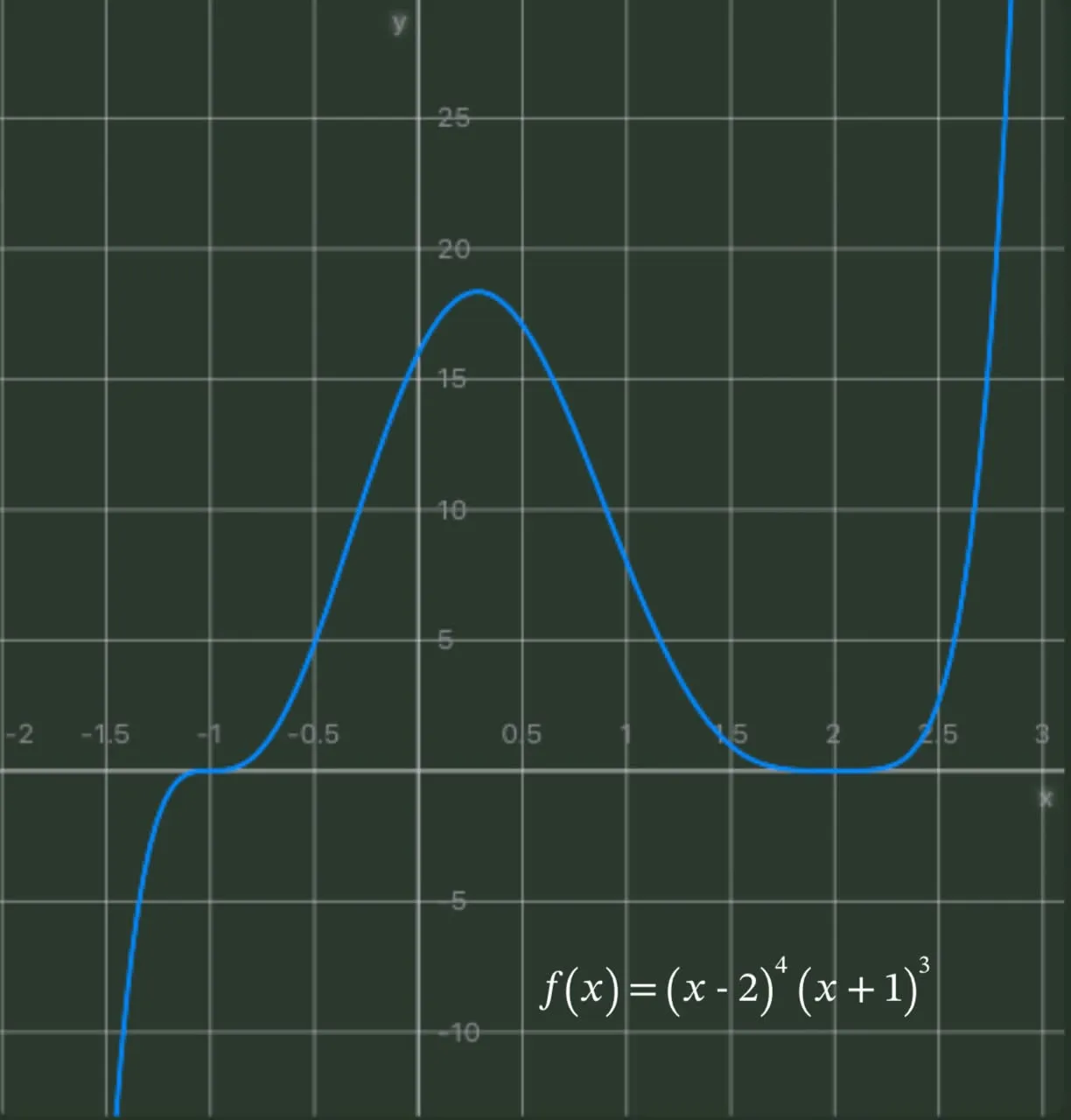
Graph Representing Function \(f(x)=(x-2)^4(x+1)^3\)
Graphical Interpretation
✏️ Solution
Complete Solution
›
Step-by-step Solution  ·  27 steps
  1. Given —
    \[ f(x)=(x-2)^4(x+1)^3 \]
  2. Differentiate the function
    \[ f'(x)=4(x-2)^3(x+1)^3+3(x-2)^4(x+1)^2 \]
  3. Taking the common factors,
    \[ f'(x)=(x-2)^3(x+1)^2[4(x+1)+3(x-2)] \]
  4. Simplifying the bracket:
    \[ 4(x+1)+3(x-2)=4x+4+3x-6=7x-2 \]
  5. Therefore,
    \[ \boxed{f'(x)=(x-2)^3(x+1)^2(7x-2)} \]
  6. Find the critical points
  7. Set \(f'(x)=0\):
    \[ (x-2)^3(x+1)^2(7x-2)=0 \]
  8. Thus,
    \[ x-2=0\quad\text{or}\quad x+1=0\quad\text{or}\quad 7x-2=0 \]
  9. The critical points are
    \[ \boxed{x=2,\quad x=-1,\quad x=\frac27} \]
  10. Part (i): Find the Local Maximum
  11. We examine the sign of \(f'(x)\) around each critical point. Since \((x+1)^2\) is non-negative and does not change sign across \(x=-1\), the sign of \(f'(x)\), away from the critical points, is determined by \((x-2)(7x-2)\).
    Interval Sign of \(f'(x)\) Behaviour of \(f(x)\)
    \((-\infty,-1)\) Positive Increasing
    \((-1,\frac27)\) Positive Increasing
    \((\frac27,2)\) Negative Decreasing
    \((2,\infty)\) Positive Increasing
  12. At \(x=\frac27\), the derivative changes from positive to negative. Therefore, \(f(x)\) has a local maximum there.
  13. Calculate the function value:
    \[ f\left(\frac27\right)=\left(\frac27-2\right)^4\left(\frac27+1\right)^3 \]
    \[ =\left(-\frac{12}{7}\right)^4\left(\frac97\right)^3 \]
    \[ =\frac{12^4}{7^4}\cdot\frac{9^3}{7^3} \]
    \[ =\frac{20736\cdot729}{7^7} \]
  14. Hence, the local maximum point is
    \[ \boxed{\left(\frac27,\frac{15116544}{823543}\right)} \]
  15. Part (ii): Find the Local Minimum
  16. At \(x=2\), the derivative changes from negative to positive. Therefore, \(f(x)\) has a local minimum at \(x=2\).
  17. Calculate the function value:
    \[ f(2)=(2-2)^4(2+1)^3=0 \]
  18. Hence, the local minimum point is
    \[ \boxed{(2,0)} \]
  19. At \(x=-1\), the derivative is zero, but its sign remains positive on both sides. Therefore, \(x=-1\) is neither a local maximum nor a local minimum.
  20. Part (iii): Find the Points of Inflexion
  21. Calculate the second derivative
  22. We have
    \[ f'(x)=(x-2)^3(x+1)^2(7x-2) \]
  23. Differentiating using the product rule and simplifying gives
    \[ \boxed{f''(x)=2(x-2)^2(x+1)(14x^2-11x-10)} \]
  24. Find the possible points of inflexion
  25. Set \(f''(x)=0\):
    \[ 2(x-2)^2(x+1)(14x^2-11x-10)=0 \]
  26. Therefore,
    \[ x=2,\quad x=-1 \]
    or
    \[ 14x^2-11x-10=0 \]
  27. Using the quadratic formula,
    \[ x=\frac{11\pm\sqrt{(-11)^2-4(14)(-10)}}{28} \]
    \[ x=\frac{11\pm\sqrt{121+560}}{28} \]
    \[ \boxed{x=\frac{11\pm\sqrt{681}}{28}} \]
  28. The points are thus
    \[ x=-1,\quad x=2,\quad x=\frac{11-\sqrt{681}}{28},\quad x=\frac{11+\sqrt{681}}{28} \]
  29. Verify the change in concavity
  30. The factor \((x-2)^2\) does not change sign as \(x\) passes through \(2\). All the other factors in \(f''(x)\) are nonzero at \(x=2\). Thus, the concavity does not change at \(x=2\), so it is not a point of inflexion.

    At \(x=-1\), the factor \((x+1)\) changes sign while the remaining factors are nonzero. Hence, the concavity changes, and \(x=-1\) is a point of inflexion.

    Each root of \(14x^2-11x-10\) is distinct, so the quadratic factor changes sign at each root. Therefore, both roots also give points of inflexion.

  31. Calculate the function values
  32. At \(x=-1\):
    \[ f(-1)=(-3)^4(0)^3=0 \]
  33. Thus, one point of inflexion is
    \[ \boxed{(-1,0)} \]
  34. For the other two points, let
    \[ r=\frac{11\pm\sqrt{681}}{28} \]
  35. The corresponding points of inflexion are
    \[ \boxed{\left(r,(r-2)^4(r+1)^3\right)} \]
  36. Equivalently, the two points are
    \[ \boxed{\left(\frac{11-\sqrt{681}}{28},\left(\frac{11-\sqrt{681}}{28}-2\right)^4\left(\frac{39-\sqrt{681}}{28}\right)^3\right)} \]
    \[ \boxed{\left(\frac{11+\sqrt{681}}{28},\left(\frac{11+\sqrt{681}}{28}-2\right)^4\left(\frac{39+\sqrt{681}}{28}\right)^3\right)} \]
💡 Answer
Final Answer
›

(i) Local maximum:

\[ \boxed{\left(\frac27,\frac{15116544}{823543}\right)} \]

(ii) Local minimum:

\[ \boxed{(2,0)} \]

(iii) Points of inflexion:

\[ \boxed{(-1,0)} \]

and

\[ \boxed{\left(r,(r-2)^4(r+1)^3\right),\quad r=\frac{11\pm\sqrt{681}}{28}} \]
🎯 Exam Significance
Exam Significance
›
  • CBSE Board examinations: This problem tests factorisation of derivatives, the first derivative test, the second derivative test and verification of concavity changes.
  • JEE and other competitive examinations: Repeated factors are important. A critical point need not be an extremum, and a zero of the second derivative need not be a point of inflexion.
  • Common mistake: Do not classify \(x=-1\) as a maximum or minimum merely because \(f'(-1)=0\). The sign of the derivative must be checked on both sides.
🔑 Key Takeaways
Key Takeaways
›
Key Takeaways  ·  5 points
  1. Factorise the first derivative to identify critical points efficiently.

  2. A change in \(f'\) from positive to negative indicates a local maximum.

  3. A change in \(f'\) from negative to positive indicates a local minimum.

  4. A point of inflexion requires a change in concavity, not merely \(f''(x)=0\).

  5. The factor \((x-2)^2\) in the second derivative does not change sign at \(x=2\), so \(x=2\) is not a point of inflexion.

← Q9
10 / 16  ·  63%
Q11 →
Q11
LONG ANSWER4 marks
Find the absolute maximum and minimum values of the function \[ f(x)=\cos^2x+\sin x,\qquad x\in[0,\pi] \]
📘 Concept & Theory
Theory and Concept
›

The absolute maximum and minimum values of a continuous function on a closed interval can be found using the closed interval method. We evaluate the function at all critical points within the interval and at both endpoints.

The procedure is:

  1. Find \(f'(x)\).
  2. Find all critical points satisfying \(f'(x)=0\) or where the derivative is undefined.
  3. Evaluate \(f(x)\) at every critical point and at the endpoints.
  4. Compare all the values to identify the absolute maximum and minimum.
🗺️ Solution Roadmap
Step-by-step Plan
›
  1. For the given function, we will differentiate, find the critical points in \([0,\pi]\), evaluate the function at these points and at \(x=0,\pi\), and compare the results. The second derivative test may classify local extrema, but comparing all candidate values establishes the absolute extrema.

📊 Graph / Figure
Graph / Figure
›
Graph Representing Function f(x) = cos² x + sin x
Graphical Interpretation
✏️ Solution
Complete Solution
›
Step-by-step Solution  ·  14 steps
  1. Given —
    \[ f(x)=\cos^2x+\sin x \]
  2. Find the first derivative
  3. Differentiating with respect to \(x\),
    \[ f'(x)=2\cos x(-\sin x)+\cos x \]
    \[ f'(x)=-2\sin x\cos x+\cos x \]
  4. Taking \(\cos x\) common,
    \[ \boxed{f'(x)=\cos x(1-2\sin x)} \]
  5. Find the critical points
  6. Set \(f'(x)=0\):
    \[ \cos x(1-2\sin x)=0 \]
  7. Therefore, either
    \[ \cos x=0 \]
    or
    \[ 1-2\sin x=0 \]
  8. From \(\cos x=0\), within \([0,\pi]\),
    \[ x=\frac{\pi}{2} \]
  9. From \(1-2\sin x=0\),
    \[ \sin x=\frac12 \]
  10. Within \([0,\pi]\), this gives
    \[ x=\frac{\pi}{6},\quad \frac{5\pi}{6} \]
  11. Hence, all critical points are
    \[ \boxed{x=\frac{\pi}{6},\quad\frac{\pi}{2},\quad\frac{5\pi}{6}} \]
  12. Evaluate the Function at the Critical Points
  13. At \(x=\pi/6\):
    \[ f\left(\frac{\pi}{6}\right)=\cos^2\frac{\pi}{6}+\sin\frac{\pi}{6} \]
    \[ =\left(\frac{\sqrt3}{2}\right)^2+\frac12 \]
    \[ =\frac34+\frac12=\boxed{\frac54} \]
  14. At \(x=\pi/2\):
    \[ f\left(\frac{\pi}{2}\right)=\cos^2\frac{\pi}{2}+\sin\frac{\pi}{2} \]
    \[ =0^2+1=\boxed{1} \]
  15. At \(x=5\pi/6\):
    \[ f\left(\frac{5\pi}{6}\right)=\cos^2\frac{5\pi}{6}+\sin\frac{5\pi}{6} \]
    \[ =\left(-\frac{\sqrt3}{2}\right)^2+\frac12 \]
    \[ =\frac34+\frac12=\boxed{\frac54} \]
  16. Evaluate the Function at the Endpoints
  17. Since the interval is closed, we must also evaluate \(f(x)\) at \(x=0\) and \(x=\pi\).

    At \(x=0\):
    \[ f(0)=\cos^2 0+\sin 0=1+0=\boxed{1} \]
  18. At \(x=\pi\):
    \[ f(\pi)=\cos^2\pi+\sin\pi=1+0=\boxed{1} \]
  19. Compare All Candidate Values
  20. Value of \(x\) \(f(x)\)
    \(0\) \(1\)
    \(\pi/6\) \(5/4\)
    \(\pi/2\) \(1\)
    \(5\pi/6\) \(5/4\)
    \(\pi\) \(1\)

    The greatest value in the table is \(5/4\), and the least value is \(1\).

💡 Answer
Final Answer
›

Absolute maximum value:

\[ \boxed{\frac54} \]

This occurs at

\[ \boxed{x=\frac{\pi}{6}\text{ and }x=\frac{5\pi}{6}} \]

Absolute minimum value:

\[ \boxed{1} \]

This occurs at

\[ \boxed{x=0,\quad\frac{\pi}{2},\quad\pi} \]
🎯 Exam Significance
Exam Significance
›
  • CBSE Board examinations: This question tests differentiation, trigonometric equations, critical points and the closed interval method.
  • JEE and other entrance examinations: It highlights the importance of considering every solution of \(f'(x)=0\) and evaluating endpoints when finding absolute extrema.
  • Common mistake: Solving only \(1-2\sin x=0\) after factoring the derivative overlooks the solution \(\cos x=0\).
🔑 Key Takeaways
Key Takeaways
›
Key Takeaways  ·  4 points
  1. Always factorise the first derivative carefully.

  2. Include every critical point inside the given interval.

  3. For absolute extrema on a closed interval, evaluate both endpoints as well as all critical points.

  4. The second derivative test is useful for classifying local extrema, but comparing all candidate values gives the definitive absolute maximum and minimum.

← Q10
11 / 16  ·  69%
Q12 →
Q12
LONG ANSWER4 marks
how that the altitude of the right circular cone of maximum volume that can be inscribed in a sphere of radius \(r\) is \(\dfrac{4r}{3}\).
📘 Concept & Theory
Theory and Concept
›

This problem illustrates the application of derivatives to geometrical optimisation. A right circular cone is inscribed in a sphere of fixed radius \(r\). We must determine the cone's height for which its volume is maximum.

The volume of a right circular cone is

\[ V=\frac{1}{3}\pi a^2h \]

where \(a\) is the radius of the cone's base and \(h\) is its altitude.

The key is to use the sphere's geometry to express the base radius in terms of the cone's height, making the volume a function of one variable.

🗺️ Solution Roadmap
Step-by-step Plan
›
  1. Represent the cone inside the sphere and identify its height and base radius.

  2. Use the sphere's radius to establish a relation between the base radius and the cone's height.

  3. Express the cone's volume as a function of its height.

  4. Differentiate the volume function and find the critical point.

  5. Use the second derivative test to prove that the volume is maximum.

✏️ Solution
Complete Solution
›
Step-by-step Solution  ·  18 steps
  1. Define the variables
  2. Let \(O\) be the centre of the sphere and \(A\) its topmost point, which is the vertex of the cone. Let the cone's base lie in a plane below \(O\).
    • Radius of the sphere \(=r\).
    • Altitude of the cone \(=h\).
    • Radius of the cone's base \(=a\).
  3. The distance from the sphere's centre to the base plane is \(r-h\), taking the cone's vertex at the top of the sphere. The right triangle formed by the sphere's centre, a point on the circular base, and the base centre gives
    \[ a^2+(r-h)^2=r^2 \]
  4. Expanding and simplifying:
    \[ a^2=r^2-(r-h)^2 \]
    \[ a^2=r^2-(r^2-2rh+h^2) \]
  5. Therefore,
    \[ \boxed{a^2=2rh-h^2} \]
  6. Form the volume function
  7. The volume of the cone is
    \[ V=\frac13\pi a^2h \]
  8. Substituting \(a^2=2rh-h^2\),
    \[ V=\frac13\pi(2rh-h^2)h \]
  9. Expanding:
    \[ V=\frac13\pi(2rh^2-h^3) \]
  10. Thus, the volume as a function of altitude is
    \[ \boxed{V(h)=\frac{\pi}{3}(2rh^2-h^3)} \]
  11. Differentiate the volume function
  12. Differentiating with respect to \(h\), treating \(r\) as a constant:
    \[ \frac{dV}{dh}=\frac{\pi}{3}(4rh-3h^2) \]
  13. Factorising:
    \[ \frac{dV}{dh}=\frac{\pi h}{3}(4r-3h) \]
  14. At a critical point,
    \[ \frac{dV}{dh}=0 \]
  15. Hence,
    \[ \frac{\pi h}{3}(4r-3h)=0 \]
  16. This gives
    \[ h=0\quad\text{or}\quad 4r-3h=0 \]
  17. The value \(h=0\) represents a degenerate cone with zero volume. Therefore, the nonzero critical point satisfies
    \[ 3h=4r \]
  18. Thus,
    \[ \boxed{h=\frac{4r}{3}} \]
  19. Verify that the volume is maximum
  20. Differentiating again:
    \[ \frac{d^2V}{dh^2}=\frac{\pi}{3}(4r-6h) \]
  21. At \(h=\dfrac{4r}{3}\),
    \[ \frac{d^2V}{dh^2}=\frac{\pi}{3}\left(4r-6\cdot\frac{4r}{3}\right) \]
    \[ =\frac{\pi}{3}(4r-8r) \]
    \[ =-\frac{4\pi r}{3} \]
  22. Since \(r>0\),
    \[ \frac{d^2V}{dh^2} < 0 \]
    Therefore, the volume is maximum at \(h=\dfrac{4r}{3}\)
💡 Answer
Final Answer
›
Hence, the altitude of the right circular cone of maximum volume that can be inscribed in a sphere of radius \(r\) is
\[ \boxed{\frac{4r}{3}} \]
🎯 Exam Significance
Exam Significance
›
  • CBSE Board examinations: This problem tests the use of a geometrical constraint, differentiation of a volume function, and the second derivative test.
  • JEE and other competitive examinations: It demonstrates how to convert a three-dimensional optimisation problem into a single-variable calculus problem.
  • Common mistake: The distance from the sphere's centre to the cone's base plane is \(r-h\), not \(h\). Using the correct geometry is essential for obtaining the required result.
🔑 Key Takeaways
Key Takeaways
›
Key Takeaways  ·  5 points
  1. Use the sphere's geometry to eliminate the cone's base radius.

  2. Express volume as a function of the altitude alone.

  3. Exclude the degenerate solution \(h=0\).

  4. A negative second derivative at the nonzero critical point confirms maximum volume.

  5. The optimum altitude is \(\dfrac{4r}{3}\), while the corresponding base radius is \(\dfrac{2\sqrt2\,r}{3}\).

← Q11
12 / 16  ·  75%
Q13 →
Q13
LONG ANSWER4 marks
Let \(f\) be a function defined on \([a,b]\) such that \[ f'(x)>0 \] for all \(x\in(a,b)\). Then prove that \(f\) is an increasing function on \([a,b]\).
📘 Concept & Theory
Theory and Concept
›

The first derivative of a function determines whether the function increases or decreases over an interval.

  • If \(f'(x)>0\) throughout an interval, then \(f\) is strictly increasing there.
  • If \(f'(x)<0\) throughout an interval, then \(f\) is strictly decreasing there.
  • If \(f'(x)=0\) throughout an interval, then \(f\) is constant there, provided the function is continuous and differentiable as required.

We will use the Mean Value Theorem to prove the result rigorously.

🗺️ Solution Roadmap
Step-by-step Plan
›
  1. Choose any two points \(x_1,x_2\) in the interval such that \(a\leq x_1

  2. Apply the Mean Value Theorem to \(f\) on \([x_1,x_2]\).

  3. Use the condition \(f'(x)>0\) to establish that \(f(x_2)>f(x_1)\).

  4. Conclude that \(f\) is strictly increasing on \([a,b]\).

✏️ Solution
Complete Solution
›
Step-by-step Solution  ·  12 steps
  1. Given —
    \[ f'(x)>0\quad\text{for all }x\in(a,b) \]
  2. To Prove — \(f\) is increasing on \([a,b]\)
  3. Proof
  4. Choose two arbitrary points
  5. Let \(x_1\) and \(x_2\) be any two points in \([a,b]\) such that
    \[ a\leq x_1 < x_2\leq b \]
  6. We need to prove that
    \[ f(x_1) < f(x_2) \]
  7. Apply the Mean Value Theorem
  8. Assuming \(f\) is continuous on \([x_1,x_2]\) and differentiable on \((x_1,x_2)\), the Mean Value Theorem guarantees that there exists a point \(c\in(x_1,x_2)\) such that
    \[ f'(c)=\frac{f(x_2)-f(x_1)}{x_2-x_1} \]
  9. Rearranging,
    \[ f(x_2)-f(x_1)=f'(c)(x_2-x_1) \]
  10. Use the given condition
  11. Since \(c\in(x_1,x_2)\subseteq(a,b)\), the given condition implies that
    \[ f'(c)>0 \]
  12. Also, because \(x_1 < x_2\),
    \[ x_2-x_1>0 \]
  13. Therefore, the product of these two positive quantities is positive:
    \[ f'(c)(x_2-x_1)>0 \]
  14. Hence,
    \[ f(x_2)-f(x_1)>0 \]
  15. Thus,
    \[ \boxed{f(x_2)>f(x_1)} \]
  16. Draw the conclusion
  17. Since \(x_1\) and \(x_2\) were chosen arbitrarily with \(x_1 < x_2\), we have shown that
    \[f(x_1) < f(x_2)\]
  18. for every such pair of points in \([a,b]\). Therefore, \(f\) is strictly increasing on \([a,b]\).
  19. Hence, by the Mean Value Theorem, if \(f'(x)>0\) for every \(x\in(a,b)\), and \(f\) is continuous on \([a,b]\) and differentiable on \((a,b)\), then

    \[ \boxed{f\text{ is strictly increasing on }[a,b].} \]
  20. Hence Proved
🎯 Exam Significance
Exam Significance
›
  • CBSE Board examinations: This is a standard proof involving the relationship between the first derivative and monotonicity.
  • JEE and other competitive examinations: The result is useful for determining monotonicity and comparing function values without calculating them individually.
  • Important mathematical detail: Continuity on \([a,b]\) and differentiability on \((a,b)\) are required to apply the Mean Value Theorem. These are standard assumptions for this result.
🔑 Key Takeaways
Key Takeaways
›
Key Takeaways  ·  4 points
  1. A positive first derivative indicates strict increase.

  2. The Mean Value Theorem connects the derivative at an intermediate point to the average rate of change over an interval.

  3. Strict increase means that \(x_1 < x_2\) implies \(f(x_1) < f(x_2)\).

  4. The derivative condition is given on the open interval, while the conclusion extends to the closed interval when the function satisfies the stated continuity and differentiability conditions.

← Q12
13 / 16  ·  81%
Q14 →
Q14
LONG ANSWER4 marks
Show that the height of the cylinder of maximum volume that can be inscribed in a sphere of radius \(R\) is \[ \frac{2R}{\sqrt{3}} \] Also, find the maximum volume.
📘 Concept & Theory
Theory and Concept
›

This problem illustrates the application of derivatives to geometrical optimisation. A right circular cylinder is inscribed in a sphere of fixed radius \(R\). We need to determine the cylinder's height and radius so that its volume is maximum.

The volume of a right circular cylinder is

\[ V=\pi r^2h \]

where \(r\) is the radius of the cylinder and \(h\) is its height.

The cylinder fits inside the sphere, so its radius and half-height satisfy a geometric constraint. Using this constraint, we can express the volume in terms of a single variable and maximise it by differentiation.

🗺️ Solution Roadmap
Step-by-step Plan
›
  1. Let \(r\) and \(h\) be the radius and height of the cylinder.

  2. Use the geometry of the sphere to relate \(r\), \(h\), and \(R\).

  3. Express the volume as a function of \(h\).

  4. Differentiate and find the critical point.

  5. Verify that the critical point gives the maximum volume.

  6. Calculate the maximum volume.

📊 Graph / Figure
Graph / Figure
›
Cylinder Inscribed in a Sphere r h R Constraint: r² + (h/2)² = R² At maximum volume: h = 2R/√3
Diagram: Cylinder Inscribed in a Sphere
✏️ Solution
Complete Solution
›
Step-by-step Solution  ·  24 steps
  1. Define the variables
  2. Let the radius of the inscribed cylinder be \(r\) and its height be \(h\). The radius of the sphere is \(R\).
  3. Consider a vertical cross-section through the centre of the sphere and cylinder. The cross-section of the cylinder is a rectangle of width \(2r\) and height \(h\), while the sphere's cross-section is a circle of radius \(R\).
  4. From the centre of the sphere to a top corner of the rectangle, the horizontal distance is \(r\), and the vertical distance is \(h/2\). By the Pythagorean theorem,
    \[ r^2+\left(\frac{h}{2}\right)^2=R^2 \]
  5. Therefore,
    \[ \boxed{r^2=R^2-\frac{h^2}{4}} \]
  6. Form the volume function
  7. The volume of the cylinder is
    \[ V=\pi r^2h \]
  8. Substituting \(r^2=R^2-\dfrac{h^2}{4}\), we obtain
    \[ V=\pi\left(R^2-\frac{h^2}{4}\right)h \]
  9. Expanding,
    \[ V=\pi R^2h-\frac{\pi h^3}{4} \]
  10. Hence, the volume as a function of height is
    \[ \boxed{V(h)=\pi R^2h-\frac{\pi h^3}{4}} \]
  11. Differentiate the volume function
  12. Differentiating with respect to \(h\), while treating \(R\) as a constant,
    \[ \frac{dV}{dh}=\pi R^2-\frac{3\pi h^2}{4} \]
  13. At a critical point,
    \[ \frac{dV}{dh}=0 \]
  14. Therefore,
    \[ \pi R^2-\frac{3\pi h^2}{4}=0 \]
  15. Dividing both sides by \(\pi\),
    \[ R^2-\frac{3h^2}{4}=0 \]
  16. Rearranging,
    \[ \frac{3h^2}{4}=R^2 \]
    \[ h^2=\frac{4R^2}{3} \]
  17. Since height is positive,
    \[ \boxed{h=\frac{2R}{\sqrt{3}}} \]
  18. Verify that the volume is maximum
  19. Differentiating the volume function a second time,
    \[ \frac{d^2V}{dh^2}=-\frac{3\pi h}{2} \]
  20. At \(h=\dfrac{2R}{\sqrt{3}}\),
    \[ \frac{d^2V}{dh^2}=-\frac{3\pi}{2}\left(\frac{2R}{\sqrt{3}}\right) \]
    \[ =-\frac{3\pi R}{\sqrt{3}} \]
    \[ =-\pi R\sqrt{3}<0 \]
  21. Therefore, the volume is maximum at
    \[ \boxed{h=\frac{2R}{\sqrt{3}}} \]
  22. Find the radius of the cylinder at maximum volume
  23. Recall the relation
    \[ r^2=R^2-\frac{h^2}{4} \]
  24. Substituting \(h=\dfrac{2R}{\sqrt{3}}\),
    \[ r^2=R^2-\frac{1}{4}\left(\frac{2R}{\sqrt{3}}\right)^2 \]
    \[ r^2=R^2-\frac{R^2}{3} \]
    \[ r^2=\frac{2R^2}{3} \]
  25. Thus, the radius of the cylinder is
    \[ \boxed{r=R\sqrt{\frac{2}{3}}} \]
  26. Calculate the maximum volume
  27. The volume is
    \[ V=\pi r^2h \]
  28. Substituting the optimal values of \(r^2\) and \(h\),
    \[ V_{\max}=\pi\left(\frac{2R^2}{3}\right)\left(\frac{2R}{\sqrt{3}}\right) \]
  29. Multiplying the factors,
    \[ V_{\max}=\frac{4\pi R^3}{3\sqrt{3}} \]
  30. Hence, the maximum volume is
    \[ \boxed{V_{\max}=\frac{4\pi R^3}{3\sqrt{3}}} \]
🎯 Exam Significance
Exam Significance
›
  • CBSE Board examinations: This problem tests geometric constraints, differentiation of a volume function, and the second derivative test.
  • JEE and other competitive examinations: It demonstrates how to reduce a three-dimensional optimisation problem to a single-variable function.
  • Common mistake: The vertical distance from the sphere's centre to either end of the cylinder is \(h/2\), not \(h\). Using the correct cross-sectional geometry is essential.
🔑 Key Takeaways
Key Takeaways
›
Key Takeaways  ·  4 points
  1. Use \(r^2+(h/2)^2=R^2\) to connect the cylinder's dimensions with the sphere's radius.

  2. Express volume in terms of one variable before differentiating.

  3. A negative second derivative at the critical point confirms a local maximum; here, the endpoint volumes are zero, so this is also the absolute maximum for a nondegenerate inscribed cylinder.

  4. The maximum-volume cylinder has height \(\dfrac{2R}{\sqrt{3}}\) and radius \(R\sqrt{\dfrac23}\).

← Q13
14 / 16  ·  88%
Q15 →
Q15
LONG ANSWER4 marks
Show that the height of the cylinder of greatest volume that can be inscribed in a right circular cone of height \(h\) and semi-vertical angle \(\alpha\) is one-third the height of the cone. Also, prove that the greatest volume of the cylinder is \[ \boxed{\frac{4}{27}\pi h^3\tan^2\alpha} \]
📘 Concept & Theory
Theory and Concept
›

This problem applies differentiation to maximise the volume of a cylinder inscribed in a right circular cone.

The volume of a right circular cylinder is

\[ V=\pi r^2x \]

where \(r\) is the cylinder's radius and \(x\) is its height.

Because the cylinder is inscribed in the cone, its radius depends on its height. Similar triangles allow us to express the radius in terms of the cone's height and semi-vertical angle. We can then maximise the volume by differentiation.

🗺️ Solution Roadmap
Step-by-step Plan
›
  1. Let \(x\) and \(r\) be the height and radius of the inscribed cylinder.

  2. Use similar triangles to express \(r\) in terms of \(x\), \(h\), and \(\alpha\).

  3. Form the volume function \(V(x)\).

  4. Differentiate and find the critical point.

  5. Verify that the critical point gives the maximum volume.

  6. Calculate the greatest volume.

✏️ Solution
Complete Solution
›
Step-by-step Solution  ·  29 steps
  1. Define the dimensions
  2. Let the height of the cone be \(h\), its semi-vertical angle be \(\alpha\), and its base radius be \(R\).

    Let the height of the inscribed cylinder be \(x\) and its radius be \(r\). The cylinder rests on the cone's base, with its upper circular face touching the cone's sloping surface.

  3. Use similar triangles
  4. The radius of the cone's base is related to its height and semi-vertical angle by
  5. \[ \tan\alpha=\frac{R}{h} \]
  6. Therefore,
    \[ R=h\tan\alpha \]
  7. At a height \(x\) from the cone's base, the cone's radius decreases linearly. The vertical distance from the cylinder's upper face to the cone's vertex is \(h-x\).
  8. By similar triangles,
    \[ \frac{r}{h-x}=\frac{R}{h} \]
  9. Substituting \(R=h\tan\alpha\),
    \[ \frac{r}{h-x}=\frac{h\tan\alpha}{h} \]
  10. Hence,
    \[ \boxed{r=(h-x)\tan\alpha} \]
  11. Form the volume function
  12. The cylinder's volume is
    \[ V=\pi r^2x \]
  13. Substitute \(r=(h-x)\tan\alpha\):
    \[ V=\pi\left[(h-x)\tan\alpha\right]^2x \]
  14. Therefore,
    \[ V=\pi x(h-x)^2\tan^2\alpha \]
  15. Since \(h\) and \(\alpha\) are constants, the volume function is
    \[ \boxed{V(x)=\pi\tan^2\alpha\;x(h-x)^2} \]
  16. Differentiate the volume function
  17. Differentiating with respect to \(x\),
    \[ \frac{dV}{dx}=\pi\tan^2\alpha\frac{d}{dx}\left[x(h-x)^2\right] \]
  18. Using the product rule,
    \[ \frac{dV}{dx}=\pi\tan^2\alpha\left[(h-x)^2-2x(h-x)\right] \]
  19. Taking \((h-x)\) common,
    \[ \frac{dV}{dx}=\pi\tan^2\alpha(h-x)\left[(h-x)-2x\right] \]
  20. Simplifying,
    \[ \boxed{\frac{dV}{dx}=\pi\tan^2\alpha(h-x)(h-3x)} \]
  21. Find the critical point
  22. For a maximum or minimum, set
    \[ \frac{dV}{dx}=0 \]
  23. Thus,
    \[ \pi\tan^2\alpha(h-x)(h-3x)=0 \]
  24. For a non-degenerate cone, \(\pi\tan^2\alpha>0\). Therefore,
    \[ h-x=0\quad\text{or}\quad h-3x=0 \]
  25. This gives
    \[ x=h\quad\text{or}\quad x=\frac{h}{3} \]
  26. The value \(x=h\) corresponds to a degenerate cylinder with zero radius and hence zero volume. Therefore, the relevant critical point is
    \[ \boxed{x=\frac{h}{3}} \]
  27. Verify that the volume is maximum
  28. From the first derivative,
    \[ \frac{dV}{dx}=\pi\tan^2\alpha(h-x)(h-3x) \]
  29. Differentiate again:
    \[ \frac{d^2V}{dx^2}=\pi\tan^2\alpha(6x-4h) \]
  30. At \(x=\dfrac{h}{3}\),
    \[ \frac{d^2V}{dx^2}=\pi\tan^2\alpha\left(6\cdot\frac{h}{3}-4h\right) \]
    \[ =\pi\tan^2\alpha(2h-4h) \]
    \[ =-2\pi h\tan^2\alpha < 0 \]
  31. Therefore, the volume is maximum when
    \[ \boxed{x=\frac{h}{3}} \]
    Hence, the height of the cylinder of greatest volume is one-third the height of the cone.
  32. Calculate the Greatest Volume
  33. The volume function is
    \[ V=\pi x(h-x)^2\tan^2\alpha \]
  34. Substitute \(x=\dfrac{h}{3}\):
    \[ V_{\max}=\pi\left(\frac{h}{3}\right)\left(h-\frac{h}{3}\right)^2\tan^2\alpha \]
  35. Simplifying the bracket,
    \[ V_{\max}=\pi\left(\frac{h}{3}\right)\left(\frac{2h}{3}\right)^2\tan^2\alpha \]
    \[ V_{\max}=\pi\left(\frac{h}{3}\right)\left(\frac{4h^2}{9}\right)\tan^2\alpha \]
  36. Multiplying the factors,
    \[ \boxed{V_{\max}=\frac{4}{27}\pi h^3\tan^2\alpha} \]
💡 Answer
Final Answer
›

The height of the cylinder of greatest volume is

\[ \boxed{\frac{h}{3}} \]

The greatest volume of the cylinder is

\[ \boxed{\frac{4}{27}\pi h^3\tan^2\alpha} \]
🎯 Exam Significance
Exam Significance
›
  • CBSE Board examinations: This problem tests similar triangles, volume formulation, differentiation, and the second derivative test.
  • JEE and other competitive examinations: It demonstrates how a geometric constraint reduces a three-dimensional optimisation problem to a single-variable function.
  • Common mistake: The cylinder's radius is \((h-x)\tan\alpha\), not \(x\tan\alpha\), because the radius is measured at a distance \(h-x\) below the cone's vertex.
🔑 Key Takeaways
Key Takeaways
›
Key Takeaways  ·  5 points
  1. Use similar triangles to relate the cylinder's radius to its height.

  2. Express the volume in terms of one variable before differentiating.

  3. Discard the degenerate solution \(x=h\), where the cylinder has zero volume.

  4. A negative second derivative confirms the maximum at \(x=h/3\).

  5. The maximum volume depends on the cone's height and semi-vertical angle through \(h^3\tan^2\alpha\).

← Q14
15 / 16  ·  94%
Q16 →
Q16
LONG ANSWER4 marks
A cylindrical tank of radius \(10\text{ m}\) is being filled with wheat at the rate of \(314\text{ m}^3/\text{h}\). Then the depth of the wheat is increasing at the rate of:
  • (A) \(1\text{ m/h}\)
  • (B) \(0.1\text{ m/h}\)
  • (C) \(1.1\text{ m/h}\)
  • (D) \(0.5\text{ m/h}\)
📘 Concept & Theory
Theory and Concept
›

This problem uses rates of change and differentiation. The volume of a cylinder depends on its radius and height. Since the tank has a fixed radius, the rate of change of volume is directly related to the rate at which the depth of wheat increases.

The volume of a cylinder is

\[ V=\pi r^2h \]

where \(r\) is the radius and \(h\) is the depth of wheat.

Differentiating with respect to time \(t\), with \(r\) constant, gives

\[ \frac{dV}{dt}=\pi r^2\frac{dh}{dt} \]
✏️ Solution
Complete Solution
›
Step-by-step Solution  ·  6 steps
  1. Given —
    • Radius of the tank: \(r=10\text{ m}\)
    • Rate of filling: \(\displaystyle \frac{dV}{dt}=314\text{ m}^3/\text{h}\)
    • Rate of increase in depth: \(\displaystyle \frac{dh}{dt}=?\)
  2. Differentiate the volume formula
  3. The volume of wheat in the cylindrical tank is
    \[ V=\pi r^2h \]
  4. Since \(r=10\text{ m}\) is constant, differentiating with respect to time gives
    \[ \frac{dV}{dt}=\pi r^2\frac{dh}{dt} \]
  5. Substitute the known values
    \[ 314=\pi(10)^2\frac{dh}{dt} \]
  6. Using \(\pi\approx3.14\),
    \[ 314=3.14\times100\times\frac{dh}{dt} \]
    \[ 314=314\frac{dh}{dt} \]
  7. Dividing both sides by \(314\),
    \[ \frac{dh}{dt}=\frac{314}{314}=1 \]
  8. Therefore,
    \[ \boxed{\frac{dh}{dt}=1\text{ m/h}} \]
💡 Answer
Final Answer
›
Correct Option: Option (A): \(1\text{ m/h}\)
🎯 Exam Significance
Exam Significance
›
  • CBSE Board examinations: This question tests differentiation with respect to time and the application of the cylinder-volume formula.
  • JEE and other competitive examinations: It reinforces the distinction between a quantity and its rate of change.
  • Common mistake: Do not differentiate the radius because it is fixed. Only the depth of wheat changes with time.
🔑 Key Takeaways
Key Takeaways
›
Key Takeaways  ·  2 points
  1. For a cylindrical tank of constant radius, the rate of increase in depth is

    \[ \boxed{\frac{dh}{dt}=\frac{1}{\pi r^2}\frac{dV}{dt}} \]

  2. Substituting the given values gives an increasing depth of \(1\text{ m/h}\).

← Q15
16 / 16  ·  100%
↑ Back to top
🎓

Chapter Complete!

All 16 solutions for Application of Derivatives covered.

↑ Review from the top
📚
ACADEMIA AETERNUM तमसो मा ज्योतिर्गमय · Est. 2025
Sharing this chapter
NCERT Class 12 Maths Chapter 6 Miscellaneous Exercise
NCERT Class 12 Maths Chapter 6 Miscellaneous Exercise — Complete Notes & Solutions · academia-aeternum.com
Explore NCERT Class 12 Mathematics Chapter 6, Application of Derivatives, with detailed, step-by-step solutions to important textbook exercises and multiple-choice questions. This chapter explains how derivatives are used to solve practical problems involving rates of change, increasing and decreasing functions, local and absolute maxima and minima, and optimisation of geometrical quantities. Learn how to determine the maximum volume of cylinders and cones, minimise or maximise areas, analyse…
🎓 Class 12 📐 Mathematics 📖 NCERT ✅ Free Access 🏆 CBSE · JEE
Share on
academia-aeternum.com/class-12/mathematics/application-of-derivatives/exercises/miscellaneous-exercise/ Copy link
💡
Exam tip: Sharing chapter notes with your study group creates a reinforcement loop. Teaching a concept is the fastest path to mastering it.

Recent posts

    APPLICATION OF DERIVATIVES — Learning Resources

    Frequently Asked Questions

    Application of Derivatives is a chapter in NCERT Class 12 Mathematics that explains how derivatives are used to study increasing and decreasing functions, rates of change, local extrema, absolute maxima and minima, and optimisation problems.

    The important topics include rate of change of quantities, increasing and decreasing functions, first derivative tests, local maxima and minima, absolute extrema, and optimisation of geometrical quantities such as areas and volumes.

    Derivatives help identify critical points where the first derivative is zero or undefined. By applying the first or second derivative test and checking the endpoints of a closed interval when required, we can determine maximum and minimum values.

    A function is strictly increasing on an interval if its derivative is positive throughout that interval. It is strictly decreasing if its derivative is negative throughout the interval, subject to the appropriate continuity and differentiability conditions.

    A local maximum is a function value that is greater than or equal to nearby function values. An absolute maximum is the greatest value of the function over its entire specified domain or interval.

    At a critical point c where f'(c) = 0, if f''(c) < 0, the function has a local maximum; if f''(c) > 0, it has a local minimum. If f''(c) = 0, the test is inconclusive.

    Related rates problems involve quantities that change with time and are connected by a mathematical relationship. Differentiating that relationship with respect to time helps calculate an unknown rate of change, such as the increasing depth of wheat in a cylindrical tank.

    First, a geometric constraint is used to express the required quantity, such as volume or area, in terms of one variable. Differentiation identifies critical points, and derivative tests help establish the dimensions that produce the maximum or minimum value.

    A continuous function on a closed interval attains its absolute maximum and minimum, but these values may occur at an endpoint rather than at an interior critical point. Therefore, evaluate the function at all critical points and both endpoints.

    Students should revise differentiation rules, practise NCERT examples and exercises, master first and second derivative tests, solve optimisation and related-rates problems step by step, and verify answers by checking critical points, endpoints, and units.

    Get in Touch

    Let's Connect

    Questions, feedback, or suggestions?
    We'd love to hear from you.