x y I (+,+) II (−,+) III (−,−) IV (+,−) A(3,2) B(−3,2) C(−2,−3) D(3,−2) Distance from x-axis = |y|
(x,y)
Chapter 3  ·  Class IX Mathematics

Points, Axes, and the Cartesian Plane

Coordinate Geometry

Plot Any Point, Name Any Quadrant — The Cartesian World Made Simple

Chapter Snapshot

6Concepts
3Formulae
4–5%Exam Weight
2–3Avg Q's
EasyDifficulty

Why This Chapter Matters for Exams

CBSE Class IXNTSEState Boards

Coordinate Geometry in Class IX is the foundation for the more advanced work in Class X. CBSE Boards typically assign 2–3 marks from this chapter through identification of quadrants, coordinates of points, and plotting problems. This chapter is completely scoring — every student should target full marks. NTSE uses coordinate plane questions in its mathematical reasoning section.

Key Concept Highlights

Cartesian System: X-axis and Y-axis
Origin and Quadrants (I, II, III, IV)
Coordinates of a Point (Abscissa and Ordinate)
Plotting Points in All Four Quadrants
Points on the Axes
Distance of a Point from Axes

Important Formula Capsules

$\text{Quadrant I: (+,+), II: (−,+), III: (−,−), IV: (+,−)}$
$\text{Distance from x-axis} = |y|,\quad \text{distance from y-axis} = |x|$
$\text{Origin: }(0,0);\text{ x-axis: }y=0;\text{ y-axis: }x=0$

What You Will Learn

Navigate to Chapter Resources

🏆 Exam Strategy & Preparation Tips

This is a completely scoring chapter with minimal content — spend 1 day and aim for perfect marks. Memorise the sign convention for each quadrant: All Students Take Calculus (All +, Sin/y +, Tan/x+y −, Cos/x +). For CBSE, graph-based questions require neat, labelled diagrams with a ruler. Time investment: 1 day.

Chapter 3 · CBSE · Class IX
📍
Coordinate Geometry
NCERT Class 9 Mathematics Chapter 3 Coordinate Geometry Coordinate Geometry Class 9 NCERT Coordinate Geometry Cartesian Plane Cartesian System Coordinate Axes Origin and Coordinates Plotting Points Abscissa and Ordinate Maths Chapter 3 Solutions Class 9 Maths Notes Coordinate Geometry Notes NCERT Solutions Class 9 Maths
📖 Introduction
🌟 Importance
Why Coordinate Geometry is Important?
🖼️ Figure
René Descartes
René Descartes
René Descartes
🏛️ Historical Note
René Descartes

The French mathematician and philosopher René Descartes introduced the idea of representing geometrical figures using numbers and equations. His revolutionary work created the Cartesian coordinate system, which became the foundation of modern analytical geometry.

Because of his contribution, the coordinate plane is often called the Cartesian Plane.

📘 Definition
Definition of Coordinate Geometry
🗒️ Defintion
Cartesian Plane

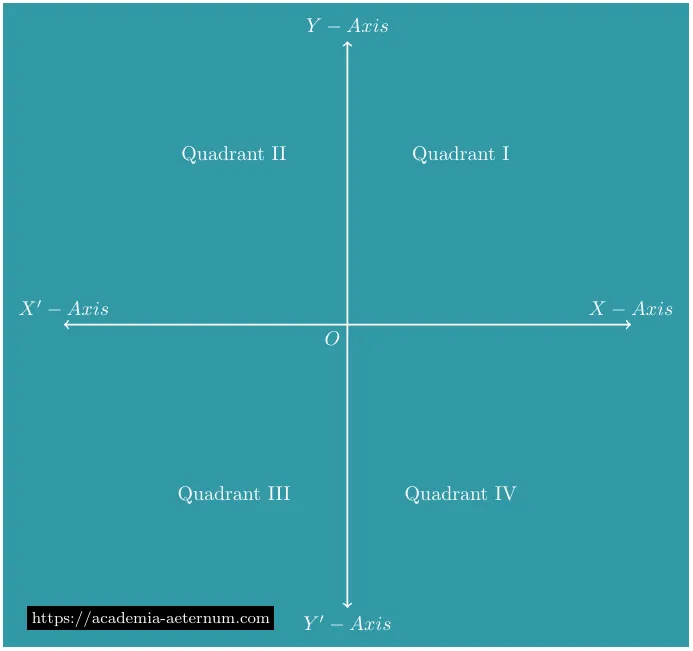
A Cartesian Plane is formed by two mutually perpendicular number lines:

  • X-axis → Horizontal number line
  • Y-axis → Vertical number line

These axes intersect at a fixed point called the Origin.

\[\small O(0,0) \]

🎨 SVG Diagram
X-axis Y-axis O
🗒️ Important Notes
Important Notes
  • X-axis and Y-axis divide the plane into four parts called quadrants.
  • Coordinates are always written in the form \(\small (x,y)\).
  • The first number always represents horizontal movement.
  • The second number always represents vertical movement.
🪟 Quadrants
Quadrants of Cartesian Plane

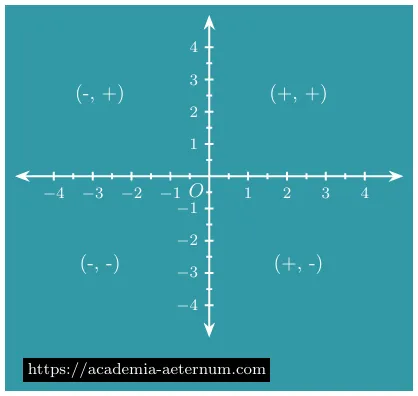
The X-axis and Y-axis divide the coordinate plane into four regions called quadrants.

Quadrant Sign of x Sign of y Example
I Quadrant + + \(\small (3,2)\)
II Quadrant - + \(\small (-4,5)\)
III Quadrant - - \(\small (-2,-3)\)
IV Quadrant + - \(\small (5,-2)\)
I II III IV (3,2) (-4,5) (-2,-3) (5,-2)
📘 Definition
Ordered Pair
📌 Note
Understanding Coordinates Abscissa Ordinate
🔄 Process

How to Plot a Point on Cartesian Plane

  • 1
    Draw and label X-axis (horizontal) and Y-axis (vertical), intersecting at origin \(\small O(0,0)\).
  • 2
    Mark suitable scale on both axes to accommodate coordinates.
  • 3
    Start at origin. Move right (positive x) or left (negative x) to \(\small x\)-coordinate.
  • 4
    From there, move up (positive y) or down (negative y) to \(\small y\)-coordinate.
  • 5
    Mark point with dot and label clearly (e.g., A for \(\small (x,y)\)).
✏️ Example
Plot a point

Plot the point:

\[\small A(3,2) \]

Theory / Concept

Positive x-coordinate means move right. Positive y-coordinate means move upward.

Roadmap
  • Move 3 units right from origin.
  • Move 2 units upward.
  • Mark the point.
Solution

Therefore, the point \(\small A(3,2)\) lies in the first quadrant.

X Y O(0,0) A(3, 2) Step 1: +3 (Right) Step 2: +2 (Up) 1st Quadrant Point A(3, 2) lies in the First Quadrant
🔎 Key Fact
Important Formulae and Facts
⚡ Exam Tip
❌ Common Mistakes
  • Writing coordinates as \(\small (y,x)\) instead of \(\small (x,y)\).
  • Forgetting signs of negative coordinates.
  • Confusing quadrants II and IV.
  • Plotting points without proper scaling.
  • Not marking the origin correctly.
  • Ignoring arrows and axis labels in graphs.
📋 Case Study

A drone is flying over a city. Its position is represented by the point \(\small (4,5)\) on a coordinate plane where the x-coordinate shows east-west movement and the y-coordinate shows north-south movement.

  1. In which quadrant is the drone located?
  2. What will happen if the x-coordinate becomes negative?
  3. Write coordinates of a point exactly opposite to the drone in III quadrant.
Solution
  1. \(\small (4,5)\) lies in the first quadrant because both coordinates are positive.
  2. If x-coordinate becomes negative, the point shifts to the left side of Y-axis.
  3. The opposite point in III quadrant will be: \[\small (-4,-5) \]
🛠️ Application
Real Life Applications of Coordinate Geometry
  • Google Maps and GPS navigation systems
  • Computer graphics and animation
  • Video game design
  • Engineering and architecture
  • Satellite positioning systems
  • Robotics and artificial intelligence
  • Physics and scientific graph analysis
Coordinate Geometry is one of the most practical and widely used branches of mathematics in modern technology and science.
📍
Cartesian Coordinate System
🗺️ Overview

In elementary mathematics, we study the number line where numbers are represented on a straight line. Extending this concept to two dimensions allows us to locate positions of objects and points on a flat surface called a plane. The mathematical system developed for locating points on a plane is known as the Cartesian Coordinate System.

This system uses two mutually perpendicular number lines called coordinate axes. Every point on the plane is represented using an ordered pair of numbers known as coordinates. The Cartesian system forms the foundation of graph plotting, analytical geometry, engineering drawings, computer graphics, navigation systems, and scientific data representation.

🗒️ Origin of Cartesian Geometry
Origin of Cartesian Geometry

The Cartesian Coordinate System was introduced by the French mathematician and philosopher René Descartes. His revolutionary idea connected algebra with geometry by allowing geometrical figures to be represented using equations and coordinates.

Because of his contribution, the coordinate plane is often called the Cartesian Plane.

Coordinate Geometry is sometimes referred to as Analytical Geometry because geometrical problems are solved analytically using numbers and equations.
📈 Coordinate Axes

The Cartesian system consists of two perpendicular number lines:

  • X-axis: The horizontal number line represented by \(\small XX'\).
  • Y-axis: The vertical number line represented by \(\small YY'\).

These two axes intersect at a fixed point called the Origin.

\[\small O(0,0) \]

Axis Positive Direction Negative Direction
X-axis \(\small OX\) \(\small OX'\)
Y-axis \(\small OY\) \(\small OY'\)
🖼️ Figure
Positive and negative directions on the coordinate axes
📊 Cartesian Plane Or XY Plane

The plane formed by the intersection of the x-axis and y-axis is called the Cartesian Plane or XY-plane.

Every point on this plane is uniquely represented by an ordered pair:

\[\small (x,y) \]

where:

  • \(\small x\) represents the horizontal distance from the origin.
  • \(\small y\) represents the vertical distance from the origin.
Important Concept:
Coordinates are always written in the order: \[\small (x,y) \] Changing the order changes the position of the point.
🪟 Quadrants Of Cartesian Plane

The x-axis and y-axis divide the plane into four regions called Quadrants.

These quadrants are numbered in an anticlockwise direction starting from the upper-right region.

The Cartesian plane divided into four quadrants
Properties of Quadrants
Properties
I Quadrant
Sign of \(\small x\) → Positive
Sign of \(\small y\) → Positive
Example: Point \(\small (3,5)\)
II Quadrant
Sign of \(\small x\) → Negative
Sign of \(\small y\) → Positive
Example: Point \(\small (-3,5)\)
III Quadrant
Sign of \(\small x\) → Negative
Sign of \(\small y\) → Negative
Example: Point \(\small (-3,-5)\)
IV Quadrant
Sign of \(\small x\) → Positive
Sign of \(\small y\) → Negative
Example: Point \(\small (3,-5)\)
Signs of coordinates in different quadrants
⭐ Special Case
Special Positions of Points
✏️ Example
<p> Identify the quadrant in which the following points lie: </p> <ol> <li>\(\small (4,3)\)</li> <li>\(\small (-5,2)\)</li> <li>\(\small (-3,-7)\)</li> <li>\(\small (6,-2)\)</li> </ol>

Determine the signs of x-coordinate and y-coordinate.

  • \(\small (+,+)\rightarrow\) First Quadrant
  • \(\small (-,+)\rightarrow\) Second Quadrant
  • \(\small (-,-)\rightarrow\) Third Quadrant
  • \(\small (+,-)\rightarrow\) Fourth Quadrant
  1. \(\small (4,3)\rightarrow\) First Quadrant
  2. \(\small (-5,2)\rightarrow\) Second Quadrant
  3. \(\small (-3,-7)\rightarrow\) Third Quadrant
  4. \(\small (6,-2)\rightarrow\) Fourth Quadrant
⚡ Exam Tip
❌ Common Mistakes
  • Confusing x-axis with y-axis.
  • Interchanging coordinates like writing \(\small (y,x)\).
  • Incorrectly identifying second and fourth quadrants.
  • Ignoring negative signs while plotting points.
  • Not labeling axes and quadrants properly.
📋 Case Study

A robot moves on a coordinate plane. It starts from the origin and moves 5 units right and 4 units upward.

  1. Write the coordinates of the robot.
  2. In which quadrant does the robot lie?
  3. If the robot moves 10 units left from its current position, what will be the new coordinates?
Solution
  1. Coordinates: \[\small (5,4) \]
  2. Since both coordinates are positive, the robot lies in the First Quadrant.
  3. New x-coordinate: \[\small 5-10=-5 \] Therefore, the new coordinates are: \[\small (-5,4) \]
🛠️ Application

Real-Life Applications of Cartesian System

  • GPS and digital map navigation systems
  • Engineering and architectural designing
  • Computer graphics and animation
  • Physics graphs and motion representation
  • Satellite positioning systems
  • Video game development
  • Scientific plotting and data analysis
The Cartesian Coordinate System is one of the most important mathematical inventions because it allows real-world objects and movements to be represented accurately using numbers and graphs.
📍
Coordinates of a Point
🗺️ Overview

Every point on the Cartesian plane is represented by an ordered pair of numbers written in the form:

\[\small (x,y) \]

These numbers are called the coordinates of the point. Coordinates help us determine the exact location of a point on the Cartesian plane.

Important:
Coordinates are always written in a fixed order: \[\small (x,y) \] where the first number represents horizontal movement and the second number represents vertical movement.
📈(x,y) Ordered Pair

The coordinates of a point are written as an Ordered Pair because the order of the numbers is extremely important.

\[\small (x,y)\neq(y,x) \]

1
Example

Consider the point:

\[\small (3,5) \]

  • \(\small 3\) represents horizontal movement from the y-axis.
  • \(\small 5\) represents vertical movement from the x-axis.

But the point:

\[\small (5,3) \]

represents an entirely different location on the coordinate plane.

🗒️ Abscissa And Ordinate

The two coordinates of a point have special mathematical names.

Coordinate Mathematical Term Meaning
\(\small x\)-coordinate Abscissa Horizontal distance from the y-axis
\(\small y\)-coordinate Ordinate Vertical distance from the x-axis
Understanding Abscissa

The abscissa is the horizontal distance of a point from the y-axis.

It tells us how far the point is located towards the right or left side.

  • Positive abscissa \(\small \rightarrow\) Point lies right of y-axis.
  • Negative abscissa \(\small \rightarrow\) Point lies left of y-axis.
Example: \[\small (3,4) \] Here, the abscissa is: \[\small 3 \]
Understanding Ordinate

The ordinate is the vertical distance of a point from the x-axis.

It tells us how far the point is located upward or downward.

  • Positive ordinate \(\small \rightarrow\) Point lies above x-axis.
  • Negative ordinate \(\small \rightarrow\) Point lies below x-axis.
Example: \[\small (3,4) \] Here, the ordinate is: \[\small 4 \]
🎨 SVG Diagram
Graphical Representation of Coordinates

The point \(\small (x,y)\) is obtained by:

  1. Moving horizontally according to the x-coordinate.
  2. Moving vertically according to the y-coordinate.
X-axis Y-axis O(0,0) P(2,2) 2 2
To locate any point:
  • First move parallel to the x-axis.
  • Then move parallel to the y-axis.
✏️ Example
Find the abscissa and ordinate of the point: \[\small A(7,-3)\]

In the ordered pair \(\small (x,y)\):

  • First coordinate \(\small \rightarrow\) Abscissa
  • Second coordinate \(\small \rightarrow\) Ordinate

Abscissa: \[\small 7\]

Ordinate: \[\small -3\]

Determine the quadrant in which the point lies:\[\small -5,4\]
  • \(\small x\) is negative
  • \(\small y\) is positive

Therefore, the point lies in the:

Second Quadrant

🔎 Key Fact
Important Facts and Formulae
⚡ Exam Tip
❌ Common Mistakes
  • Interchanging abscissa and ordinate.
  • Ignoring negative signs while plotting points.
  • Confusing horizontal and vertical movements.
  • Writing coordinates without brackets.
  • Plotting coordinates in incorrect quadrants.
📋 Case Study

A treasure is hidden at the point: \[\small -6,5)\] on a coordinate map.

  1. Find the abscissa of the point.
  2. Find the ordinate of the point.
  3. Identify the quadrant in which the treasure lies.
Solution
  1. Abscissa: \[\small -6 \]
  2. Ordinate: \[\small 5 \]
  3. Since x is negative and y is positive, the point lies in the: Second Quadrant.
🛠️ Application
Real-Life Applications of Coordinates
  • Locating positions on digital maps and GPS systems
  • Computer graphics and animation designing
  • Tracking aircraft and satellites
  • Engineering and architectural planning
  • Robotics and automated navigation systems
  • Scientific graph plotting and data analysis
Coordinates are used extensively in modern technology to represent positions accurately on maps, screens, graphs, and scientific models.
📍
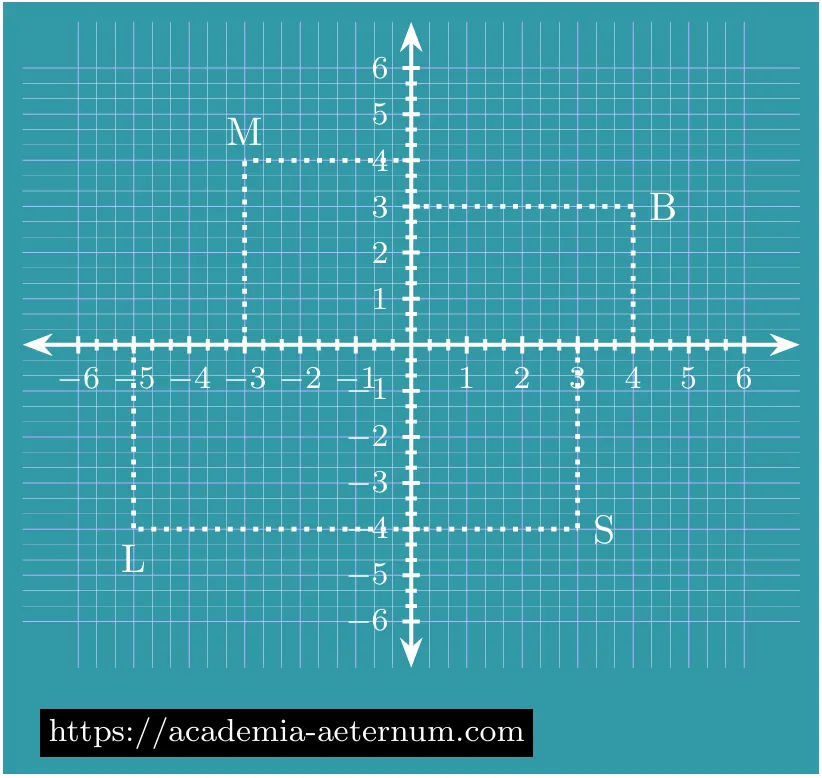
Example 1 : Reading Coordinates from Cartesian Plane
❓ Question
  1. The abscissa and the ordinate of the point \(\small B\) are _ _ _ and _ _ _, respectively. Hence, the coordinates of \(\small B\) are (_ _, _ _).
  2. The x-coordinate and the y-coordinate of the point \(\small M\) are _ _ _ and _ _ _, respectively. Hence, the coordinates of \(\small M\) are (_ _, _ _).
  3. The x-coordinate and the y-coordinate of the point \(\small L\) are _ _ _ and _ _ _, respectively. Hence, the coordinates of \(\small L\) are (_ _, _ _).
  4. The x-coordinate and the y-coordinate of the point \(\small S\) are _ _ _ and _ _ _, respectively. Hence, the coordinates of \(\small S\) are (_ _, _ _).
🖼️ Figure
Coordinates of points on Cartesian plane
Reading coordinates of points on Cartesian plane
Coordinates of points on Cartesian plane
💡 Concept
🗺️ Roadmap
  • Locate the point on the graph.
  • Read the x-coordinate from the x-axis.
  • Read the y-coordinate from the y-axis.
  • Write the ordered pair carefully.
  • Check signs of coordinates according to the quadrant.
🧩 Solution
1. Coordinates of Point \(\small B\)

Point \(\small B\) lies:

  • 4 units to the right of the y-axis
  • 3 units above the x-axis

Therefore:

Abscissa \(\small =4\)

Ordinate \(\small =3\)

Hence, the coordinates of \(\small B\) are:

\[\small (4,3)\]

2. Coordinates of Point \(\small M\)

Point \(\small M\) lies:

  • 3 units to the left of the y-axis
  • 4 units above the x-axis

Therefore:

x-coordinate \(\small =-3\)

y-coordinate \(\small =4\)

Hence, the coordinates of \(\small M\) are:

\[\small (-3,4) \]

3. Coordinates of Point \(\small L\)

Point \(\small L\) lies:

  • 5 units to the left of the y-axis
  • 4 units below the x-axis

Therefore:

x-coordinate \(\small =-5\)

y-coordinate \(\small =-4\)

Hence, the coordinates of \(\small L\) are:

\[\small (-5,-4) \]

4. Coordinates of Point \(\small S\)

Point \(\small S\) lies:

  • 3 units to the right of the y-axis
  • 4 units below the x-axis

Therefore:

x-coordinate \(\small =3\)

y-coordinate \(\small =-4\)

Hence, the coordinates of \(\small S\) are:

\[\small (3,-4) \]

Quadrant Analysis
Point Coordinates Signs Quadrant
\(\small B\) \(\small (4,3)\) \(\small (+,+)\) First Quadrant
\(\small M\) \(\small (-3,4)\) \(\small (-,+)\) Second Quadrant
\(\small L\) \(\small (-5,-4)\) \(\small (-,-)\) Third Quadrant
\(\small S\) \(\small (3,-4)\) \(\small (+,-)\) Fourth Quadrant
⚡ Exam Tip
❌ Common Mistakes
  • Interchanging x-coordinate and y-coordinate.
  • Ignoring negative signs while reading the graph.
  • Writing coordinates without commas or brackets.
  • Confusing quadrants II and IV.
📝 Summary
Learning Summary
📍
Example 2 : Coordinates of Points on Axes
❓ Question
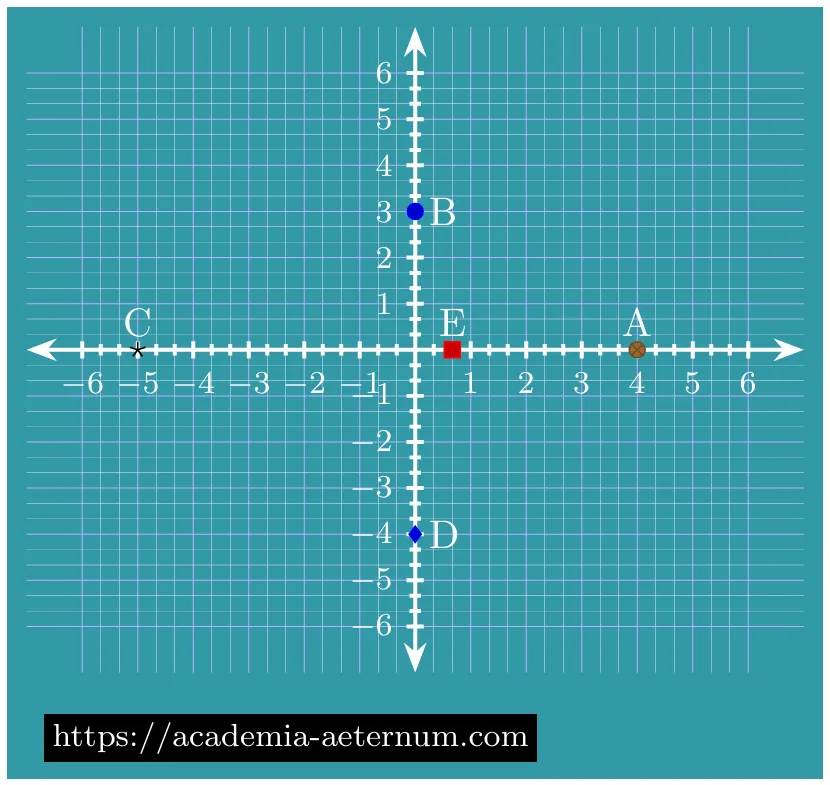
Write the coordinates of the points marked on the coordinate axes in Fig-2.
🖼️ Figure
Coordinates of points marked on the axes
💡 Concept
📖 Theory
🗺️ Roadmap
  1. Observe whether the point lies on x-axis or y-axis.
  2. Read the distance of the point from the origin.
  3. Assign positive or negative sign according to direction.
  4. Write coordinates carefully in the form: \[\small (x,y) \]
🧩 Solution
1. Coordinates of Point \(\small A\)

Point \(\small A\) lies on the positive x-axis.

  • Distance from y-axis \(\small =4\)
  • Distance from x-axis \(\small =0\)

Therefore:

x-coordinate \(\small =4\)

y-coordinate \(\small =0\)

Hence, the coordinates of point \(\small A\) are:

\[\small (4,0) \]

2. Coordinates of Point \(\small B\)

Point \(\small B\) lies on the positive y-axis.

  • Distance from y-axis \(\small =0\)
  • Distance from x-axis \(\small =3\)

Therefore:

x-coordinate \(\small =0\)

y-coordinate \(\small =3\)

Hence, the coordinates of point \(\small B\) are:

\[\small (0,3) \]

3. Coordinates of Point \(\small C\)

Point \(\small C\) lies on the negative x-axis.

  • Distance from y-axis \(\small =-5\)
  • Distance from x-axis \(\small =0\)

Therefore:

x-coordinate \(\small =-5\)

y-coordinate \(\small =0\)

Hence, the coordinates of point \(\small C\) are:

\[\small (-5,0) \]

4. Coordinates of Point \(\small D\)

Point \(\small D\) lies on the negative y-axis.

  • Distance from y-axis \(\small =0\)
  • Distance from x-axis \(\small =-4\)

Therefore:

x-coordinate \(\small =0\)

y-coordinate \(\small =-4\)

Hence, the coordinates of point \(\small D\) are:

\[\small (0,-4) \]

5. Coordinates of Point \(\small E\)

Point \(\small E\) lies on the positive x-axis.

  • Distance from y-axis: \[\small \frac{2}{3} \]
  • Distance from x-axis \(\small =0\)

Therefore:

x-coordinate: \[\small \frac{2}{3} \]

y-coordinate: \[\small 0 \]

Hence, the coordinates of point \(\small E\) are:

\[\small \left(\frac{2}{3},0\right) \]

Summary Table

Point Coordinates Position
\(\small A\) \(\small (4,0)\) Positive x-axis
\(\small B\) \(\small (0,3)\) Positive y-axis
\(\small C\) \(\small (-5,0)\) Negative x-axis
\(\small D\) \(\small (0,-4)\) Negative y-axis
\(\small E\) \[\small \left(\frac{2}{3},0\right) \] Positive x-axis
👁️ Observation
Important Observations
⚡ Exam Tip
❌ Common Mistakes
  • Writing \(\small (0,x)\) instead of \(\small (x,0)\).
  • Ignoring negative direction on axes.
  • Confusing x-coordinate with y-coordinate.
  • Writing coordinates without brackets or commas.
  • Incorrectly placing fractional coordinates.
📝 Summary
Learning Summary
📍
Example 3 : Plotting Points on Cartesian Plane
❓ Question

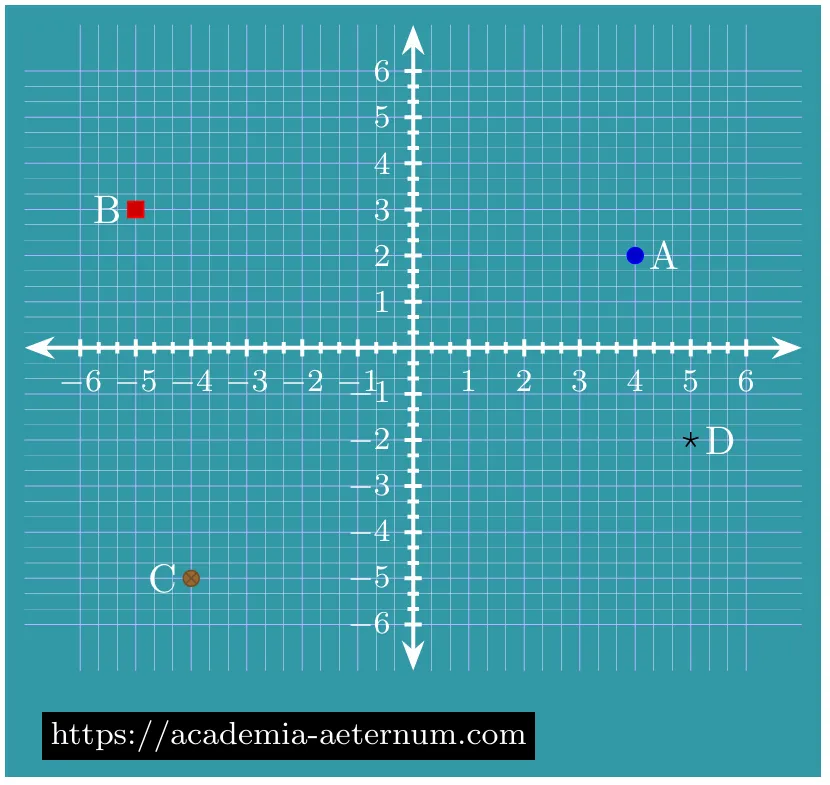
Plot the following points on the Cartesian plane:

\[\small A(4,2),\quad B(-5,3),\quad C(-4,-5),\quad D(5,2) \]

💡 Concept
Concept Used
📖 Theory
Theory and Concep
🗺️ Roadmap
Roadmap to Plot Points
  • Read the x-coordinate first.
  • Move left or right on the x-axis.
  • Then read the y-coordinate.
  • Move upward or downward parallel to the y-axis.
  • Mark and label the point carefully.
👁️ Observation
bservation Table
🧩 Solution
Plotting Point \(\small A(4,2)\)
  • Move 4 units to the right of the origin.
  • From there, move 2 units upward.
  • Mark the point as \(\small A\).

Since both coordinates are positive, point \(\small A\) lies in the: First Quadrant.

Plotting Point \(\small B(-5,3)\)
  • Move 5 units to the left of the origin.
  • From there, move 3 units upward.
  • Mark the point as \(\small B\).

Since x-coordinate is negative and y-coordinate is positive, point \(\small B\) lies in the: Second Quadrant.

Plotting Point \(\small C(-4,-5)\)
  • Move 4 units to the left of the origin.
  • From there, move 5 units downward.
  • Mark the point as \(\small C\).

Since both coordinates are negative, point \(\small C\) lies in the: Third Quadrant.

Plotting Point \(\small D(5,2)\)
  • Move 5 units to the right of the origin.
  • From there, move 2 units upward.
  • Mark the point as \(\small D\).

Since both coordinates are positive, point \(\small D\) lies in the: First Quadrant.

🖼️ Figure
Plotting points on Cartesian coordinate plane
Fig-3 : Graph showing plotted points on Cartesian plane
⚡ Exam Tip
❌ Common Mistakes
  • Interchanging x-coordinate and y-coordinate.
  • Moving vertically before horizontal movement.
  • Ignoring negative signs.
  • Plotting points in wrong quadrants.
  • Using unequal spacing on axes.
  • Forgetting to label plotted points.
📝 Summary
Learning Summary
📍
Example 4 : Finding the Fourth Vertex of a Rectangle
❓ Question

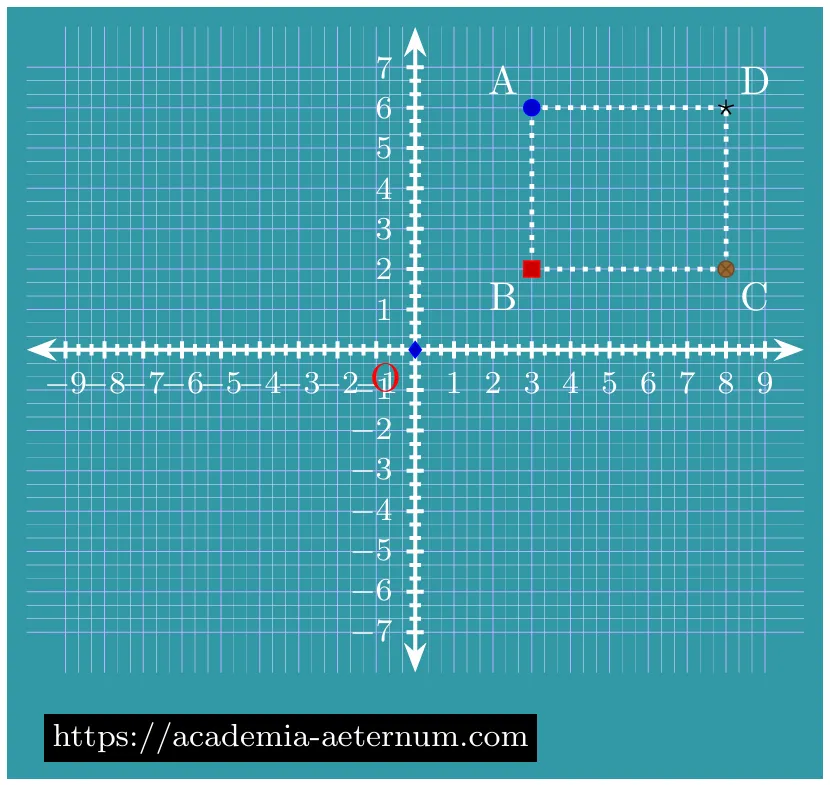
The points \[\small A(3,6),\quad B(3,2),\quad C(8,2) \] are the vertices of a rectangle. Plot these points on the Cartesian plane and use the graph to find the coordinates of the fourth vertex \(\small D\).

💡 Concept
Concept Used
📖 Theory
👁️ Observation
🗺️ Roadmap
Solution Roadmap
  1. Plot the given points carefully.
  2. Observe horizontal and vertical sides.
  3. Use properties of rectangle.
  4. Determine missing coordinate using parallel sides.
  5. Plot the fourth vertex and complete the rectangle.
🔄 Process
Construction Procedure
  • 1
    Draw Coordinate Axes

    Draw two mutually perpendicular lines intersecting at the origin \(\small O(0,0)\).

    • Horizontal line \(\small \rightarrow\) x-axis
    • Vertical line \(\small \rightarrow\) y-axis

    Mark equal divisions on both axes.

  • 2
    Plot the Given Points
    • Move 3 units right.
    • Move 6 units upward.
    • Mark the point as \(\small A\).
    Plot Point \(\small B(3,2)\)
    • Move 3 units right.
    • Move 2 units upward.
    • Mark the point as \(\small B\).
    Plot Point \(\small C(8,2)\)
    • Move 8 units right.
    • Move 2 units upward.
    • Mark the point as \(\small C\).
  • 3
    Join the Points

    Join:

    • \(\small A\) to \(\small B\)
    • \(\small B\) to \(\small C\)

    These form two adjacent sides of the rectangle.

  • 4
    Determine Coordinates of \(\small D\)

    Observe carefully:

    • Point \(\small A\) and point \(\small D\) lie on the same horizontal line.
    • Therefore, y-coordinate of \(\small D\) will be same as point \(\small A\): \(\small 6\)
    • Point \(\small C\) and point \(\small D\) lie on the same vertical line.
    • Therefore, x-coordinate of \(\small D\) will be same as point \(\small C\): \(\small 8\)

    Hence, the coordinates of point \(\small D\) are:

    \[\small D(8,6)\]
  • 5
    Complete the Rectangle

    Plot point:

    \[\small D(8,6)\]

    Join:

    • \(\small C\) to \(\small D\)
    • \(\small D\) to \(\small A\)

    Rectangle \(\small ABCD\) is obtained.

📎 Side Note

Coordinate Analysis

Vertex Coordinates Observation
\(\small A\) \(\small (3,6)\) Upper-left corner
\(\small B\) \(\small (3,2)\) Same x-coordinate as \(\small A\)
\(\small C\) \(\small (8,2)\) Same y-coordinate as \(\small B\)
\(\small D\) \(\small (8,6)\) Same x-coordinate as \(\small C\) and same y-coordinate as \(\small A\)
🖼️ Figure
Rectangle formed by plotting the given vertices
🧩 Solution

Shortcut Method

In rectangles parallel to coordinate axes:

  • Horizontal sides have same y-coordinate.
  • Vertical sides have same x-coordinate.

Therefore:

\[\small D=(x\text{-coordinate of }C,\ y\text{-coordinate of }A)\]

\[\small D=(8,6) \]

⚡ Exam Tip
❌ Common Mistakes
  • Interchanging x-coordinate and y-coordinate.
  • Incorrectly identifying horizontal and vertical sides.
  • Using unequal scale on axes.
  • Plotting points in wrong locations.
  • Writing incorrect coordinates for the fourth vertex.
🗒️ Applicatons
  • Designing rectangular parks and buildings.
  • Computer graphics and digital designing.
  • Blueprint construction in engineering.
  • Game development and coordinate mapping.
  • Navigation systems and map plotting.
📝 Summary
📍
Example 5 : Checking Collinearity of Points
❓ Question

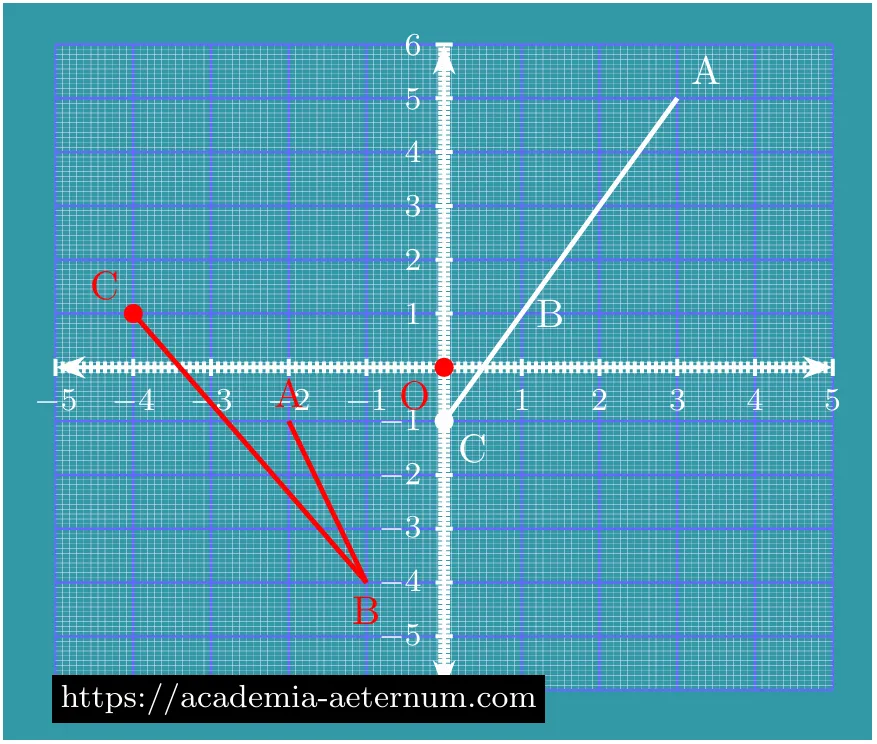
By plotting the following points on the same graph paper, determine whether the given points are collinear or not:

(i) \[\small (3,5),\quad (1,1),\quad (0,-1) \]

(ii) \[\small (-2,-1),\quad (-1,-4),\quad (-4,1) \]

💡 Concept
🗒️ Definiton

Three or more points are said to be collinear if they lie on the same straight line.

If the points do not lie on a single straight line, they are called non-collinear points.

👁️ Observation

Important Observation

🔄 Process

Construction Procedure

  • 1
    Draw Coordinate Axes

    Draw the x-axis and y-axis perpendicular to each other.

    Choose a suitable scale so that all coordinates can be plotted easily.

  • 2
    Plot the Given Points

    Plot all the points carefully by:

    • Moving horizontally according to x-coordinate.
    • Moving vertically according to y-coordinate.
    For Set (i)

    Plot: \[\small (3,5),\quad (1,1),\quad (0,-1) \]

    For Set (ii)

    Plot: \[\small (-2,-1),\quad (-1,-4),\quad (-4,1) \]

  • 3
    Join the Points

    Draw straight lines through the plotted points in each group.

    Observe whether all points lie on the same straight line.

  • 4
    Check Collinearity
    • If all three points lie on one straight line \(\small \rightarrow\) Collinear
    • If one point lies away from the line \(\small \rightarrow\) Non-collinear
🖼️ Figure
Checking collinearity of points on Cartesian plane
Fig-5 : Collinear and non-collinear points plotted on Cartesian plane
🔍 Interpretation
Graphical Analysis
Set (i)

Points:

\[\small (3,5),\quad (1,1),\quad (0,-1)\]

After plotting and joining these points, we observe that all three points lie on the same straight line.

Therefore, the points are: Collinear

Set (ii)

Points:

\[\small (-2,-1),\quad (-1,-4),\quad (-4,1) \]

After plotting and joining these points, one point does not lie on the same straight line formed by the other two points.

Therefore, the points are: Non-collinear

⚡ Exam Tip
❌ Common Mistakes
  • Incorrect plotting of negative coordinates.
  • Using unequal scale on graph paper.
  • Joining points inaccurately.
  • Confusing collinear with nearby points.
  • Forgetting to label axes and points.
📝 Summary

Learning Summary

📍
Important Points to Remember
⚡ Quick Revision

The following concepts form the core foundation of Coordinate Geometry. These points are extremely important for CBSE board examinations, objective questions, viva questions, and higher mathematics.

Why These Points Are Important?
  • Frequently asked in MCQs and short-answer questions.
  • Helpful in graph plotting and case-study based questions.
  • Builds foundation for higher coordinate geometry.
  • Important for competitive and Olympiad examinations.
💡 Concept
Fundamental Concepts
🔎 Key Fact
Important Facts About Coordinates
🗒️ Points On Coordinate Axes
Position of Point Coordinate Form Observation
Point on x-axis \[\small (x,0) \] y-coordinate is always zero
Point on y-axis \[\small (0,y) \] x-coordinate is always zero
Origin \[\small (0,0) \] Both coordinates are zero
🗒️ Important
  • Points on axes do not belong to any quadrant.
  • Only points inside the regions belong to quadrants.
NCERT Class IX · Chapter 3

Coordinate Geometry
AI Learning Engine

A complete, interactive mastery system — concepts, solver, formulas,
quizzes, and smart tips all in one place.

9 Core Concepts
20+ Practice Problems
5 Solver Modules
15 Quiz Questions
 Interactive Tools
Core Knowledge
All Concepts Explained

Tap any concept card to expand a detailed explanation with formulas, examples, and key notes.

Reference Sheet
All Formulas at a Glance

Every formula from NCERT Class IX Coordinate Geometry — cleanly organised with notes.

Step-by-Step AI Solver
Solve Any Problem Instantly

Pick a problem type, enter values, and receive a complete step-by-step solution with all working shown.

Find the distance between two points P(x₁,y₁) and Q(x₂,y₂).

Find the midpoint M of the segment joining P(x₁,y₁) and Q(x₂,y₂).

Find the point dividing P(x₁,y₁)–Q(x₂,y₂) internally in ratio m:n.

Find the area of a triangle with vertices A(x₁,y₁), B(x₂,y₂), C(x₃,y₃).

Determine the quadrant or axis position for any point P(x, y).

Practice & Mastery
Concept-Based Questions

Original questions with full step-by-step solutions. Filter by concept or difficulty level.

Smart Study
Tips, Tricks & Memory Aids

Time-saving shortcuts, mnemonics, and insights for faster and more accurate problem-solving.

Error Prevention
Common Mistakes to Avoid

Students lose marks on these. Learn the exact pitfalls and always get it right.

Interactive Learning
Plot & Explore the Coordinate Plane

Click anywhere on the grid to plot points. Use the tools below to measure distances, find midpoints, and explore quadrants.

Click on the grid to plot a point
🧭
Quadrant Explorer

Signs and properties of all four quadrants at a glance.

Quadrant II (−, +) x negative · y positive
Quadrant I (+, +) x positive · y positive
Quadrant III (−, −) x negative · y negative
Quadrant IV (+, −) x positive · y negative
💡
Mnemonic: Start from Quadrant I (top-right), go anti-clockwise → I (+,+), II (−,+), III (−,−), IV (+,−). Remember: "All Students Take Classes".
Test Yourself
Concept Mastery Quiz

15 questions covering all topics. Each answer comes with a detailed explanation.

0/15
Quiz Complete!
📚
ACADEMIA AETERNUM तमसो मा ज्योतिर्गमय · Est. 2025
Sharing this chapter
Coordinate Geometry Notes for Class 9 Maths NCERT
Coordinate Geometry Notes for Class 9 Maths NCERT — Complete Notes & Solutions · academia-aeternum.com
Coordinate Geometry is a branch of mathematics that links algebra and geometry through the use of coordinates. In Chapter 3 of the NCERT Class IX Mathematics textbook, students learn how to describe the position of points in a plane using ordered pairs and apply the concepts to solve geometry problems. The chapter introduces the Cartesian system, the meaning of axes, origin, coordinates, and how to plot points on graph paper. It lays the foundation for understanding relations between algebraic…
🎓 Class 9 📐 Mathematics 📖 NCERT ✅ Free Access 🏆 CBSE · JEE
Share on
academia-aeternum.com/class-9/mathematics/coordinate-geometry/notes/ Copy link
💡
Exam tip: Sharing chapter notes with your study group creates a reinforcement loop. Teaching a concept is the fastest path to mastering it.

Recent posts

    COORDINATE GEOMETRY — Learning Resources

    📝 Exercises

    Get in Touch

    Let's Connect

    Questions, feedback, or suggestions?
    We'd love to hear from you.