Triangles is the highest-weightage geometry chapter in Class IX, contributing 12–14 marks in CBSE Boards. Congruence proofs (SSS, SAS, ASA, AAS, RHS) are guaranteed 3–5 mark questions. Properties of isosceles triangles and inequalities in triangles appear as short-answer questions. NTSE and Olympiad problems involve multi-step congruence chains.
Key Concept Highlights
Congruence of Triangles
SAS Congruence Criterion
ASA Congruence Criterion
AAS Congruence Criterion
SSS Congruence Criterion
RHS Congruence Criterion
Properties of Isosceles Triangles
Inequalities in a Triangle
Angle-Side Relationship
Properties of Equilateral Triangles
CPCT (Corresponding Parts of Congruent Triangles)
Important Formula Capsules
$\text{SAS: Two sides and included angle equal}$
$\text{ASA: Two angles and included side equal}$
$\text{AAS: Two angles and non-included side equal}$
$\text{SSS: All three sides equal}$
$\text{RHS: Right angle, hypotenuse, one side equal}$
$\text{Isosceles: angles opposite equal sides are equal}$
$\text{Greater side is opposite the greater angle}$
What You Will Learn
◆State all five congruence criteria with diagrams
◆Write formal congruence proofs using CPCT
◆Prove properties of isosceles and equilateral triangles
◆Apply inequalities to compare sides and angles
◆Construct two-column or paragraph proofs
◆Identify which criterion to apply in a given situation
Every congruence proof follows the same structure: state the given, identify the criterion, list three matching conditions, conclude congruence, then use CPCT for further deductions. Learn to recognise which criterion is applicable within 10 seconds of reading the problem. CBSE proofs are always 5-markers — they demand every step with reasons. Time investment: 4–5 days.
Chapter 7 · CBSE · Class IX
🔺
Congruency of Figures and Triangles
NCERT Class 9 MathematicsCongruence of TrianglesTriangle Congruence CriteriaSSS Congruence RuleSAS Congruence RuleASA Congruence RuleRHS Congruence RuleProperties of TrianglesIsosceles TriangleEquilateral TriangleAngle Sum Property of TriangleExterior Angle PropertyNCERT Maths Chapter 7Triangles Notes
🗺️ Overview
Congruency is one of the most important concepts in geometry and forms the foundation of
triangle properties, constructions, proofs, symmetry, and mensuration. Two geometric figures
are said to be congruent if they have exactly the same shape and the same size.
Such figures perfectly overlap each other when placed one above another.
Congruent figures may appear in different orientations because they can be shifted, rotated,
or reflected without changing their dimensions. These movements are called
rigid transformations.
Symbol of Congruency:
\[
\cong
\]
Example:
\[
\triangle ABC \cong \triangle PQR
\]
🔍 Interpretation
Meaning of Congruency
If two figures are congruent, then every corresponding part of one figure is equal to
the corresponding part of the other figure.
Property
Congruent Figures
Shape
Equal
Size
Equal
Area
Equal
Perimeter
Equal
Corresponding Angles
Equal
Corresponding Sides
Equal
📌 Rigid Transformations in Congruency
Congruent figures can be transformed into one another using rigid motions.
These transformations preserve both shape and size.
Translation
Sliding a figure from one position to another without rotating it.
Rotation
Turning a figure about a fixed point through a certain angle.
Reflection
Flipping a figure across a line to create a mirror image.
📘 Congruent Triangles
Two triangles are congruent if all corresponding sides and corresponding angles
are equal.
Important:
If two triangles are congruent, then their corresponding parts are equal.
This result is called CPCT.
🌟 CPCT: Corresponding Parts of Congruent Triangles
CPCT means:
Corresponding Parts of Congruent Triangles are Equal
If:
\[
\triangle ABC \cong \triangle PQR
\]
then:
\[
AB = PQ
\]
\[
BC = QR
\]
\[
AC = PR
\]
\[
\angle A = \angle P
\]
\[
\angle B = \angle Q
\]
\[
\angle C = \angle R
\]
📊 Difference Between Congruency and Similarity
Basis
Congruent Figures
Similar Figures
Shape
Same
Same
Size
Same
May differ
Corresponding Sides
Equal
Proportional
Area
Equal
May differ
Symbol
\(\cong\)
\(\sim\)
✏️ Example
Solved Examples
In triangles \( \triangle ABC \) and \( \triangle PQR \),
if
\[
AB = PQ,\quad BC = QR,\quad AC = PR
\]
then prove that:
\[
\triangle ABC \cong \triangle PQR
\]
The SSS Congruence Rule states that if all three corresponding
sides of two triangles are equal, then the triangles are congruent.
1
Identify corresponding sides.
2
Check equality of all three sides.
3
Apply SSS congruence criterion.
4
Conclude congruency.
Given
\[\small AB = PQ,\quad BC = QR,\quad AC = PR\]
Since all the three corresponding sides are equal,
by SSS congruence criterion,
\[\small \triangle ABC \cong \triangle PQR\]
🌟 Importance
Congruency forms the basis of theorem proofs in the chapter
"Triangles".
Questions based on CPCT are frequently asked in board exams.
Students must know correct correspondence while writing congruent
triangles.
Diagram understanding and proper notation carry significant marks.
Congruency is also important for higher mathematics and coordinate geometry.
❌ Common Mistakes
Writing incorrect correspondence in congruent triangles.
Confusing congruency with similarity.
Forgetting to mention the congruence rule used.
Assuming equal appearance means congruent dimensions.
Ignoring orientation while matching vertices.
📋 Case Study
Two triangular metal plates are manufactured for a machine.
Each plate has side lengths:
The engineer claims that both plates are exactly identical.
Questions
Which congruence criterion can verify the claim?
Are the plates congruent?
Why is congruency important in machine design?
">
Answer
SSS Congruence Criterion.
Yes, the plates are congruent because all corresponding
sides are equal.
Congruent machine parts ensure proper fitting,
precision, balance, and smooth functioning.
⚡ Quick Revision
Congruent figures have same shape and same size.
Symbol of congruency is \(\cong\).
Rigid transformations preserve dimensions.
CPCT means corresponding parts are equal.
Congruency is different from similarity.
🔺
Congruence of Triangles
🗺️ Overview
Two triangles are said to be congruent if they are exactly equal in both
shape and size. In congruent triangles, all corresponding sides and corresponding angles
are equal. Such triangles completely overlap each other when placed one above another.
Important Mathematical Symbol:
\[\small
\cong
\]
Example:
\[\small
\triangle ABC \cong \triangle PQR
\]
📘 Definition
Definition of Congruent Triangles
If every side and angle of one triangle is equal to the corresponding side and angle
of another triangle, then the two triangles are called congruent triangles.
Congruent triangles may have different orientations because they can be rotated,
reflected, or translated without changing their dimensions.
🎨 Graphical Representation
🏷️ Properties
Properties of Congruent Triangles
Properties
Equal Corresponding Sides
Each side of one triangle is equal to the corresponding side
of the other triangle.
\[\small AB = PQ\]
Equal Corresponding Angles
Each angle of one triangle equals the corresponding angle
of the other triangle.
\[\small \angle A = \angle P\]
Equal Perimeter
Congruent triangles always have equal perimeter because all
corresponding sides are equal.
Equal Area
Since both triangles are identical in dimensions,
their areas are also equal.
💡 CPCT Concept
In congruent triangles, corresponding parts are equal. This is written in short as:
CPCT = Corresponding Parts of Congruent Triangles
If:
\[
\triangle ABC \cong \triangle PQR
\]
then:
\[
AB = PQ
\]
\[
BC = QR
\]
\[
AC = PR
\]
\[\small
\angle A = \angle P
\]
\[\small
\angle B = \angle Q
\]
\[\small
\angle C = \angle R
\]
Exam Note:
Students often lose marks by writing incorrect corresponding vertices.
The order of vertices must always match correctly.
🔢 Criteria for Congruence of Triangles
It is not necessary to compare all six parts of two triangles.
Some special criteria are sufficient to prove congruency.
Criterion
Full Form
Condition
SSS
Side-Side-Side
All three corresponding sides are equal
SAS
Side-Angle-Side
Two sides and included angle are equal
ASA
Angle-Side-Angle
Two angles and included side are equal
RHS
Right angle-Hypotenuse-Side
Applicable in right triangles
🌟 Importance
Helps in proving geometrical theorems.
Used in construction of bridges, buildings, and machines.
Forms the basis of symmetry and transformations.
Frequently used in board examination proofs.
Essential for higher mathematics and engineering graphics.
🔺
Example-1
❓ Question
In triangles \( \triangle ABC \) and \( \triangle DEF \),
the following are given:
\[\small AB = DE\]
\[\small BC = EF\]
\[\small AC = DF\]
Prove that:
\[\small
\triangle ABC \cong \triangle DEF
\]
💡 Concept
SSS Criterion
If all three corresponding sides of two triangles are equal,
then the triangles are congruent by SSS criterion.
🗺️ Roadmap
Roadmap to Solution
Identify equal corresponding sides.
Apply SSS congruence criterion.
Conclude congruency.
🧩 Solution
Step-by-step Solution
Given
\[\small AB = DE\]
\[\small BC = EF\]
\[\small AC = DF\]
Since all three corresponding sides are equal,
by SSS congruence criterion,
\[\small
\triangle ABC \cong \triangle DEF
\]
⚡ Exam Tip
Always write congruent triangles in correct corresponding order.
Mention the congruence criterion clearly in proofs.
Draw neat diagrams with proper labelling.
Revise CPCT thoroughly because many theorem proofs depend on it.
Practice HOTS and case-study based questions regularly.
❌ Common Mistakes
Writing wrong corresponding vertices.
Confusing congruent triangles with similar triangles.
Forgetting to mention the criterion used.
Assuming triangles are congruent merely by appearance.
Ignoring proper notation in geometry proofs.
⚡ Quick Revision
Congruent triangles have equal shape and size.
Symbol of congruency:
\[
\cong
\]
CPCT means corresponding parts are equal.
SSS, SAS, ASA, and RHS are important congruence criteria.
Correct correspondence is essential in theorem proofs.
🔺
SSS Congruence Criterion
📘 Definition
If all three sides of one triangle are equal to the corresponding three sides
of another triangle, then the two triangles are congruent.
\[\small
AB = PQ,\quad BC = QR,\quad AC = PR
\]
then
\[\small
\triangle ABC \cong \triangle PQR
\]
💡 Concept
A triangle is completely determined when all its three sides are fixed.
Therefore, another triangle with exactly the same three side lengths
must overlap perfectly with it.
🎨 SSS Criterion
✏️ Example
In triangles \(\small \triangle ABC \) and \( \triangle DEF \):
\[\small
AB = DE,\quad BC = EF,\quad AC = DF
\]
Since all corresponding sides are equal,
by SSS criterion:
\[\small
\triangle ABC \cong \triangle DEF
\]
🔺
SAS Congruence Criterion
📘 Definition
If two sides and the included angle of one triangle are equal to the
corresponding two sides and included angle of another triangle,
then the triangles are congruent.
\[\small
AB = PQ,\quad BC = QR,\quad \angle B = \angle Q
\]
then
\[\small
\triangle ABC \cong \triangle PQR
\]
Meaning of Included Angle
The included angle is the angle formed between the two given sides.
🎨 SAS Criterion
Board Exam Tip
Students frequently make mistakes by using a non-included angle in SAS.
Always verify that the given angle lies between the two given sides.
🔺
ASA Congruence Criterion
📘 Definition
If two angles and the included side of one triangle are equal to the
corresponding two angles and included side of another triangle,
then the triangles are congruent.
\[\small
\angle A = \angle P,\quad
AC = PR,\quad
\angle C = \angle R
\]
then
\[\small
\triangle ABC \cong \triangle PQR
\]
💡 Concept
When two angles and the side between them are fixed, the triangle gets a
unique shape and size.
👁️ Observation
Since the sum of angles in a triangle is always:
\[\small
180^\circ
\]
the third angle automatically becomes equal.
🔺
AAS Congruence Criterion
📘 Definition
If two angles and one non-included side of one triangle are equal to
the corresponding two angles and one non-included side of another triangle,
then the triangles are congruent.
\[\small
\angle A = \angle P,\quad
\angle B = \angle Q,\quad
AC = PR
\]
then
\[\small
\triangle ABC \cong \triangle PQR
\]
💡 Concept
Two equal angles determine the third angle automatically because:
Therefore, AAS effectively reduces to the ASA condition.
🔺
RHS Congruence Criterion
📘 Definition
In two right-angled triangles, if the hypotenuse and one corresponding side
are equal, then the triangles are congruent.
If:
\[\small
\angle B = \angle Q = 90^\circ
\]
\[\small
AC = PR
\]
\[\small
AB = PQ
\]
then:
\[\small
\triangle ABC \cong \triangle PQR
\]
🎨 RHS Criterion
👁️ Observation
RHS criterion is applicable only for right-angled triangles.
It cannot be used for ordinary triangles.
🔺
Example-2
❓ Question
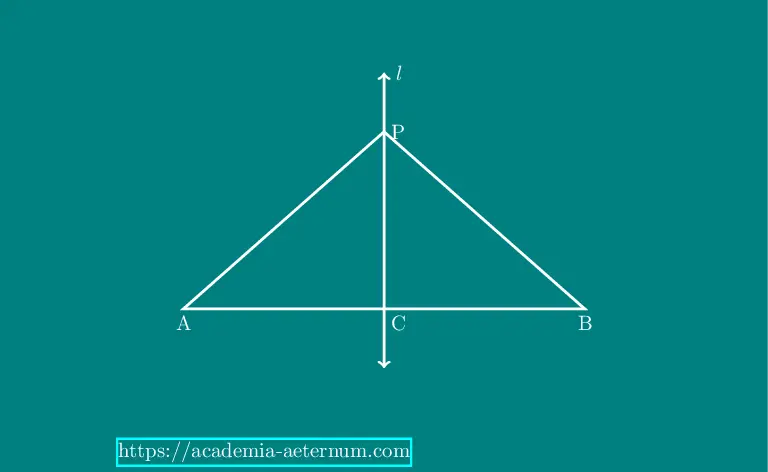
\(AB\) is a line segment and line \(l\) is its perpendicular bisector.
If a point \(P\) lies on \(l\), show that \(P\) is equidistant from
\(A\) and \(B\).
🖼️ Figure
Fig. 7.9 : Point on Perpendicular Bisector is Equidistant from Endpoints
💡 Concept
Every point lying on the perpendicular bisector of a line segment is
equidistant from the endpoints of that segment.
🔬 Proof
Given
\(\small AB\) is a line segment.
\(\small l\) is the perpendicular bisector of \(\small AB\).
Let \(\small C\) be the midpoint of \(\small AB\).
Since line \(\small l\) is the perpendicular bisector of \(\small AB\),
\[\small AC = CB\]
Also
\[\small \angle ACP = \angle BCP = 90^\circ\]
and
\[\small PC = PC\]
therefore,
In triangles \(\small \triangle APC \) and \(\small \triangle BPC \):
\(\small C\) is midpoint of \(\small AB\), therefore,
\[\small AC = CB\]
Each Angles is equals to \(\small 90^\circ\)
\[\small \angle ACP = \angle BCP\]
Common side
\[\small PC = PC\]
Hence,
\[\small \triangle APC \cong \triangle BPC\]
(By SAS Congruence Criterion)
Therefore, corresponding sides are equal:
\[\small AP = BP\quad \text{(By CPCT)}\]
Hence Proved.
👁️ Observation
This theorem is frequently used in constructions and theorem proofs.
It also forms the basis of locus concepts in higher mathematics.
Remember:
Every point on the perpendicular bisector of a line segment is equidistant
from the endpoints of that segment.
🔺
Example-3
❓ Question
Line-segment \(\small AB\) is parallel to another line-segment \(\small CD\).
\(\small O\) is the midpoint of \(\small AD\) (see Fig. 7.15).
Show that:
\[\small
\triangle AOB \cong \triangle DOC
\]
\(\small O\) is also the midpoint of \(\small BC\).
🎨 SVG Diagram
Fig. 7.15 : Congruent Triangles Formed by Parallel Segments
💡 Concept
Parallel lines produce equal alternate interior angles,
which help establish triangle congruency.
🧩 Solution
Given
\[\small
AB \parallel CD
\]
\(\small O\) is midpoint of \(\small AD\)
\[\small
AO = OD
\]
To Prove
\[\small \triangle AOB \cong \triangle DOC\]
and
\(\small O\) is midpoint of \(\small BC\)
Concept Analysis
Since:
\[
AB \parallel CD
\]
Alternate interior angles become equal.
Also, vertically opposite angles are always equal.
Using these angle equalities and one equal side,
we can apply the AAS congruence criterion.
🔬 Proof
Since \(O\) is midpoint of \(AD\),
\[\small AO = OD\]
Since:
\[\small AB \parallel CD\]
therefore alternate interior angles are equal:
\[\small \angle ABO = \angle DCO\]
Also, vertically opposite angles are equal:
\[\small \angle AOB = \angle DOC\]
Therefore, in triangles
\( \triangle AOB \) and \( \triangle DOC \):
\[\small AO = OD\]
Given
\[\small \angle ABO = \angle DCO\]
Alternate interior angles
\[\small \angle AOB = \angle DOC\]
Vertically opposite angles
Hence,
\[\small \triangle AOB \cong \triangle DOC\]
(By AAS Congruence Criterion)
Therefore, corresponding sides are equal:
\[\small OB = OC\]
(By CPCT)
Hence, \(O\) is midpoint of \(BC\).
⚡ Exam Tip
Always mention the reason while writing equal angles.
Do not confuse alternate interior angles with corresponding angles.
Mention the congruence criterion clearly in proofs.
Write CPCT only after proving congruency.
Maintain proper order while naming congruent triangles.
If two angles of a triangle are equal,
then the sides opposite to them are equal.
If:
\[\small
\angle B = \angle C
\]
then:
\[\small
AB = AC
\]
⚡ Exam Tip
Always write the congruence criterion used in proofs.
Mention CPCT only after proving congruency.
Draw neat labelled diagrams for theorem proofs.
Learn both theorem and converse theorem carefully.
Practice theorem proofs step-by-step to improve scoring accuracy.
❌ Common Mistakes
Writing incorrect angle names while proving equal angles.
Forgetting to mention construction steps.
Using CPCT before proving congruency.
Confusing isosceles triangles with equilateral triangles.
Not maintaining proper triangle correspondence.
📋 Case Study
A designer creates a decorative triangular frame such that:
\[\small
AB = AC = 15\text{ cm}
\]
The designer wants both base angles to be identical for symmetry.
Questions
What type of triangle is formed?
Which theorem guarantees equal base angles?
Why are isosceles triangles preferred in symmetrical designs?
Solution
Isosceles triangle.
Angles opposite to equal sides of an isosceles triangle are equal.
They provide symmetry, visual balance,
and equal force distribution.
⚡ Quick Revision
An isosceles triangle has two equal sides.
Angles opposite equal sides are equal.
The theorem is proved using SAS congruence criterion.
Converse theorem is equally important.
Isosceles triangles are highly symmetrical figures.
🔺
Theorem: Sides Opposite to Equal Angles are Equal
📖 Theory
In a triangle, the sides opposite to equal angles are equal.
This theorem is the converse of the theorem:
“Angles opposite to equal sides of an isosceles triangle are equal.”
If:
\[\small
\angle B = \angle C
\]
then:
\[\small
AB = AC
\]
🎨 Angles Opposite to Equal Sides are Equal
📌 Understanding the Theorem
In any triangle, larger angles face larger sides and equal angles face equal sides.
Therefore, if two angles of a triangle are equal,
the sides opposite to those angles must also be equal.
Equal angles imply equal opposite sides.
Idea Behind the Proof
The theorem can be proved using contradiction or congruence concepts.
If the sides opposite equal angles were not equal,
then unequal sides would produce unequal opposite angles,
which contradicts the given condition.
Logical Flow
Assume:
\[\small
\angle B = \angle C
\]
Compare sides opposite these angles.
Use angle-side relationship in triangles.
Conclude:
\[\small
AB = AC
\]
✏️ Example
Solved Example
In \( \triangle ABC \), the bisector \(AD\) of
\( \angle A \) is perpendicular to side \(BC\)
(see Fig. 7.27).
Show that:
\[\small AB = AC\]
and hence \(\small \triangle ABC \) is an isosceles triangle.
Fig. 7.27 Isosceles Triangle
If an angle bisector from the vertex of a triangle is also perpendicular
to the opposite side, then the triangle becomes symmetric and hence isosceles.
Given
\(\small AD\) bisects \(\small \angle A \)
\(\small \angle BAD = \angle CAD\)
\(\small AD \perp BC\)
To Prove
\[\small AB = AC\]
and therefore
\(\small \triangle ABC \) is an isosceles triangle.
1
Consider triangles \(\small \triangle ABD \) and \(\small \triangle ACD \).
2
Use angle bisector property:
\[\small
\angle BAD = \angle CAD
\]
3
Use common side:
\[\small
AD = AD
\]
4
Use perpendicular condition:
\[\small
\angle ADB = \angle ADC = 90^\circ
\]
5
Apply ASA congruence criterion.
6
Use CPCT to prove:
\[\small
AB = AC
\]
🔬 Proof
Consider triangles \(\small \triangle ABD \) and \(\small \triangle ACD \).
\[\small \angle BAD = \angle CAD\]
Given
\[\small AD = AD\]
Common side
\[\small \angle ADB = \angle ADC = 90^\circ\]
\[\small AD \perp BC\]
Therefore:
\[\small \triangle ABD \cong \triangle ACD\]
(By ASA Congruence Criterion)
Hence, corresponding sides are equal:
\[\small AB = AC\]
(By CPCT)
therefore, \(\small \triangle ABC \) is an isosceles triangle.
Hence Proved.
👁️ Observation
In an isosceles triangle, the altitude, median,
perpendicular bisector, and angle bisector from the vertex
coincide on the same line.
⚡ Exam Tip
Always mention the congruence criterion clearly.
Write perpendicular angles as:
\[\small
90^\circ
\]
Use CPCT only after proving congruency.
Maintain proper triangle correspondence.
Draw neat labelled diagrams in theorem proofs.
❌ Common Mistakes
Forgetting to mention that \(\small AD\) is common.
Writing incorrect congruence criterion.
Using CPCT before congruency proof.
Confusing angle bisector with perpendicular bisector.
Not writing the final conclusion properly.
⚡ Quick Revision
Equal angles imply equal opposite sides.
Converse theorem is important in geometry proofs.
ASA congruence criterion is used in the example.
CPCT helps prove equality of corresponding sides.
Isosceles triangles possess symmetry properties.
🔺
Example-4
❓ Question
\(\small E\) and \(\small F\) are respectively the midpoints of equal sides
\(\small AB\) and \(\small AC\) of \(\small \triangle ABC \)
(see Fig. 7.28).
Show that:
\[\small
BF = CE
\]
🗒️ Svg
💡 Concept
Equal sides divided equally produce smaller congruent triangles,
which help establish equality of remaining corresponding parts.
🗺️ Understanding the Question
Since:
\[
AB = AC
\]
the triangle \( \triangle ABC \) is an isosceles triangle.
This example demonstrates how midpoint properties,
equal sides, and congruence criteria work together
to establish equality of unknown lengths.
Key Concepts Used
Midpoint theorem concepts
Properties of isosceles triangles
SAS Congruence Criterion
CPCT
❌ Common Mistakes
Writing incorrect corresponding triangles.
Forgetting to justify:
\[\small
AF = AE
\]
Using CPCT before proving congruency.
Confusing midpoint with perpendicular bisector.
Writing wrong angle correspondence.
⚡ Exam Tip
Always identify corresponding vertices carefully.
Mention reasons clearly for every equality.
Revise midpoint properties thoroughly.
Use proper mathematical notation in geometry proofs.
Practice writing congruence proofs in tabular form.
⚡ Quick Revision
Equal sides imply equal halves.
Midpoints divide segments into two equal parts.
SAS criterion is used in the proof.
CPCT proves equality of corresponding sides.
Correct correspondence is essential in congruency proofs.
🔺
Example-5
❓ Question
\(\small AB\) is a line segment. \(\small P\) and \(\small Q\) are points on opposite
sides of \(\small AB\) such that each of them is equidistant from the
points \(\small A\) and \(\small B\) (see Fig. 7.37).
Show that the line \(\small PQ\) is the perpendicular bisector of \(\small AB\).
🎨 SVG Diagram
Fig. 7.37 : Points Equidistant from Endpoints of a Line Segment
💡 Concept
If a point is equidistant from the endpoints of a line segment,
then the point lies on the perpendicular bisector of the segment
🔬 Proof
Given
\[\small
AP = BP
\]
\[\small
AQ = BQ
\]
\(\small P\) and \(\small Q\) lie on opposite sides of \(\small AB\)
To Prove
\(\small PQ\) is the perpendicular bisector of \(\small AB\)
What Must Be Proved?
To prove that \(\small PQ\) is the perpendicular bisector of \(\small AB\),
we must prove two conditions:
\(\small PQ\) passes through the midpoint of \(\small AB\)
\(\small PQ \perp AB\)
Let \(\small C\) be the point where line \(\small PQ\) intersects \(\small AB\).
Therefore, we need to prove:
\[\small
AC = BC
\]
and
\[\small
\angle ACP = \angle BCP = 90^\circ
\]
Concept Analysis
Since both \(\small P\) and \(\small Q\) are equidistant from \(\small A\) and \(\small B\),
triangles involving these points can be shown congruent.
Therefore, \(\small C\) is midpoint of \(\small AB\).
Also:
\[\small PQ \perp AB\]
Hence:
\(\small PQ\) is the perpendicular bisector of \(\small AB\).
❌ Common Mistakes
Writing incorrect corresponding triangles.
Forgetting to justify CPCT steps.
Using perpendicularity before proving equal angles.
Ignoring midpoint condition.
Confusing linear pair with vertically opposite angles.
⚡ Exam Tip
Mention all reasons clearly in proof-based questions.
Use SSS and SAS criteria carefully with correct correspondence.
Revise linear pair property thoroughly.
Write CPCT only after congruency proof.
Practice geometry proofs in stepwise tabular form.
⚡ Quick Revision
Points equidistant from endpoints lie on perpendicular bisector.
SSS and SAS congruence criteria are both used.
CPCT helps prove equal angles and equal sides.
Equal adjacent angles forming a linear pair are each \(90^\circ\).
A perpendicular bisector must pass through midpoint and be perpendicular.
NCERT · Class IX · Chapter 7
Triangles
Comprehensive AI Learning Engine · Congruence · Theorems · Proofs · Practice
Chapter Overview — What You'll Master
Chapter 7 of NCERT Class IX Mathematics introduces the concept of congruence of triangles, a foundational idea in Euclidean geometry. Two figures are congruent if they have the same shape and the same size. This chapter covers criteria for congruence (SSS, SAS, ASA, AAS, RHS), inequalities in triangles, and several important theorems about isosceles triangles and the relationship between sides and angles.
Core Concepts at a Glance
≅
Congruence
Same shape & size. Six pairs of equal parts (3 sides + 3 angles).
△
SSS
Three sides equal → triangles congruent.
∠
SAS
Two sides and the included angle equal.
△△
ASA
Two angles and the included side equal.
∡
AAS
Two angles and a non-included side equal.
⊾
RHS
Right angle, hypotenuse, one side equal.
Key Theorems
Thm 1 Isosceles Triangle — Angles
If two sides of a triangle are equal, the angles opposite to those sides are also equal. (Angles opposite to equal sides are equal.)
Thm 2 Isosceles Triangle — Sides (Converse)
If two angles of a triangle are equal, the sides opposite to those angles are also equal.
Thm 3 Triangle Inequality
In a triangle, the side opposite to the larger angle is longer. Equivalently, the angle opposite to the longer side is greater.
Thm 4 Sum of Two Sides
The sum of any two sides of a triangle is always greater than the third side.
CPCT — An Indispensable Tool
CPCT stands for Corresponding Parts of Congruent Triangles. Once you establish △ABC ≅ △PQR by any criterion, you can immediately conclude all six corresponding parts are equal — the remaining sides and angles become provable "for free." This is the most frequently used reasoning step in proofs.
Congruence Criteria — Deep Dive
Two triangles are congruent (≅) if and only if all six corresponding parts (3 sides + 3 angles) are equal. However, we need only minimum conditions to guarantee congruence — these are the criteria below.
Criterion 1
SSS Rule
AB = PQ AND BC = QR AND CA = RP
⟹ △ABC ≅ △PQR
When to use: All three sides of one triangle are known and equal to the three sides of another. No angles needed.
Mnemonic: "Three sticks make one unique triangle." Given three fixed lengths, only one triangle shape is possible.
Concept Note
SSS is an axiom (accepted without proof) in NCERT. It forms the backbone from which other criteria are derived. In proofs, mark equal sides with tick marks (one tick, two ticks, three ticks) to keep track.
Criterion 2
SAS Rule
AB = PQ AND ∠B = ∠Q AND BC = QR
⟹ △ABC ≅ △PQR
The angle must be included — it lies between the two equal sides. If the angle is not between the two sides, SAS does NOT apply (that would be SSA, which is NOT a congruence criterion).
⚠ Common Error: Applying SAS when the given angle is not the included angle. Always check the angle is sandwiched between the two sides.
Criterion 3
ASA Rule
∠B = ∠Q AND BC = QR AND ∠C = ∠R
⟹ △ABC ≅ △PQR
Two angles and the included side (the side between the two angles) are equal. ASA is a theorem proved using SAS in NCERT.
Key Insight: If two angles of a triangle are known, the third is automatically determined (angle sum = 180°). So ASA and AAS are closely related.
Criterion 4
AAS Rule (Corollary of ASA)
∠A = ∠P AND ∠B = ∠Q AND BC = QR
⟹ △ABC ≅ △PQR
Here BC is not the side between ∠A and ∠B (it is opposite ∠A). AAS is derived from ASA: since ∠A = ∠P and ∠B = ∠Q, we get ∠C = ∠R (third angles equal). Now ∠B = ∠Q, BC = QR, ∠C = ∠R → by ASA, the triangles are congruent.
Criterion 5 (Right Triangles Only)
RHS Rule
∠B = ∠Q = 90° AND AC = PR (Hypotenuse) AND BC = QR
⟹ △ABC ≅ △PQR
Exclusively for right-angled triangles. The right angle is fixed (90°), the hypotenuse must be equal, and one other side must be equal. The third side follows from Pythagoras' Theorem, making this a special case of SSS.
Why RHS Works
Given hypotenuse AC = PR and side BC = QR, by Pythagoras: AB² = AC² − BC² = PR² − QR² = PQ². So AB = PQ. Now SSS applies. ∎
What Does NOT Work
AAA is NOT a congruence criterion. Equal angles only guarantee similarity, not congruence. Two equilateral triangles with all 60° angles can have completely different sizes.
SSA (or ASS) is NOT a congruence criterion. Two sides and a non-included angle can produce two different triangles (the "ambiguous case").
Theorems with Full Proofs
THEOREM 7.1Angles Opposite to Equal Sides
Statement: If two sides of a triangle are equal, the angles opposite to them are also equal.
AB = AC ⟹ ∠ABC = ∠ACB
Proof
Draw the bisector of ∠A; let it meet BC at D.
In △ABD and △ACD:
(i) AB = AC (given)
(ii) AD = AD (common)
(iii) ∠BAD = ∠CAD (AD is angle bisector)
Every equilateral triangle is also equiangular (each angle = 60°), and vice versa.
THEOREM 7.2Sides Opposite to Equal Angles (Converse)
Statement: If two angles of a triangle are equal, the sides opposite to them are also equal.
∠ABC = ∠ACB ⟹ AB = AC
Proof (by contradiction)
Assume AB ≠ AC. WLOG, suppose AB > AC.
Then ∠ACB > ∠ABC (angle opposite longer side is greater).
But this contradicts the given ∠ABC = ∠ACB.
∴ AB = AC. ∎
THEOREM 7.3Larger Angle Opposite Longer Side
Statement: In a triangle, the side opposite to the larger angle is longer.
∠B > ∠C ⟹ AC > AB
Proof Sketch
Case 1: AC = AB → ∠B = ∠C (Thm 7.1), contradiction.
Case 2: AC < AB → ∠B < ∠C (longer side gives larger angle), contradiction.
∴ AC > AB. ∎
THEOREM 7.4Triangle Inequality
Statement: The sum of any two sides of a triangle is greater than the third side.
AB + BC > CA
BC + CA > AB
CA + AB > BC
Proof (for AB + AC > BC)
Extend BA to D such that AD = AC. Join DC.
In △ACD: AD = AC ⟹ ∠ACD = ∠ADC (Thm 7.1)
∠BCD > ∠ACD = ∠ADC = ∠BDC
In △BCD: ∠BCD > ∠BDC ⟹ BD > BC
BD = BA + AD = BA + AC ⟹ AB + AC > BC. ∎
RESULTDifference of Two Sides
The difference of any two sides of a triangle is always less than the third side: |AB − BC| < CA. This follows directly from the Triangle Inequality.
Formulas, Rules & Relations
Angle Properties
Angle Sum Property
∠A + ∠B + ∠C = 180°
Exterior Angle Theorem
Exterior angle = Sum of two non-adjacent interior angles
∠ACD = ∠A + ∠B (where D is on BC extended)
Corollary
Exterior angle of a triangle > each of the two opposite interior angles
Congruence Summary
Criterion
Given
Included?
Valid?
SSS
3 equal sides
—
✅ Yes
SAS
2 sides + angle
Angle included between sides
✅ Yes
ASA
2 angles + side
Side included between angles
✅ Yes
AAS
2 angles + side
Side NOT included
✅ Yes
RHS
90° + hyp + side
Right triangles only
✅ Yes
SSA
2 sides + angle
Angle NOT included
❌ No
AAA
3 equal angles
—
❌ No (Similarity only)
Inequalities
Side vs Angle Inequality
a > b ⟺ ∠A > ∠B (where a is side opposite ∠A)
Triangle Inequality (All Three)
a + b > c AND b + c > a AND c + a > b
Difference Inequality
|a − b| < c AND |b − c| < a AND |c − a| < b
Isosceles Triangle Properties
Isosceles: AB = AC
∠B = ∠C
Median from A ⊥ bisects BC (altitude = median = ⊥ bisector from A)
Equilateral Triangle
Equilateral: AB = BC = CA
∠A = ∠B = ∠C = 60°
Height (h) = (√3 / 2) × side
Area = (√3 / 4) × side²
Step-by-Step AI Solver
Select a problem type, enter your values, and get a full worked solution.
Concept-Building Practice Problems
Unique, original questions organised by concept — not from the NCERT textbook. Each has a full step-by-step solution.
In △ABC and △DEF, AB = DE = 5 cm, BC = EF = 7 cm, and CA = FD = 6 cm. Prove that △ABC ≅ △DEF and hence find ∠D if ∠A = 48°.
Step-by-Step Solution
1
Given:
AB = DE = 5 cm, BC = EF = 7 cm, CA = FD = 6 cm
2
Identify all three equal sides:
Since all three corresponding sides are equal: AB=DE, BC=EF, CA=FD
3
Apply SSS criterion:
By SSS congruence rule: △ABC ≅ △DEF
4
Use CPCT:
Since △ABC ≅ △DEF, corresponding parts are equal: ∠A = ∠D
5
Conclusion:
∠D = ∠A = 48°
Two triangles △PQR and △XYZ have PQ = XY = 8 cm, ∠Q = ∠Y = 65°, and QR = YZ = 9 cm. Which congruence criterion applies? What can you conclude about PR and XZ?
Step-by-Step Solution
1
List the given equal parts:
PQ = XY (side), ∠Q = ∠Y (included angle), QR = YZ (side)
2
Check if angle is included:
∠Q is between PQ and QR. ∠Y is between XY and YZ. The angle IS the included angle.
3
Apply SAS criterion:
By SAS: △PQR ≅ △XYZ
4
Apply CPCT:
All corresponding parts are equal, so PR = XZ, ∠P = ∠X, ∠R = ∠Z
5
Conclusion:
PR = XZ (CPCT). The third sides are automatically equal.
In quadrilateral ABCD, diagonal AC bisects both ∠A and ∠C. Prove that AB = AD and CB = CD.
Step-by-Step Solution
1
Identify triangles:
The diagonal AC creates △ABC and △ADC.
2
List equal parts:
∠BAC = ∠DAC (AC bisects ∠A); AC = AC (common side); ∠BCA = ∠DCA (AC bisects ∠C)
3
Note angle placement:
AC is between ∠BAC & ∠BCA in △ABC, and between ∠DAC & ∠DCA in △ADC — it IS the included side.
4
Apply ASA:
By ASA: △ABC ≅ △ADC
5
Use CPCT:
∴ AB = AD and CB = CD (CPCT) ∎
In isosceles △ABC, AB = AC. D is the midpoint of BC. Prove that AD ⊥ BC.
Step-by-Step Solution
1
Set up triangles:
Consider △ABD and △ACD
2
List equal parts:
AB = AC (given, isosceles); BD = DC (D is midpoint of BC); AD = AD (common)
3
Apply SSS:
By SSS: △ABD ≅ △ACD
4
Use CPCT for angles at D:
∠ADB = ∠ADC (CPCT)
5
Since they are supplementary:
∠ADB + ∠ADC = 180° (linear pair) ⟹ 2∠ADB = 180° ⟹ ∠ADB = 90°
6
Conclusion:
∴ AD ⊥ BC ∎
Can a triangle have sides of lengths (a) 4 cm, 7 cm, 11 cm? (b) 5 cm, 8 cm, 12 cm? (c) 6 cm, 8 cm, 13 cm? Justify for each.
Step-by-Step Solution
1
Rule to check:
A triangle is possible only if: sum of any two sides > third side. Check the smallest two sides' sum against the largest side.
2
Case (a): 4, 7, 11:
4 + 7 = 11. But we need sum > third side (strictly greater). 11 is NOT > 11. ❌ NOT a triangle.
In right triangles △ABC and △PQR, ∠B = ∠Q = 90°. AC = PR = 13 cm and BC = QR = 5 cm. Find AB and prove the triangles congruent. Also find ∠A.
Step-by-Step Solution
1
RHS congruence check:
∠B = ∠Q = 90° ✓ (right angle), AC = PR = 13 cm ✓ (hypotenuse), BC = QR = 5 cm ✓ (one side)
2
Apply RHS:
By RHS: △ABC ≅ △PQR
3
Find AB using Pythagoras:
AB² + BC² = AC² → AB² + 25 = 169 → AB² = 144 → AB = 12 cm
4
CPCT: AB = PQ = 12 cm:
Both triangles have legs 5 cm and 12 cm, hypotenuse 13 cm.
5
Find ∠A:
tan A = BC/AB = 5/12. ∠A = tan⁻¹(5/12) ≈ 22.6°. (Or: a 5-12-13 is a Pythagorean triple.)
In △ABC, the altitudes BE and CF from vertices B and C to sides AC and AB respectively are equal. Prove that △ABC is isosceles (AB = AC).
Step-by-Step Solution
1
Setup triangles:
Consider △BFC and △BEC (note the shared side BC)
2
List equal parts:
∠BFC = ∠BEC = 90° (BE and CF are altitudes); BC = BC (hypotenuse, common); BE = CF (given)
3
Apply RHS:
By RHS: △BFC ≅ △BEC
4
CPCT:
∠FBC = ∠ECB (CPCT), i.e., ∠ABC = ∠ACB
5
Apply Theorem 7.2:
Since ∠ABC = ∠ACB, the sides opposite them are equal: AC = AB. ∴ △ABC is isosceles. ∎
Concept Check Quiz
10 questions · Auto-graded with explanations
Q1. Which of these is NOT a valid congruence criterion?
Q2. In SAS, the angle must be:
Q3. If △ABC ≅ △PQR by ASA, then which sides are equal by CPCT?
Q4. In △ABC, AB = AC = 7 cm. What can be concluded?
Q5. Can a triangle have sides 3 cm, 5 cm, and 8 cm?
Q6. RHS congruence applies when:
Q7. In △ABC, ∠B = 70°, ∠C = 50°. Which side is longest?
Q8. Exterior angle of a triangle equals:
Q9. △ABC is equilateral. What is each angle?
Q10. If altitude AD from A to BC also bisects BC, what type of triangle is △ABC?
0/10
Complete all questions to see your score.
Tricks, Tips & Common Mistakes
✨ Exam Tips & Strategies
💡
Name the Triangles First In any proof, begin by writing 'In △___ and △___'. This orients your reader and keeps you organised.
📌
Use Tick Marks Mark equal sides with single/double/triple ticks and equal angles with arcs on your diagram to avoid confusion.
🎯
CPCT is the Key Establish congruence first, then use CPCT to prove any remaining equal parts. This is the two-step strategy for almost every geometry proof.
🔄
Find the Common Element In most textbook problems, the 'common side' or 'common angle' is always present. Spot it quickly: AD=AD, BC=BC, ∠A=∠A.
📐
Check the Included Part For SAS, the angle is between the two sides. For ASA, the side is between the two angles. Always verify this condition.
🧩
Third Angle Trick If two angles of a triangle are equal to two angles of another, the third angles are automatically equal (since all sum to 180°). Use this to switch from AAS to ASA.
✏️
State the Criterion Explicitly Always write 'By SSS / SAS / ASA / AAS / RHS' after listing the three conditions. Examiners award marks for this.
🔺
Isosceles Shortcut When a triangle is isosceles (2 equal sides), immediately write the two equal angles. This often provides the angle equality needed to complete a proof.
⚠️ Common Mistakes to Avoid
❌
Using SSA as a Criterion SSA (two sides and a non-included angle) does NOT guarantee congruence. This is the most common error. Always check whether the angle is included.
❌
Confusing Similarity with Congruence AAA makes triangles similar (same shape), not congruent (same shape + size). Don't use equal angles as a congruence argument unless sides are also shown.
❌
Wrong Correspondence Order Writing △ABC ≅ △PQR means A↔P, B↔Q, C↔R. Mixing up the order leads to wrong CPCT conclusions. Always match vertices carefully.
❌
Forgetting to Label CPCT After proving congruence, students often state a side/angle equality without saying 'by CPCT'. In exams, marks are deducted for this.
❌
Triangle Inequality with 'Equal' Sum If a + b = c (not > c), the three points are collinear — no triangle. Remember: strictly greater than, not ≥.
❌
Applying RHS to Non-Right Triangles RHS is exclusively for right-angled triangles. Verify ∠ = 90° first before applying this criterion.
For the included part rule: think of a sandwich. In SAS, the angle is the filling sandwiched between the two side-breads. In ASA, the side is the filling between the two angle-breads.
Inequality quick-test: Sort the three given lengths. If smallest + middle > largest, it's a valid triangle.
Interactive Visual Lab
Explore geometric relationships visually. Click on diagrams to interact.
Triangle Type Classifier
Congruence Criterion Explorer
Select what information is given and find which criterion applies.
Select at least 3 conditions to identify the criterion.
Interactive Proof Builder
Arrange the proof steps in the correct order for the following theorem:
Prove: In isosceles △ABC with AB = AC, if D is the midpoint of BC, then ∠ADB = ∠ADC = 90°.
Triangles form the foundation of geometry and mathematical reasoning. In NCERT Class 9 Mathematics Chapter 7, students embark on an exploration of triangles, covering their different types, properties, and defining features. This chapter builds essential problem-solving skills, introducing concepts such as congruence, criteria for triangle congruence (SSS, SAS, ASA, RHS), and important properties like the sum of angles in a triangle and triangle inequalities. Practical examples and theorems…
🎓 Class 9📐 Mathematics📖 NCERT✅ Free Access🏆 CBSE · JEE