Maths_Curious_Baby

Number System

Numbers are the basic tools of Mathematics. A Number System is a way of representing and expressing numbers using a set of symbols and rules. The study of the number system enables us to classify numbers into distinct groups and comprehend their properties.

In mathematics, numbers are broadly divided into:
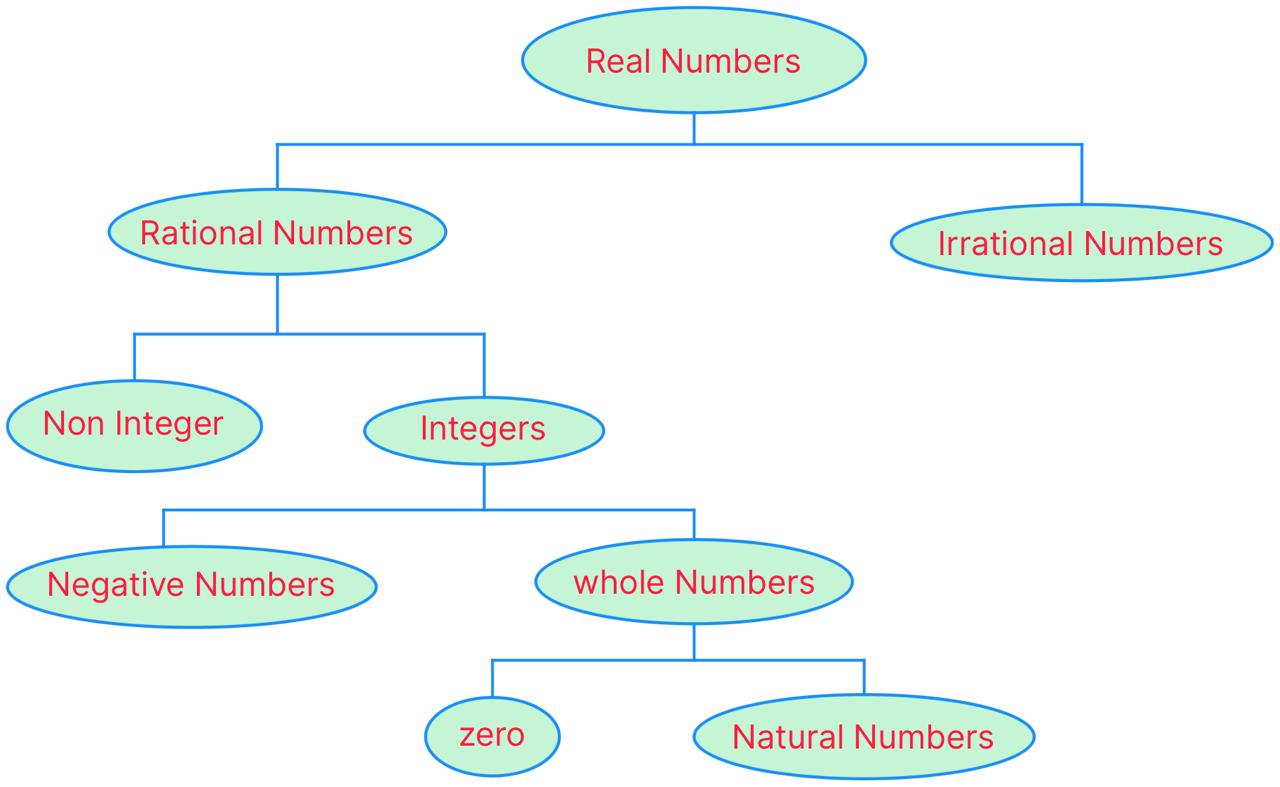
  • Natural Numbers \(\mathbb{(N)}\): Counting numbers starting from 1, 2, 3, …
  • Whole Numbers \(\mathbb{(W)}\): All natural numbers along with 0.
  • Integers \(\mathbb{(Z)}\): All whole numbers and their negatives (…, -3, -2, -1, 0, 1, 2, 3, …).
  • Rational Numbers \(\mathbb{(Q)}\): Numbers that can be written in the form p/q, where p and q are integers and q ≠ 0.
  • Irrational Numbers: Numbers that cannot be written in the form p/q (like √2, π, etc.).
  • Real Numbers \(\mathbb{(R)}\): The set of all rational and irrational numbers.
Real numbers
Classification of Numbers

Natural Numbers \((\mathbb{N})\)

  • Definition: The numbers that we use for counting objects are called Natural Numbers. Example: 1, 2, 3, 4, 5, …
  • Symbol: The set of natural numbers is denoted by \((\mathbb{N})\).
\[\mathbb{N} = \left\{1,2,3,4,5,\cdots\right\}\]
  • Important Points:
    • Natural numbers start from 1 and go on endlessly.
    • 0 is not a natural number.
    • Every natural number has a successor (next number), but no natural number has a predecessor (previous number).

Whole Number

whole number is a number without fractions or decimals. It includes 0 and all natural numbers (1, 2, 3, 4, …).

In short:
  • Whole Numbers \(\mathbb{(W)}\) = {0, 1, 2, 3, 4, …}
  • They do not include negative numbers, fractions, or decimals.

Integer \(\mathbb{(Z)}\)

An Integer is a number that can be positive, negative, or zero, but it cannot be a fraction or a decimal.
Set of integers:
\[\scriptsize Integers \mathbb{(Z)}=\left\{\cdots, -3, -2, -1, 0, 1, 2, 3,\cdots \right\}\]

Key Points:
  • Positive Integers: 1, 2, 3, 4, …
  • Negative Integers: -1, -2, -3, -4, …
  • Zero (0) is also an integer.
why integer
Why Integer?

Rational Number\(\mathbb{(Q)}\)

The collection of rational numbers is denoted by \(\mathbb{Q}\).
‘Rational’ comes from the word ‘ratio’, and Q comes from the word ‘quotient’.
A number ‘r’ is called a rational number if it can be written in the form \(\frac{p}{q}\), where p and q are integers and \(q \neq 0\).
Examples:
Fractions: \(\frac{1}{2}, \frac{-3}{4}, \frac{5}{1}\)
Integers: (since they can be written as \(\frac{n}{1})\): -3, 0, 5
Repeating Decimals: \(0.333\cdots = \frac{1}{3}, 0.142857\cdots\frac{1}{7}\)

Terminating Decimals: \(0.5 = \frac{1}{2}, 1.25 = \frac{5}{4}\)
Key Points:

  • All integers are rational numbers.
  • Every terminating or repeating decimal is a rational number.
  • Denominator can never be zero.

Note: There are infinitely many rational
numbers between any two given rational numbers

Irrational Number

An irrational number is a real number that cannot be expressed as a ratio of two integers; it cannot be written in the form \(\frac{p}{q}\), where p and q are integers and \(q\neq 0\).
Key Features of Irrational Numbers: Their decimal expansion is non-terminating and non-repeating.
  • They cannot be expressed as fractions of integers.
  • They lie on the number line just like rational numbers, but they “fill the gaps” left by rationals
Examples:
  • \(\pi = 3.141592\cdots\) (non-repeating, non-terminating)
  • \(\sqrt{2} = 1.414213\cdots\)
  • \(e=2.718281\cdots\)
Together, rational and irrational numbers form the set of real numbers \(\mathbb{(R)}\)

Important Points:

  1. A number r is called a rational number, if it can be written in the form \(\frac{p}{q}\) , where p and q are integers and (qne 0).
  2. A number s is called a irrational number, if it cannot be written in the form (frac{p}{q}), where p and q are integers and \(q\ne 0).
  3. All the rational and irrational numbers make up the collection of real numbers.
  4. If r is rational and s is irrational, then r + s and r – s are irrational numbers, and rs and \(\frac{r}{s}\) are irrational numbers, \(r\ne 0\).
  5. For positive real numbers a & b, the following identities holds:
    • \(\sqrt{ab}=\sqrt{a}\sqrt{b}\)
    • \(\sqrt{a\over b}={\sqrt{a}\over \sqrt{b}}\)
    • \((\sqrt{a} + \sqrt{b}) - (\sqrt{a} - \sqrt{b})=a-b\)
    • \((a + \sqrt{b})(a - \sqrt{b})=a^2 - b\)
    • \((\sqrt{a} + \sqrt{b})^2 = a + 2\sqrt{ab} +b\)
  6. To Rationalize the Denominator of \(\frac{1}{\sqrt{a} +b}\), we multiply this by \(\frac{\sqrt{a} -b}{\sqrt{a} -b}\) where a & b are integers.
  7. Let (agt 0) be real number and p and q be rational number then
    • \(a^p . a^p = a^{(p+q)}\)
    • \({(a^p)}^q = a^{pq}\)
    • \(\frac{a^p}{a^q}=a^{p-q}\)
    • \(a^p . b^p = (ab)^p\)
  8. The decimal expansion of a rational number is either terminating or nonterminating recurring. Moreover, a number whose decimal expansion is terminating or non-terminating recurring is rational.
  9. The decimal expansion of an irrational number is non-terminating non-recurring. Moreover, a number whose decimal expansion is non-terminating non-recurring is irrational.

Heros Contribution

Archimedes
Archimedes

The Greek genius Archimedes was the first to compute digits in the decimal system. expansion of π. He showed 3.140845< π < 3.142857.
Aryabhatt
AryaBhatta

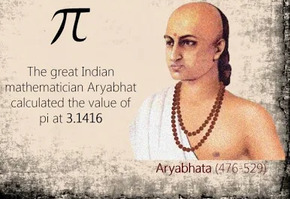
Aryabhatta (476 – 550 C.E.), the great Indian mathematician and astronomer, found the value of π correct to four decimal places (3.1416).

Recent posts

    📚
    ACADEMIA AETERNUM तमसो मा ज्योतिर्गमय · Est. 2025
    Sharing this chapter
    Free NCERT Solutions, Notes & MCQs for Class 9–12 | Academia Aeternum
    Free NCERT Solutions, Notes & MCQs for Class 9–12 | Academia Aeternum — Complete Notes & Solutions · academia-aeternum.com
    🎓 Class 0 📐 📖 NCERT ✅ Free Access 🏆 CBSE · JEE
    Share on
    academia-aeternum.com/blogs/Notes/Mathematics/Number%20System-Notes/ Copy link
    💡
    Exam tip: Sharing chapter notes with your study group creates a reinforcement loop. Teaching a concept is the fastest path to mastering it.

    Frequently Asked Questions

    Academia Aeternum is an online educational platform providing NCERT based notes, MCQs, quizzes, and conceptual explanations for students from Class 9 to Class 12 and competitive exam aspirants.

    The platform provides structured learning resources for Mathematics, Physics, Chemistry, Biology, and Computer Science aligned with the NCERT curriculum.

    Yes. Many MCQs are designed in patterns similar to JEE, NEET, and other entrance exams to improve analytical thinking and exam readiness.

    Yes. Most study materials are derived directly from NCERT textbooks to ensure alignment with school curriculum and board examination requirements.

    Yes. Students can access learning materials, MCQs, and revision resources freely without subscription.

    MCQs improve accuracy, speed, and conceptual clarity while helping students practice objective questions commonly asked in exams.

    Yes. Each question is accompanied by a clear explanation to help students understand the reasoning behind the correct answer.

    Yes. Teachers can use the questions and explanations for classroom discussions, worksheets, and quick revision exercises.

    Yes. The structured format and clear explanations make it ideal for independent learning.

    Yes. Concise notes and MCQ practice sets allow students to revise important concepts quickly.

    Yes. Explanations are written in clear student friendly language for easy understanding.

    Yes. Questions range from basic conceptual understanding to advanced application based problems.

    New chapters, questions, and quizzes are regularly added to expand the learning resources.

    Yes. Consistent practice improves concept retention, problem solving ability, and exam confidence.

    Regular objective practice helps students identify weak areas, improve speed, and prepare effectively for competitive examinations.

    NUMBER SYSTEMS — Learning Resources

    🧠 Practice MCQs
    ✔️ True / False
    📌 Exercise
    📝 Exercises
    Exercise 1.1 Exercise 1.2 Exercise 1.3 Exercise 1.4 Exercise 1.5

    Get in Touch

    Let's Connect

    Questions, feedback, or suggestions?
    We'd love to hear from you.