(a) Grass, flowers and leather
(b) Grass, wood and plastic
(c) Fruit-peels, cake and lime-juice
(d) Cake, wood and grass
Concept & Theory
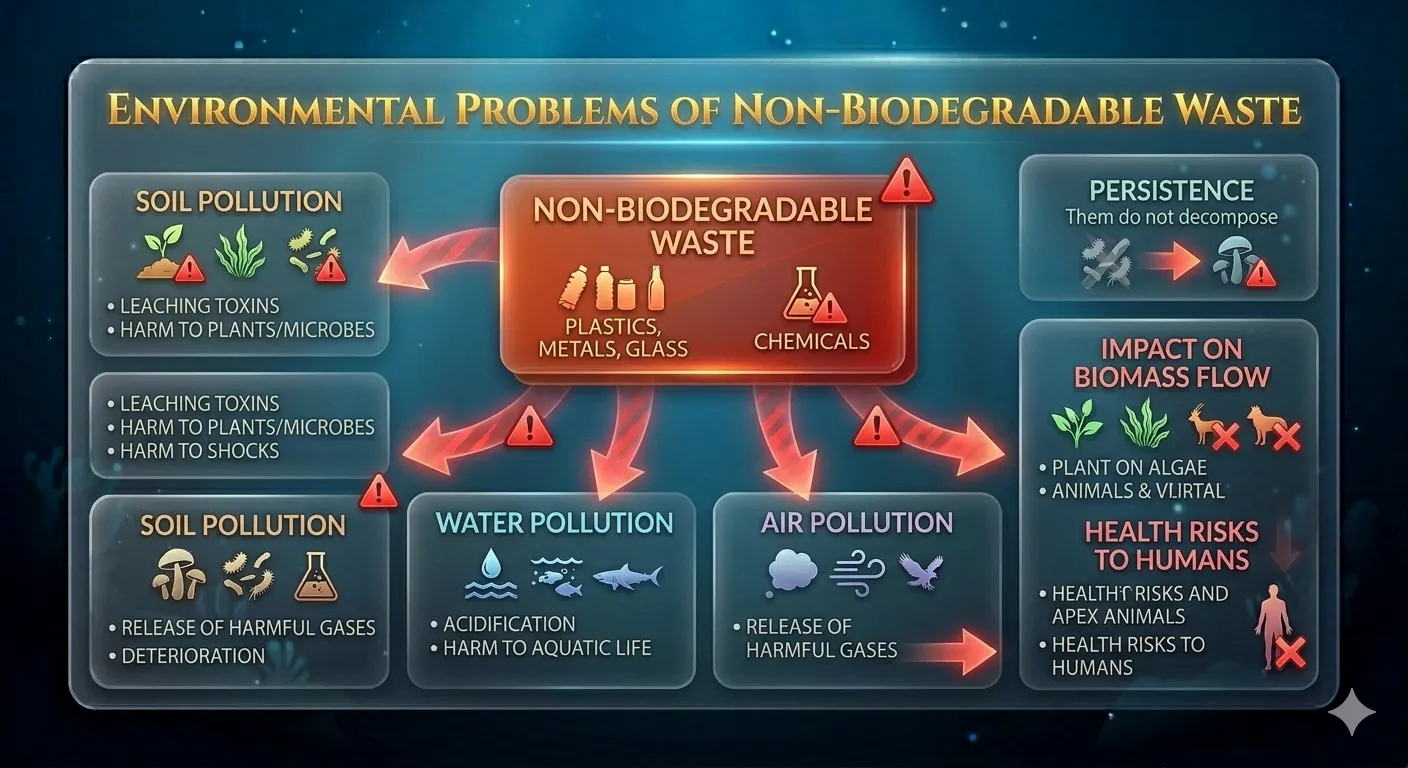
Materials in our environment are classified into biodegradable and non-biodegradable based on their ability to decompose.
- Biodegradable substances: These are broken down into simpler, harmless substances by microorganisms like bacteria and fungi. Examples: plant waste, food waste, paper, wood.
- Non-biodegradable substances: These cannot be decomposed easily by natural agents and persist in the environment. Examples: plastics, glass, metals.
Solution Roadmap
- Identify each material in the options.
- Check whether it is of natural origin (plant/animal-based).
- Determine if microorganisms can decompose it.
- Eliminate options containing non-biodegradable materials.
- Select options where all items are biodegradable.
Step-by-Step Solution
Step 1: Understand the requirement.
We need to find groups that contain only biodegradable items. Even one non-biodegradable item makes the option incorrect.
Step 2: Analyze each option carefully.
Option (a): Grass, flowers and leather
Grass → plant-based → biodegradable
Flowers → plant-based → biodegradable
Leather → obtained from animal skin → biodegradable (slow process)
Conclusion: All items are biodegradable.
Option (b): Grass, wood and plastic
Grass → biodegradable
Wood → biodegradable
Plastic → non-biodegradable
Conclusion: Contains plastic, so rejected.
Option (c): Fruit-peels, cake and lime-juice
Fruit-peels → organic waste → biodegradable
Cake → food item → biodegradable
Lime-juice → natural product → biodegradable
Conclusion: All items are biodegradable.
Option (d): Cake, wood and grass
Cake → biodegradable
Wood → biodegradable
Grass → biodegradable
Conclusion: All items are biodegradable.
Step 3: Final Answer
Correct options are: (a), (c) and (d)
Concept Visualization
Exam Significance
- Frequently asked in CBSE Board Exams as MCQ or short-answer question.
- Important for competitive exams like NTSE, Olympiads, and foundation-level NEET preparation.
- Helps in understanding environmental issues such as pollution, waste management, and sustainability.
- Builds a conceptual base for higher topics like ecosystems and biogeochemical cycles.