Producers 10,000 J Primary Cons. 1,000 J Secondary Cons. 100 J Tertiary Cons. 10 J 10% 10% 10% CFCs → Cl radicals → O₃ depletion Bio-magnification: DDT accumulates Biodegradable: paper, food, cotton Non-biodegradable: plastic, glass
🌍
Chapter 13  ·  Class X Science

Ecosystems, Food Chains, and Environmental Management

Our Environment

How Nature Recycles Everything — And How We Must Help Protect It

Chapter Snapshot

10Concepts
3Formulae / Reactions
6–8%Exam Weight
3–4Avg Q's
EasyDifficulty

Why This Chapter Matters for Exams

CBSE BoardNTSEState Boards

Our Environment contributes 6–8 marks in CBSE Boards. Food chains, food webs, and the 10% energy flow rule are standard 2-mark questions. Biodegradable vs non-biodegradable waste, ozone depletion, and waste management are guaranteed topics. NTSE includes ecosystem component identification and energy flow MCQs.

Key Concept Highlights

Ecosystem: Components (Biotic and Abiotic)
Producers, Consumers, and Decomposers
Food Chain and Food Web
10% Energy Flow Rule (Law of 10%)
Trophic Levels
Biological Magnification
Biodegradable and Non-biodegradable Waste
Ozone Layer and its Depletion
Effects of CFCs on Ozone Layer
Waste Management and Environmental Protection

Important Formulae & Reactions

$\text{10\% Rule: only 10\% energy transferred to next trophic level}$
$\text{Ozone: 3O}_2 \xrightarrow{\text{UV}} 2O_3\ \text{(formation)}$
$\text{CFC effect: Cl radicals break down ozone: O}_3 \rightarrow O_2$

What You Will Learn

Navigate to Chapter Resources

🏆 Exam Strategy & Preparation Tips

10% rule is a guaranteed easy mark — if grass has 10,000 J, grasshoppers get 1,000 J, frogs get 100 J. Biological magnification: pesticides (DDT) accumulate at each trophic level, highest in top predators. Ozone depletion: CFCs release Cl radicals that break O₃ into O₂. These three concepts cover 90% of this chapter's exam questions. Time investment: 1–2 days.

Chapter 13 · CBSE · Class X
🌱
Ecosystem – Complete Conceptual Notes
NCERT Class 10 Science Chapter 13 Our Environment Ecosystem Food Chains and Food Webs Trophic Levels Energy Flow in Ecosystem Biodegradable and Non-biodegradable Substances Environmental Pollution Biological Magnification Ozone Layer Depletion Waste Management Sustainable Development
📘 Definition
💡 Concept
Core Concept
🗂️ Types / Category
Structure of Ecosystem
Biotic Components
Definition All living organisms in an ecosystem that interact through food chains and energy flow.
Components
  • Producers (Autotrophs): Make food via photosynthesis using sunlight, CO₂, and water.
    Examples: Green plants, algae, phytoplankton (base of all food chains).
  • Consumers (Heterotrophs): Depend on others for food energy.
    • Primary (Herbivores): Eat producers (e.g., grass → rabbit → deer).
    • Secondary (Carnivores): Eat herbivores (e.g., frog → snake).
    • Tertiary (Top Carnivores): Apex predators (e.g., eagle → lion → tiger).
  • Decomposers: Break down dead matter, recycle nutrients.
    Examples: Bacteria, fungi, earthworms (convert waste → soil nutrients).
Importance Maintain energy flow and nutrient cycling in ecosystems.
Abiotic Components
Definition Non-living physical and chemical factors that influence living organisms and ecosystem functioning.
Key Factors
  • Temperature: Affects metabolic rates (e.g., 0-40°C ideal for most organisms; extremes kill).
  • Sunlight: Powers photosynthesis; varies by latitude/season (e.g., deserts get 300+ sunny days).
  • Water: Essential solvent; availability shapes biomes (e.g., ponds vs. deserts).
  • Soil: Provides nutrients, anchorage (e.g., clay holds water; sand drains quickly).
  • Air: Supplies O₂ for respiration, CO₂ for photosynthesis (e.g., wind spreads pollen/seeds).
Importance Determines species distribution and ecosystem productivity (e.g., tropical rainforests thrive with high sunlight/water).
🌿 Functions Of Ecosystem
  • Energy Flow: Solar energy → Producers → Consumers → Decomposers
  • Nutrient Cycling: Recycling of carbon, nitrogen, water etc.
  • Food Chain Formation: Transfer of food and energy
  • Ecological Balance: Maintains stability in nature
🔢 Formula
10% Law
📐 Derivation
Derivation of 10% Law

When energy flows from one trophic level to another:

  • Large portion is lost as heat due to respiration.
  • Some energy is used for growth and maintenance.
  • Only a small fraction (~10%) is stored as biomass and passed on.

Hence,

\[ Efficiency = \frac{Energy\ transferred}{Energy\ received} \times 100 \approx 10\% \]

🗂️ Types / Category

Types of Ecosystem

Natural Ecosystem
Definition A self-sustaining biological community shaped by natural processes without significant human intervention.
Characteristics
  • Formed by natural events like climate, geology, and evolution.
  • High biodiversity and complex food webs.
    Resilient to minor changes but vulnerable to large-scale disruptions.
  • Examples
    • Forest: Interconnected trees, animals, and microbes (e.g., tropical rainforest with jaguars, orchids, and decomposers).
    • Pond: Freshwater habitat with algae, fish, frogs, and aquatic plants maintaining oxygen and nutrient cycles.
    • Desert: Sparse vegetation like cacti, camels, and scorpions adapted to extreme aridity and temperature swings.
  • Importance Provides essential services like clean air, water purification, and climate regulation.
Artificial Ecosystem
Definition A human-created and managed biological community designed for specific purposes like food production or recreation.
Characteristics
  • Controlled by humans (e.g., irrigation, fertilizers, or selective breeding).
  • Lower biodiversity; simpler food chains.
  • Requires ongoing maintenance to sustain balance.
  • Examples
    • Aquarium: Glass tank with fish, plants, and filters mimicking a natural aquatic system.
    • Crop Field: Monoculture like wheat farms with pesticides and irrigation for high yield.
    • Garden: Home or park areas with flowers, vegetables, and pollinators like bees, often fertilized.
  • Importance Supports human needs like food security but can lead to issues like soil depletion if mismanaged.
🎨 SVG Diagram
Ecosystem Structure
Ecosystem Functions: Energy Flow SUN Producers Consumers Decomposers
✏️ Example
Explain the role of decomposers in an ecosystem.
Nutrient recycling and breakdown of organic matter.
Definition → Function → Importance → Conclusion
Decomposers such as bacteria and fungi break down dead plants and animals into simpler substances. These nutrients are returned to the soil and reused by plants. Thus, decomposers play a crucial role in maintaining nutrient cycles and ecosystem stability.
⚡ Exam Tip
❌ Common Mistakes
  • Ignoring decomposers in answers.
  • Confusing food chain with ecosystem.
  • Not explaining interaction between components.
📋 Case Study

A farmer uses excessive pesticides in his field ecosystem.

Question: How will it affect the ecosystem?

Answer: Excessive pesticide use kills beneficial organisms and disrupts food chains. It leads to biomagnification, reduces biodiversity, and disturbs ecological balance.

🌟 Importance
🌱
Biotic Components
📘 Definition
💡 Concept
Core Concept
🗂️ Types / Category
Producers Consumers Decomposers

Classification of Biotic Components

Producers (Autotrophs)

Organisms that synthesize their own food using sunlight, carbon dioxide, and water through photosynthesis.

Photosynthesis Equation:

\[ \small 6CO_2 + 6H_2O \xrightarrow[\text{chlorophyll}]{\text{sunlight}} C_6H_{12}O_6 + 6O_2 \]

Examples: Green plants, algae, cyanobacteria

Consumers (Heterotrophs)

Organisms that depend on producers or other organisms for food.

  • Primary Consumers: Herbivores (e.g., deer, rabbit)
  • Secondary Consumers: Small carnivores (e.g., frog)
  • Tertiary Consumers: Top predators (e.g., tiger)
  • Omnivores: Humans, bears
  • Parasites: Tapeworm, lice
Decomposers (Saprophytes)

Microorganisms that decompose dead organic matter into simpler inorganic substances.

Function: Nutrient recycling and soil enrichment

Examples: Bacteria, fungi

🗂️ Types / Category
Food Chain Food Web Symbiosis Predation Competition

Interaction Among Biotic Components

🌱
Food Chain
A linear sequence showing how energy flows through an ecosystem from producers (plants that make food via photosynthesis) to primary consumers (herbivores that eat plants), secondary consumers (carnivores that eat herbivores), tertiary consumers (top predators), and finally decomposers (bacteria and fungi that break down dead matter)
🕸️
Food Web
A complex network of multiple interconnected food chains within the same ecosystem, showing realistic feeding relationships where most organisms eat more than one type of food and serve multiple trophic levels.
🤝
Symbiosis
Any close, long-term relationship between two different species. Includes mutualism (both benefit, e.g., lichen = algae + fungus), commensalism (one benefits, other unaffected), and parasitism (parasite benefits, host harmed).
🦁
Predation
An interaction where a predator captures, kills, and eats its prey as its primary food source. Regulates population sizes and maintains ecosystem balance (e.g., lion hunting zebra).
⚔️
Competition
Occurs when two or more organisms (same or different species) seek the same limited resources like food, water, space, light, or mates. The superior competitor survives better; the other may be eliminated or move elsewhere.
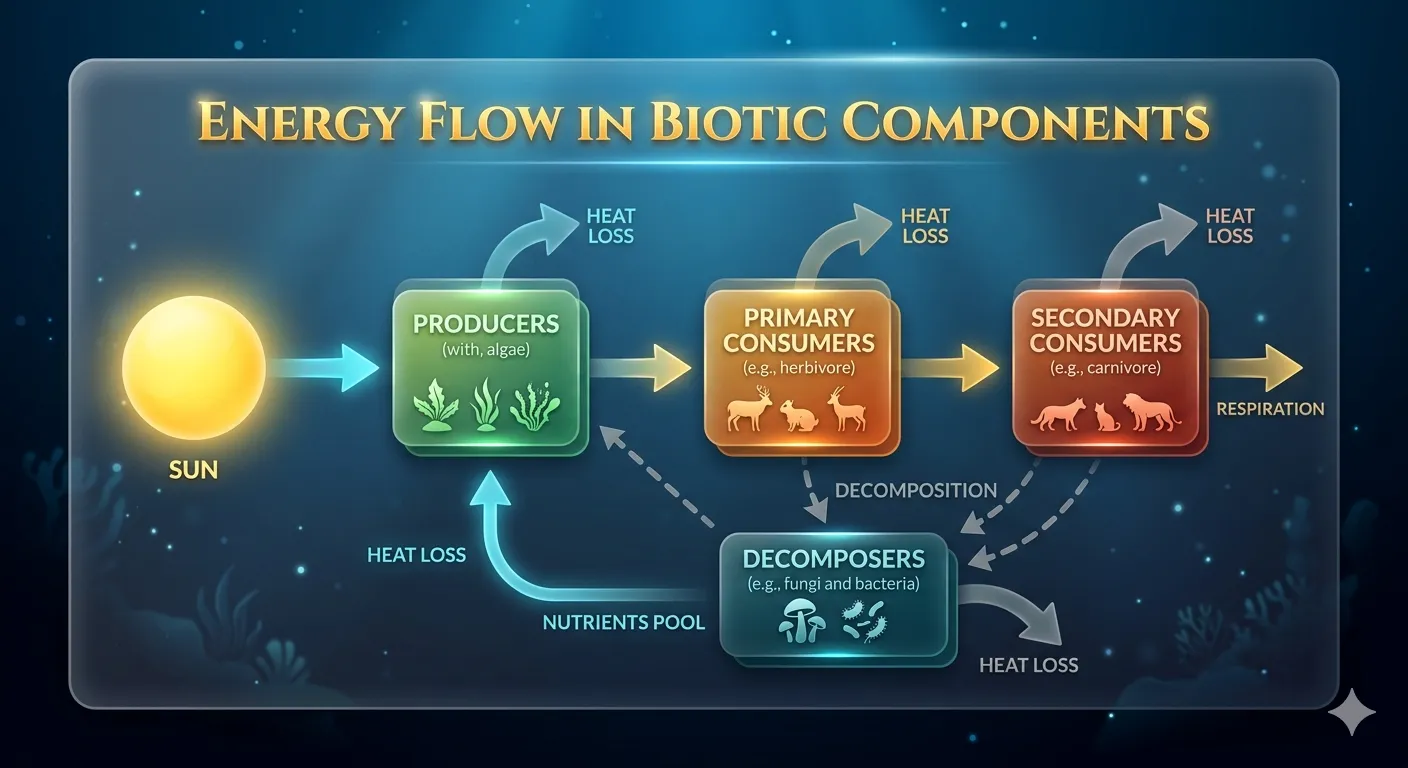
➡️ Energy Flow

Energy Flow in Biotic Components

Energy flows from producers to consumers and finally to decomposers:

\[ Sun \rightarrow Producers \rightarrow Consumers \rightarrow Decomposers \]

This flow is unidirectional and follows the 10% law.

🖼️ Figure

Energy Flow in Biotic Components

Energy Flow in Biotic Components
✏️ Example
Differentiate between producers and consumers.
Autotrophic vs heterotrophic nutrition
Definition → Function → Example
  • Producers: Prepare their own food using sunlight (e.g., plants)
  • Consumers: Depend on other organisms for food (e.g., animals)
⚡ Exam Tip
❌ Common Mistakes
  • Forgetting decomposers in classification.
  • Confusing herbivores with producers.
  • Not explaining energy flow clearly.
📋 Case Study

A forest ecosystem loses its decomposers due to pollution.

Question: What will happen to the ecosystem?

Answer: Dead organic matter will accumulate, nutrients will not be recycled, soil fertility will decrease, and producers will not survive. This will ultimately collapse the ecosystem.

🌟 Importance
🌱
Abiotic Components
📘 Definition
💡 Concept
Core Concept
🗂️ Types / Category

Classification of Abiotic Components

☀️
Climatic Factors

Climatic factors are atmospheric conditions that directly influence biological processes and species distribution.

  • Sunlight: Primary energy source for photosynthesis; determines day length and plant growth
  • Temperature: Controls metabolic rates, enzyme activity, and species distribution ranges
  • Rainfall: Determines water availability, influences plant growth and animal migration patterns
  • Wind: Affects transpiration rates, seed dispersal, and evaporation from soil surfaces
🌱
Edaphic Factors (Soil-related)

Edaphic factors refer to soil properties that determine which plants can grow and how well they thrive.

  • Soil type & texture: Sandy, clayey, or loamy affects water retention and root penetration
  • Mineral content: Provides essential nutrients (N, P, K, Ca, Mg) for plant growth
  • Soil pH: Determines nutrient availability (most plants prefer 6.0-7.5 pH range)
  • Water holding capacity: Influences drought resistance and irrigation needs
🧬
Chemical Factors

Chemical factors are essential substances required for metabolic processes in living organisms.

  • O₂ (Oxygen): Essential for aerobic respiration in animals, plants (roots), and decomposers
  • CO₂ (Carbon dioxide): Raw material for photosynthesis; affects plant growth rates
  • Nutrients: Nitrogen (proteins), phosphorus (DNA/ATP), potassium (osmotic regulation)
  • pH level: Affects enzyme activity, nutrient solubility, and microbial activity
⛰️
Topographic Factors

Topographic factors relate to physical landscape features that influence microclimate and species distribution.

  • Altitude: Temperature decreases 6.5°C per 1000m rise; affects vegetation zones
  • Slope: Steeper slopes have thinner soil, faster drainage, more erosion
  • Latitude: Determines solar radiation intensity and seasonal variations
🔢 Formula

Important Formula (Photosynthesis Link)

⚖️ Law Of Limiting Factor

The growth of organisms is controlled not by the total resources available, but by the scarcest resource (limiting factor).

Example: Low rainfall limits plant growth even if sunlight is abundant.

🗂️ Types / Category

Interaction with Biotic Components

☀️
Sunlight
Sunlight enables photosynthesis in producers, converting solar energy into chemical energy (glucose), which forms the base of all food chains and drives energy flow in ecosystems
🌱
Soil
Soil provides essential minerals (N, P, K) and mechanical support (anchorage) for plants, influencing plant growth, productivity, and nutrient cycling in ecosystems
💧
Water
Water supports metabolic activities such as photosynthesis, digestion, transport of nutrients, and temperature regulation, making it indispensable for all living organisms
🌬️
Air
Air enables respiration (oxygen supply) in organisms and photosynthesis (carbon dioxide supply) in plants, maintaining atmospheric gas balance and life processes
🎨 SVG Diagram

Abiotic Factors Influencing Ecosystem

ABIOTIC FACTORS: ECOSYSTEM INFLUENCE 1. CLIMATIC FACTORS ☀️ Sunlight (Energy Input) 🌡️ Temperature (Rate of Metabolism) 💧 Precipitation (Water Availability) 💨 Wind & Humidity 2. PHYSICO-CHEMICAL 🌿 Soil Texture & Composition 🧪 Soil/Water pH 💎 Mineral Nutrients (N, P, K) ⛰️ Topography & Altitude ECOSYSTEM RESPONSE 🌱 Producers (Plants/Algae) Primary Productivity Rate Species Distribution 🦋 Consumers (Animals) Survival & Migration Population Dynamics
✏️ Example
How does temperature affect living organisms?
Enzyme activity and metabolic rate
Definition → Effect → Example
Temperature affects enzyme activity and metabolic processes. Extreme temperatures can denature enzymes and disrupt life processes, thereby limiting the survival of organisms in that region.
⚡ Exam Tip
❌ Common Mistakes
  • Confusing abiotic factors with decomposers.
  • Not explaining their role in ecosystem functioning.
  • Ignoring chemical factors like pH and gases.
📋 Case Study

A region receives very low rainfall and has high temperature.

Question: What type of ecosystem will form and why?

Answer: A desert ecosystem will form because low water availability and high temperature act as limiting factors, restricting vegetation and supporting drought-resistant organisms only.

🌟 Importance
🌱
Producers (Autotrophs)
📘 Definition
💡 Concept
Core Concept
🌳 Photosynthesis
Key Process

Balanced Equation:

\[ 6CO_2 + 6H_2O \xrightarrow[\text{chlorophyll}]{\text{sunlight}} C_6H_{12}O_6 + 6O_2 \]

  • Raw materials: CO₂, Water
  • Energy source: Sunlight
  • Pigment: Chlorophyll
  • Products: Glucose, Oxygen
🗂️ Types / Category
Photoautotrophs Chemoautotrophs

Types of Producers

☀️🌱
Photoautotrophs

Photoautotrophs use sunlight as their energy source and carbon dioxide as their carbon source through photosynthesis.

They contain chlorophyll and produce carbohydrates using the equation:

6CO₂ + 6H₂O + sunlight → C₆H₁₂O₆ + 6O₂

  • Examples: Green plants, algae, phytoplankton, cyanobacteria
  • Role: Primary producers forming the base of all food chains
🧪🔬
Chemoautotrophs

Chemoautotrophs use chemical energy from inorganic compounds (instead of sunlight) and carbon dioxide as their carbon source.

They oxidize chemicals like ammonia, hydrogen sulfide, or iron through chemosynthesis.

  • Examples: Nitrifying bacteria (Nitrosomonas, Nitrobacter), sulfur bacteria (Thiobacillus), iron bacteria
  • Habitats: Deep-sea hydrothermal vents, soil, freshwater sediments
  • Role: Nutrient cycling and primary production in dark environments
🌟 Importance
Role in Ecosystem
🧮 Energy Calculation

If producers capture 1000 J of solar energy:

\[ Energy_\text{{primary consumers}} = 100 \, J \]

(Based on 10% law of energy transfer)

✏️ Example
Why are producers called the foundation of an ecosystem?
Energy source and trophic levels
Definition → Role → Energy flow → Conclusion
Producers synthesize food using sunlight and form the base of all food chains. They supply energy to all other organisms directly or indirectly, making them the foundation of the ecosystem
⚡ Exam Tip
❌ Common Mistakes
  • Forgetting phytoplankton as producers.
  • Confusing producers with primary consumers.
  • Not explaining energy flow properly.
📋 Case Study

A water body loses its phytoplankton due to pollution.

Question: Predict the effect on the ecosystem.

Answer: Loss of phytoplankton reduces primary productivity, disrupts food chains, decreases oxygen levels, and may lead to collapse of aquatic life.

🌟 Importance
🌱
Consumers (Heterotrophs)
📘 Definition
💡 Concept
Core Concept
🗂️ Types / Category

Classification of Consumers

🐰🌱
Primary Consumers (Herbivores)

Primary consumers (herbivores) feed directly on producers (plants) and represent the second trophic level in food chains.

  • Diet: Only plants, grass, leaves, fruits
  • Role: Convert plant material into animal tissue; form base of grazing food chain
  • Examples: Deer, rabbit, cow, goat, grasshopper, elephant
🐸🐛
Secondary Consumers

Secondary consumers feed on primary consumers and occupy the third trophic level. They are typically small carnivores or omnivores.

  • Diet: Herbivores and smaller animals
  • Types: Carnivores (frogs, spiders), omnivores (small birds)
  • Examples: Frog, lizard, small birds, spider, wolf
🦅🐍
Tertiary Consumers (Top Carnivores)

Tertiary consumers are apex predators that feed on secondary consumers and rarely have natural predators themselves.

  • Role: Control population of other consumers; maintain ecosystem balance
  • Characteristics: Large carnivores, low population density
  • Examples: Tiger, eagle, shark, crocodile, lion
🧑🍽️
Omnivores

Omnivores can feed on both producers (plants) and consumers (animals) at multiple trophic levels.

  • Diet: Plants + animals (flexible feeding habits)
  • Role: Connect different food chains; highly adaptable
  • Examples: Humans, bears, crows, raccoons, pigs
🦠🩸
Parasites

Parasites live on or inside host organisms, deriving nutrients while often harming the host.

  • Types: Ectoparasites (external), endoparasites (internal)
  • Relationship: One-sided benefit (parasite gains, host harmed)
  • Examples: Tapeworm, lice, ticks, malaria parasite, mistletoe
⚡ Energy Transfer

Energy Transfer in Consumers

Consumers follow the 10% Law of energy transfer:

\[ Energy_{next\ trophic\ level} = 0.1 \times Energy_{previous\ level} \]

Example: If producers contain 1000 J energy, primary consumers receive 100 J, secondary consumers receive 10 J, and so on.

🗂️ Types / Category
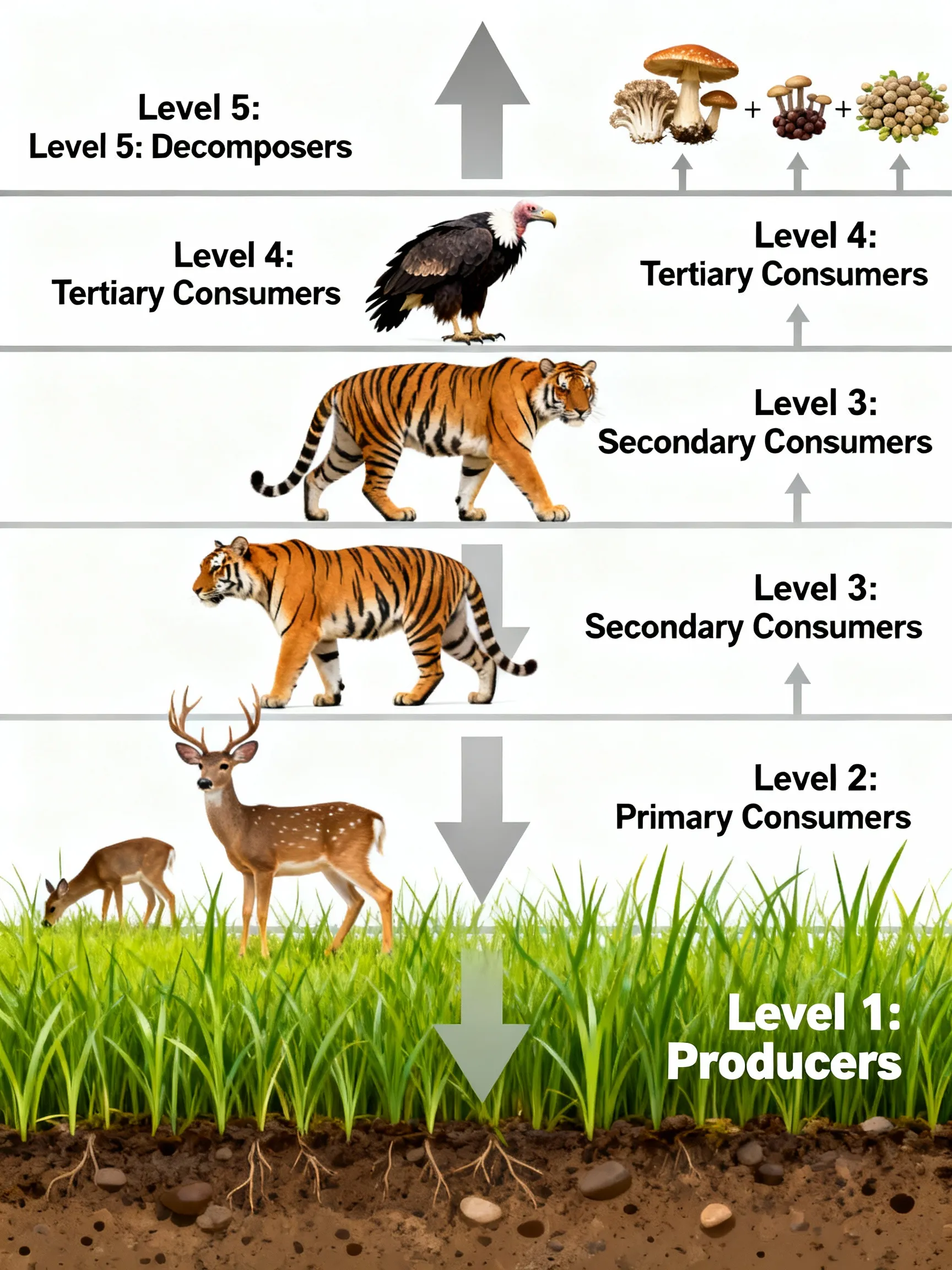
Trophic Levels
🌱
1st Trophic Level: Producers
Definition: Autotrophic organisms that create their own food using sunlight or chemicals
Explanation: Capture solar energy through photosynthesis; form base of all food chains with 100% available energy
Examples: Green plants, algae, phytoplankton, cyanobacteria
🐰
2nd Trophic Level: Primary Consumers
Definition: Herbivores that feed directly on producers
Explanation: Receive ~10% energy from producers; convert plant material into animal tissue
Examples: Deer, rabbit, cow, goat, grasshopper
🐸
3rd Trophic Level: Secondary Consumers
Definition: Carnivores/omnivores that feed on primary consumers
Explanation: Receive ~1% energy; small to medium predators in food chain
Examples: Frog, lizard, small birds, spider, fox
🦅
4th Trophic Level: Tertiary Consumers
Definition: Apex predators that feed on secondary consumers
Explanation: Receive ~0.1% energy; few in number, large in size, control populations below
Examples: Tiger, eagle, shark, crocodile, lion
📌
Note

Energy Flow Rule: Only ~10% energy transfers to next level (90% lost as heat). As we move up trophic levels, available energy decreases (100% → 10% → 1% → 0.1%) while organism size and dominance increase.

✏️ Example
Explain why energy decreases at higher trophic levels.
Energy loss as heat and metabolic activities
Law → Reason → Conclusion
At each trophic level, most energy is lost as heat during respiration and other life processes. Only about 10% is passed to the next level, leading to decreased energy at higher trophic levels.
⚡ Exam Tip
❌ Common Mistakes
  • Confusing trophic levels order.
  • Not explaining energy loss clearly.
  • Ignoring omnivores and parasites.
📋 Case Study

A sudden decrease in herbivore population is observed in a forest.

Question: What will be its effect on producers and carnivores?

Answer: Producers will increase due to less grazing, while carnivores will decline due to lack of food. This disrupts the balance of the ecosystem.

🌟 Importance
🌱
Decomposers (Saprophytes)
📘 Definition
💡 Concept
Core Concept
🔄 Process

Mechanism of Decomposition

  • 1
    ⚔️ Fragmentation
    Physical breakdown of dead organic matter (leaves, wood, animal remains) into smaller pieces by decomposers like earthworms and millipedes. Increases surface area for enzyme action.
  • 2
    🧪 Extracellular Digestion
    Enzymes (cellulase, protease, ligninase) released outside decomposer bodies to chemically break complex organic compounds (proteins, cellulose, lignin) into simpler soluble molecules.
  • 3
    💧 Absorption
    Soluble nutrients (amino acids, sugars, vitamins) absorbed through decomposer body surfaces via diffusion and active transport into their cytoplasm.
  • 4
    ⚡ Mineralization
    Final conversion of organic nutrients into inorganic ions (NH₄⁺, PO₄³⁻, SO₄²⁻) released into soil. These ions become available for plant uptake, completing nutrient cycling.
⚗️ Chemical Equation

Chemical Breakdown Concept

⚗️ Decomposition
Chemical Breakdown Concept
\[ \ce{\text{Organic Matter }\rightarrow CO2 + H2O + \text{Nutrients (N, P, K)}} \]
🗂️ Types / Category
Micro-decomposers Detritivores

Types of Decomposers

🦠
Micro-decomposers

Micro-decomposers (bacteria & fungi) are microscopic organisms that secrete extracellular enzymes to chemically break down complex organic matter into simple soluble compounds.

  • Role: Main agents of decomposition; mineralize 90% of organic matter
  • Enzymes: Cellulase, protease, amylase, ligninase
  • Examples: Bacteria (Bacillus, Pseudomonas), Fungi (Aspergillus, Penicillium, Rhizopus)
🐛
Detritivores

Detritivores (macro-decomposers) physically fragment and ingest dead organic matter (detritus), aiding initial breakdown and increasing surface area for microbial action.

  • Role: Physical fragmentation; gut microbial decomposition
  • Process: Fragmentation → Ingestion → Gut digestion → Egestion
  • Examples: Earthworms, termites, millipedes, snails, dung beetles
🌟 Importance
Role in Ecosystem
📌 Note
Link with Nutrient Cycle
✏️ Example
Why are decomposers essential in an ecosystem?
Nutrient recycling and sustainability
Role → Process → Impact
Decomposers break down dead organisms into simpler nutrients which are reused by plants. Without them, nutrients would not be recycled, leading to accumulation of waste and collapse of ecosystem functioning.
⚡ Exam Tip
❌ Common Mistakes
  • Confusing decomposers with scavengers.
  • Not explaining the process of decomposition.
  • Ignoring their role in nutrient cycles.
📋 Case Study

A region loses its microbial decomposers due to chemical pollution.

Question: Predict long-term ecological consequences.

Answer: Nutrient cycling will stop, soil fertility will decline, dead matter will accumulate, and producers will eventually die, leading to ecosystem collapse.

🗒️ Improtance
  • Frequently asked in 3–5 mark questions
  • Important for nutrient cycles and ecosystem balance
  • Common in case-based and HOTS questions
🌱
Food Chains and Food Webs
📘 Definition
💡 Concept
Core Concept
✏️ Example

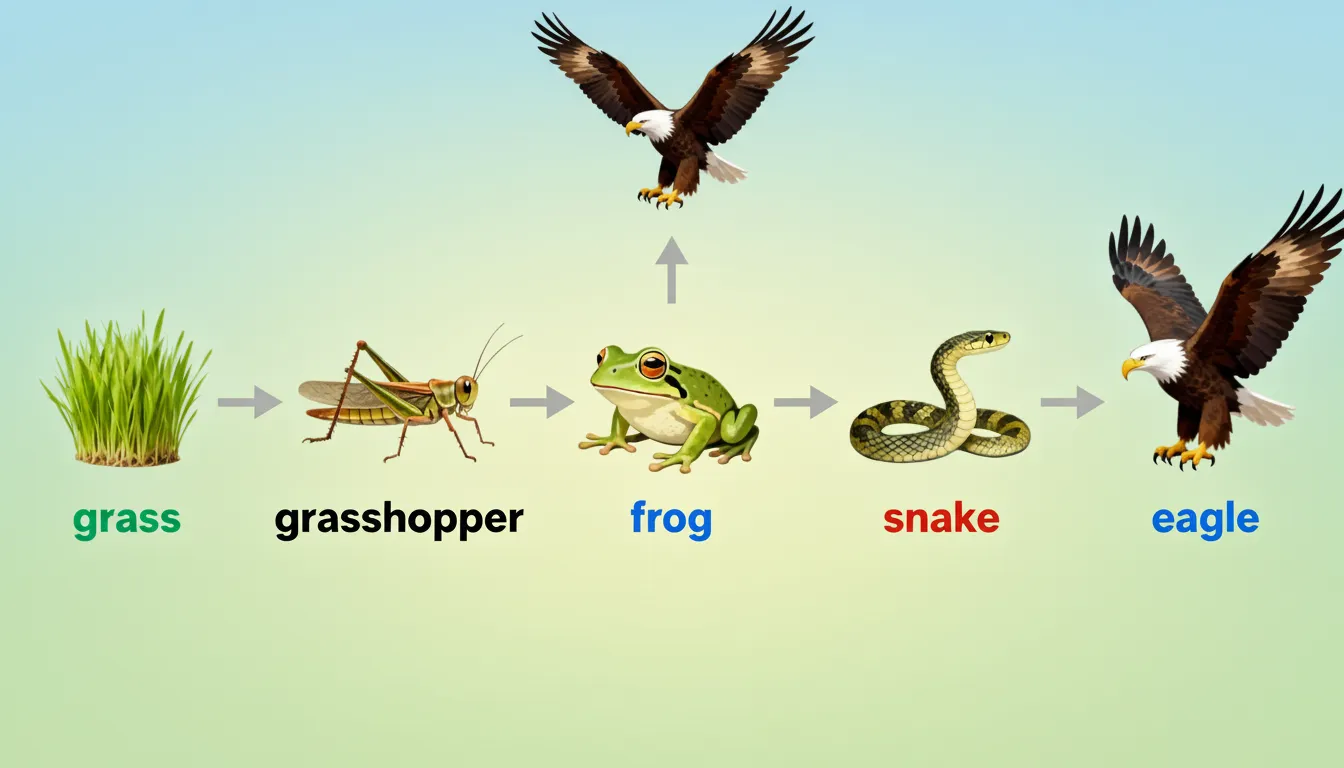
Example of Food Chain

\[ \mathrm{Grass \rightarrow Grasshopper \rightarrow Frog \rightarrow Snake \rightarrow Eagle} \]

Here, grass is the producer, grasshopper is the primary consumer, frog is the secondary consumer, snake is the tertiary consumer, and eagle is the top predator.

🖼️ Figure
Food chain in forest, grassland, and pond ecosystems
⚡ Energy Transfer
10% Law of Energy Transfer

\[ \mathrm{Energy_{next\ level} = 0.1 \times Energy_{previous\ level}} \]

Only about 10% of energy is transferred to the next trophic level, while the rest is lost as heat.

📘 Definition

Food Web

🗒️ Important

Why Food Web is Important

  • Provides multiple pathways for energy flow.
  • Increases ecosystem stability.
  • Prevents collapse if one food chain is disturbed.
  • Supports biodiversity.
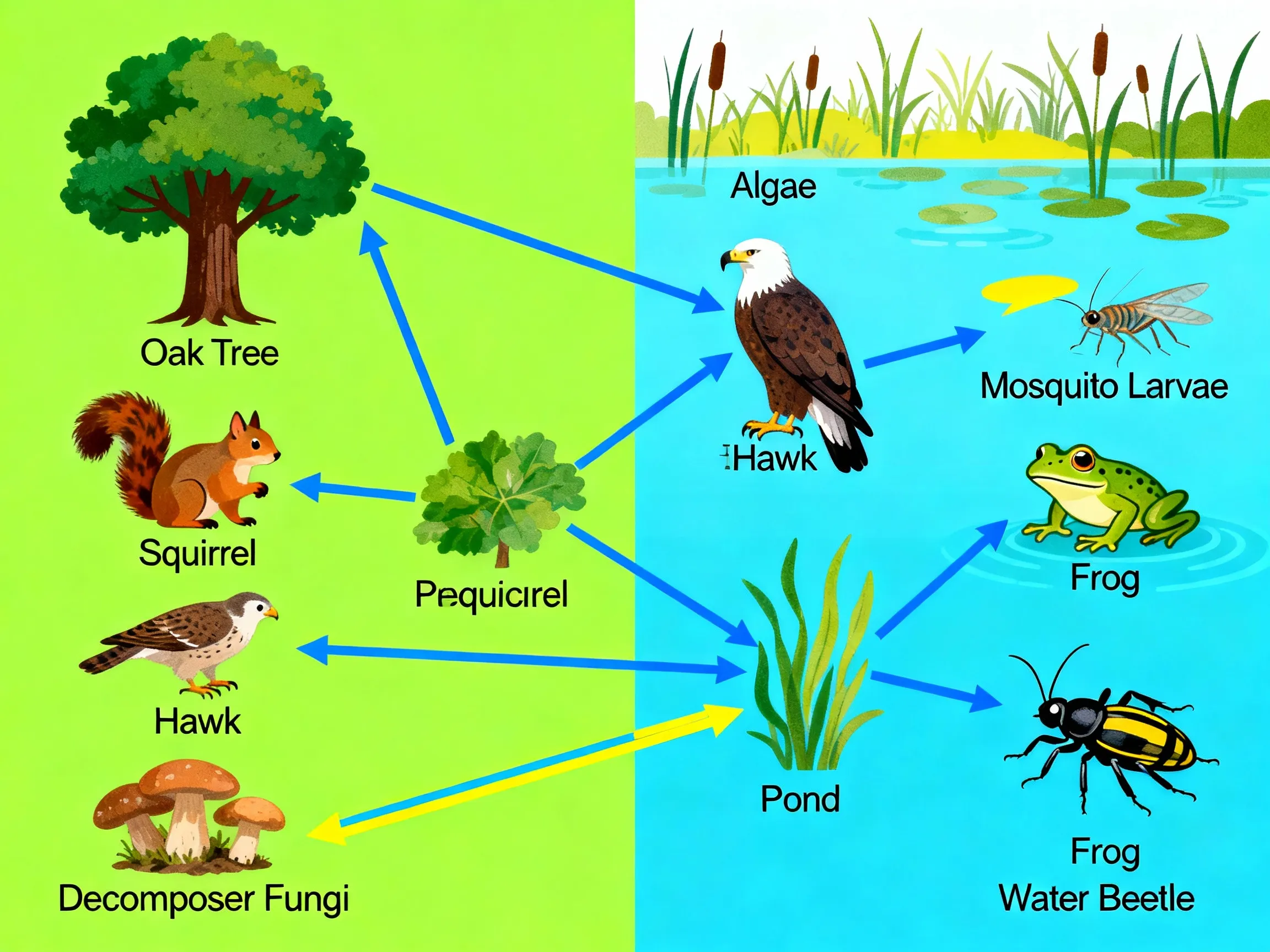
🖼️ Figure
Food web showing interconnected food chains
📊 Comparison Table

Difference Between Food Chain and Food Web

Food Chain Food Web
Linear sequence Complex network
Single pathway Multiple pathways
Less stable More stable
Rare in nature Common in nature
✏️ Example
Why are food webs more stable than food chains?
Multiple feeding relationships
Definition → Comparison → Stability
Food webs consist of multiple interconnected food chains, providing alternative pathways for energy flow. If one organism is removed, others can still survive using alternate food sources, making the ecosystem stable.
⚡ Exam Tip
❌ Common Mistakes
  • Confusing food chain with food web.
  • Ignoring decomposers.
  • Not explaining energy loss.
📋 Case Study

A pesticide enters a food chain starting from plants.

Question: What will happen at higher trophic levels?

Answer: The pesticide concentration will increase at higher trophic levels due to biomagnification, affecting top predators the most.

🌟 Importance
🌱
Trophic Levels
📘 Definition
💡 Concept
Core Concept
🗂️ Types / Category
Producers Primary Consumers Secondary Consumers Tertiary Consumers

Classification of Trophic Levels

🌱
First Trophic Level (Producers)

100% Energy Available - Autotrophs that convert solar energy into chemical energy through photosynthesis.

  • Process: 6CO₂ + 6H₂O + sunlight → C₆H₁₂O₆ + 6O₂
  • Biomass: Maximum (base of pyramid)
  • Examples: Grass, trees, algae, phytoplankton
🐰
Second Trophic Level (Primary Consumers)

~10% Energy Transfer - Herbivores that consume producers and convert plant biomass into animal tissue.

  • Diet: Grass, leaves, fruits, seeds
  • Numbers: Abundant but less biomass than producers
  • Examples: Rabbit, deer, cow, grasshopper, elephant
🐸
Third Trophic Level (Secondary Consumers)

~1% Energy Transfer - Carnivores/omnivores that prey on primary consumers.

  • Diet: Herbivores and smaller animals
  • Numbers: Fewer individuals, moderate biomass
  • Examples: Frog, lizard, spider, small birds, fox
🦅
Fourth Trophic Level (Tertiary Consumers)

~0.1% Energy Transfer - Apex predators with no natural enemies that control populations below them.

  • Role: Maintain ecosystem balance
  • Characteristics: Fewest numbers, largest individuals
  • Examples: Eagle, tiger, shark, crocodile, lion
⚡ Energy Transfer

Energy Transfer Formula (10% Law)

\[ Energy_{n+1} = 0.1 \times Energy_n \]

Only about 10% of energy is passed to the next trophic level, while the rest is lost as heat.

✏️ Example

Example of Trophic Levels

\[ Grass \rightarrow Deer \rightarrow Tiger \]

  • Grass → Producer (1st level)
  • Deer → Primary consumer (2nd level)
  • Tiger → Secondary consumer (3rd level)
🖼️ Figure
Representation of trophic levels in a food chain
💡 Concept

Ecological Pyramid Concept

  • Base is wide (producers) → maximum energy.
  • Top is narrow → minimum energy.
  • Represents decrease in energy, biomass, and number.
ECOLOGICAL PYRAMID PRODUCERS PRIMARY CONSUMERS SECONDARY CONSUMERS TERTIARY
✏️ Example
Why is the number of trophic levels limited in a food chain?
Energy loss at each level
Law → Energy decrease → Conclusion
Due to the 10% law, only a small fraction of energy is transferred to the next level. As energy decreases significantly at each step, only 3–4 trophic levels can be sustained.
⚡ Exam Tip
❌ Common Mistakes
  • Confusing trophic levels with food chain.
  • Incorrect order of levels.
  • Ignoring energy loss explanation.
📋 Case Study

A food chain shows five trophic levels.

Question: Is this possible? Explain.

Answer: It is rare because energy decreases drastically at each level. Generally, only 3–4 trophic levels are sustainable due to energy limitations.

🌟 Importance
🌱
Biological Magnification
📘 Definition
💡 Concept
COre Concept
⚙️ Mechanism

Stepwise Mechanism

  • Step 1: Producers absorb small amounts of toxins from soil/water.
  • Step 2: Herbivores consume many producers → toxin concentration increases.
  • Step 3: Carnivores eat herbivores → further increase.
  • Step 4: Top predators accumulate maximum toxin levels.
✏️ Example

Example of Biomagnification

\[ \mathrm{Water \rightarrow Phytoplankton \rightarrow Small\ Fish \rightarrow Big\ Fish \rightarrow Human} \]

If water contains a small amount of DDT, phytoplankton absorb it. Small fish eat many phytoplankton, increasing toxin levels. Big fish accumulate even more, and humans consuming fish receive the highest concentration.

⚠️ Harmful Effects

Harmful Effects of Biomagnification

  • Damage to nervous system
  • Reduced reproductive capacity
  • Hormonal imbalances
  • Long-term diseases and toxicity
💥 Causes
Causes of Biomagnification
  • Use of persistent pesticides (e.g., DDT)
  • Industrial waste discharge
  • Heavy metals (mercury, lead)
  • Pollution of water and soil
🛡️ Prevention And Control
  • Use biodegradable pesticides
  • Adopt biological pest control methods
  • Treat industrial waste before disposal
  • Promote environmental awareness
✏️ Example
Why are top predators most affected by biomagnification?
Accumulation of toxins at higher trophic levels
Definition → Process → Conclusion
Top predators consume organisms from lower trophic levels that already contain toxins. As a result, toxins accumulate and reach maximum concentration at the top level.
⚡ Exam Tip
❌ Common Mistakes
  • Confusing biomagnification with bioaccumulation.
  • Not explaining trophic levels.
  • Ignoring harmful effects.
📋 Case Study

Fish in a polluted river show high mercury levels.

Question: Predict its impact on humans consuming these fish.

Answer: Humans consuming contaminated fish will accumulate mercury, leading to severe health issues like nervous system damage and poisoning.

🌟 Importance
🌱
How Do Our Activities Affect the Environment?
📘 Definition
💡 Concept
Core Concept
🏭 Pollution And Resource Overuse
Air Pollution

Sources: Burning fossil fuels (coal, petrol), industrial emissions, vehicle exhaust releasing CO₂, SO₂, NOₓ, particulate matter (PM2.5).

  • Health Effects: Asthma, bronchitis, lung cancer, cardiovascular diseases
  • Environmental Effects: Acid rain, global warming, ozone depletion
  • Control: CNG vehicles, smokeless zones, afforestation
Water Pollution

Sources: Domestic sewage, industrial effluents, agricultural runoff (pesticides, fertilizers), plastic waste, oil spills.

  • Aquatic Effects: Eutrophication, dead zones, biomagnification of toxins
  • Human Effects: Cholera, dysentery, typhoid, jaundice
  • Control: Sewage treatment plants, effluent treatment, rainwater harvesting
Resource Depletion

Types: Overexploitation of renewable (forests, fisheries) and non-renewable (minerals, fossil fuels) resources beyond regeneration capacity.

  • Forest Depletion: Deforestation → soil erosion, desertification, loss of habitat
  • Fossil Fuels: Coal, petroleum depletion → energy crisis
  • Mineral Resources: Mining → land degradation
  • Control: Sustainable harvesting, recycling, renewable energy
🕳️  Ozone Depletion

Ozone Depletion and Climate Change

    Ozone Depletion:

    Thinning of stratospheric ozone layer that protects Earth from harmful UV radiation.

    • Cause: Chlorofluorocarbons (CFCs) from refrigerants, aerosols release chlorine atoms that destroy ozone (Cl + O₃ → ClO + O₂)
    • Effects: Increased UV-B radiation reaching Earth surface
    • Consequences: Skin cancer, cataracts, phytoplankton damage, crop yield reduction
    • Solution: Montreal Protocol banned CFCs; ozone recovering
    Greenhouse Effect:

    Trapping of Earth's heat by atmospheric gases creating natural temperature balance.

    \[\small\ce{CO₂ + CH₄ + N₂O + H₂O vapor absorb infrared → Heat retention → Global temperature regulation}\]

    • Enhanced Effect: Excess greenhouse gases from fossil fuel burning, deforestation
    • Consequences: Global warming (1.1°C rise), glacier melting, sea-level rise (20cm since 1900)
    • Impacts: Extreme weather, coral bleaching, species migration
    • Solution: Carbon sequestration, renewable energy, reforestation
🗑️ Waste Generation

Waste Generation and Non-Biodegradable Materials

  • Solid Waste:

    Non-biodegradable municipal waste including plastics, metals, glass, and electronic waste (e-waste) that accumulates in landfills and environment.

    • Volume: India generates 62M tons/year; only 70% collected
    • Problems: Landfill overflow, leachate contamination of groundwater
    • Sources: Packaging, consumer goods, obsolete electronics
  • Plastic Pollution:

    Persistent synthetic polymers that don't decompose naturally, entering food chains through fragmentation.

    • Drainage Blockage: Causes urban flooding during monsoons
    • Wildlife Harm: Turtles eat bags (mistake for jellyfish), birds feed plastic to chicks
    • Microplastics: <1mm particles enter food chain; found in human blood and placenta
  • Toxic Waste:

    Hazardous chemical, industrial, biomedical, and nuclear waste containing heavy metals, persistent organic pollutants.

    • Biomagnification: Toxins concentrate up food chain (DDT in eagles' eggs)
    • Health Effects: Cancer, neurological damage, birth defects
    • Examples: Mercury (Minamata disease), lead, arsenic, hospital waste
🦋 Impact

Impact on Ecosystems and Biodiversity

  • Deforestation:

    Removal of forest cover for agriculture, timber, urbanization destroys natural habitats.

    • Habitat Loss: 70% of terrestrial species lose homes; fragmentation isolates populations
    • Species Extinction: 50,000 species/year extinct; keystone species loss disrupts entire ecosystems
    • Soil Effects: Erosion, desertification, nutrient leaching reduces land productivity
  • Overexploitation:

    Unsustainable harvesting of wild species beyond reproductive capacity.

    • Overfishing: 33% fish stocks collapsed; bycatch kills non-target species
    • Hunting: Trophy hunting, bushmeat trade threatens tigers, rhinos, elephants
    • Population Collapse: Food chain disruption when top predators disappear
  • Invasive Species:

    Non-native species outcompete local organisms, disrupting established food webs.

    • Competition: Eat native species or consume their food/resources
    • Predation: No natural predators; prey populations crash (e.g., rats eating bird eggs)
    • Habitat Change: Lantana smothers native plants; water hyacinth blocks water bodies
✏️ Example
How does deforestation affect the environment?
Habitat loss and ecological imbalance
Cause → Effect → Conclusion
Deforestation destroys habitats, reduces biodiversity, disrupts food chains, and increases carbon dioxide levels, contributing to global warming.
⚡ Exam Tip
❌ Common Mistakes
  • Writing general points without explanation.
  • Ignoring examples.
  • Not linking cause and effect properly.
📋 Case Study

A city shows increased pollution due to rapid industrialization.

Question: Predict long-term environmental effects.

Answer: Increased pollution will degrade air and water quality, harm health, reduce biodiversity, and contribute to climate change.

✅ Prevention

Need for Eco-Friendly Practices

  • Follow 3Rs: Reduce, Reuse, Recycle
  • Use renewable energy (solar, wind)
  • Plant trees and conserve forests
  • Use public transport
  • Treat waste before disposal
🌟 Importance
🌱
Managing the Garbage We Produce
📘 Definition
💡 Concept
COre Concept
♻️ 3r Principle

The 3Rs Principle

  • 1. Reduce
    Minimize waste generation by avoiding unnecessary consumption.
    • Avoid single-use plastics
    • Use minimal packaging products
  • 2. Reuse
    Use items multiple times instead of discarding.
    • Reuse containers and bags
    • Repair old items
  • 3. Recycle
    Convert waste into new usable products.
    • Recycle paper, metal, glass
    • Saves energy and resources
🚮 Waste Segregation
  • Biodegradable Waste: Food scraps like vegetable peels and fruit skins, paper (old notebooks, newspapers), leaves, grass clippings, and cotton cloth scraps.
    Fun fact: These decompose naturally in 1-2 months via microbes—perfect for making compost fertilizer for plants!
  • Non-biodegradable Waste: Plastics (water bottles, bags), metals (aluminum cans, steel utensils), glass (bottles, jars), and e-waste (old batteries, broken chargers).
    Fun fact: These take 100s of years to break down, harming soil and animals—recycle them to save resources!

Segregating waste at source makes recycling super easy, cuts pollution, and helps fight climate change. Use color-coded bins: green for biodegradable, blue for non-biodegradable!

⛽ Composting And Biogas
  • Biodegradable waste (like veggie peels and leaves) is broken down by tiny microbes into rich compost.
    Fun fact: Just like how earthworms digest soil!
  • This compost boosts soil fertility by adding nutrients, helping plants grow stronger and healthier.
    Why it matters: Farmers use it instead of chemicals for better crops!
  • Biogas plants turn food waste into methane gas—a clean fuel for cooking and electricity.
    Fun fact: One cow's dung can power a home stove for hours!

These processes turn everyday waste into treasures, reducing pollution and saving energy. Try making compost at home!

☣️ Handling Hazardous Waste
  • Comprises hazardous materials such as batteries, chemicals, e-waste, and expired medicines.
  • Requires specialized treatment and disposal facilities to ensure safe handling.
  • Helps prevent toxic substances from contaminating soil, water, and air.
🦋 Impact

Environmental Impact Relation

\[ \mathrm{Proper\ Waste\ Management \Rightarrow Reduced\ Pollution + Resource\ Conservation} \]

✏️ Example
Why is waste segregation important?
Efficient recycling and treatment
Definition → Benefit → Conclusion
Waste segregation separates biodegradable and non-biodegradable waste, making recycling easier and preventing contamination. It reduces pollution and improves waste management efficiency.
⚡ Exam Tip
💡 Concept
📋 Case Study

A city mixes all types of waste before disposal.

Question: What problems may arise?

Answer: Mixed waste becomes difficult to recycle, increases pollution, spreads diseases, and overloads landfills.

🤝 🧑‍🤝‍🧑 Role Of Citizens
  • Follow Reduce, Reuse, Recycle
  • Segregate waste at source
  • Avoid littering
  • Support eco-friendly practices
🌟 Importance
🌱
Important Points – Our Environment
💡 Concept
Core Revision Concepts
🔢 Formula
⚡ Exam Tip
❌ Common Mistakes
  • Ignoring decomposers in answers.
  • Confusing food chain with food web.
  • Not explaining energy loss properly.
  • Writing vague answers without examples.
NCERT Class X  ·  Chapter 13

Our Environment
AI Learning Engine

Master ecosystems, food chains, ozone depletion & waste management with concept-first learning, step-by-step solving, and interactive modules.

🌿

Core Concepts

Everything from Ecosystem basics to Ozone Depletion — organized by concept.

🌍 1 · Ecosystem — The Living World
All living and non-living things interacting in a defined area form an ecosystem.

🧬 Biotic Components

All living organisms in an ecosystem — producers (plants), consumers (animals), and decomposers (bacteria, fungi). Each plays a distinct energy role.

🪨 Abiotic Components

All non-living factors — sunlight, temperature, wind, soil, water, minerals. These determine which organisms can survive where.

🌱 Producers (Autotrophs)

Organisms that synthesise food from sunlight via photosynthesis. Form the base of every food chain. Examples: green plants, algae, phytoplankton.

🦌 Consumers (Heterotrophs)

Cannot make their own food. Herbivores eat plants (primary), carnivores eat animals (secondary, tertiary). Omnivores eat both.

🍄 Decomposers

Break down dead organic matter into simple inorganic substances, returning nutrients to the soil. Examples: bacteria, fungi. Often called saprotrophs.

🔄 Nutrient Cycling

Inorganic matter is cycled continuously between living organisms and the environment (e.g., nitrogen cycle, carbon cycle). Decomposers are essential to this process.

Key Distinction: Decomposers are NOT consumers. They break down dead organisms externally and absorb nutrients — they do not ingest food like animals do.
🔗 2 · Food Chains & Food Webs
The linear transfer of energy from one trophic level to the next.
🌾 Grass (Producer)
🐛 Grasshopper (Primary Consumer)
🐸 Frog (Secondary Consumer)
🐍 Snake (Tertiary Consumer)
🦅 Hawk (Apex Predator)

⚡ Energy Flow — 10% Rule

Only 10% of energy from one trophic level passes to the next. 90% is lost as heat, respiration, and metabolic activity. This is why food chains rarely exceed 4–5 levels.

🕸 Food Web

Multiple interconnected food chains in an ecosystem. More realistic than a single food chain. Provides stability — if one organism disappears, others can compensate.

📊 Trophic Levels

T1: Producers | T2: Herbivores | T3: Primary Carnivores | T4: Secondary Carnivores. Energy decreases at each step.

☀️ Sun — Ultimate Source

All energy in a food chain ultimately comes from the Sun. Producers capture solar energy via photosynthesis. Consumers harvest it secondhand.

Trophic LevelOrganism TypeEnergy Available (J)Example
T1Producer10,000Grass, Algae
T2Herbivore1,000Deer, Grasshopper
T3Carnivore I100Fox, Frog
T4Carnivore II10Hawk, Snake
🔺 3 · Ecological Pyramids
Graphical representation of the number, biomass, or energy at each trophic level.

🔢 Pyramid of Numbers

Shows the number of organisms at each level. Usually upright (more producers than consumers). Exception: a tree ecosystem has inverted pyramid — one tree supports many insects.

⚖️ Pyramid of Biomass

Shows the total dry weight of organisms at each level. Upright in most terrestrial ecosystems. Can be inverted in aquatic systems (phytoplankton reproduced rapidly).

⚡ Pyramid of Energy

Shows the total energy content at each trophic level. Always upright and never inverted. Most accurate representation — follows the 10% law strictly.

Always Remember: Pyramid of Energy is ALWAYS upright. Pyramids of Number and Biomass can be inverted in special cases.
☠️ 4 · Biological Magnification (Biomagnification)
Progressive increase in concentration of harmful chemicals as you move up the food chain.
Definition: The process by which toxic chemicals (DDT, heavy metals, pesticides) accumulate in increasing concentrations at successively higher trophic levels because they are non-biodegradable.

🧪 Why It Happens

Non-biodegradable chemicals are not excreted. They accumulate in fat tissues. As predators eat many prey, the chemical concentrates — a large fish eats thousands of small fish, each carrying traces.

🐟 Classic Example: DDT

DDT concentration: Water → Phytoplankton → Zooplankton → Small fish → Large fish → Birds. Birds at top suffer thin eggshells, reproductive failure.

👤 Humans — Most Affected

Humans are at the top of many food chains, so chemicals accumulate most in us. This causes hormonal disruption, cancer, and neurological damage.

Water (T0)
0.02 ppm
Phytoplankton (T1)
0.1 ppm
Zooplankton (T2)
2.5 ppm
Small Fish (T3)
25 ppm
Large Fish (T4)
200 ppm
♻️ 5 · Waste Management & Pollution
Human activities generate waste that disrupts natural ecosystems.

🟢 Biodegradable Waste

Broken down by natural decomposers into harmless substances. Examples: food scraps, paper, cotton, wood, agricultural residue.

🔴 Non-Biodegradable Waste

Cannot be broken down by natural processes. Persists in the environment for centuries. Examples: plastic, DDT, synthetic fibres, metals, glass.

🌊 Water Pollution

Industrial effluents, sewage, agricultural runoff (fertilisers, pesticides) contaminate water bodies, causing eutrophication and death of aquatic life.

💨 Air Pollution

Burning of fossil fuels, industrial emissions, CFCs deplete the ozone layer and cause acid rain, smog, and greenhouse effect.

PropertyBiodegradableNon-Biodegradable
Decomposed byBacteria, FungiCannot be decomposed
Time to decomposeDays to monthsDecades to centuries
Environmental effectMinimal (returns nutrients)Severe (pollutes soil, water)
ExampleVegetable peels, manurePlastic, DDT, glass
BiomagnificationNoYes (if toxic)
🌤️ 6 · Ozone Layer & Depletion
Earth's protective UV shield and why it is under threat.

🛡 What is Ozone?

A molecule of 3 oxygen atoms (O₃). Present in the stratosphere (15–35 km altitude). Formed when UV light splits O₂ molecules, which then combine with another O₂.

☀️ Why Does It Matter?

Absorbs harmful UV-B and UV-C radiation from the sun. Without it, UV radiation causes skin cancer, cataracts, immune suppression, and DNA damage in all life forms.

🧊 CFCs — The Culprit

Chlorofluorocarbons (CFCs) from refrigerators, ACs, aerosols reach the stratosphere. Each Cl atom from CFC can destroy 100,000 ozone molecules.

🕳 Ozone Hole

Discovered over Antarctica in 1985. A region where ozone concentration drops significantly during spring. Growing due to continued CFC use.

Ozone Formation & Breakdown
O₂ UV O + O  |  O + O₂ → O₃ (Ozone)

O₃ + Cl ClO + O₂  |  ClO + O → Cl + O₂   (Net: O₃ → O₂, Cl regenerated!)
Montreal Protocol (1987): International agreement to phase out CFCs globally. A landmark example of global environmental cooperation. Ozone layer is slowly recovering.
🧮

Formulas & Key Relationships

Every quantitative formula and relationship in Chapter 13 — ready for quick reference.

⚡ Energy Transfer — 10% Law (Lindemann)
Energy at Tₙ₊₁ = Energy at Tₙ × (10 / 100)
Energy at T₂ = Energy at T₁ × 0.1

Where T₁ = Producer level, T₂ = Herbivore level, etc. Only 10% of energy is transferred; 90% is lost as heat, respiration, locomotion.

🧮 Energy Calculation Examples
If T1 has 10,000 J → T2 = 1,000 J → T3 = 100 J → T4 = 10 J
If T3 has X joules → T1 = X × 100 joules (work backwards: multiply by 10 each step)
Energy Lost at each level = 90% of that level's energy
🌿 Photosynthesis (Producer Equation)
6CO₂ + 6H₂O → C₆H₁₂O₆ + 6O₂   (in presence of sunlight + chlorophyll)
🛡 Ozone Chemistry
O₂ + UV → O + O   (photodissociation)
O + O₂ → O₃   (ozone formation)
O₃ + Cl• → ClO + O₂   (destruction by CFC-derived Cl)
ClO + O• → Cl + O₂   (Cl is regenerated — catalytic cycle!)

Net effect: O₃ is destroyed and Cl acts as a catalyst (not consumed), so one Cl atom can destroy up to 100,000 O₃ molecules.

📊 Biomagnification Relationship
Concentration at Tₙ ≈ Concentration at T₁ × 10^(n-1)

Chemical concentration multiplies by roughly 10× at each trophic level (inverse of energy transfer — energy goes down, chemical concentration goes up).

🔄 Key Ratios to Remember
QuantityValue / RelationshipContext
Energy transfer efficiency10%Between each trophic level
Energy loss per level90%Lost as heat + metabolism
Max food chain length4–5 levelsDue to 10% rule limiting energy
Ozone height in stratosphere15–35 kmAbove Earth's surface
CFC destructive power1 Cl → 100,000 O₃Catalytic destruction
Ozone formulaO₃Triatomic oxygen molecule
🔬

Step-by-Step AI Solver

Original concept-building questions with full solutions — organized by topic.

⚡ Energy Flow & 10% Law Questions
Click any question to reveal the full step-by-step solution.
🔗 Food Chain & Web Questions
Application and analysis questions on food chain structure.
♻️ Pollution, Waste & Ozone Questions
Higher-order thinking questions on human impact.
💡

Tips & Tricks

Memory shortcuts, mnemonics, and exam strategies for Chapter 13.

🧠 Memory Tricks & Mnemonics
🎯

10% Rule Trick: "Add a zero at the beginning when going DOWN (from T1 to T2), remove a zero when going UP." If T2 has 500 J → T1 has 5,000 J. If T1 has 8,000 J → T2 has 800 J.

🔤

Mnemonic — Ecosystem Components: "B-ABC" → Biotic = Autotrophs (producers), B-Heterotrophs (consumers), C-Decomposers. Abiotic = Everything else.

🔺

Pyramid Trick — "Energy is ALWAYS Up": The Pyramid of Energy is ALWAYS upright (biggest at base = most energy). Remember: Energy = Erect Always. For others, exceptions exist.

☁️

CFC Trick: CFCs → Chlorine → Catches ozone (destroys it). Chlorine is the agent, CFCs are the source, stratosphere is the location. Three C's to remember!

📈

Biomagnification vs Energy — Opposites: Energy goes DOWN as you go up the food chain. Chemical concentration goes UP as you go up the food chain. They are always inversely related.

🔗

Food Chain Start: Every food chain MUST start with a producer (green plant). If a question gives you an animal as the start — it's a trap! Check again — you may be joining a chain mid-way.

♻️

Biodegradable Trick: If it comes FROM nature (wood, paper, cotton, food), it IS biodegradable. If it was MADE by humans chemically (plastic, nylon, DDT), it's NON-biodegradable. Works 90% of the time!

🌍

Ozone Location: Ozone is in the STRATOsphere. Remember: Strato = Shield. The shield is in the stratosphere. NOT the troposphere (where we live and breathe).

🏅

Exam Tip — "Justify" Questions: When asked to justify why food chains are short, always mention TWO reasons: (1) 10% law reduces energy rapidly, and (2) higher organisms need more energy to sustain themselves.

📌

Montreal Protocol Year: Remember 1987 = Montreal Protocol. Trick: "1-9-8-7 = saving heaven from seven CFC sins." Montreal sounds like Mountain — mountains are cold like refrigerators (which use CFCs)!

⚠️

Common Mistakes

Errors students frequently make in exams — and how to avoid them.

🚫 Top Conceptual Mistakes

Mistake: Thinking decomposers are consumers.
Correction: Decomposers are a separate category. They break down dead organic matter externally using enzymes and absorb nutrients. They do not eat or ingest food. They could replace consumers in diagrams but are never listed as T2/T3.

Mistake: "10% of energy is lost at each level."
Correction: Exactly the opposite! 10% is TRANSFERRED and 90% is LOST. Students often confuse which is lost and which is passed on.

Mistake: Pyramid of Biomass is always upright.
Correction: It can be inverted in aquatic ecosystems where phytoplankton (small biomass) supports large zooplankton biomass due to rapid reproduction. Only Pyramid of Energy is ALWAYS upright.

Mistake: Ozone is in the troposphere (the air we breathe).
Correction: The protective ozone is in the stratosphere (15–35 km). Ground-level ozone (troposphere) is actually a pollutant and harmful to breathe.

Mistake: Biological magnification happens for all pollutants.
Correction: Only non-biodegradable toxic chemicals undergo biomagnification (e.g., DDT, mercury). Biodegradable substances are broken down, so they don't accumulate.

Mistake: Energy flows in a cycle through ecosystems.
Correction: Energy flows in one direction only (sun → producers → consumers → lost as heat). It does NOT cycle back. Matter (nutrients) cycles, energy doesn't.

Mistake: DDT is a medicine or fertiliser.
Correction: DDT (Dichlorodiphenyltrichloroethane) is a synthetic pesticide — used to kill insects (especially mosquitoes). It is non-biodegradable and highly prone to biomagnification.

Mistake: A food web is just many food chains side by side.
Correction: A food web shows interconnected food chains where organisms can feed at multiple levels. It's more realistic and provides ecosystem stability — something parallel chains alone don't offer.

Mistake: Removing a species from a food web just removes that one link.
Correction: Removing one species causes a cascade effect. Prey of the removed predator may overpopulate; food sources of the removed organism may decrease due to less predation pressure. This ripples through the web.

🎮

Interactive Learning Modules

8 interactive tools to build deep, lasting understanding — not just memory.

📝 Quick Quiz — Test Your Knowledge
10-question adaptive quiz covering all chapter topics. Get instant feedback with explanations.
Question 1 of 10
🔗 Food Chain Builder
Build a valid food chain by adding organisms in the correct order.
Your chain appears here...
🃏 Concept Flashcards
20 flashcards covering every key term. Click a card to flip it.
Click to reveal answer
Answer
1 / 20
⚡ Energy Transfer Calculator
Enter energy at any trophic level, and see how it flows through the chain.
🔀 Match the Column
Click one item from each column to match. 10 pairs to match.
Column A
Column B
✏️ Fill in the Blanks
Complete the statements using your chapter knowledge.
🔺 Interactive Ecological Pyramid Builder
Click each level of the pyramid to learn about it. Toggle between Number, Biomass, and Energy views.

Click a level to learn about it.

🔍 Ecosystem Scenario Analyser
Choose a scenario and predict what happens. Get an instant step-by-step environmental impact analysis.
📚
ACADEMIA AETERNUM तमसो मा ज्योतिर्गमय · Est. 2025
Sharing this chapter
Class 10 Our Environment Notes Made Easy: Ecosystem & Food Chains
Class 10 Our Environment Notes Made Easy: Ecosystem & Food Chains — Complete Notes & Solutions · academia-aeternum.com
Our lives are closely linked with the air we breathe, the water we drink and the land we use, yet everyday choices often disturb this delicate balance. Chapter 13, “Our Environment”, helps students understand how living and non living components of nature form ecosystems, how food chains and food webs transfer energy, and how human activities can disturb these natural relationships. Through ideas like trophic levels, ozone layer depletion, biological magnification and waste management, the…
🎓 Class 10 📐 Science 📖 NCERT ✅ Free Access 🏆 CBSE · JEE
Share on
academia-aeternum.com/class-10/science/our-environment/notes/ Copy link
💡
Exam tip: Sharing chapter notes with your study group creates a reinforcement loop. Teaching a concept is the fastest path to mastering it.

Recent posts

    Get in Touch

    Let's Connect

    Questions, feedback, or suggestions?
    We'd love to hear from you.