
Sections of a Cone
In geometry, a cone is one of the most fundamental three-dimensional figures formed by joining all points of a plane curve (usually a circle) to a fixed point called the vertex.
When a plane intersects (cuts) this cone at different angles and positions, the curves obtained are called conic sections. These curves form the foundation of analytical geometry and appear extensively in physics, astronomy, engineering, and competitive examinations such as JEE, NEET, BITSAT.
Types of Conic Sections
- Circle → Plane ⟂ axis of cone
- Ellipse → Plane cuts at an angle, but does not intersect base
- Parabola → Plane parallel to one generator of cone
- Hyperbola → Plane cuts both nappes (double cone)
Unified Mathematical Definition (Eccentricity)
Every conic section can be defined as the locus of a point whose distance from a fixed point (focus) bears a constant ratio with its perpendicular distance from a fixed line (directrix).
e = (Distance from Focus) / (Distance from Directrix)
| Conic | Eccentricity (e) | Nature |
|---|---|---|
| Circle | e = 0 | Perfect symmetry |
| Ellipse | 0 < e < 1 | Closed curve |
| Parabola | e = 1 | Open curve (one side) |
| Hyperbola | e > 1 | Open curve (two branches) |
Geometric Foundation (Why Different Curves Form?)
Consider a double cone (two identical cones placed tip-to-tip). The intersection of a plane with this structure produces different curves depending on orientation:
- If the plane cuts parallel to base → circle forms
- If the plane is slightly tilted → ellipse forms
- If the plane is parallel to a generator → parabola forms
- If the plane cuts both halves → hyperbola forms
Visual Representation
- Circle: x² + y² = r²
- Parabola: y² = 4ax
- Ellipse: x²/a² + y²/b² = 1
- Hyperbola: x²/a² − y²/b² = 1
Circle → Ellipse → Parabola → Hyperbola
This continuous transition is a powerful conceptual tool for solving locus-based problems.
Definition of a Cone
A right circular cone is a three-dimensional geometric figure formed by joining every point of a fixed circle to a fixed point that does not lie in the plane of the circle.
- Vertex: The fixed point where all generating lines meet
- Base: The fixed circle
- Axis: The line joining the vertex to the centre of the base
- Generator: Any line segment joining the vertex to a point on the base circle
When this cone is extended infinitely in both upward and downward directions, it forms a double-napped cone. In this configuration, the vertex acts as the common point joining the two identical cones (called nappes).
Geometric Visualization
Meaning of Sections of a Cone
A section of a cone is the curve obtained when a plane intersects (cuts) a cone. The exact nature of the curve depends on the inclination of the cutting plane with respect to the axis of the cone.
By changing the orientation of the cutting plane, different curves are produced:
- Circle → Plane perpendicular to the axis
- Ellipse → Plane inclined to axis but does not cut the base
- Parabola → Plane parallel to a generator of the cone
- Hyperbola → Plane cuts both nappes of the cone
These curves are collectively known as conic sections and form the basis of coordinate geometry and many real-world applications such as planetary motion, optics, and engineering design.
Visualization of Sections
Circle → Ellipse → Parabola → Hyperbola
This concept is crucial for solving locus and transformation problems.
Circle
A circle is obtained when the cutting plane is perpendicular to the axis of the cone.
Important Aspects
- The circle is a special case of an ellipse where eccentricity \(e = 0\).
- It lies entirely on one nappe of the cone.
- The radius depends on the distance of the cutting plane from the vertex.
Geometric Visualization
Standard Equation (Centre at Origin)
Let the centre be \(O(0,0)\) and radius be \(r\). Consider any point \(P(x,y)\) on the circle.
By definition: \[ OP = r \] Using distance formula: \[ OP = \sqrt{x^2 + y^2} \] Therefore: \[ \sqrt{x^2 + y^2} = r \] Squaring both sides: \[ x^2 + y^2 = r^2 \]
Equation of Circle with Centre \((h,k)\)
Let centre be \(C(h,k)\), radius \(r\), and \(P(x,y)\) be any point on the circle.
By definition: \[ CP = r \] Using distance formula: \[ \sqrt{(x - h)^2 + (y - k)^2} = r \] Squaring: \[ (x - h)^2 + (y - k)^2 = r^2 \]
General Equation of a Circle
Expanding: \[ (x - h)^2 + (y - k)^2 = r^2 \] \[ x^2 + y^2 - 2hx - 2ky + h^2 + k^2 - r^2 = 0 \] Let: \[ g = -h,\quad f = -k,\quad c = h^2 + k^2 - r^2 \] Then: \[ x^2 + y^2 + 2gx + 2fy + c = 0 \]
Ellipse
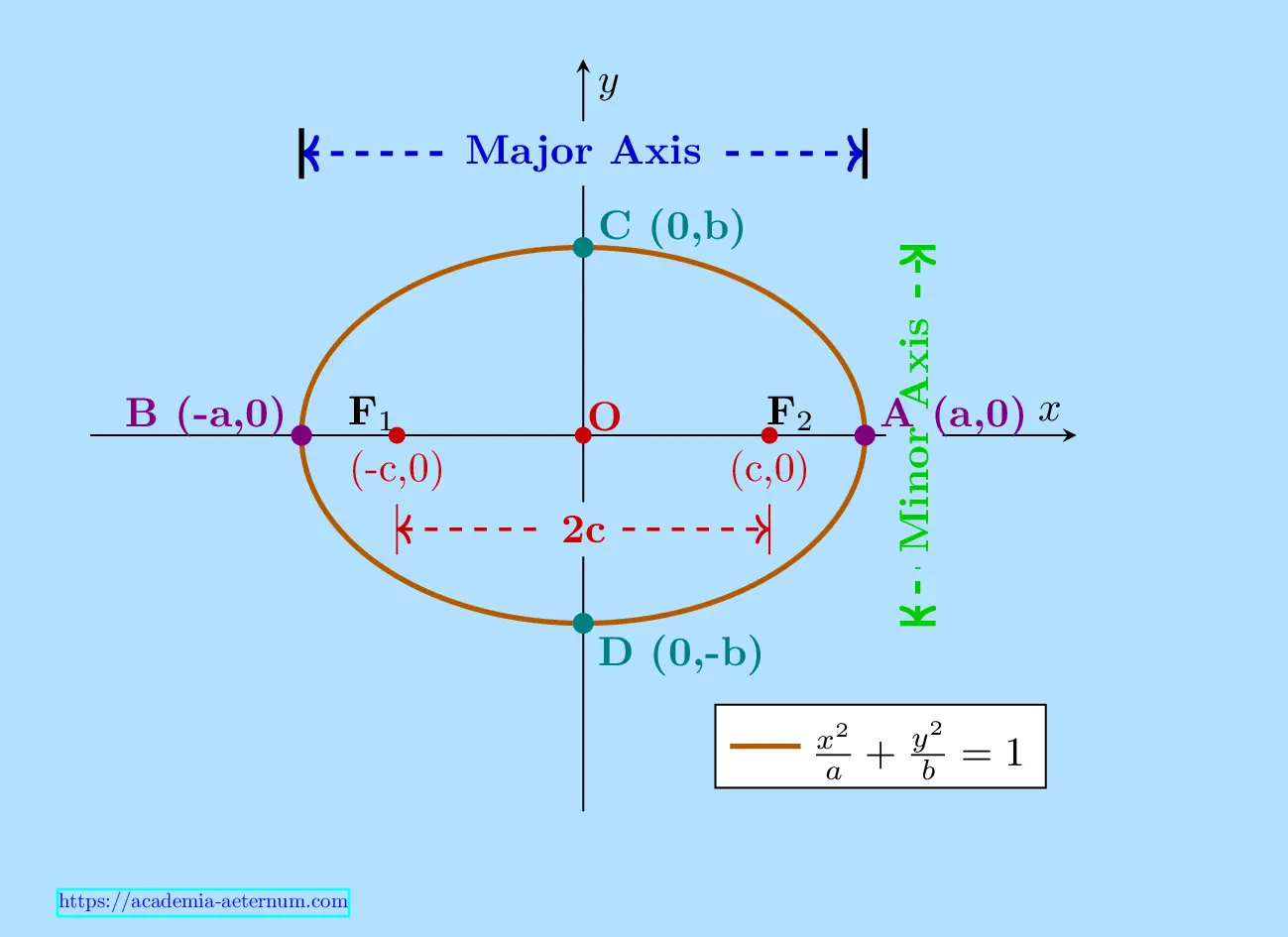
An ellipse is obtained when a plane cuts a cone at an angle such that it intersects all generators of one nappe but does not intersect the base.
Focus–Directrix Property
For any point on the ellipse:
\[ \frac{\text{Distance from Focus}}{\text{Distance from Directrix}} = e,\quad 0 < e < 1 \]
where \(e\) is the eccentricity.
Important Terminology
- Centre: Midpoint of the line joining the foci
- Major Axis: Longest chord through the centre
- Minor Axis: Shortest chord perpendicular to major axis
- Semi-major axis: \(a\)
- Semi-minor axis: \(b\)
- Focal distance: \(c\)
Fundamental Relation
\[ b^2 = a^2 - c^2 \]
Eccentricity
\[ e = \frac{c}{a}, \quad 0 < e < 1 \]
Standard Equation (Major Axis along x-axis)
Let foci be \((\pm c,0)\). Using definition:
\[ \sqrt{(x-c)^2 + y^2} + \sqrt{(x+c)^2 + y^2} = 2a \]
After algebraic simplification:
\[ \frac{x^2}{a^2} + \frac{y^2}{b^2} = 1 \]
Standard Equation (Major Axis along y-axis)
\[ \frac{x^2}{b^2} + \frac{y^2}{a^2} = 1 \]
Geometric Elements
- Centre: \((0,0)\)
- Foci: \((\pm c,0)\), where \(c^2 = a^2 - b^2\)
- Vertices: \((\pm a,0)\)
- Co-vertices: \((0,\pm b)\)
- Major Axis Length: \(2a\)
- Minor Axis Length: \(2b\)
Directrices
\[ x = \pm \frac{a}{e} \]
Latus Rectum
Length = \(\frac{2b^2}{a}\)
Parametric Representation
\[ (x,y) = (a\cos t,\; b\sin t) \]
Axes of Symmetry
- Major axis
- Minor axis
Important Aspects
- Ellipse is a closed curve
- Sum of distances from foci is constant (= \(2a\))
- \(0 < e < 1\)
Parabola
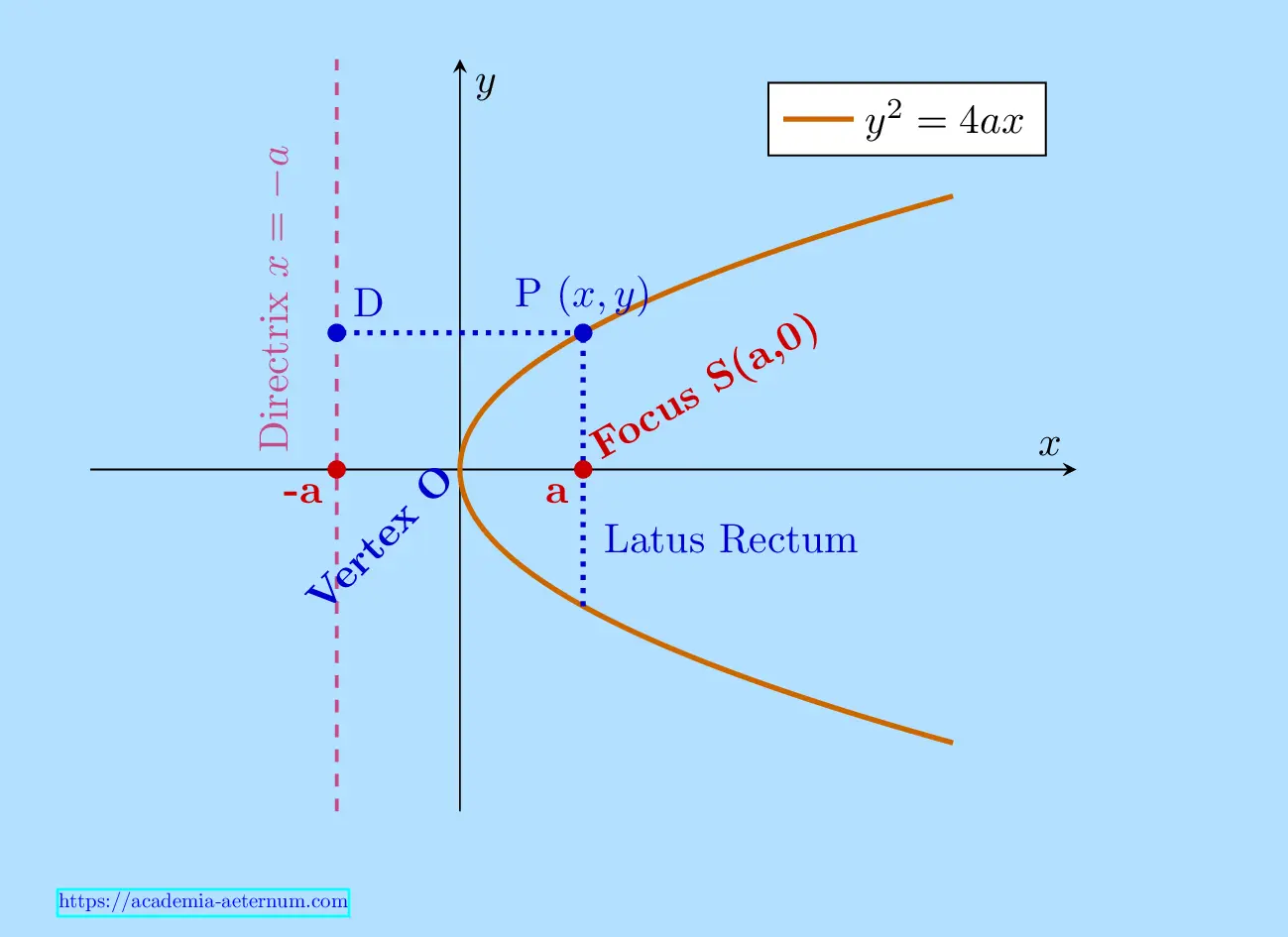
A parabola is obtained when the cutting plane is parallel to a generator of the cone.
Definition (Locus Form)
A parabola is the locus of a point in a plane such that its distance from a fixed point (focus) is equal to its perpendicular distance from a fixed straight line (directrix).
- Focus: Fixed point
- Directrix: Fixed line
Focus–Directrix Property
\[ \frac{\text{Distance from Focus}}{\text{Distance from Directrix}} = 1 \]
Hence, the eccentricity of a parabola is:
\[ e = 1 \]
Standard Setup
Let focus \(S(a,0)\) and directrix \(x = -a\). Let \(P(x,y)\) be any point.
Distance from focus: \[ PS = \sqrt{(x - a)^2 + y^2} \] Distance from directrix: \[ PM = x + a \]
Using definition: \[ \sqrt{(x - a)^2 + y^2} = x + a \]
Derivation of Standard Equation
\[ (x - a)^2 + y^2 = (x + a)^2 \]
\[ x^2 - 2ax + a^2 + y^2 = x^2 + 2ax + a^2 \]
\[ y^2 = 4ax \]
Important Elements
- Vertex: \((0,0)\)
- Focus: \((a,0)\)
- Directrix: \(x = -a\)
- Axis: \(y = 0\)
Latus Rectum
Length = \(4a\), endpoints: \((a,\pm 2a)\)
Different Orientations
- Right: \(y^2 = 4ax\)
- Left: \(y^2 = -4ax\)
- Upward: \(x^2 = 4ay\)
- Downward: \(x^2 = -4ay\)
Tangent
At \((x_1,y_1)\): \[ yy_1 = 2a(x + x_1) \]
Normal (Parametric Form)
At parameter \(t\): \[ y = -tx + 2at + at^3 \]
Parametric Point
\[ (at^2,\;2at) \]
Important Aspects
- Parabola is an open curve
- Lies on one nappe
- Used in projectile motion & reflective surfaces
Hyperbola
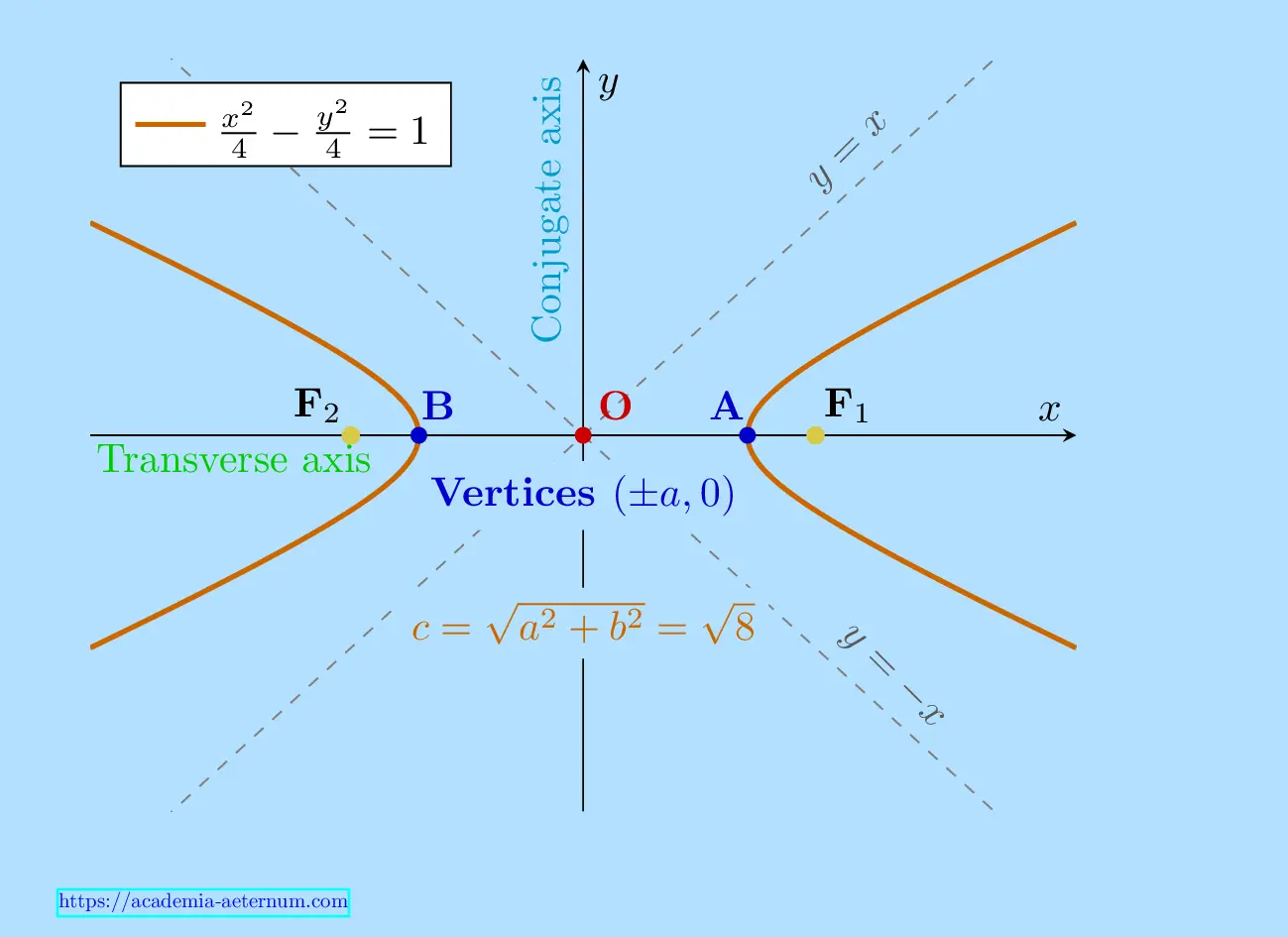
A hyperbola is obtained when the cutting plane intersects both nappes of the cone and is inclined at a smaller angle than the generator.
Focus–Directrix Property
\[ \frac{\text{Distance from Focus}}{\text{Distance from Directrix}} = e,\quad e > 1 \]
where \(e\) is the eccentricity.
Standard Equation
For a hyperbola centered at origin with transverse axis along x-axis:
\[ c^2 = a^2 + b^2 \]
Important Elements
- Centre: \((0,0)\)
- Vertices: \((\pm a,0)\)
- Foci: \((\pm c,0)\)
- Transverse Axis: Along x-axis
- Conjugate Axis: Along y-axis
Latus Rectum
Length = \(\frac{2b^2}{a}\)
Asymptotes (Derivation Insight)
For large \(x\), neglect constant term:
\[ \frac{x^2}{a^2} - \frac{y^2}{b^2} \approx 0 \]
\[ y = \pm \frac{b}{a}x \]
Rectangular Hyperbola
When \(a = b\):
\[ x^2 - y^2 = a^2 \]
Asymptotes become perpendicular → rectangular hyperbola.
Parametric Form
\[ (x,y) = (a\sec t,\; b\tan t) \]
Tangent
\[ \frac{xx_1}{a^2} - \frac{yy_1}{b^2} = 1 \]
Normal (Parametric Form)
\[ ax\sin t - by\cos t = a^2 + b^2 \]
Conjugate Hyperbola
\[ \frac{y^2}{b^2} - \frac{x^2}{a^2} = 1 \]
Both hyperbolas share the same asymptotes.
Important Aspects
- Hyperbola has two branches
- Difference of distances from foci is constant
- \(e > 1\)
Eccentricity and Classification
The eccentricity \(e\) of a conic section is defined as the ratio of the distance of any point on the curve from the focus to its perpendicular distance from the corresponding directrix.
\[ e = \frac{PF}{PD} \]
Classification Based on Eccentricity
-
\(e = 0\) → Circle
Perfect symmetry; focus coincides with centre -
\(0 < e < 1\) → Ellipse
Closed curve; sum of distances from foci is constant -
\(e = 1\) → Parabola
Open curve; equal focus-directrix distance -
\(e > 1\) → Hyperbola
Two branches; difference of distances is constant
Conceptual Continuum
Circle → Ellipse → Parabola → Hyperbola
This transition is continuous and forms the basis of many locus and transformation problems.
For ellipse: \(e = \frac{c}{a}\) For hyperbola: \(e = \frac{c}{a}\) For parabola: \(e = 1\)
Example 1 – Equation of Circle (Centre at Origin)
Find the equation of the circle with centre at (0,0) and radius \(r\).
Solution
Using distance formula:
$$\sqrt{(x-h)^2 + (y-k)^2} = r$$
Substitute \(h=0,\;k=0\):
$$\sqrt{x^2 + y^2} = r$$
Squaring both sides:
$$x^2 + y^2 = r^2$$
Final Equation:
$$x^2 + y^2 = r^2$$
Interactive Visualization
Live Equation
\(x^2 + y^2 = 6400\)
Concept Insight
Moving the slider changes the radius dynamically. Observe how the equation updates as \(r^2\), reinforcing the concept that radius directly controls the size of the circle.
Example 2 – Equation of Circle (Shifted Centre)
Find the equation of the circle with centre \((-3, 2)\) and radius \(4\).
Concept Used
Standard equation:
$$ (x-h)^2 + (y-k)^2 = r^2 $$
Substitution of Values
- \(h = -3,\; k = 2\)
- \(r = 4\)
$$ (x+3)^2 + (y-2)^2 = 16 $$
Final Answer
$$ (x+3)^2 + (y-2)^2 = 16 $$
Interactive Visualization
Live Equation
\( (x+3)^2 + (y-2)^2 = 16 \)
Concept Insight
Observe how shifting the centre changes the equation. The form always remains (x − h)² + (y − k)² = r².
Example 3 – Finding Centre & Radius from General Equation
Find the centre and radius of the circle: \(x^2 + y^2 + 8x + 10y - 8 = 0\)
Concept Used
Convert general form into standard form using completing the square.
Given Equation
$$x^2 + y^2 + 8x + 10y - 8 = 0$$
Step 1: Group Terms
$$ (x^2 + 8x) + (y^2 + 10y) = 8 $$
Step 2: Complete the Square
Add \((4)^2 = 16\) and \((5)^2 = 25\):
$$ (x+4)^2 + (y+5)^2 = 8 + 16 + 25 $$
Step 3: Standard Form
$$ (x+4)^2 + (y+5)^2 = 49 $$
Final Result
- Centre: \((-4, -5)\)
- Radius: \(7\)
Interactive Exploration (JEE-Level Insight)
Live Equation
\(x^2 + y^2 + 8x + 10y - 8 = 0\)
Centre = (-4,-5), Radius = 7
Shortcut Method (JEE)
General form:
$$x^2 + y^2 + 2gx + 2fy + c = 0$$
- Centre = \((-g, -f)\)
- Radius = \(\sqrt{g^2 + f^2 - c}\)
Concept Insight
Move sliders to see how coefficients affect centre and radius directly. This builds strong intuition for JEE MCQs.
Example 4 – Circle Through Two Points with Centre on a Line
Find the equation of the circle passing through \((2,-2)\), \((3,4)\) and whose centre lies on the line \(x + y = 2\).
Concept Used
The centre \((h,k)\) is equidistant from both points:
$$ (h-2)^2 + (k+2)^2 = (h-3)^2 + (k-4)^2 $$
Step 1: Simplify
$$ h + 6k = 13 $$
Step 2: Line Condition
$$ h + k = 2 $$
Step 3: Solve
Subtract equations:
$$ (h+6k) - (h+k) = 13 - 2 $$
$$ 5k = 11 \Rightarrow k = \frac{11}{5} $$
$$ h = 2 - k = -\frac{1}{5} $$
Step 4: Radius
$$ r^2 = (h-2)^2 + (k+2)^2 $$
$$ r^2 = \frac{441}{25} \Rightarrow r = \frac{21}{5} $$
Final Equation
$$ \left(x+\frac{1}{5}\right)^2 + \left(y-\frac{11}{5}\right)^2 = \frac{441}{25} $$
Interactive Visualization
Live Equation
Equation updates dynamically
Concept Insight
Move the centre along the line. Only one position satisfies equal distance from both points — that is the required circle.
Example 5 – Elements of a Parabola (Focus, Axis, Directrix, Latus Rectum)
Find the coordinates of focus, axis, directrix and latus rectum of the parabola \(y^2 = 8x\).
Concept Used
Compare with standard form:
$$y^2 = 4ax$$
Step 1: Identify \(a\)
$$4a = 8 \Rightarrow a = 2$$
Step 2: Key Elements
- Vertex: (0, 0)
- Focus: (a,0) = (2,0)
- Axis: y = 0
- Directrix: x = −2
Step 3: Latus Rectum
Length:
$$4a = 8$$
Endpoints:
$$ (2,4),\;(2,-4) $$
Final Answer
- Focus: (2, 0)
- Directrix: x = −2
- Latus Rectum Length: 8
Interactive Exploration
Live Equation
\(y^2 = 8x\)
Focus = (2,0), Directrix = x = -2, Latus Rectum = 8
Concept Insight
Changing \(a\) shifts the focus and directrix while preserving the parabola shape. This builds strong intuition for JEE coordinate geometry.
Example 6 – Equation of Parabola (Given Focus & Directrix)
Find the equation of the parabola with focus \((2,0)\) and directrix \(x = -2\).
Concept Used
A parabola is the locus of a point whose distance from focus equals its distance from directrix.
Step 1: Standard Form
$$ y^2 = 4ax $$
Step 2: Compare
Focus = \((a,0)\), Directrix = \(x = -a\)
$$ a = 2 $$
Step 3: Substitute
$$ y^2 = 4(2)x $$
Final Equation
$$ y^2 = 8x $$
Interactive Visualization
Live Equation
\(y^2 = 8x\)
Concept Insight
Moving the focus changes the opening of the parabola. The directrix always remains symmetric.
Exam Insight
- Direct use of focus-directrix definition
- Common in Boards & JEE Main
- Identify orientation quickly
Example 7 – Equation of Parabola (Vertex & Focus Given)
Find the equation of the parabola with vertex at \((0,0)\) and focus at \((0,2)\).
Concept Used
The orientation depends on the position of focus relative to vertex.
Step 1: Identify Orientation
- Vertex = (0,0)
- Focus = (0,2)
Focus lies on positive y-axis ⇒ parabola opens upward.
Step 2: Standard Form
$$ x^2 = 4ay $$
Step 3: Find \(a\)
$$ a = 2 $$
Step 4: Substitute
$$ x^2 = 8y $$
Final Answer
$$ x^2 = 8y $$
Interactive Visualization
Live Equation
\(x^2 = 8y\)
Concept Insight
Moving the focus changes the opening of the parabola. The directrix shifts symmetrically below the vertex.
Exam Insight
- Focus position ⇒ orientation instantly
- Very common in Boards & JEE Main
- Always match with correct standard form
Quick Revision
Focus on y-axis ⇒ \(x^2 = 4ay\)
Focus on x-axis ⇒ \(y^2 = 4ax\)
Example 8 – Parabola Symmetric About y-axis
Find the equation of the parabola which is symmetric about the y-axis and passes through \((2,-3)\).
Concept Used
If a parabola is symmetric about the y-axis, its standard form is:
$$ x^2 = 4ay $$
The sign of \(a\) determines the direction:
- \(a > 0\) → opens upward
- \(a < 0\) → opens downward
Step 1: Substitute the Given Point
Since the parabola passes through \((2,-3)\), substitute \(x = 2\), \(y = -3\):
$$ (2)^2 = 4a(-3) $$
Step 2: Simplify
$$ 4 = -12a $$
Step 3: Solve for \(a\)
$$ a = -\frac{1}{3} $$
Step 4: Substitute Back
$$ x^2 = 4\left(-\frac{1}{3}\right)y $$
Final Equation
$$ x^2 = -\frac{4}{3}y $$
Interactive Visualization
Live Equation
Concept Insight
Notice that the parabola opens downward because \(a\) is negative. The red point always satisfies the equation, while the yellow point is the original given point.
Exam Insight
- Symmetry directly gives equation form
- Substitution determines value of \(a\)
- Very common in Boards & JEE
Example 9 – Complete Analysis of an Ellipse
Find the foci, vertices, axes lengths, eccentricity and latus rectum of: \(\dfrac{x^2}{25} + \dfrac{y^2}{9} = 1\)
Step 1: Compare with Standard Form
Standard equation of ellipse:
$$ \frac{x^2}{a^2} + \frac{y^2}{b^2} = 1 $$
Comparing:
- \(a^2 = 25 \Rightarrow a = 5\)
- \(b^2 = 9 \Rightarrow b = 3\)
Since \(a > b\), the ellipse is elongated along the x-axis.
Step 2: Find \(c\)
Relation:
$$ c^2 = a^2 - b^2 $$
$$ c^2 = 25 - 9 = 16 $$
$$ c = 4 $$
Step 3: Eccentricity
$$ e = \frac{c}{a} = \frac{4}{5} $$
Step 4: Key Elements
- Foci: \((\pm4,0)\)
- Vertices: \((\pm5,0)\)
- Major Axis: \(2a = 10\)
- Minor Axis: \(2b = 6\)
Step 5: Latus Rectum
Formula:
$$ \text{Length} = \frac{2b^2}{a} $$
$$ = \frac{2 \times 9}{5} = \frac{18}{5} $$
Interactive Exploration
Live Equation
Concept Insight
Increasing \(a\) stretches the ellipse horizontally, while increasing \(b\) makes it taller. The distance between foci depends on \(c = \sqrt{a^2 - b^2}\).
Example 10 – Ellipse with Major Axis along y-axis
Find the foci, vertices, axes lengths and eccentricity of: \(9x^2 + 4y^2 = 36\)
Step 1: Convert to Standard Form
Divide both sides by 36:
$$ \frac{9x^2}{36} + \frac{4y^2}{36} = 1 $$
$$ \frac{x^2}{4} + \frac{y^2}{9} = 1 $$
Step 2: Compare with Standard Form
For ellipse along y-axis:
$$ \frac{x^2}{b^2} + \frac{y^2}{a^2} = 1 $$
- \(a^2 = 9 \Rightarrow a = 3\)
- \(b^2 = 4 \Rightarrow b = 2\)
Since \(a > b\), the major axis lies along the y-axis.
Step 3: Find \(c\)
$$ c^2 = a^2 - b^2 $$
$$ c^2 = 9 - 4 = 5 $$
$$ c = \sqrt{5} $$
Step 4: Eccentricity
$$ e = \frac{c}{a} = \frac{\sqrt{5}}{3} $$
Step 5: Key Elements
- Foci: \((0, \pm \sqrt{5})\)
- Vertices: \((0, \pm 3)\)
- Major Axis: \(2a = 6\)
- Minor Axis: \(2b = 4\)
Step 6: Latus Rectum
$$ \text{Length} = \frac{2b^2}{a} = \frac{8}{3} $$
Interactive Exploration
Live Equation
Concept Insight
Increasing \(a\) stretches the ellipse vertically. The foci move away as \(c = \sqrt{a^2 - b^2}\) increases.
Example 11 – Equation of Ellipse (Given Vertices & Foci)
Find the equation of the ellipse whose vertices are \((\pm 13, 0)\) and foci are \((\pm 5, 0)\).
Concept Used
Standard form of ellipse with major axis along x-axis:
$$ \frac{x^2}{a^2} + \frac{y^2}{b^2} = 1 $$
Relation:
$$ c^2 = a^2 - b^2 $$
Step 1: Identify Parameters
- Vertices = \((\pm 13, 0)\) ⇒ \(a = 13\)
- Foci = \((\pm 5, 0)\) ⇒ \(c = 5\)
Step 2: Find \(b^2\)
Using:
$$ c^2 = a^2 - b^2 $$
Substitute values:
$$ 5^2 = 13^2 - b^2 $$
$$ 25 = 169 - b^2 $$
$$ b^2 = 169 - 25 = 144 $$
Step 3: Write Equation
$$ \frac{x^2}{169} + \frac{y^2}{144} = 1 $$
Final Answer
$$ \frac{x^2}{169} + \frac{y^2}{144} = 1 $$
Interactive Exploration
Live Equation
Concept Insight
Vertices determine \(a\), foci determine \(c\), and the ellipse shape is controlled by \(b = \sqrt{a^2 - c^2}\). Move sliders to see how ellipse changes.
Exam Insight
- Very common in Boards & JEE
- Always find \(a\) and \(c\) first
- Then compute \(b^2 = a^2 - c^2\)
Example 12 – Equation of Ellipse (Given Major Axis & Foci)
Find the equation of the ellipse whose length of major axis is 20 and foci are \((0, \pm 5)\).
Concept Used
Standard form (major axis along y-axis):
$$ \frac{x^2}{b^2} + \frac{y^2}{a^2} = 1 $$
Fundamental relation:
$$ c^2 = a^2 - b^2 $$
Step 1: Find \(a\)
Length of major axis = \(2a = 20\)
$$ a = 10 $$
Step 2: Identify \(c\)
Foci are \((0, \pm 5)\)
$$ c = 5 $$
Step 3: Find \(b^2\)
Using relation:
$$ c^2 = a^2 - b^2 $$
$$ 25 = 100 - b^2 $$
$$ b^2 = 75 $$
Step 4: Write Equation
$$ \frac{x^2}{75} + \frac{y^2}{100} = 1 $$
Final Answer
$$ \frac{x^2}{75} + \frac{y^2}{100} = 1 $$
Interactive Exploration
Live Equation
Concept Insight
Major axis length gives \(a\), foci give \(c\), and then \(b\) is determined using \(b = \sqrt{a^2 - c^2}\). Move sliders to explore how ellipse changes.
Exam Insight
- Very common in Boards & JEE
- Orientation must be identified correctly
- Always compute \(b^2 = a^2 - c^2\)
Example 13 – Ellipse Passing Through Given Points
Find the equation of the ellipse with major axis along the x-axis and passing through the points \((4,3)\) and \((-1,4)\).
Concept Used
Standard form (major axis along x-axis):
$$ \frac{x^2}{a^2} + \frac{y^2}{b^2} = 1 $$
Step 1: Substitute Point (4,3)
$$ \frac{4^2}{a^2} + \frac{3^2}{b^2} = 1 $$
$$ \frac{16}{a^2} + \frac{9}{b^2} = 1 \quad ...(1) $$
Step 2: Substitute Point (-1,4)
$$ \frac{(-1)^2}{a^2} + \frac{4^2}{b^2} = 1 $$
$$ \frac{1}{a^2} + \frac{16}{b^2} = 1 \quad ...(2) $$
Step 3: Solve System of Equations
From equation (2):
$$ \frac{1}{a^2} = 1 - \frac{16}{b^2} $$
Step 4: Substitute into (1)
Multiply (2) by 16:
$$ \frac{16}{a^2} = 16 - \frac{256}{b^2} $$
Substitute in (1):
$$ \left(16 - \frac{256}{b^2}\right) + \frac{9}{b^2} = 1 $$
$$ 16 - \frac{247}{b^2} = 1 $$
Step 5: Solve for \(b^2\)
$$ 16 - 1 = \frac{247}{b^2} $$
$$ 15 = \frac{247}{b^2} $$
$$ b^2 = \frac{247}{15} $$
Step 6: Find \(a^2\)
Substitute into equation (2):
$$ \frac{1}{a^2} + \frac{16}{247/15} = 1 $$
$$ \frac{1}{a^2} + \frac{240}{247} = 1 $$
$$ \frac{1}{a^2} = \frac{7}{247} $$
$$ a^2 = \frac{247}{7} $$
Step 7: Final Equation
$$ \frac{x^2}{247/7} + \frac{y^2}{247/15} = 1 $$
Final Answer
$$ \frac{7x^2}{247} + \frac{15y^2}{247} = 1 $$
Interactive Exploration
Live Equation
Concept Insight
Two points give two equations. Solving simultaneously gives \(a^2\) and \(b^2\). Move sliders to see when both points lie on ellipse.
Example 14 – Complete Analysis of Hyperbolas
Find foci, vertices, eccentricity, and length of latus rectum of:
(i) \(\dfrac{x^2}{9} - \dfrac{y^2}{16} = 1\)
(ii) \(y^2 - 16x^2 = 16\)
(i) Hyperbola along x-axis
Standard form:
$$ \frac{x^2}{a^2} - \frac{y^2}{b^2} = 1 $$
Step 1: Identify parameters
- \(a^2 = 9 \Rightarrow a = 3\)
- \(b^2 = 16 \Rightarrow b = 4\)
Step 2: Find \(c\)
For hyperbola:
$$ c^2 = a^2 + b^2 $$
$$ c^2 = 9 + 16 = 25 $$
$$ c = 5 $$
Step 3: Find required elements
- Foci: \((\pm 5, 0)\)
- Vertices: \((\pm 3, 0)\)
- Eccentricity: \( e = \frac{c}{a} = \frac{5}{3} \)
- Latus Rectum: \( \frac{2b^2}{a} = \frac{32}{3} \)
(ii) Hyperbola along y-axis
Step 1: Convert to standard form
$$ y^2 - 16x^2 = 16 $$
Divide by 16:
$$ \frac{y^2}{16} - \frac{x^2}{1} = 1 $$
Step 2: Identify parameters
- \(a^2 = 16 \Rightarrow a = 4\)
- \(b^2 = 1 \Rightarrow b = 1\)
Step 3: Find \(c\)
$$ c^2 = a^2 + b^2 = 16 + 1 = 17 $$
$$ c = \sqrt{17} $$
Step 4: Results
- Foci: \((0, \pm \sqrt{17})\)
- Vertices: \((0, \pm 4)\)
- Eccentricity: \( \frac{\sqrt{17}}{4} \)
- Latus Rectum: \( \frac{1}{2} \)
Interactive Exploration
Live Parameters
Concept Insight
Unlike ellipse, hyperbola uses \(c^2 = a^2 + b^2\). Increasing \(b\) makes branches wider, while increasing \(a\) shifts vertices outward.
Exam Insight
- Sign determines orientation
- Hyperbola uses addition in \(c^2\)
- Very important for JEE MCQs
Example 15 – Equation of Hyperbola (Given Foci & Vertices)
Find the equation of the hyperbola with foci \((0, \pm 3)\) and vertices \(\left(0, \pm \dfrac{\sqrt{11}}{2}\right)\).
Concept Used
Since both foci and vertices lie on the y-axis, the transverse axis is along y-axis.
Standard form:
$$ \frac{y^2}{a^2} - \frac{x^2}{b^2} = 1 $$
Relation:
$$ c^2 = a^2 + b^2 $$
Step 1: Identify Parameters
- \(a = \dfrac{\sqrt{11}}{2} \Rightarrow a^2 = \dfrac{11}{4}\)
- \(c = 3 \Rightarrow c^2 = 9\)
Step 2: Find \(b^2\)
Using relation:
$$ c^2 = a^2 + b^2 $$
$$ 9 = \frac{11}{4} + b^2 $$
$$ b^2 = 9 - \frac{11}{4} $$
$$ b^2 = \frac{36 - 11}{4} = \frac{25}{4} $$
Step 3: Substitute in Equation
$$ \frac{y^2}{11/4} - \frac{x^2}{25/4} = 1 $$
Step 4: Simplify
Multiply throughout by 4:
$$ \frac{4y^2}{11} - \frac{4x^2}{25} = 1 $$
Final Equation
$$ \frac{4y^2}{11} - \frac{4x^2}{25} = 1 $$
Interactive Exploration
Live Parameters
Concept Insight
For hyperbola, unlike ellipse, we use \(c^2 = a^2 + b^2\). Increasing \(c\) pushes foci away, while \(a\) controls vertex position.
Exam Insight
- Always identify axis first (x vs y)
- Use correct relation (addition, not subtraction)
- Common conceptual trap in JEE
Example-16
Find the equation of the hyperbola where foci are \((0, \pm 12)\) and the length of the latus rectum is 36.
Solution
The foci of the hyperbola are \((0, \pm 12)\), so the transverse axis lies along the \(y\)-axis and \(c = 12\).
The length of the latus rectum is given as \(36\), and for a hyperbola:
$$ \begin{aligned} \frac{2b^2}{a} &= 36\\ 2b^2 &= 36a\\ b^2 &= 18a \quad ...(1) \end{aligned} $$
Using the relation \(c^2 = a^2 + b^2\):
$$ \begin{aligned} 12^2 &= a^2 + b^2\\ 144 &= a^2 + 18a\\ a^2 + 18a - 144 &= 0\\ (a - 6)(a + 24) &= 0\\ a &= 6 \quad (\text{reject negative value}) \end{aligned} $$
Substituting \(a = 6\) to find \(b^2\):
$$ \begin{aligned} b^2 &= 18a\\ b^2 &= 18 \times 6\\ b^2 &= 108 \end{aligned} $$
Since the transverse axis is along the \(y\)-axis, the standard equation of the hyperbola is:
$$ \begin{aligned} \frac{y^2}{a^2} - \frac{x^2}{b^2} &= 1\\ \frac{y^2}{36} - \frac{x^2}{108} &= 1 \end{aligned} $$
Therefore, the required equation of the hyperbola is:
$$ \boxed{\frac{y^2}{36} - \frac{x^2}{108} = 1} $$
Interactive Exploration
Live Parameters
Example 18 – Beam Deflection as Parabola
A beam is supported at its ends which are \(12\) metres apart. Due to a load at the centre, there is a deflection of \(3\) cm at the centre. The deflected beam takes the shape of a parabola. How far from the centre is the deflection \(1\) cm?
Concept Used
- Parabolic symmetry about centre
- Vertex form used since maximum deflection at centre
Solution
Let the centre of the beam be taken as the origin \((0,0)\) and the beam lie along the \(x\)-axis.
Since the beam bends downward symmetrically, the equation of the parabola is:
$$ \begin{aligned} y = ax^2 + c \end{aligned} $$
At the centre, the deflection is \(3\) cm downward:
$$ \begin{aligned} x = 0,\quad y = -3 \end{aligned} $$
$$ \begin{aligned} -3 = a(0)^2 + c \\ \therefore c = -3 \end{aligned} $$
The supports are \(12\) m apart, so each support is \(6\) m from the centre.
At the supports, deflection is zero:
$$ \begin{aligned} x = 6,\quad y = 0 \end{aligned} $$
$$ \begin{aligned} 0 &= a(6)^2 - 3 \\ 0 &= 36a - 3 \\ 36a &= 3 \\ a &= \frac{1}{12} \end{aligned} $$
Hence, the equation of the parabola is:
$$ \begin{aligned} y = \frac{1}{12}x^2 - 3 \end{aligned} $$
Now, to find the position where deflection is \(1\) cm downward:
$$ \begin{aligned} y = -1 \end{aligned} $$
$$ \begin{aligned} -1 &= \frac{1}{12}x^2 - 3 \\ \frac{1}{12}x^2 &= 2 \\ x^2 &= 24 \\ x &= \pm 2\sqrt{6} \end{aligned} $$
Therefore, the deflection of \(1\) cm occurs at a distance:
\(\boxed{2\sqrt{6}\ \text{metres from the centre}}\)
🔍 Live Interactive Exploration
Equation: \(y = \frac{1}{12}x^2 - 3\)
Example 19 – Locus of a Point on a Rod (Ellipse)
A rod \(AB\) of length \(15\) cm rests between two coordinate axes such that end point \(A\) lies on the \(x\)-axis and end point \(B\) lies on the \(y\)-axis. A point \(P(x, y)\) is taken on the rod such that \(AP = 6\) cm. Show that the locus of \(P\) is an ellipse.
Concept Used
:contentReference[oaicite:0]{index=0}- Distance formula for rod length
- Section formula (internal division)
- Elimination of parameters to obtain locus
Solution
Let the coordinate axes be mutually perpendicular with origin \(O\).
Let the coordinates of the end points be:
$$ \begin{aligned} A(a, 0), \quad B(0, b) \end{aligned} $$
Since the length of the rod is constant:
$$ \begin{aligned} AB^2 &= (a-0)^2 + (0-b)^2 \\ &= a^2 + b^2 \\ \therefore a^2 + b^2 &= 15^2 = 225 \end{aligned} $$
Given \(AP = 6\) cm and total length \(AB = 15\) cm:
$$ AP : PB = 6 : 9 = 2 : 3 $$
Hence, point \(P\) divides \(AB\) internally in the ratio \(2:3\).
Using section formula:
$$ \begin{aligned} x &= \frac{3a + 2\cdot 0}{2+3} = \frac{3a}{5} \\ y &= \frac{3\cdot 0 + 2b}{2+3} = \frac{2b}{5} \end{aligned} $$
Express \(a\) and \(b\) in terms of \(x\) and \(y\):
$$ \begin{aligned} a &= \frac{5x}{3} \\ b &= \frac{5y}{2} \end{aligned} $$
Substitute into \(a^2 + b^2 = 225\):
$$ \begin{aligned} \left(\frac{5x}{3}\right)^2 + \left(\frac{5y}{2}\right)^2 &= 225 \\ \frac{25x^2}{9} + \frac{25y^2}{4} &= 225 \end{aligned} $$
Divide throughout by \(225\):
$$ \begin{aligned} \frac{x^2}{81} + \frac{y^2}{36} = 1 \end{aligned} $$
This is the standard equation of an ellipse. Hence, the locus of \(P\) is an ellipse.
🔍 Live Interactive Exploration
Equation: \(\frac{x^2}{81} + \frac{y^2}{36} = 1\)