
Cartesian Product of Sets
The concept of a Cartesian Product is fundamental in the study of relations and functions. It provides a systematic way of pairing elements from two sets and forms the mathematical basis for describing coordinates, relations, mappings and ordered structures.
Definition
Let \(A\) and \(B\) be two non-empty sets. The Cartesian Product of \(A\) and \(B\), denoted by \(A \times B\), is defined as the set of all ordered pairs \((a,b)\) such that \(a \in A\) and \(b \in B\).
\[ A \times B = \{(a,b) : a \in A, \; b \in B\} \]
Each element of \(A \times B\) is called an ordered pair. The first component of the pair belongs to set \(A\) and the second component belongs to set \(B\).
A crucial property of ordered pairs is that order matters. In general,
\[ (a,b) \ne (b,a) \]
unless \(a=b\). Therefore, the Cartesian product depends not only on the sets involved but also on the order in which they appear.
Illustrative Example
Consider the sets
\(A=\{1,2\}\) and \(B=\{x,y,z\}\)
The Cartesian product \(A \times B\) consists of all possible ordered pairs formed by taking the first element from \(A\) and the second element from \(B\).
\[ A \times B = \{(1,x),(1,y),(1,z),(2,x),(2,y),(2,z)\} \]
Thus the Cartesian product systematically combines every element of \(A\) with every element of \(B\).
Visual Representation
Cartesian products can be visualised as a grid of points where rows represent elements of set \(A\) and columns represent elements of set \(B\).
Each point represents one ordered pair of the Cartesian product.
Number of Elements in Cartesian Product
If set \(A\) contains \(m\) elements and set \(B\) contains \(n\) elements, then the total number of ordered pairs in \(A \times B\) is:
\[ n(A \times B) = m \times n \]
This follows from the fundamental counting principle: each element of \(A\) can be paired with every element of \(B\).
Important Properties
- Order matters: In general, \(A \times B \ne B \times A\).
- Equality of ordered pairs: \[ (a,b) = (c,d) \iff a=c \text{ and } b=d \]
- Cardinality rule: If \(n(A)=p\) and \(n(B)=q\), then \(n(A \times B)=pq\).
- Empty set rule: If either set is empty, the Cartesian product is empty: \[ A \times \varnothing = \varnothing \]
- Cartesian square: \(A \times A\) is called the Cartesian square of \(A\).
- Ordered triplets: \[ A \times A \times A = \{(a,b,c):a,b,c \in A\} \]
Connection with Coordinate Geometry
One of the most important applications of Cartesian products appears in coordinate geometry. The set
\[ \mathbb{R} \times \mathbb{R} \]
represents all ordered pairs of real numbers and corresponds exactly to the Cartesian plane. Every point in the plane is represented by an ordered pair \((x,y)\).
Thus, Cartesian products provide the mathematical framework for describing coordinates, graphs of functions and geometric relations.
Why Cartesian Products Are Important
- They form the foundation of relations.
- Functions are defined as special types of relations that arise from Cartesian products.
- They provide the structure required to describe coordinate systems.
- They are widely used in probability, databases, computer science and graph theory.
Relations Between Sets
In mathematics, a relation describes a meaningful association between elements of two sets. Instead of studying elements independently, relations help us understand how elements of one set are connected to elements of another set.
The concept of relations naturally arises from the idea of the Cartesian Product. Since a Cartesian product lists all possible ordered pairs formed from two sets, a relation can be viewed as a selection of certain ordered pairs that satisfy a specific condition.
Definition of a Relation
Let \(A\) and \(B\) be two non-empty sets. A relation \(R\) from set \(A\) to set \(B\) is defined as any subset of the Cartesian product \(A \times B\).
\[ R \subseteq A \times B \]
If an ordered pair \((a,b)\) belongs to \(R\), we say that
\(a\) is related to \(b\)
and write this relationship symbolically as
\[ a\,R\,b \]
where \(a \in A\) and \(b \in B\).
Illustrative Example
Let
\(A = \{1,2,3\}\), \(B = \{2,4,6\}\)
Define a relation \(R\) from \(A\) to \(B\) such that
\[ a\,R\,b \iff b = 2a \]
The ordered pairs satisfying this condition are:
\[ R = \{(1,2),(2,4),(3,6)\} \]
Thus, \(R\) is a subset of \(A \times B\) and therefore forms a valid relation.
Arrow Diagram Representation
Relations are often visualised using an arrow diagram, where arrows connect related elements of the two sets.
Each arrow represents one ordered pair of the relation.
Total Number of Possible Relations
Suppose set \(A\) contains \(m\) elements and set \(B\) contains \(n\) elements. Then the Cartesian product \(A \times B\) contains
\[ m \times n \]
ordered pairs.
Since every relation is a subset of \(A \times B\), the total number of possible relations equals the number of subsets of a set containing \(mn\) elements.
\[ \boxed{\text{Number of relations} = 2^{mn}} \]
Even for small sets, the number of possible relations can be extremely large.
Relation on a Set
If a relation is defined from a set \(A\) to itself, then it is called a relation on the set \(A\).
\[ R \subseteq A \times A \]
Such relations play an important role in defining mathematical concepts like
- Equivalence relations
- Order relations
- Functions
Domain of a Relation
The domain of a relation \(R\) is the set of all first elements of the ordered pairs in \(R\).
\[ \text{Domain}(R)=\{a\in A : (a,b)\in R\} \]
Range of a Relation
The range of a relation \(R\) is the set of all second elements of the ordered pairs in \(R\).
\[ \text{Range}(R)=\{b\in B : (a,b)\in R\} \]
Codomain
The set \(B\) itself is called the codomain of the relation.
In general,
\[ \text{Range}(R) \subseteq \text{Codomain} \]
This means that every element appearing as an image in the relation belongs to the codomain, but not every element of the codomain necessarily appears in the range.
Importance of Relations
Relations provide the mathematical framework for studying structured connections between objects. They are essential in:
- Defining functions as special types of relations
- Studying equivalence and order relations
- Representing graphs and networks
- Applications in computer science, databases and logic
Functions
In mathematics, a function is a special type of relation that associates elements of one set with elements of another set in a precise and well-defined manner. Functions play a central role in algebra, calculus, coordinate geometry and mathematical modelling because they describe how one quantity depends on another.
Every function is built upon the idea of the Cartesian product. Since relations are subsets of \(A \times B\), a function can be viewed as a relation that satisfies an additional restriction: each element of the first set must correspond to exactly one element of the second set.
Definition of a Function
Let \(A\) and \(B\) be two non-empty sets. A function \(f\) from \(A\) to \(B\) is a relation such that every element of \(A\) is associated with exactly one element of \(B\).
\[ f : A \rightarrow B \]
For each \(a \in A\), there exists a unique element \(b \in B\) such that
\[ f(a)=b \]
The element \(b\) is called the image of \(a\) under the function \(f\).
Mapping Diagram of a Function
Functions are often illustrated using mapping diagrams, where arrows connect elements of the domain to their corresponding images in the codomain.
Each element of the domain has exactly one arrow pointing to its image.
Domain, Codomain and Range
For a function \(f : A \rightarrow B\):
- Domain: The set \(A\) containing all input values.
- Codomain: The set \(B\) in which all images lie.
- Range: The set of actual outputs produced by the function.
\[ \text{Range}(f) = \{f(a) : a \in A\} \subseteq B \]
Thus the range is always a subset of the codomain.
Total Number of Functions
Suppose set \(A\) contains \(m\) elements and set \(B\) contains \(n\) elements.
For each element of \(A\), we can choose any of the \(n\) elements of \(B\) as its image. Since these choices are independent, the total number of functions is
\[ n \times n \times \cdots \times n \]
\[ \boxed{n^m} \]
Therefore,
\[ \text{Number of functions from } A \text{ to } B = n^m \]
Equality of Functions
Two functions \(f : A \rightarrow B\) and \(g : A \rightarrow B\) are said to be equal if they assign the same image to every element of the domain.
\[ f = g \iff f(a) = g(a) \quad \text{for all } a \in A \]
Thus, equality of functions depends not only on the rule of assignment but also on the domain and codomain.
Ways to Represent a Function
Functions can be represented in several different ways:
- By listing ordered pairs
- By an algebraic rule (e.g., \(f(x)=x^2\))
- By a mapping or arrow diagram
- By a graph in the coordinate plane
Importance of Functions
Functions form the backbone of many areas of mathematics and its applications. They are used in:
- Algebra and coordinate geometry
- Calculus and differential equations
- Mathematical modelling in physics and economics
- Computer science and data analysis
Important Functions and Their Graphs
In mathematics, functions are often studied not only through algebraic expressions but also through their graphs. Graphs provide a visual representation of how the output of a function varies with its input.
Understanding the graphs of common functions helps students analyse symmetry, monotonic behaviour, discontinuities, domain and range. These ideas are extremely important for higher mathematics and competitive exams such as IIT-JEE, NEET and engineering entrance examinations.
The following are some important functions frequently used in mathematics.
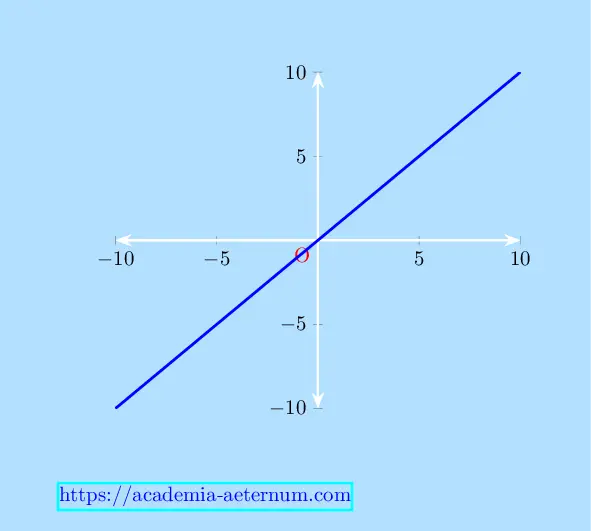
Identity Function
The function \(f:\mathbb{R}\rightarrow\mathbb{R}\) defined by
\(f(x)=x\)
is called the identity function. Every element of the domain maps to itself.
Domain: \(\mathbb{R}\)
Range: \(\mathbb{R}\)
The graph of the identity function is a straight line passing through the origin with slope \(1\).
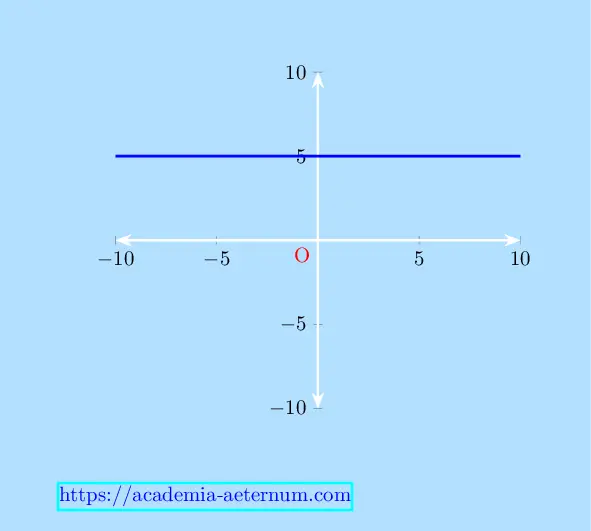
Constant Function
A function \(f:\mathbb{R}\rightarrow\mathbb{R}\) defined by
\(f(x)=c\)
where \(c\) is a constant is called a constant function.
Domain: \(\mathbb{R}\)
Range: \(\{c\}\)
Its graph is a horizontal line parallel to the \(x\)-axis.
.webp)
Quadratic Function
The function
\(f(x)=x^2\)
is a polynomial function of degree 2.
Domain: \(\mathbb{R}\)
Range: \([0,\infty)\)
Its graph is a parabola opening upward and symmetric about the \(y\)-axis.
.webp)
Cubic Function
\(f(x)=x^3\)
This is a polynomial function of degree 3.
Domain: \(\mathbb{R}\)
Range: \(\mathbb{R}\)
The graph is symmetric about the origin and is an example of an odd function.
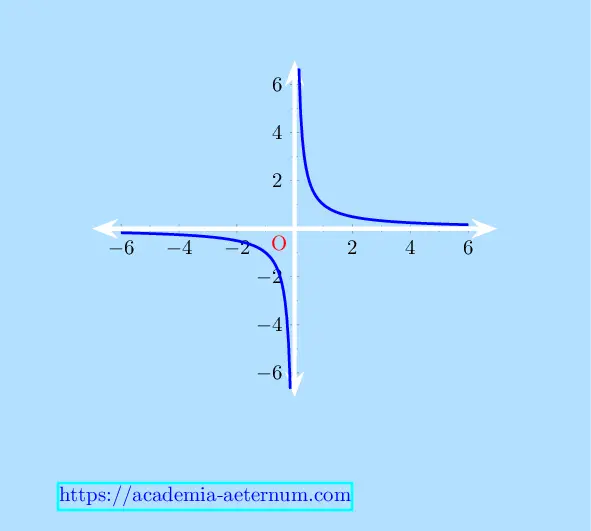
Rational Function
A rational function is of the form
\(\frac{p(x)}{q(x)}\)
where \(p(x)\) and \(q(x)\) are polynomials and \(q(x)\neq0\).
Such functions often have asymptotes and play an important role in calculus.
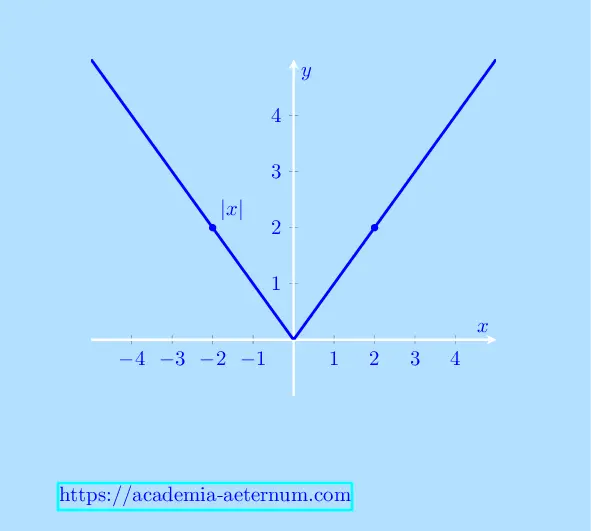
Modulus Function
\(f(x)=|x|\)
The modulus function gives the absolute value of a real number.
\[ |x|= \begin{cases} x, & x\ge0 \\ -x, & x<0 \end{cases} \]
Its graph is V-shaped and symmetric about the \(y\)-axis.
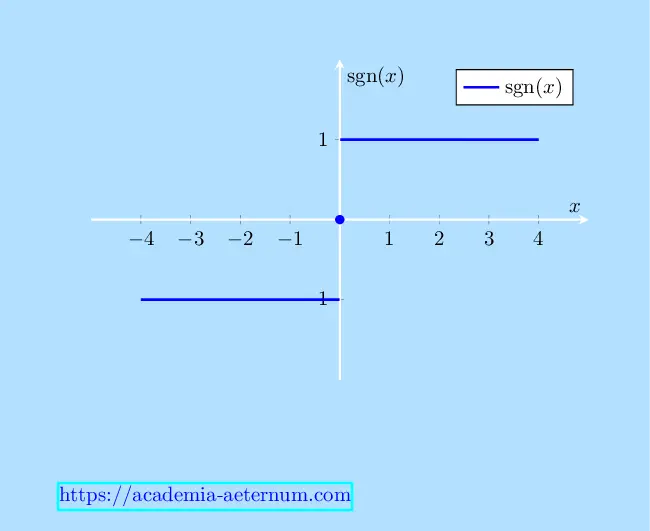
Signum Function
The signum function is defined as
\[ f(x)= \begin{cases} 1, & x>0\\ 0, & x=0\\ -1, & x<0 \end{cases} \]It indicates whether a number is positive, negative or zero.
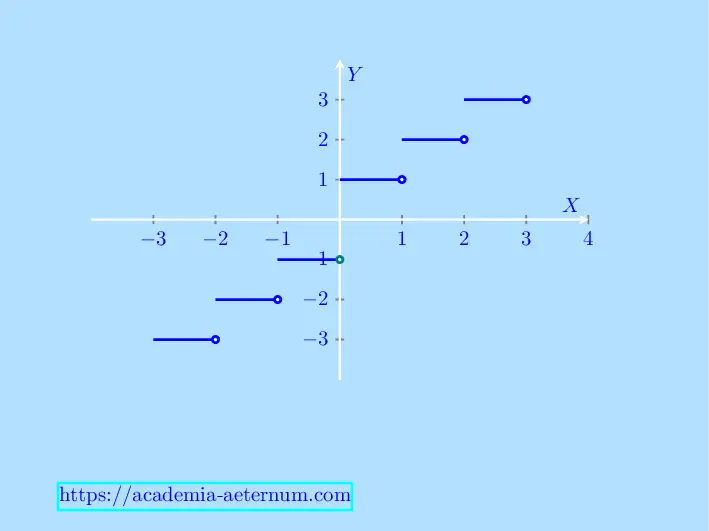
Greatest Integer Function
\(f(x)=[x]\)
This function returns the greatest integer less than or equal to \(x\).
It is also called the floor function.
The graph consists of step-like segments and shows discontinuities at every integer.
Algebra of Real Functions
Once functions are defined as mappings between sets, it becomes natural to study how functions can be combined and manipulated algebraically. The algebra of real functions deals with operations performed on functions whose domain and range consist of real numbers.
These operations resemble the usual algebraic operations on real numbers and allow us to construct new functions from existing ones. This concept plays an important role in simplifying expressions and analysing functional relationships in algebra, calculus, and coordinate geometry.
Basic Operations on Functions
Let \(f\) and \(g\) be two real-valued functions defined on a common domain \(D \subseteq \mathbb{R}\). Then new functions can be formed as follows:
\[ (f+g)(x) = f(x) + g(x) \]
\[ (f-g)(x) = f(x) - g(x) \]
\[ (fg)(x) = f(x)g(x) \]
\[ \left(\frac{f}{g}\right)(x) = \frac{f(x)}{g(x)}, \quad g(x)\neq0 \]
These operations are defined pointwise, meaning the operation is performed on the values of the functions at the same input \(x\).
Domain of Algebraic Combinations
The domain of a function obtained through algebraic operations depends on where the expression is meaningful.
- For \(f+g\), \(f-g\), and \(fg\), the domain is the intersection of the domains of \(f\) and \(g\).
- For \(\frac{f}{g}\), the domain excludes values where \(g(x)=0\).
\[ \text{Domain}(f+g) = \text{Domain}(f) \cap \text{Domain}(g) \]
Illustrative Example
Let
\(f(x)=x^2\) and \(g(x)=x+1\)
Then
\[ (f+g)(x)=x^2+x+1 \]
\[ (fg)(x)=x^2(x+1)=x^3+x^2 \]
\[ \left(\frac{f}{g}\right)(x)=\frac{x^2}{x+1}, \quad x\neq -1 \]
This example illustrates how new functions can be generated through algebraic combinations.
Algebraic Properties of Functions
Algebraic operations on functions satisfy properties similar to those of real numbers. Let \(f\), \(g\), and \(h\) be functions defined on the same domain.
-
Commutative Property
\(f+g = g+f\), \(fg = gf\) -
Associative Property
\(f+(g+h)=(f+g)+h\) -
Distributive Property
\(f(g+h)=fg+fh\)
Idea Behind the Proof
These properties follow directly from the corresponding properties of real numbers. For example, to prove the commutative property of addition, take any \(x\) in the domain.
\[ (f+g)(x)=f(x)+g(x) \]
\[ = g(x)+f(x) \]
\[ =(g+f)(x) \]
Since this holds for every \(x\), we conclude
\(f+g=g+f\).
Identity Functions
Similar to real numbers, certain functions behave as identity elements.
- Additive Identity: The zero function \(z(x)=0\) satisfies \((f+z)(x)=f(x)\).
- Multiplicative Identity: The constant function \(u(x)=1\) satisfies \((fu)(x)=f(x)\).
Importance in Mathematics
The algebra of real functions forms the foundation for many advanced topics in mathematics. It is essential for:
- Simplifying complex functional expressions
- Studying composite and inverse functions
- Analysing graphs of combined functions
- Preparing for higher topics in calculus
Example 1: Equality of Ordered Pairs
If \((x+1,\,y-2)=(3,\,1)\), find the values of \(x\) and \(y\).
Concept Used
Two ordered pairs are equal if and only if their corresponding components are equal.
\[ (a,b)=(c,d) \iff a=c \text{ and } b=d \]
Solution
Since the ordered pairs \((x+1,\,y-2)\) and \((3,\,1)\) are equal, we equate the corresponding components.
Step 1: Equate the First Components
\[ x+1 = 3 \]
Solving for \(x\),
\[ x = 3-1 = 2 \]
Step 2: Equate the Second Components
\[ y-2 = 1 \]
Solving for \(y\),
\[ y = 1+2 = 3 \]
Verification
Substitute the obtained values \(x=2\) and \(y=3\) into the ordered pair:
\[ (x+1,\,y-2)=(2+1,\,3-2)=(3,\,1) \]
This matches the given ordered pair. Hence the solution is correct.
Final Answer
\[ \boxed{(x,\,y)=(2,\,3)} \]
Example 2: Cartesian Products of Two Sets
If \(P=\{a,b,c\}\) and \(Q=\{r\}\), form the sets \(P\times Q\) and \(Q\times P\). Are these two Cartesian products equal?
Concept Used
The Cartesian product of two sets \(A\) and \(B\) is the set of all ordered pairs whose first element belongs to \(A\) and second element belongs to \(B\).
\[ A\times B=\{(a,b)\mid a\in A,\; b\in B\} \]
The order of elements in an ordered pair is important. Therefore,
\[ (a,b)\neq(b,a) \]
Solution
Step 1: Find \(P\times Q\)
The Cartesian product \(P\times Q\) contains all ordered pairs whose first element is from \(P\) and second element is from \(Q\).
\[ P\times Q=\{a,b,c\}\times\{r\} \]
\[ P\times Q=\{(a,r),(b,r),(c,r)\} \]
Step 2: Find \(Q\times P\)
Now the first element must come from \(Q\) and the second element from \(P\).
\[ Q\times P=\{r\}\times\{a,b,c\} \]
\[ Q\times P=\{(r,a),(r,b),(r,c)\} \]
Comparison
The ordered pairs in the two products are different because their first and second elements are interchanged.
\[ P\times Q=\{(a,r),(b,r),(c,r)\} \]
\[ Q\times P=\{(r,a),(r,b),(r,c)\} \]
Conclusion
\[ \boxed{P\times Q \neq Q\times P} \]
This example illustrates that the Cartesian product of two sets depends on the order of the sets.
Additional Insight
If \(n(P)=3\) and \(n(Q)=1\), then
\[ n(P\times Q)=3\times1=3 \]
\[ n(Q\times P)=1\times3=3 \]
Although the number of elements is the same, the ordered pairs themselves are different.
Example 4: Cartesian Product of Three Sets
If \(P=\{1,2\}\), form the set \(P\times P\times P\).
Concept Used
The Cartesian product of three sets \(A\), \(B\), and \(C\) is the set of all ordered triples:
\[ A\times B\times C=\{(a,b,c)\mid a\in A,\; b\in B,\; c\in C\} \]
When the same set is repeated, the Cartesian product \(P\times P\times P\) contains all ordered triples whose elements belong to \(P\).
Solution
Step 1: Find \(P\times P\)
Given \(P=\{1,2\}\).
\[ P\times P=\{1,2\}\times\{1,2\} \]
\[ P\times P=\{(1,1),(1,2),(2,1),(2,2)\} \]
Step 2: Form \(P\times P\times P\)
Each ordered pair of \(P\times P\) is combined with each element of \(P\) to produce ordered triples.
\[ P\times P\times P= \{(1,1),(1,2),(2,1),(2,2)\}\times\{1,2\} \]
\[ P\times P\times P= \{ (1,1,1),(1,1,2),(1,2,1),(1,2,2), (2,1,1),(2,1,2),(2,2,1),(2,2,2) \} \]
Final Answer
\[ \boxed{ P\times P\times P= \{(1,1,1),(1,1,2),(1,2,1),(1,2,2), (2,1,1),(2,1,2),(2,2,1),(2,2,2)\} } \]
Important Observation
If a set \(P\) has \(n\) elements, then
\[ n(P\times P\times P)=n^3 \]
Since \(n(P)=2\), the total number of ordered triples is
\[ 2^3=8 \]
This matches the number of elements obtained in the set above.
Example 5: Number of Relations Between Two Sets
Let \(A=\{1,2\}\) and \(B=\{3,4\}\). Find the number of relations from \(A\) to \(B\).
Concept Used
A relation from \(A\) to \(B\) is any subset of the Cartesian product \(A \times B\).
If \(n(A)=m\) and \(n(B)=n\), then the number of elements in the Cartesian product is
\[ n(A\times B)=m\times n \]
Since every relation is a subset of \(A\times B\), the total number of relations is
\[ \text{Number of relations}=2^{mn} \]
Solution
Step 1: Find the number of elements in each set
\[ n(A)=2,\qquad n(B)=2 \]
Step 2: Form the Cartesian product
\[ A\times B=\{(1,3),(1,4),(2,3),(2,4)\} \]
Therefore,
\[ n(A\times B)=4 \]
Step 3: Determine the number of relations
Since a relation is any subset of \(A\times B\), the total number of relations equals the number of subsets of a set containing \(4\) elements.
\[ \text{Number of relations}=2^{4} \]
\[ =16 \]
Final Answer
\[ \boxed{16} \]
Important Insight
If \(n(A)=m\) and \(n(B)=n\), then
\[ \text{Number of relations from }A\text{ to }B=2^{mn} \]
In this example, \(m=2\) and \(n=2\), so the number of relations is \(2^{2\times2}=16\).
Example 6: Identifying Whether a Relation is a Function
Examine the following relations and determine whether each relation is a function or not.
(i) \(R=\{(2,1),(3,1),(4,2)\}\)
(ii) \(R=\{(2,2),(2,4),(3,3),(4,4)\}\)
(iii) \(R=\{(1,2),(2,3),(3,4),(4,5),(5,6),(6,7)\}\)
Concept Used
A relation \(f: A \rightarrow B\) is called a function if every element of the domain has exactly one image in the codomain.
\[ a \in A \Rightarrow \text{there exists a unique } b \in B \]
Note that multiple elements of the domain may have the same image, but a single element cannot have two different images.
Solution
(i) Relation \(R=\{(2,1),(3,1),(4,2)\}\)
The first components are \(2,3,4\). Each element appears exactly once and is associated with one image.
Although both \(2\) and \(3\) map to the same value \(1\), this is allowed because different elements can have the same image.
Therefore, relation (i) is a function.
(ii) Relation \(R=\{(2,2),(2,4),(3,3),(4,4)\}\)
The element \(2\) appears twice as the first component and is related to two different values, \(2\) and \(4\).
Since one element of the domain has two images, the defining condition of a function is violated.
Therefore, relation (ii) is not a function.
(iii) Relation \(R=\{(1,2),(2,3),(3,4),(4,5),(5,6),(6,7)\}\)
Each element of the first component appears exactly once and has one unique image.
Therefore, relation (iii) is a function.
Final Conclusion
| Relation | Function / Not a Function |
|---|---|
| (i) | Function |
| (ii) | Not a Function |
| (iii) | Function |
Example 6: Identifying Whether a Relation is a Function
Examine the following relations and determine whether each relation is a function or not.
(i) \(R=\{(2,1),(3,1),(4,2)\}\)
(ii) \(R=\{(2,2),(2,4),(3,3),(4,4)\}\)
(iii) \(R=\{(1,2),(2,3),(3,4),(4,5),(5,6),(6,7)\}\)
Concept Used
A relation \(f: A \rightarrow B\) is called a function if every element of the domain has exactly one image in the codomain.
\[ a \in A \Rightarrow \text{there exists a unique } b \in B \]
Note that multiple elements of the domain may have the same image, but a single element cannot have two different images.
Solution
(i) Relation \(R=\{(2,1),(3,1),(4,2)\}\)
The first components are \(2,3,4\). Each element appears exactly once and is associated with one image.
Although both \(2\) and \(3\) map to the same value \(1\), this is allowed because different elements can have the same image.
Therefore, relation (i) is a function.
(ii) Relation \(R=\{(2,2),(2,4),(3,3),(4,4)\}\)
The element \(2\) appears twice as the first component and is related to two different values, \(2\) and \(4\).
Since one element of the domain has two images, the defining condition of a function is violated.
Therefore, relation (ii) is not a function.
(iii) Relation \(R=\{(1,2),(2,3),(3,4),(4,5),(5,6),(6,7)\}\)
Each element of the first component appears exactly once and has one unique image.
Therefore, relation (iii) is a function.
Final Conclusion
| Relation | Function / Not a Function |
|---|---|
| (i) | Function |
| (ii) | Not a Function |
| (iii) | Function |