
Sets
Definition of a Set
A set is a well-defined collection of distinct objects. These objects are called the elements or members of the set.
The objects in a set may represent numbers, symbols, people, geometric figures, or any clearly identifiable entities.
If an object belongs to a set \(A\), we write
\(a \in A\)
If an object does not belong to a set \(A\), we write
\(a \notin A\)
Meaning of “Well-Defined”
The phrase well-defined means that for any given object, it must be possible to clearly decide whether the object belongs to the set or not.
In other words, membership of a set should never be ambiguous or subjective.
- The collection of natural numbers less than 5 is a set: \( \{1,2,3,4\} \)
- The collection of vowels in the English alphabet is a set: \( \{a,e,i,o,u\} \)
- The collection of “beautiful flowers” is not a set because the term beautiful is subjective and cannot be precisely defined.
Visual Illustration of a Set
A set is often represented diagrammatically by enclosing its elements inside a closed curve. Such graphical representations help visualize membership of elements.
Example: \(A = \{1,2,3,4\}\)
Important Sets Used in Mathematics
In mathematics, several standard sets of numbers occur frequently. These sets form the foundation of algebra, calculus, and higher mathematics.
- \( \mathbb{N} \) : Set of natural numbers \( \{1,2,3,4,\dots\} \)
- \( \mathbb{Z} \) : Set of integers \( \{\dots,-2,-1,0,1,2,\dots\} \)
- \( \mathbb{Q} \) : Set of rational numbers \( \left\{\frac{p}{q} \mid p,q \in \mathbb{Z}, q \ne 0 \right\} \)
- \( \mathbb{R} \) : Set of real numbers (all points on the number line)
- \( \mathbb{Z^+} \) : Set of positive integers
- \( \mathbb{Q^+} \) : Set of positive rational numbers
- \( \mathbb{R^+} \) : Set of positive real numbers
Why Sets Are Important
The concept of sets forms the foundation of modern mathematics. Nearly every branch of mathematics — algebra, probability, statistics, relations, and functions — uses set theory as a fundamental framework.
In Class 11 mathematics, sets help us understand:
- Relations and functions
- Venn diagrams and logical reasoning
- Probability theory
- Mathematical logic used in competitive exams
JEE / Competitive Exam Insight
In competitive examinations such as IIT-JEE, BITSAT, and Olympiads, the concept of sets is often tested through:
- Set operations (union, intersection, difference)
- Venn diagram based problems
- Logic statements involving set membership
- Applications in probability and relations
Methods of Representing a Set
A set can be described in different ways depending on the context and the type of elements involved. In mathematics, two standard methods are used to represent sets.
- Roster or Tabular Form
- Set-Builder Form
Both representations describe the same set but present the information in different mathematical forms. Understanding both methods is important for solving problems in relations, functions, probability, and Venn diagram questions in competitive exams like IIT-JEE, BITSAT, and Olympiads.
1. Roster (Tabular) Form
In the roster form, all the elements of a set are explicitly listed. The elements are separated by commas and enclosed within curly braces \( \{\} \).
Example: The set of all even positive integers less than 7 can be written as
\( \{2,4,6\} \)
Examples
- Set of all natural numbers that divide 42 \( \{1,2,3,6,7,14,21,42\} \)
- Set of vowels in the English alphabet \( \{a,e,i,o,u\} \)
- Set of odd natural numbers \( \{1,3,5,7,9,\dots\} \) (Dots indicate that the sequence continues indefinitely.)
2. Set-Builder Form
In the set-builder form, the elements of a set are not listed individually. Instead, the set is described by a property or rule satisfied by its elements.
The general structure of set-builder notation is
\( A = \{x : \text{property satisfied by } x \} \)
The symbol “:” is read as “such that.”
Example
Consider the set of vowels in the English alphabet. Instead of listing them explicitly, we may write
\( V = \{x : x \text{ is a vowel in the English alphabet} \} \)
More Examples
- \(A = \{x : x \text{ is a natural number that divides } 42\}\)
- \(B = \{y : y \text{ is a vowel in the English alphabet}\}\)
- \(C = \{z : z \text{ is an odd natural number}\}\)
Conversion Between the Two Forms
In many problems, especially in competitive examinations, students are required to convert a set from roster form to set-builder form or vice versa.
Example
Given the roster form
\( A = \{2,4,6,8,10\} \)
This set can be written in set-builder form as
\( A = \{x : x \text{ is an even natural number and } x \le 10\} \)
Important Points
- In roster form, the order of elements does not matter. Example: \( \{1,2,3\} = \{3,2,1\} \)
- Each element of a set is written only once. Repetition does not change the set.
- The set of letters forming the word SCHOOL is \( \{S,C,H,O,L\} \) (the letter O appears twice in the word but only once in the set).
- Roster form is useful when the set has finite elements, while set-builder form is preferred when the set has many or infinitely many elements.
JEE / Olympiad Insight
Questions in competitive examinations often test the student's ability to identify the pattern or property that defines a set.
- Converting between roster and set-builder forms
- Identifying the rule that generates the elements
- Recognizing finite and infinite sets
- Using these representations in Venn diagram problems
The Empty Set
A set that does not contain any element is called the empty set, null set, or void set.
The empty set is denoted by
\( \varnothing \) or \( \{\} \)
Even though it contains no elements, the empty set is still considered a valid set in mathematics. It plays an important role in many areas such as set operations, logic, probability, and computer science.
Visual Representation
The empty set can be visualized as a set that contains no elements inside it.
Examples of Empty Sets
-
\(A = \{x : 1 < x < 2,\; x \text{ is a natural number}\}\)
There is no natural number between 1 and 2, therefore \(A = \varnothing\). -
\(B = \{x : x^2 - 2 = 0,\; x \text{ is rational}\}\)
The solutions of \(x^2 - 2 = 0\) are \(x = \pm \sqrt{2}\), which are irrational numbers. Therefore, \(B = \varnothing\). -
\(C = \{x : x \text{ is an even prime number greater than } 2\}\)
Since 2 is the only even prime number, there is no such element greater than 2. Hence \(C = \varnothing\). -
\(D = \{x : x^2 = 4,\; x \text{ is odd}\}\)
The solutions of \(x^2 = 4\) are \(x = 2\) and \(x = -2\), neither of which is odd. Therefore \(D = \varnothing\).
Important Properties of the Empty Set
- The empty set is a subset of every set.
- If \(A\) is any set, then \(A \cup \varnothing = A\)
- If \(A\) is any set, then \(A \cap \varnothing = \varnothing\)
- The empty set is a finite set with zero elements.
JEE / Olympiad Insight
In competitive examinations, empty sets often appear in problems involving set intersections, inequalities, and domain restrictions. Students are frequently asked to determine whether a set defined by certain conditions contains any element.
Finite and Infinite Sets
A set that is empty or contains a definite number of elements is called a finite set. A set that contains infinitely many elements is called an infinite set.
Visual Comparison
Examples
-
Let \(W\) be the set of days of the week.
\(W = \{Monday, Tuesday, Wednesday, Thursday, Friday, Saturday, Sunday\}\)
Since it contains 7 elements, \(W\) is a finite set. - Let \(S\) be the set of solutions of the equation \(x^2 - 16 = 0\) The solutions are \(x = 4\) and \(x = -4\). Therefore \(S = \{-4,4\}\), which is a finite set.
- Let \(G\) be the set of all points on a straight line. A line contains infinitely many points, therefore \(G\) is an infinite set.
- The set of natural numbers \( \mathbb{N} = \{1,2,3,4,\dots\} \) is also an infinite set.
Important Note
- Many infinite sets cannot be completely written in roster form.
- For example, the set of real numbers \( \mathbb{R} \) cannot be listed because it contains infinitely many elements between any two numbers.
- In such cases, sets are usually expressed using set-builder notation or interval notation.
JEE Insight
Questions in JEE frequently involve determining whether a set defined by an equation, inequality, or function domain is finite, infinite, or empty.
For example, the set of real solutions of certain trigonometric equations may contain infinitely many elements, while polynomial equations usually produce finite sets of solutions.
Equal Sets
Two sets \(A\) and \(B\) are said to be equal if they contain exactly the same elements.
\(A = B\)
This means every element of \(A\) is also an element of \(B\), and every element of \(B\) is also an element of \(A\).
\(A = B \iff (A \subseteq B \text{ and } B \subseteq A)\)
If two sets do not contain exactly the same elements, they are called unequal sets.
\(A \ne B\)
Visual Illustration
Two sets are equal if they contain identical elements, even if the order of listing the elements is different.
\(A = B\)
Examples
-
\(A = \{1,2,3,4\}\)
\(B = \{3,1,4,2\}\)
Since both sets contain exactly the same elements, therefore \(A = B\). -
Let \(A\) be the set of prime numbers less than 6.
\(A = \{2,3,5\}\)
Let \(P\) be the set of prime factors of 30. \(P = \{2,3,5\}\)
Since both sets contain the same elements, therefore \(A = P\). -
\(X = \{a,b,c\}\)
\(Y = \{c,b,a\}\)
Order does not matter in sets, therefore \(X = Y\).
Important Notes
-
The order of elements in a set does not matter.
Example: \( \{1,2,3\} = \{3,2,1\} \) -
Repetition of elements does not change a set.
Example: \(A = \{1,2,3\}\) \(B = \{2,2,1,3,3\}\) Therefore \(A = B\). - Equal sets must have the same elements and the same number of elements.
Relation with Cardinality
If two sets are equal, then they must have the same cardinality (number of elements).
\(A = B \Rightarrow n(A) = n(B)\)
However, the converse is not always true. Two sets may have the same number of elements but still be different sets.
Example: \(A=\{1,2,3\},\; B=\{4,5,6\}\)
JEE / Olympiad Insight
In competitive examinations, equal sets are often tested through parameter comparison problems. For example, values of variables are determined such that two sets become equal.
Example type frequently asked in JEE:
If \(A = \{x,2,3\}\) and \(B = \{1,2,3\}\), find \(x\) such that \(A = B\).
Subsets
A set \(A\) is said to be a subset of a set \(B\) if every element of \(A\) is also an element of \(B\).
\(A \subseteq B\)
In other words, whenever an element belongs to set \(A\), it must also belong to set \(B\).
\(a \in A \Rightarrow a \in B\)
If set \(A\) is not a subset of \(B\), we write
\(A \not\subseteq B\)
Visual Representation
In a Venn diagram, a subset is represented by drawing one set completely inside another set.
\(A \subseteq B\)
Examples
-
The set of rational numbers is a subset of the set of real numbers.
\( \mathbb{Q} \subseteq \mathbb{R} \) -
Let \(A\) be the set of all divisors of 56 and \(B\) the set of all prime divisors of 56.
Since every prime divisor is also a divisor,
\(B \subseteq A\) -
\(A = \{1,3,5\}\)
\(B = \{x : x \text{ is a natural number less than } 6\}\)
Since every element of \(A\) belongs to \(B\),
\(A \subseteq B\) -
\(A = \{a,e,i,o,u\}\)
\(B = \{a,b,c,d\}\)
Since elements \(e,i,o,u\) are not in \(B\),
\(A \not\subseteq B\)
Proper Subset
If \(A \subseteq B\) and \(A \ne B\), then \(A\) is called a proper subset of \(B\).
\(A \subset B\)
Example:
\(A = \{1,2\}, \quad B = \{1,2,3\}\)
Important Properties of Subsets
-
Every set is a subset of itself.
\(A \subseteq A\) -
The empty set is a subset of every set.
\( \varnothing \subseteq A \) -
If \(A \subseteq B\) and \(B \subseteq A\), then
\(A = B\)
Number of Subsets
If a set contains \(n\) elements, then the total number of subsets of the set is
\(2^n\)
Example:
\(A = \{1,2,3\}\)
Number of elements \(=3\)
Total subsets \(=2^3 = 8\)
JEE / Competitive Exam Insight
Subset problems are extremely common in IIT-JEE, BITSAT, and Olympiad mathematics.
Students are often asked to:
- Determine the number of subsets of a given set
- Find subsets satisfying certain conditions
- Work with power sets and Venn diagram relationships
Universal Set
A universal set is the set that contains all elements under consideration in a particular discussion or mathematical problem.
The universal set is usually denoted by the symbol
\(U\)
Every other set involved in the problem is assumed to be a subset of the universal set.
Dependence on Context
The universal set is not fixed; it depends entirely on the context of the problem. The same mathematical objects may belong to different universal sets in different situations.
For example:
- If we are studying natural numbers less than 10, then the universal set may be \(U = \{1,2,3,4,5,6,7,8,9\}\).
- If we are studying all integers, then the universal set may be \(U = \mathbb{Z}\).
- In many algebra problems, the universal set is taken as the set of real numbers \(U = \mathbb{R}\).
Visual Representation
In Venn diagrams, the universal set is represented by a rectangle that contains all other sets.
Sets \(A\) and \(B\) are subsets of the universal set \(U\).
Examples
-
Let \(U = \{1,2,3,4,5,6,7,8,9\}\)
If \(A = \{2,4,6,8\}\), then \(A \subseteq U\). - If \(U = \mathbb{R}\) and \(A = \{x : x^2 < 4\}\), then the elements of \(A\) are real numbers satisfying the inequality.
- If \(U\) is the set of all students in a class, then subsets may represent students participating in sports, music, or other activities.
Importance in Set Theory
The concept of a universal set is essential for defining several important operations in set theory, such as:
- Complement of a set
- Venn diagram representations
- Logical operations on sets
JEE / Competitive Exam Insight
In many competitive examination problems, the universal set is used to determine the complement of a set.
Complement of \(A = U - A\)
Understanding the universal set helps students correctly interpret Venn diagrams and solve set identity problems.
Venn Diagrams
Many relationships between sets can be represented visually using Venn diagrams. These diagrams were introduced by the English logician John Venn (1834–1883).
A Venn diagram uses simple geometric shapes to represent sets and their relationships.
- The universal set is usually represented by a rectangle.
- Subsets are represented by circles or closed curves inside the rectangle.
- Overlapping regions represent relationships such as union and intersection.
Basic Structure of a Venn Diagram
A subset \(A\) inside the universal set \(U\).
Union of Sets
The union of two sets \(A\) and \(B\) consists of all elements that belong to \(A\), or \(B\), or both.
\(A \cup B\)
Intersection of Sets
The intersection of two sets consists of all elements that are common to both sets.
\(A \cap B\)
Complement of a Set
The complement of a set \(A\) consists of all elements in the universal set \(U\) that do not belong to \(A\).
\(A' = U - A\)
Importance of Venn Diagrams
Venn diagrams are extremely useful in understanding relationships between sets and solving many mathematical problems.
- Visualizing set operations such as union and intersection
- Solving counting problems in mathematics
- Understanding probability problems
- Representing logical relationships
JEE / Competitive Exam Insight
Venn diagrams are frequently used in competitive examinations such as IIT-JEE, BITSAT, and Olympiads.
Many questions involve finding the number of elements in different regions of overlapping sets using formulas like
\(n(A \cup B) = n(A) + n(B) - n(A \cap B)\)
Union of Sets
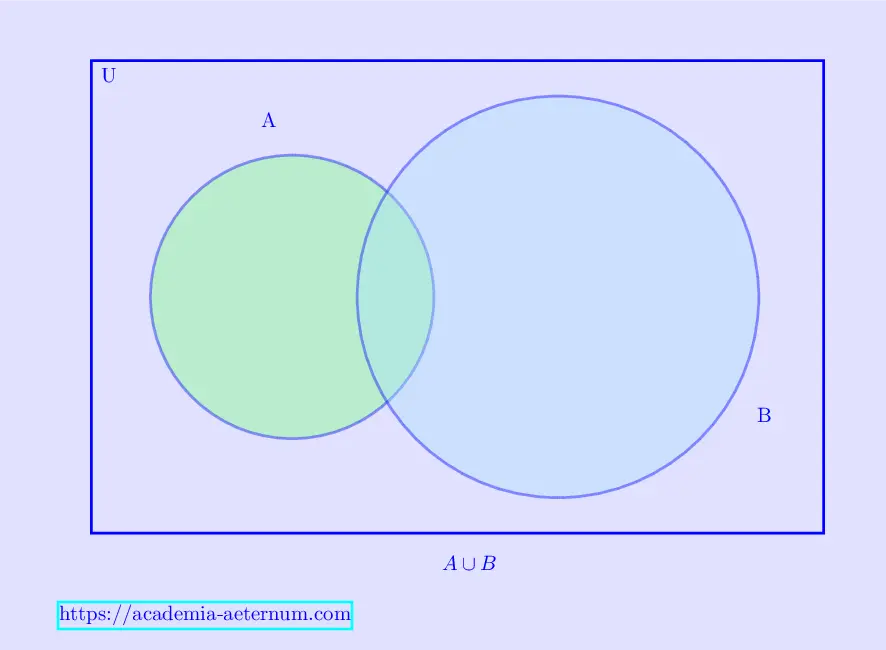
Let \(A\) and \(B\) be any two sets. The union of sets \(A\) and \(B\) is the set that contains all elements belonging to \(A\), or \(B\), or both.
\(A \cup B\)
The common elements of the two sets are included only once. The symbol \( \cup \) denotes the union operation.
In set-builder notation,
\(A \cup B = \{x : x \in A \text{ or } x \in B\}\)
Example
Let
\(A = \{1,2,3,4\}\)
\(B = \{3,4,5,6\}\)
Then the union of the two sets is
\(A \cup B = \{1,2,3,4,5,6\}\)
Properties of Union
-
Commutative Law
\(A \cup B = B \cup A\)
-
Associative Law
\((A \cup B) \cup C = A \cup (B \cup C)\)
-
Identity Law
\(A \cup \varnothing = A\)
-
Idempotent Law
\(A \cup A = A\)
-
Domination Law
\(U \cup A = U\)
Counting Formula (Important for JEE)
If \(A\) and \(B\) are finite sets, the number of elements in their union is given by
\(n(A \cup B) = n(A) + n(B) - n(A \cap B)\)
This formula avoids counting the common elements twice.
JEE / Competitive Exam Insight
Union formulas are frequently used in set counting problems and probability questions.
Many JEE problems involve finding the number of elements in unions of multiple sets using Venn diagrams and counting formulas.
Intersection of Sets

The intersection of two sets \(A\) and \(B\) is the set consisting of all elements that belong to both \(A\) and \(B\).
\(A \cap B\)
In set-builder notation,
\(A \cap B = \{x : x \in A \text{ and } x \in B\}\)
In a Venn diagram, the intersection is represented by the overlapping region of the two sets.
Example
Let
\(A = \{1,2,3,4\}\)
\(B = \{3,4,5,6\}\)
The elements common to both sets are \(3\) and \(4\).
\(A \cap B = \{3,4\}\)
Properties of Intersection
-
Commutative Law
\(A \cap B = B \cap A\)
-
Associative Law
\((A \cap B) \cap C = A \cap (B \cap C)\)
-
Identity Law
\(U \cap A = A\)
-
Domination Law
\(A \cap \varnothing = \varnothing\)
-
Idempotent Law
\(A \cap A = A\)
-
Distributive Law
\(A \cap (B \cup C) = (A \cap B) \cup (A \cap C)\)
Important Results
- If \(A \cap B = \varnothing\), the sets are called disjoint sets.
-
If \(A \subseteq B\),
then
\(A \cap B = A\)
- Intersection is used frequently in solving probability and counting problems.
JEE / Competitive Exam Insight
Intersection plays a key role in Venn diagram problems and set counting formulas.
For example,
\(n(A \cup B) = n(A) + n(B) - n(A \cap B)\)
This formula ensures that the elements common to both sets are not counted twice.
Difference of Sets
The difference of two sets \(A\) and \(B\) (in this order) is the set of all elements that belong to \(A\) but do not belong to \(B\).
\(A - B\)
It is read as “A minus B”.
\(A - B = \{x : x \in A \text{ and } x \notin B\}\)
Example
Let
\(A = \{1,2,3,4,5\}\)
\(B = \{3,4,6\}\)
The elements belonging to \(A\) but not to \(B\) are \(1,2,5\).
\(A - B = \{1,2,5\}\)
Venn Diagram Representation
The non-overlapping portion of \(A\) represents \(A-B\).
Important Properties
- \(A - A = \varnothing\)
- \(A - \varnothing = A\)
- \(A - B \neq B - A\)
- \(A - B = A \cap B'\)
Complement of a Set
Let \(U\) be the universal set and \(A\) be a subset of \(U\). The complement of \(A\) is the set of all elements of \(U\) which do not belong to \(A\).
\(A'\)
In set-builder form,
\(A' = \{x : x \in U \text{ and } x \notin A\}\)
\(A' = U - A\)
Example
Let
\(U = \{1,2,3,4,5,6\}\)
\(A = \{1,3,5\}\)
The elements of \(U\) that are not in \(A\) are \(2,4,6\).
\(A' = \{2,4,6\}\)
Properties of Complement
-
Complement Laws
\(A \cup A' = U\)
\(A \cap A' = \varnothing\)
-
De Morgan’s Laws
\((A \cup B)' = A' \cap B'\)
\((A \cap B)' = A' \cup B'\)
-
Double Complement Law
\((A')' = A\)
-
Universal and Empty Set Laws
\(\varnothing' = U\)
\(U' = \varnothing\)
JEE / Competitive Exam Insight
Complement and De Morgan’s laws are extremely important in Venn diagram problems, probability, and logical reasoning.
Many JEE problems simplify complicated set expressions by applying De Morgan’s laws.
Chapter Summary
- A set is a well-defined collection of distinct objects called elements or members.
- A set that contains no element is called the empty set and is denoted by \( \varnothing \).
- A set containing a definite number of elements is called a finite set; otherwise it is an infinite set.
- Two sets \(A\) and \(B\) are said to be equal if they contain exactly the same elements.
-
A set \(A\) is said to be a
subset of \(B\) if every element of \(A\) belongs to \(B\).
\(A \subseteq B\) - If a set contains \(n\) elements, then the total number of subsets is \(2^n\).
-
The union of two sets consists of all elements belonging to
\(A\) or \(B\) or both.
\(A \cup B = \{x : x \in A \text{ or } x \in B\}\) -
The intersection of two sets consists of all elements common
to both sets.
\(A \cap B = \{x : x \in A \text{ and } x \in B\}\) -
The difference of sets \(A\) and \(B\) is the set of elements
that belong to \(A\) but not to \(B\).
\(A - B = \{x : x \in A \text{ and } x \notin B\}\) -
The complement of a set \(A\) (with respect to universal set \(U\))
is the set of all elements in \(U\) that are not in \(A\).
\(A' = U - A\)
Important Set Identities
- \(A \cup A' = U\)
- \(A \cap A' = \varnothing\)
- \(A \cup \varnothing = A\)
- \(A \cap U = A\)
- \(A - B = A \cap B'\)
De Morgan’s Laws
\((A \cup B)' = A' \cap B'\)
\((A \cap B)' = A' \cup B'\)
Quick Revision for JEE / Board Exams
- Always remember the formula: \(n(A \cup B) = n(A) + n(B) - n(A \cap B)\)
- If \(A \cap B = \varnothing\), the sets are called disjoint sets.
- Complement and De Morgan’s laws are heavily used in simplifying complex set expressions.
Example 1
Write the solution set of the equation \(x^2 + x - 2 = 0\) in roster form.
Solution
$$\begin{aligned} x^2 + x - 2 &= 0 \\ x^2 + 2x - x - 2 &= 0 \\ x(x+2) -1(x+2) &= 0 \\ (x+2)(x-1) &= 0 \end{aligned}$$Therefore,
$$ x+2=0 \quad \text{or} \quad x-1=0 $$Hence,
$$ x=-2 \quad \text{or} \quad x=1 $$The solution set in roster form is
\( \{-2,\,1\} \)
Example 2
Write the set \( \{x : x \text{ is a positive integer and } x^2 < 40\} \) in roster form.
Solution
We are given the condition
$$ x^2 < 40 $$Taking square roots,
$$ x < \sqrt{40} $$Since
$$ \sqrt{40} \approx 6.32 $$and \(x\) is a positive integer, the possible values of \(x\) are
\(1,2,3,4,5,6\)
Therefore the required set in roster form is
\( \{1,2,3,4,5,6\} \)
Example 3
Write the set \(A=\{1,4,9,16,25,\dots\}\) in set-builder form.
Solution
Observe that the elements of the set are perfect squares:
\(1=1^2,\quad 4=2^2,\quad 9=3^2,\quad 16=4^2,\quad 25=5^2,\dots\)
Therefore, the general term of the set can be written as
\(x=n^2\)
where \(n\) is a natural number.
Hence the set in set-builder form is
\(A=\{x : x=n^2,\; n\in\mathbb{N}\}\)
Example 4
Write the set \[ \left\{ \frac{1}{2},\frac{2}{3},\frac{3}{4},\frac{4}{5},\frac{5}{6},\frac{6}{7} \right\} \] in set-builder form.
Solution
Observe the pattern in the given elements:
\[ \frac{1}{2},\quad \frac{2}{3},\quad \frac{3}{4},\quad \frac{4}{5},\quad \frac{5}{6},\quad \frac{6}{7} \]
Each element can be written in the form
\[ \frac{n}{n+1} \]
where \(n\) is a natural number.
The values of \(n\) range from \(1\) to \(6\).
Therefore the required set in set-builder form is
\[ \{x : x=\frac{n}{n+1},\; n\in\mathbb{N},\; 1\le n\le 6\} \]
Example 5
Find the pairs of equal sets, if any, giving reasons:
\(A=\{0\}\)
\(B=\{x : x>15 \text{ and } x<5\}\)
\(C=\{x : x-5=0\}\)
\(D=\{x : x^2=25\}\)
\(E=\{x : x \text{ is an integral positive root of } x^2-2x-15=0\}\)
Solution
Evaluate each set individually.
Set A
\(A=\{0\}\)
Set B
The condition
\(x>15 \text{ and } x<5\)
cannot be satisfied by any number. Therefore
\(B=\varnothing\)
Set C
From
\(x-5=0\)
we get
\(x=5\)
\(C=\{5\}\)
Set D
Given
\(x^2=25\)
Taking square roots,
\(x=\pm5\)
\(D=\{-5,5\}\)
Set E
Solve the equation
$$ x^2-2x-15=0 $$ $$ x^2-5x+3x-15=0 $$ $$ x(x-5)+3(x-5)=0 $$ $$ (x-5)(x+3)=0 $$Therefore,
$$ x=5 \quad \text{or} \quad x=-3 $$Since \(E\) contains only the positive integral root,
\(E=\{5\}\)
Comparison of Sets
- \(A=\{0\}\)
- \(B=\varnothing\)
- \(C=\{5\}\)
- \(D=\{-5,5\}\)
- \(E=\{5\}\)
Therefore the equal sets are
\(C = E = \{5\}\)
Example 6
Consider the sets
\( \varnothing,\quad A=\{1,3\},\quad B=\{1,5,9\},\quad C=\{1,3,5,7,9\} \)
Insert the symbol \( \subset \) or \( \not\subset \) between each pair of sets:
(i) \( \varnothing\ \ldots\ B \)
(ii) \( A\ \ldots\ B \)
(iii) \( A\ \ldots\ C \)
(iv) \( B\ \ldots\ C \)
Solution
Recall that the empty set is a subset of every set.
$$\begin{aligned} (i)\quad \varnothing &\subset B \end{aligned}$$Set \(A=\{1,3\}\) contains the element \(3\), but \(3\) is not in set \(B\).
$$\begin{aligned} (ii)\quad A &\not\subset B \end{aligned}$$Every element of \(A=\{1,3\}\) belongs to \(C=\{1,3,5,7,9\}\).
$$\begin{aligned} (iii)\quad A &\subset C \end{aligned}$$Every element of \(B=\{1,5,9\}\) belongs to \(C\).
$$\begin{aligned} (iv)\quad B &\subset C \end{aligned}$$Example 7
Let \(A=\{2,4,6,8\}\) and \(B=\{6,8,10,12\}\). Find \(A \cup B\).
Solution
The union of two sets contains all elements that belong to either set \(A\) or set \(B\), with common elements written only once.
$$\begin{aligned} A &= \{2,4,6,8\} \\ B &= \{6,8,10,12\} \end{aligned}$$Combining the elements of both sets and removing repetitions,
$$\begin{aligned} A \cup B = \{2,4,6,8,10,12\} \end{aligned}$$Example 8
Consider the sets \(A\) and \(B\) of Example 7. Find \(A \cap B\).
Solution
From Example 7,
$$ A=\{2,4,6,8\} $$ $$ B=\{6,8,10,12\} $$The intersection of two sets consists of elements common to both sets.
The common elements in \(A\) and \(B\) are \(6\) and \(8\).
$$ A \cap B = \{6,8\} $$Example 9
Let \(A=\{1,2,3,4,5,6\}\) and \(B=\{2,4,6,8\}\). Find \(A-B\) and \(B-A\).
Solution
$$ A=\{1,2,3,4,5,6\} $$ $$ B=\{2,4,6,8\} $$\(A-B\) represents elements that belong to \(A\) but not to \(B\).
$$ A-B=\{1,3,5\} $$\(B-A\) represents elements that belong to \(B\) but not to \(A\).
$$ B-A=\{8\} $$Hence,
$$ A-B \neq B-A $$Example 10
Let \(V=\{a,e,i,o,u\}\) and \(B=\{a,i,k,u\}\). Find \(V-B\) and \(B-V\).
Solution
$$ V=\{a,e,i,o,u\} $$ $$ B=\{a,i,k,u\} $$\(V-B\) represents elements that belong to \(V\) but not to \(B\).
Removing \(a,i,u\) from \(V\),
$$ V-B=\{e,o\} $$\(B-V\) represents elements that belong to \(B\) but not to \(V\).
$$ B-V=\{k\} $$Hence,
$$ V-B \ne B-V $$Example 11
Let \(U=\{1,2,3,4,5,6,7,8,9,10\}\) and \(A=\{1,3,5,7,9\}\). Find \(A'\).
Solution
The complement of \(A\) consists of all elements of the universal set \(U\) that do not belong to \(A\).
$$ U=\{1,2,3,4,5,6,7,8,9,10\} $$ $$ A=\{1,3,5,7,9\} $$Removing the elements of \(A\) from \(U\),
$$ A'=\{2,4,6,8,10\} $$Recent posts
Share this Chapter
Found this helpful? Share this chapter with your friends and classmates.
💡 Exam Tip: Share helpful notes with your study group. Teaching others is one of the fastest ways to reinforce your own understanding.