
Laws of Motion – NCERT Class XI Chapter 4

Master Newton’s Laws, friction, momentum and circular motion with visual notes, formula capsules and exam‑centric practice.

CBSE Boards JEE Main / Advanced NEET
Start Reading Detailed Notes
Laws of Motion
Newton’s Laws
Friction
Momentum
Circular Motion
NCERT Chapter
4 – Laws of Motion
Board Weightage
6–10 marks
JEE / NEET
2–3 MCQs
Difficulty
Conceptual + Numeric

Why “Laws of Motion” Matters for Boards & Entrance Exams

  • Forms the foundation for work–energy, rotational motion, SHM and gravitation in Class XI–XII and beyond.
  • High‑frequency topic in JEE Main/Advanced, NEET, Olympiads (blocks & pulleys, friction and circular motion).
  • Builds intuition for free‑body diagrams, vector forces and equilibrium, which appear in almost every mechanics problem.
  • Direct theory questions on Newton’s laws, inertia, friction and momentum in board exams.
  • Many PYQs are variations of standard situations covered in this chapter.
  • Strong grip here reduces time taken in calculation‑heavy questions later.

Key Concept Highlights

Historical Ideas & Inertia

Aristotle’s Fallacy, Galileo’s Law of Inertia and the transition to Newton’s First Law.

Newton’s Three Laws & FBDs

First Law, Second Law, Third Law, free‑body diagrams and equilibrium of a particle.

Friction & Circular Motion

Static, kinetic & rolling friction, centripetal force, cars on level and banked roads, centrifugal force.

Important Formula Capsules

Momentum
p = m v
Newton’s 2nd Law
F = m a
Impulse
J = F Δt = Δp
Friction
fmax = μsN,
fk = μkN
Centripetal
ac = v²/R,
Fc = m v²/R
Conservation
pinitial = pfinal

For the full list, see the Laws of Motion Formula Sheet section.

What You Will Learn in This Page

Exam Strategy for Laws of Motion

  1. Always start numericals with a neat free‑body diagram; use the interactive FBD Builder below for practice.
  2. Memorise and revise the formula sheet, then solve 10–15 mixed problems daily (friction, pulleys, circular motion).
  3. Before exam day, quickly scan the 30‑second revision and mind map.
  4. For JEE/NEET, focus on the patterns in PYQ Patterns and avoid the traps in Common Mistakes.

Quick Exam Checklist

  • Can you derive F = m a from momentum?
  • Can you decide direction and magnitude of friction correctly?
  • Can you write momentum conservation equations quickly?
  • Can you identify centripetal force provider in each situation?

Aristotle’s Fallacy

Aristotle’s Fallacy refers to the incorrect ancient belief proposed by the Greek philosopher Aristotle (384–322 BC) regarding the nature of motion. Aristotle argued that a body can remain in motion only if a continuous external force is applied to it.

According to his idea, the moment the applied force disappears, the motion of the object should immediately stop. In other words, Aristotle believed that force is required to maintain motion.

Aristotle’s Statement of Motion:
Continuous force is necessary to keep an object moving.
Why Aristotle’s Idea Appeared Correct

Aristotle’s conclusion was based on everyday observations. For example, when we push a book across a table, it moves only for a short distance and eventually stops. From this observation, Aristotle concluded that motion stops because the applied force is removed.

However, the real reason the book stops is the presence of friction between the book and the table surface, which continuously opposes the motion.

Conceptual Mistake in Aristotle’s Argument

The major limitation of Aristotle’s reasoning was that he did not distinguish between two different roles of force in motion.

  • Force required to start motion.
  • Force required to overcome resistive forces such as friction or air resistance.

In reality, an object stops moving because resistive forces like friction continuously act opposite to the direction of motion. If these opposing forces were completely absent, the object would continue moving indefinitely.

Correct Interpretation (Later Explained by Newton)

The flaw in Aristotle’s reasoning was corrected many centuries later through the work of Galileo Galilei and finally formalized by Newton’s First Law of Motion, which states that:

A body continues in its state of rest or uniform motion in a straight line unless acted upon by an external unbalanced force.
Illustrative Example

Consider pushing a hockey puck across smooth ice. The puck travels a long distance before stopping because friction between the ice and the puck is extremely small. If friction were completely eliminated, the puck would continue moving forever with constant velocity.

Concept Visualization
Applied Force Friction
Key Learning from Aristotle’s Fallacy
  • Motion does not require a continuous force.
  • Force is required only to change the state of motion.
  • Resistive forces such as friction cause moving objects to stop.
  • This concept forms the foundation of Newton’s First Law of Motion.
Importance in Board Exams
  • Frequently asked as a short conceptual question.
  • Used to explain the historical development of Newton’s laws.
  • Appears in 2–3 mark theory questions in CBSE and state boards.
Importance in JEE / NEET / Competitive Exams
  • Helps understand the concept of inertia.
  • Forms the conceptual base of Newton’s First Law.
  • Important for solving problems involving frictionless motion.
  • Appears in conceptual MCQs in JEE Main, NEET, and Olympiad exams.

Galileo’s Law of Inertia

Galileo’s Law of Inertia is one of the most important ideas in the historical development of mechanics. It was proposed by the Italian scientist Galileo Galilei (1564–1642) through careful experiments with rolling balls on inclined planes.

Galileo realized that objects do not naturally come to rest by themselves. Instead, they stop moving because of external resistive forces such as friction and air resistance. When these forces are absent, motion can continue indefinitely.

Statement of Galileo’s Law of Inertia
A body continues in its state of rest or uniform motion in a straight line unless an external force acts on it to change that state.

This idea later became the foundation for Newton’s First Law of Motion.

Galileo’s Inclined-Plane Experiment

Galileo performed a series of experiments using smooth inclined planes and rolling balls to study motion. These experiments helped him understand how motion behaves in the absence of friction.

  • A ball released from the top of a smooth inclined plane rolls downward due to gravity.
  • When the ball climbs a second inclined plane placed opposite the first, it rises to nearly the same height from which it was released.
  • When the second plane becomes less steep, the ball must travel a longer distance to reach the same height.
  • If the second plane becomes perfectly horizontal, the ball would continue moving forever (in the absence of friction).
Concept Visualization – Galileo’s Experiment
Initial height Same height
Key Idea Derived from the Experiment
  • Motion does not require a continuous force.
  • Objects resist changes in their state of motion.
  • Friction is responsible for stopping moving objects in everyday situations.
  • This property of matter is called inertia.
Difference Between Aristotle’s Idea and Galileo’s Idea
  • Aristotle: Continuous force is required to keep a body moving.
  • Galileo: Motion continues naturally unless external forces stop it.
  • Aristotle: Rest is the natural state of objects.
  • Galileo: Both rest and uniform motion are natural states.
Importance in Board Exams
  • Frequently asked as a theory question explaining the development of Newton’s First Law.
  • Students may be asked to describe Galileo’s inclined plane experiment.
  • Appears in 3–4 mark descriptive questions in CBSE and state board exams.
Importance in JEE / NEET / Competitive Exams
  • Helps build the conceptual base of Newton’s Laws of Motion.
  • Important for understanding inertia and frictionless motion.
  • Conceptual MCQs often test the difference between Aristotle’s and Galileo’s views.

Newton's First Law of Motion

Newton’s First Law of Motion describes the natural behavior of objects when no external force acts on them. It establishes the fundamental idea that motion does not require a continuous force.

Statement of the Law
A body remains at rest or continues to move with uniform velocity in a straight line unless it is compelled to change that state by an external unbalanced force.

This law is also known as the Law of Inertia because it describes the natural tendency of matter to resist any change in its state of motion.

Understanding the Law

According to this law, if the total external force acting on a body is zero, the body will either remain at rest or continue moving with constant velocity.

  • If an object is at rest, it will remain at rest.
  • If an object is moving with constant velocity, it will continue moving in the same direction with the same speed.
  • Only an external unbalanced force can change its velocity.
Balanced and Unbalanced Forces
  • Balanced Forces: Forces acting on a body cancel each other and produce no change in motion.
  • Unbalanced Force: A net force that changes the speed or direction of motion.
Visualization of Newton’s First Law
Force Force Balanced Forces → No Change in Motion
Real-Life Examples
  • Passengers jerk backward when a bus suddenly starts moving.
  • Passengers jerk forward when a moving bus suddenly stops.
  • A hockey puck slides for a long distance on smooth ice due to very small friction.
Relation with Inertia

The property of matter that resists any change in its state of rest or motion is called inertia. Newton’s First Law provides the formal scientific description of inertia.

  • Inertia of rest
  • Inertia of motion
  • Inertia of direction
Importance in Board Exams
  • Very common definition-based question (2–3 marks).
  • Board exams frequently ask real-life examples of inertia.
  • Students may be asked to explain passenger motion in buses or cars.
Importance in JEE / NEET / Competitive Exams
  • Forms the conceptual foundation of Newton’s Laws of Motion.
  • Important for solving problems involving frictionless motion.
  • Frequently appears in conceptual MCQs on inertia and equilibrium.

Newton’s Second Law of Motion

Newton’s Second Law of Motion provides a quantitative description of the relationship between force, mass, and acceleration. It explains how the motion of a body changes when an external force acts on it.

Statement of the Law
The rate of change of momentum of a body is directly proportional to the external unbalanced force acting on it and occurs in the direction of the applied force.

This law provides the mathematical definition of force and forms the foundation for most calculations in mechanics.

Momentum

The momentum of a body is defined as the product of its mass and velocity.

\[ \vec{p}=m\vec{v} \]

where:

  • \(m\) = mass of the body
  • \(\vec{v}\) = velocity of the body
  • \(\vec{p}\) = momentum

Momentum is a vector quantity, meaning it has both magnitude and direction.

Mathematical Form of Newton’s Second Law

Suppose a body of mass \(m\) changes its velocity from \(\vec{v}\) to \(\vec{v}+\Delta\vec{v}\) in a small time interval \(\Delta t\).

Initial momentum:

\[ \vec{p}=m\vec{v} \]

Change in momentum:

\[ \Delta\vec{p}=m\Delta\vec{v} \]

According to Newton’s Second Law:

\[ \vec{F}\propto \frac{\Delta\vec{p}}{\Delta t} \]

Introducing a proportionality constant \(k\):

\[ \vec{F}=k\frac{\Delta\vec{p}}{\Delta t} \]

In SI units \(k=1\), therefore:

\[ \vec{F}=\frac{d\vec{p}}{dt} \]

For a body of constant mass:

\[ \vec{F}=m\frac{d\vec{v}}{dt} \]

Since acceleration \( \vec{a}=\frac{d\vec{v}}{dt} \), we obtain:

\[ \boxed{\vec{F}=m\vec{a}} \]

SI Unit of Force

In the SI system, the unit of force is the newton (N).

\[ 1\ \mathrm{N}=1\ \mathrm{kg\,m\,s^{-2}} \]

One newton is defined as the force required to produce an acceleration of \(1\,\mathrm{m\,s^{-2}}\) in a mass of \(1\,\mathrm{kg}\).

Vector Form of the Law

Newton’s Second Law is a vector equation and can be resolved into three components:

\[ F_x=\frac{dp_x}{dt}=ma_x \] \[ F_y=\frac{dp_y}{dt}=ma_y \] \[ F_z=\frac{dp_z}{dt}=ma_z \]

Impulse

Impulse is the effect of a force acting over a short time interval.

\[ \text{Impulse}=F\Delta t \]

Even a very large force acting for a very small time interval can significantly change the momentum of a body.

Impulse–Momentum Theorem

According to Newton’s Second Law, impulse equals the change in momentum of a body.

\[ F\Delta t=\Delta p \]

Concept Visualization

Applied Force Acceleration

Real-Life Examples

  • A football accelerates rapidly when kicked due to the applied force.
  • A heavier cart requires more force to accelerate than a lighter cart.
  • Airbags in cars increase the time of collision, reducing force during impact.

Important Points

  • If \( \vec{F}=0 \), then \( \vec{a}=0 \).
  • Newton’s Second Law is consistent with Newton’s First Law.
  • It provides the quantitative definition of force.

Importance in Board Exams

  • Derivation of \(F=ma\) is frequently asked in CBSE and state boards.
  • Numerical problems involving force, mass, and acceleration are common.

Importance in JEE / NEET / Competitive Exams

  • Core concept used in nearly every mechanics problem.
  • Important for solving problems in friction, circular motion, and dynamics.
  • Impulse–momentum problems frequently appear in JEE Main and NEET.

Newton’s Third Law of Motion

Newton’s Third Law of Motion explains how forces always arise from the interaction between two bodies. Whenever one body exerts a force on another, the second body simultaneously exerts a force of equal magnitude in the opposite direction.

Statement of the Law
To every action, there is always an equal and opposite reaction.

This law means that forces always occur in pairs. No force exists independently; it always results from the interaction between two objects.

Mathematical Representation

If body A exerts a force on body B, then body B exerts an equal and opposite force on body A.

\[ \boxed{\vec{F}_{AB}=-\vec{F}_{BA}} \]

where:

  • \( \vec{F}_{AB} \) = force on body B due to body A
  • \( \vec{F}_{BA} \) = force on body A due to body B

Important Characteristics

  • Forces always occur in pairs.
  • Action and reaction forces are equal in magnitude.
  • They act in opposite directions.
  • They act on different bodies, not on the same body.
  • They occur simultaneously; there is no cause–effect delay.

Concept Visualization

Body A Body B Action Reaction

Real-Life Examples

  • When a person walks, the foot pushes the ground backward and the ground pushes the person forward.
  • A gun recoils backward when a bullet is fired forward.
  • Rockets move upward because gases are expelled downward.
  • When a swimmer pushes water backward, the water pushes the swimmer forward.

Common Misconception

Action and reaction forces do not cancel each other because they act on different bodies.

Importance in Board Exams

  • Definition-based question frequently asked for 2–3 marks.
  • Students may be asked to explain examples such as walking or rocket motion.

Importance in JEE / NEET / Competitive Exams

  • Important for understanding interaction forces.
  • Used in problems involving contact forces and collisions.
  • Frequently tested through conceptual MCQs.

Conservation of Momentum

The Law of Conservation of Momentum is one of the most fundamental principles of mechanics. It states that when no external force acts on a system, the total momentum of the system remains constant.

Law of Conservation of Momentum:
When no external force acts on a system, the total momentum of the system remains constant.

A system that is not influenced by external forces is called an isolated system.

Derivation Using Newton’s Laws

Consider two bodies A and B that interact with each other during a collision.

Let their initial momenta be:

\[ \vec{P}_A = m_A\vec{v}_A \] \[ \vec{P}_B = m_B\vec{v}_B \]

After collision, their final momenta become:

\[ \vec{P}_A' = m_A\vec{v}_A' \] \[ \vec{P}_B' = m_B\vec{v}_B' \]

According to Newton’s Second Law, the change in momentum equals the impulse:

\[ \vec{F}_{AB}\Delta t = \vec{P}_A' - \vec{P}_A \] \[ \vec{F}_{BA}\Delta t = \vec{P}_B' - \vec{P}_B \]

By Newton’s Third Law:

\[ \vec{F}_{AB} = -\vec{F}_{BA} \]

Therefore,

\[ \vec{P}_A' - \vec{P}_A = -(\vec{P}_B' - \vec{P}_B) \]

Rearranging,

\[ \vec{P}_A + \vec{P}_B = \vec{P}_A' + \vec{P}_B' \]

This shows that the total momentum before collision equals the total momentum after collision.

\[ \boxed{\vec{P}_{initial} = \vec{P}_{final}} \]

Concept Visualization

Body A Body B

Real-Life Examples

  • Recoil of a gun when a bullet is fired.
  • Motion of rockets due to expulsion of gases.
  • Collision of billiard balls on a pool table.
  • Two ice skaters pushing each other apart on frictionless ice.

Important Points

  • Conservation of momentum applies only to an isolated system.
  • Internal forces cancel in pairs according to Newton’s Third Law.
  • Momentum conservation is valid for both elastic and inelastic collisions.

Importance in Board Exams

  • Derivation of conservation of momentum is frequently asked for 3–4 marks.
  • Numerical problems involving collisions often use this law.

Importance in JEE / NEET / Competitive Exams

  • Essential for solving collision problems.
  • Frequently used in problems involving explosions and recoil.
  • Important in elastic and inelastic collision questions.

Equilibrium of a Particle

In mechanics, a particle is said to be in equilibrium when the net external force acting on it is zero.

A particle is in equilibrium when the vector sum of all forces acting on it is zero.

According to Newton’s First Law of Motion, if the net force on a particle is zero, the particle will either:

  • Remain at rest, or
  • Continue to move with uniform velocity.

Equilibrium Under Two Forces

If only two forces act on a particle, equilibrium requires that the forces must be equal in magnitude and opposite in direction.

\[ \vec{F}_1+\vec{F}_2=0 \]

This means the forces cancel each other and the particle remains in equilibrium.

Equilibrium Under Three Concurrent Forces

If three forces \( \vec{F}_1, \vec{F}_2, \vec{F}_3 \) act simultaneously at a point, equilibrium requires that their vector sum is zero.

\[ \vec{F}_1+\vec{F}_2+\vec{F}_3=0 \]

Forces that act through the same point are called concurrent forces.

Component Form of Equilibrium Condition

Since force is a vector quantity, the equilibrium condition can also be written in terms of components along coordinate axes.

\[ F_{1x}+F_{2x}+F_{3x}=0 \] \[ F_{1y}+F_{2y}+F_{3y}=0 \] \[ F_{1z}+F_{2z}+F_{3z}=0 \]

These equations mean that the sum of forces along each coordinate direction must individually be zero.

Concept Visualization

F₁ F₂ F₃

Examples of Equilibrium

  • A book resting on a table where the normal reaction balances its weight.
  • A hanging object supported by two strings.
  • A lamp suspended from the ceiling by a wire.

Important Points

  • The net force acting on a particle in equilibrium is zero.
  • Equilibrium does not necessarily mean the particle is at rest; it may move with constant velocity.
  • The vector sum of forces must be zero in all directions.

Importance in Board Exams

  • Questions often ask students to write the equilibrium conditions.
  • Numerical problems involving forces on a hanging body are common.

Importance in JEE / NEET / Competitive Exams

  • Essential for solving problems involving tension, friction, and connected bodies.
  • Free Body Diagram (FBD) analysis heavily relies on equilibrium conditions.
  • Commonly used in statics and pulley-system questions.

Friction

Friction is the force that resists the relative motion or the tendency of motion between two surfaces that are in contact. It is a common force encountered in everyday life and plays an essential role in activities such as walking, writing, driving vehicles, and holding objects.

Friction is a force that opposes the relative motion or attempted motion between two surfaces in contact.

Without friction, many everyday tasks would become impossible. For example, we would not be able to walk on the ground, write on paper, or apply brakes to a moving vehicle.

Nature of Friction

  • Friction always acts along the surface of contact.
  • It acts opposite to the direction of motion or attempted motion.
  • It depends on the nature of surfaces in contact.
  • It is nearly independent of the apparent area of contact.

At the microscopic level, surfaces appear rough due to tiny irregularities. These irregularities interlock with each other, producing frictional resistance.

Types of Friction

  1. Static Friction

    Static friction acts when a body is at rest and an external force attempts to move it.

    • It adjusts itself according to the applied force.
    • It reaches a maximum value called limiting friction.
    • The body remains at rest until this limit is exceeded.

    Example: Pushing a heavy box that initially does not move.

  2. Kinetic (Sliding) Friction

    When the applied force exceeds limiting friction, the body starts sliding and kinetic friction comes into action.

    • It acts between surfaces that slide over each other.
    • It is usually smaller than limiting friction.

    Example: A book sliding on a table.

  3. Rolling Friction

    Rolling friction occurs when a body rolls over a surface.

    • It is much smaller than sliding friction.
    • Wheels are used in vehicles to reduce friction.

    Example: A bicycle moving on a road.

Limiting Friction

The maximum value of static friction just before a body begins to move is called limiting friction.

\[ f_{max} = \mu_s N \]

where:

  • \( \mu_s \) = coefficient of static friction
  • \( N \) = normal reaction force

Kinetic Friction Formula

\[ f_k = \mu_k N \]

where \( \mu_k \) is the coefficient of kinetic friction.

Concept Visualization

Applied Force Friction

Importance in Board Exams

  • Definitions of static, kinetic, and rolling friction are commonly asked.
  • Numerical problems involving \(f = \mu N\) frequently appear.

Importance in JEE / NEET / Competitive Exams

  • Friction is one of the most important topics in mechanics.
  • Problems involving inclined planes, connected bodies, and circular motion often require friction concepts.
  • Many JEE and NEET questions test the relationship between static and kinetic friction.

Circular Motion

Circular motion refers to the motion of a body along a circular path. Even when the speed of the body remains constant, its velocity continuously changes because the direction of motion changes at every point of the circle.

A body moving in a circle with constant speed experiences an acceleration directed toward the centre of the circle called centripetal acceleration.

Centripetal Acceleration

For a body moving with speed \(v\) in a circle of radius \(R\), the acceleration directed toward the centre of the circle is:

\[ a_c=\frac{v^2}{R} \]

This acceleration is always directed toward the centre of the circular path and is therefore called centripetal acceleration.

Centripetal Force

According to Newton’s Second Law of Motion, force is required to produce this centripetal acceleration.

\[ F_c = m a_c \]

Substituting the value of centripetal acceleration:

\[ F_c=\frac{mv^2}{R} \]

where:

  • \(m\) = mass of the body
  • \(v\) = speed of the body
  • \(R\) = radius of the circular path

This force acting toward the centre of the circle is called the centripetal force.

Relation with Angular Velocity

Since linear speed \(v = \omega R\), centripetal acceleration can also be written as:

\[ a_c=\omega^2R \]

Therefore the centripetal force can also be expressed as:

\[ F_c=m\omega^2R \]
Concept Visualization

Velocity Centripetal Force Centre

Real-Life Examples

  • Motion of planets around the Sun due to gravitational force.
  • A stone tied to a string and whirled in a circular path.
  • A car turning around a circular track.
  • Motion of satellites around Earth.

Important Points

  • The direction of velocity is always tangent to the circular path.
  • The centripetal force always acts toward the centre of the circle.
  • If the centripetal force disappears, the body moves along the tangent.

Importance in Board Exams

  • Definition and formula of centripetal force are frequently asked.
  • Numerical problems involving \(F=\frac{mv^2}{R}\) are common.

Importance in JEE / NEET / Competitive Exams

  • Circular motion forms the basis for topics like conical pendulum, banked roads, and vertical circular motion.
  • Many mechanics problems combine circular motion with friction and Newton’s laws.

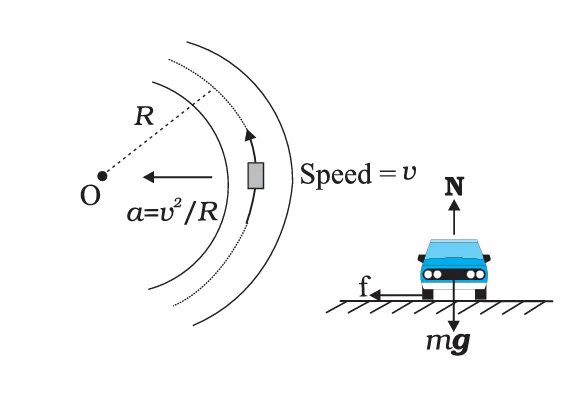
Motion of a Car on a Level Road

Circular motion of a car on a level road

When a car moves along a circular path on a level road, it requires a centripetal force directed toward the centre of the circle to maintain circular motion.

On a level road, this required centripetal force is provided entirely by static friction between the tyres and the road.

Forces Acting on the Car
  • Weight of the car, \(mg\) (acting vertically downward)
  • Normal reaction from the road, \(N\) (acting vertically upward)
  • Static friction \(f\) acting toward the centre of the circular path
Vertical Force Balance

Since there is no acceleration in the vertical direction, the normal reaction balances the weight of the car.

\[ N - mg = 0 \] \[ N = mg \]
Condition for Circular Motion

Static friction provides the centripetal force required for circular motion:

\[ f = \frac{mv^2}{R} \]

The maximum possible value of static friction is:

\[ f_{max} = \mu_s N \]

Therefore, for the car to remain on the circular path:

\[ \frac{mv^2}{R} \le \mu_s N \] Substituting \(N = mg\): \[ \frac{mv^2}{R} \le \mu_s mg \] \[ v^2 \le \mu_s R g \]

Hence, the maximum possible speed is

\[ \boxed{v_{max}=\sqrt{\mu_s R g}} \]

Interestingly, this result is independent of the mass of the car.
Important Points
  • Static friction provides the centripetal force.
  • If the speed exceeds \(v_{max}\), the car will skid outward.
  • The maximum speed depends on the coefficient of friction and radius of the circular path.
Importance in Board Exams
  • Derivation of the maximum speed of a car on a level road is commonly asked in descriptive questions.
  • Students may be asked to explain the role of friction in circular motion.
Importance in JEE / NEET / Competitive Exams
  • Numerical problems involving circular motion and friction frequently appear in entrance examinations.
  • Often combined with problems on banked roads and inclined planes.

Motion of a Car on a Banked Road

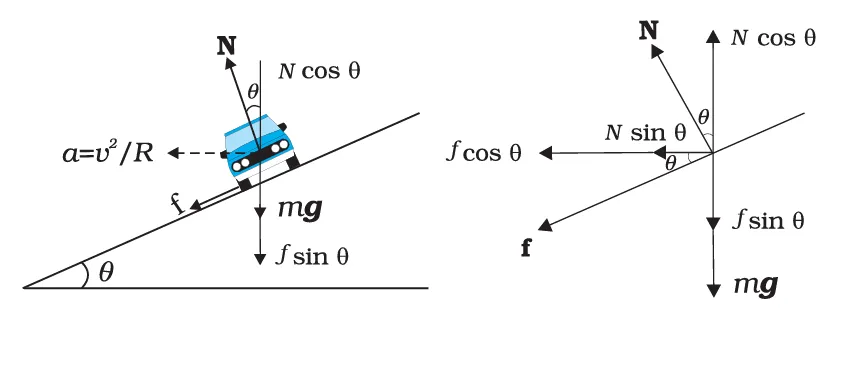
Circular motion of a car on a banked road

When a car moves along a curved road, the required centripetal force must act toward the centre of the circular path. If the road is banked (tilted at an angle \( \theta \)), a component of the normal reaction helps provide this centripetal force.

Banking reduces the dependence on friction and allows vehicles to safely negotiate curves at higher speeds.

Forces Acting on the Car
  • Weight of the car \(mg\) acting vertically downward
  • Normal reaction \(N\) perpendicular to the road surface
  • Frictional force \(f\) along the road surface
Vertical Force Balance

Since there is no acceleration in the vertical direction,

\[ N \cos\theta = mg + f \sin\theta \tag{1} \]
Horizontal Direction (Centripetal Force)

The horizontal components of \(N\) and \(f\) provide the required centripetal force.

\[ N \sin\theta + f \cos\theta = \frac{mv^2}{R} \tag{2} \]
Maximum Speed Condition

The maximum speed occurs when friction reaches its limiting value:

\[ f = \mu_s N \]

Substituting into equation (1):

\[ N\cos\theta = mg + \mu_s N \sin\theta \] \[ N(\cos\theta - \mu_s \sin\theta) = mg \] \[ N = \frac{mg}{\cos\theta - \mu_s \sin\theta} \]

Substituting this value of \(N\) into equation (2):

\[ N(\sin\theta + \mu_s \cos\theta) = \frac{mv^2}{R} \] \[ \frac{mg(\sin\theta + \mu_s \cos\theta)} {\cos\theta - \mu_s \sin\theta} = \frac{mv^2}{R} \]

Therefore, the maximum speed of the car is

\[ \boxed{ v_{max}= \sqrt{ Rg \frac{\sin\theta + \mu_s \cos\theta} {\cos\theta - \mu_s \sin\theta} } } \]
Special Case: Frictionless Banking

If friction is negligible (\(f=0\)), the centripetal force is provided entirely by the horizontal component of the normal reaction.

\[ N\cos\theta = mg \] \[ N\sin\theta = \frac{mv^2}{R} \] Dividing the two equations: \[ \tan\theta = \frac{v^2}{Rg} \] \[ v = \sqrt{Rg\tan\theta} \]
Important Points
  • Banking helps vehicles move safely around curves at higher speeds.
  • Friction assists centripetal force at speeds above or below the design speed.
  • Without banking, vehicles depend entirely on friction.
Importance in Board Exams
  • Derivation of maximum speed on a banked road is frequently asked.
  • Conceptual questions on banking and friction are common.
Importance in JEE / NEET / Competitive Exams
  • Appears in problems involving circular motion and friction.
  • Often combined with questions on inclined planes and dynamics.

Centrifugal Force and Non-Inertial Frames

When we observe circular motion from a rotating frame of reference, an apparent outward force seems to act on the body. This apparent force is called the centrifugal force.

Centrifugal force is a pseudo force that appears to act on a body moving in a circular path when observed from a rotating (non-inertial) frame of reference.
Expression for Centrifugal Force

The magnitude of centrifugal force is equal to the centripetal force required to maintain circular motion.

\[ F_{cf} = \frac{mv^2}{R} \]

where

  • \(m\) = mass of the body
  • \(v\) = speed of the body
  • \(R\) = radius of the circular path

While centripetal force acts toward the centre, centrifugal force appears to act away from the centre.

Inertial and Non-Inertial Frames

The concept of centrifugal force is closely related to the type of reference frame used to observe motion.

  • Inertial Frame: A reference frame that is either at rest or moving with constant velocity. Newton’s laws hold directly in such frames.
  • Non-Inertial Frame: A reference frame that is accelerating or rotating. In such frames, fictitious forces like centrifugal force must be introduced to apply Newton’s laws.
Concept Visualization
Centripetal Centrifugal Centre
Real-Life Examples
  • Passengers feel pushed outward when a car turns around a curve.
  • Water moves outward in a rotating bucket.
  • Centrifuges used in laboratories separate substances using centrifugal force.
Important Points
  • Centrifugal force is not a real force; it is a pseudo force.
  • It appears only in rotating or accelerating frames.
  • Its magnitude equals the centripetal force but its direction is opposite.

Laws of Motion – Quick Revision Formula Sheet

This quick revision section summarizes the most important formulas from NCERT Physics Class XI – Laws of Motion. Use it for rapid revision before board exams, JEE Main, NEET, and other competitive exams.

Momentum
\[ \vec{p}=m\vec{v} \]
Newton’s Second Law
\[ \vec{F}=\frac{d\vec{p}}{dt} \] \[ \vec{F}=m\vec{a} \]
Impulse
\[ J=F\Delta t \] \[ J=\Delta p \]
Conservation of Momentum
\[ p_{initial}=p_{final} \] \[ m_1u_1+m_2u_2=m_1v_1+m_2v_2 \]
Maximum Static Friction
\[ f_{max}=\mu_s N \]
Kinetic Friction
\[ f_k=\mu_k N \]
Centripetal Acceleration
\[ a_c=\frac{v^2}{R} \]
Centripetal Force
\[ F_c=\frac{mv^2}{R} \] \[ F_c=m\omega^2R \]
Car on Level Road
\[ v_{max}=\sqrt{\mu_s R g} \]
Banked Road
\[ v_{max}= \sqrt{ Rg \frac{\sin\theta+\mu_s\cos\theta} {\cos\theta-\mu_s\sin\theta} } \]
Banking Without Friction
\[ \tan\theta=\frac{v^2}{Rg} \] \[ v=\sqrt{Rg\tan\theta} \]

Top 15 Conceptual Mistakes Students Make in Laws of Motion

Many students lose marks in board exams and competitive examinations due to small conceptual misunderstandings in Newton’s Laws and friction problems. Avoid these common mistakes.

  1. Thinking that a force is required to maintain motion.
  2. Assuming friction always acts opposite to motion instead of impending motion.
  3. Forgetting to draw a Free Body Diagram (FBD) before solving problems.
  4. Assuming action and reaction forces act on the same body.
  5. Confusing mass with weight.
  6. Using \(f=\mu N\) for static friction always. (Actually \(f \le \mu_s N\)).
  7. Forgetting that centripetal force is not a new force; it is provided by forces like tension, gravity, or friction.
  8. Ignoring the direction of acceleration while applying \(F = ma\).
  9. Assuming heavier objects fall faster (ignoring air resistance).
  10. Forgetting that momentum is a vector quantity.
  11. Applying conservation of momentum even when external forces are present.
  12. Mixing up centripetal and centrifugal forces.
  13. Ignoring the normal reaction direction on inclined or banked surfaces.
  14. Assuming friction depends on the area of contact.
  15. Forgetting that friction can act toward the center in circular motion.

30-Second Laws of Motion Quick Revision

If you have only 30 seconds before an exam, revise these key ideas from the Laws of Motion chapter.

  • Newton’s First Law: A body remains at rest or in uniform motion unless acted upon by an external force.
  • Newton’s Second Law: \(F = ma\)
  • Newton’s Third Law: Every action has an equal and opposite reaction.
  • Momentum: \(p = mv\)
  • Impulse: \(J = F\Delta t = \Delta p\)
  • Maximum static friction: \(f_{max} = \mu_s N\)
  • Centripetal acceleration: \(a = \dfrac{v^2}{R}\)
  • Centripetal force: \(F = \dfrac{mv^2}{R}\)
  • Car on level road: \(v_{max}=\sqrt{\mu_s R g}\)
  • Banked road (no friction): \(v=\sqrt{Rg\tan\theta}\)

10 Most Important JEE / NEET PYQ Patterns – Laws of Motion

Competitive examinations such as JEE Main, JEE Advanced, and NEET repeatedly test certain standard problem patterns from the Laws of Motion chapter. Understanding these patterns helps students solve a large number of exam questions quickly.

  1. Block on Rough Horizontal Surface
    Problems involving friction when a block is pushed or pulled with force \(F\).
    Key relation: \[ f_{max} = \mu_s N \]
  2. Block on an Inclined Plane
    Determining acceleration or friction when a body moves on a rough incline.
    Key relations: \[ mg\sin\theta, \quad N = mg\cos\theta \]
  3. Connected Bodies (Pulley Systems)
    Acceleration and tension in systems connected by strings and pulleys.
    Key concept: Apply \(F = ma\) to each body.
  4. Elevator Problems
    Apparent weight inside elevators moving up or down.
    \[ N = m(g \pm a) \]
  5. Momentum Conservation in Collisions
    Problems involving collisions of two bodies.
    \[ m_1u_1 + m_2u_2 = m_1v_1 + m_2v_2 \]
  6. Impulse Problems
    Short-duration forces changing momentum of objects.
    \[ J = F\Delta t = \Delta p \]
  7. Circular Motion Using Friction
    Motion of vehicles on circular roads.
    \[ F_c = \frac{mv^2}{R} \]
  8. Car on Level Circular Road
    Maximum safe speed of a vehicle on a flat curve.
    \[ v_{max} = \sqrt{\mu_s R g} \]
  9. Banked Road Problems
    Circular motion when roads are inclined.
    \[ v = \sqrt{Rg\tan\theta} \]
  10. Multiple Force Systems (Equilibrium)
    Determining unknown forces when several forces act on a particle.
    Key condition: \[ \sum \vec{F} = 0 \]
Exam Strategy: If you master these 10 patterns, you can solve most Laws of Motion problems in JEE Main and NEET because exam questions are usually variations of these concepts.

Laws of Motion Mind Map (Visual Summary)

This visual mind map summarizes the most important ideas from the Laws of Motion chapter. It helps students quickly connect key concepts before exams such as CBSE Boards, JEE Main, and NEET.

Laws of Motion Newton • Friction • Momentum Newton's Laws Momentum p = mv Friction f = μN Circular Motion Impulse J = FΔt Equilibrium ΣF = 0
Quick Tip: If you understand the connections between Newton’s laws, friction, momentum, and circular motion, you can solve most Laws of Motion problems in competitive exams.

Interactive Practice Test – Laws of Motion (10 Questions)

Test your understanding of the Laws of Motion chapter with this quick practice quiz. Select the correct answers and click Check Score.

1. Which law defines inertia?

Newton's Second Law
Newton's First Law
Newton's Third Law

2. Momentum of a body is given by

p = mv
p = ma
p = v/m

3. Unit of force in SI system is

Joule
Newton
Watt

4. Static friction is

always constant
self-adjusting up to a maximum value
always equal to μN

5. Centripetal acceleration is

v²/R
R/v²
v/R²

6. Impulse is equal to

Change in momentum
Force
Work done

7. Maximum friction force is

μN
mg
ma

8. For circular motion, centripetal force acts

towards the centre
away from the centre
tangent to circle

9. Momentum conservation applies when

external force is zero
friction is zero
velocity is constant

10. Maximum speed of a car on level road is

√(μRg)
√(Rg)
μRg

Interactive Free Body Diagram Builder (Drag-and-Learn)

Practice identifying forces by building a Free Body Diagram (FBD). Drag force arrows onto the block, rotate them to match directions, and reset when done.

Force Toolbox
↓ Weight
↑ Normal
← Friction
→ Applied

Block

Interactive Free Body Diagram Builder – Auto Check Mode

Choose a scenario, drag the forces onto the object, and click Check Diagram. The tool will verify whether the correct forces are present.

Force Toolbox
Weight (mg)
Normal Reaction (N)
Friction (f)
Applied Force (F)

Object

Recent posts

    Share this Chapter

    Found this helpful? Share this chapter with your friends and classmates.


    💡 Exam Tip: Share helpful notes with your study group. Teaching others is one of the fastest ways to reinforce your own understanding.

    Frequently Asked Questions

    Newton's First Law states that a body remains at rest or in uniform straight-line motion unless acted upon by a net external force; this is called the law of inertia.

    Newton's Second Law states that the rate of change of momentum of a body is proportional to the applied net force and takes place in the direction of the force, \(\vec{F} = \frac{d\vec{p}}{dt} = m\vec{a}\).

    Newton's Third Law states that for every action there is an equal and opposite reaction; forces always occur in pairs acting on different bodies.

    Inertia is the property of a body by virtue of which it resists any change in its state of rest or uniform motion in a straight line.

    Linear momentum \(\vec{p}\) of a body is defined as the product of its mass and velocity, \(\vec{p} = m\vec{v}\).

    Impulse of a force is the product of force and the time for which it acts and is equal to the change in momentum, \(I = F\Delta t = \Delta p\).

    In an isolated system with no external force, the total linear momentum of the system remains constant during any interaction.

    For constant mass, Newton's Second Law reduces to \(\vec{F}_{net} = m\vec{a}\).

    An inertial frame is a reference frame in which Newton's First Law holds, i.e., a frame that is either at rest or moving with uniform velocity.

    A non-inertial frame is a reference frame that is accelerating with respect to an inertial frame, in which fictitious or pseudo forces must be introduced to apply Newton's laws.

    Pseudo force is an apparent force introduced in a non-inertial frame of reference, given by \(\vec{F}_{pseudo} = -m\vec{a}_{frame}\), acting opposite to the acceleration of the frame.

    Normal reaction is the contact force exerted by a surface on a body, acting perpendicular to the surface.

    Friction is the contact force that opposes the relative motion or the tendency of relative motion between two surfaces in contact.

    Static friction acts between surfaces at rest relative to each other and can vary up to a limiting value, while kinetic friction acts when surfaces slide over each other with relative motion.

    Limiting friction is the maximum value of static friction just before the body begins to move relative to the surface.

    LAWS OF MOTION – Learning Resources

    Get in Touch

    Let's Connect

    Questions, feedback, or suggestions?
    We'd love to hear from you.