Q1
Which of the following statements are true and which are false?
Give reasons for your answers.
- Only one line can pass through a single point.
- There are an infinite number of lines which pass through two distinct points.
- A terminated line can be produced indefinitely on both the sides.
- If two circles are equal, then their radii are equal.
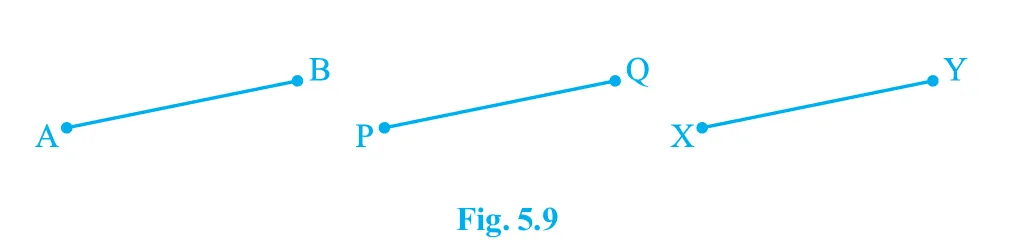
- In Fig. 5.9, if AB = PQ and PQ = XY, then AB = XY.
📘 Concept & Theory Concept Used in this Exercise ›
This exercise is based on the basic ideas introduced by the Greek mathematician Euclid.
The questions mainly use Euclid’s definitions, axioms and postulates.
| Concept | Explanation |
|---|---|
| Point | A point indicates an exact position. It has no length, breadth or thickness. |
| Line | A line extends endlessly in both directions. |
| Line Segment | A line segment has two fixed end points. |
| Euclid’s First Axiom | Things which are equal to the same thing are equal to one another. |
| Euclid’s Second Postulate | A terminated line can be produced indefinitely. |
| Unique Line Property | Through two distinct points, only one unique line can pass. |
🗺️ Solution Roadmap Step-by-step Plan ›
- Think about all possible directions through one point.
- Check whether only one line is possible.
- Use geometric understanding of lines through a point.
📊 Graph / Figure Graph / Figure ›
✏️ Solution Part (i) ›
Step-by-step Solution · 5 steps
- The statement says that only one line can pass through a single point.
- Consider a point \(P\).
- Through this point, we can draw lines in infinitely many directions.
- Therefore, infinitely many lines can pass through one point.
- Hence, the given statement is False.
📝 Part(ii) ›
There are an infinite number of lines which pass through two distinct points.
🗺️ Solution Roadmap Step-by-step Plan ›
- Recall the unique line property.
- Take two distinct points.
- Check how many lines can join them.
📊 Graph / Figure Graph / Figure ›
✏️ Solution Part (ii) ›
Step-by-step Solution · 5 steps
- Let \(A\) and \(B\) be two distinct points.
- According to Euclidean Geometry:
- “Through two distinct points, only one unique line can pass.”
- Therefore, it is not possible to draw infinitely many lines through the same two distinct points.
- Hence, the given statement is False.
📝 Part(iii) ›
A terminated line can be produced indefinitely on both the sides.
🗺️ Solution Roadmap Step-by-step Plan ›
- Recall Euclid’s Second Postulate.
- Understand meaning of terminated line.
- Check whether extension is possible.
📊 Graph / Figure Graph / Figure ›
✏️ Solution Part(iii) ›
Step-by-step Solution · 5 steps
- A terminated line means a line segment having fixed end points.
- Euclid’s Second Postulate states:
- "A terminated line can be produced indefinitely.”
- This means the line segment can be extended endlessly in both directions.
- Therefore, the given statement is True.
📝 Part(iv) ›
If two circles are equal, then their radii are equal.
🗺️ Solution Roadmap Step-by-step Plan ›
- Recall definition of equal circles.
- Understand relation between equal circles and radius.
✏️ Solution Complete Solution ›
Step-by-step Solution · 3 steps
- Two circles are said to be equal if their radii are equal.
- Therefore, if two circles are equal, then their radii must also be equal.
- Hence, the given statement is True.
📝 Part(v) ›
In Fig. 5.9, if AB = PQ and PQ = XY, then AB = XY.
📊 Graph / Figure Graph / Figure ›
🗺️ Solution Roadmap Step-by-step Plan ›
- Observe equality relation among line segments.
- Use Euclid’s First Axiom.
- Conclude equality between AB and XY.
✏️ Solution Part (v) ›
Step-by-step Solution · 9 steps
- It is given that:
- \[AB = PQ\]
- Also,
- \[PQ = XY\]
- According to Euclid’s First Axiom:
- “Things which are equal to the same thing are equal to one another.”
- Since both \(AB\) and \(XY\) are equal to \(PQ\),
- \[AB = XY\]
- Therefore, the given statement is True.
🎯 Exam Significance Exam Significance ›
- Questions based on Euclid’s axioms and postulates are frequently asked in CBSE school examinations.
- Understanding logical reasoning in geometry helps in Olympiads and NTSE-type examinations.
- Euclid Geometry develops proof-writing skills which are essential in higher mathematics.
- Basic geometric logic is useful for competitive examinations involving quantitative aptitude and reasoning.