Post.1: line through 2 points r Post.3: circle any centre/r l₁ l₂ Post.5 (Playfair): unique parallel Given → To Prove Construction → Proof [Reason in brackets] 5 Postulates · Axioms · Theorems
Chapter 5  ·  Class IX Mathematics

Axioms, Postulates, and the Birth of Logical Proof

Introduction to Euclid's Geometry

Five Postulates That Built All of Geometry — The Foundation of Mathematical Reasoning

Chapter Snapshot

7Concepts
5Formulae
4–5%Exam Weight
2–3Avg Q's
EasyDifficulty

Why This Chapter Matters for Exams

CBSE Class IXNTSEState Boards

Introduction to Euclid's Geometry contributes 4–5 marks in CBSE Class IX Boards. Questions focus on stating Euclid's postulates, distinguishing axioms from theorems, and proving simple statements using Euclid's axioms. NTSE tests logical deduction and the difference between axioms and postulates. This chapter establishes the proof-writing skills used throughout geometry.

Key Concept Highlights

Euclid's Definitions
Euclid's Axioms (Common Notions)
Euclid's Five Postulates
Theorems and Proofs
Equivalent Versions of Euclid's Fifth Postulate
Playfair's Axiom (Parallel Lines)
Non-Euclidean Geometry (Introduction)

Important Formula Capsules

$\text{Postulate 1: A straight line can be drawn between any two points}$
$\text{Postulate 2: A line segment can be extended indefinitely}$
$\text{Postulate 3: A circle can be drawn with any centre and radius}$
$\text{Postulate 4: All right angles are equal}$
$\text{Postulate 5 (Parallel): Through P not on line }l\text{, exactly one parallel exists}$

What You Will Learn

Navigate to Chapter Resources

🏆 Exam Strategy & Preparation Tips

All five postulates must be memorised word-for-word — CBSE asks you to "state Euclid's Postulate X" exactly. Proof questions follow a fixed template: given → to prove → construction → proof (reason in brackets). The fifth postulate question (Playfair's axiom equivalence) appears almost every year. Time investment: 1 day.

Chapter 5 · CBSE · Class X
📐
Euclid’s Geometrical Framework
NCERT Class 9 Mathematics Chapter 5 Introduction to Euclid’s Geometry Euclid Geometry Class 9 NCERT Euclid Geometry Introduction to Geometry Euclid and Geometry Euclid’s Definitions Euclid’s Axioms Euclid’s Postulates Axioms and Postulates Geometrical Concepts Plane Geometry Mathematics Class 9 Geometry Euclidean Geometry Geometry Basics Statement and Proof Mathematical Reasoning History of Geometry Elementary Geometry
📖 Introduction
📘 Definition

What is Euclidean Geometry?

🏛️ Historical Note
Euclid and His Contribution

Euclid was a Greek mathematician who lived around 300 BCE in Alexandria, Egypt. He wrote the famous mathematical treatise called “Elements”, consisting of thirteen books.

In this work, Euclid organized geometry into definitions, axioms, postulates and theorems. This systematic structure became the standard method of mathematical proof for centuries.

Board Important Fact: Questions related to Euclid’s contribution, axiomatic system and Euclid’s Elements are frequently asked in CBSE examinations.
Euclid (325 BCE – 265 BCE)
📌 Note

Axiomatic System of Geometry

🏛️ Euclid’s Five Postulates
  1. A straight line may be drawn from any one point to any other point.
  2. A terminated line can be produced indefinitely.
  3. A circle can be drawn with any centre and any radius.
  4. All right angles are equal to one another.
  5. If a straight line falling on two straight lines makes interior angles on the same side less than two right angles, then the two lines meet on that side if produced indefinitely.
Most Important: The fifth postulate is also called the Parallel Postulate.
📌 Note

Understanding the Parallel Postulate

🧠 Remember

Important Terms in Euclidean Geometry

✏️ Example
State whether the following statement is an axiom or a postulate: “A circle can be drawn with any centre and any radius.”
Postulates are geometry-specific assumptions.
  1. 1
    Identify whether the statement belongs only to geometry.
  2. 2
    Check whether it is accepted without proof.
The statement is related specifically to geometrical construction. Therefore, it is a postulate.

Why is Euclid’s geometry called an axiomatic system?
Theorems are logically derived from axioms and postulates.
Euclid’s geometry is called an axiomatic system because it starts with basic assumptions called axioms and postulates. Using logical reasoning, all geometrical results and theorems are proved from these assumptions.
📋 Case Study
A civil engineer is designing two railway tracks that must always remain at equal distance from each other and never intersect. He uses the concept of parallel lines from Euclidean geometry.

Based on the above information, answer the following:

  1. Which Euclidean postulate is related to this situation?
  2. Why do the tracks never meet?
Answers
  • The situation is related to Euclid’s fifth postulate (parallel postulate).
  • The tracks never meet because parallel lines remain at equal distance and do not intersect.
⚡ Exam Tip
❌ Common Mistakes
  • Confusing axioms with postulates
  • Memorizing postulates without understanding meaning
  • Writing incomplete definitions in exams
  • Forgetting that Euclid’s geometry mainly applies to flat surfaces
  • Misinterpreting the fifth postulate
⚡ Quick Revision
  • Euclid is known as the Father of Geometry.
  • Euclid’s book is called “Elements”.
  • Euclidean geometry is based on axioms and postulates.
  • Axioms are universal truths accepted without proof.
  • Postulates are assumptions specific to geometry.
  • The fifth postulate is related to parallel lines.
📐
Importance of Euclid’s Elements
🌟 Importance
📘 Definition
Core Definitions from Euclid’s Elements
📊 Comparison Table

Difference Between Line and Line Segment

Line Line Segment
Extends infinitely in both directions Has fixed endpoints
No definite length Definite measurable length
Represented with arrows Represented without arrows
✏️ Example
Which geometrical figure has only position but no dimensions?
Definition of point
A point has only position and no dimensions.

Why is a line said to extend infinitely in both directions?
A line has no endpoints.
A line extends infinitely in both directions because it has no fixed endpoints and can continue endlessly.
⚡ Exam Tip
❌ Common Mistakes
  • Confusing line with line segment
  • Writing incomplete geometrical definitions
  • Forgetting that a point has no dimensions
  • Incorrect labelling of diagrams
⚡ Quick Revision
  • Euclid is known as the Father of Geometry.
  • His famous mathematical work is called Elements.
  • A point has no dimensions.
  • A line extends infinitely in both directions.
  • A plane surface is perfectly flat.
  • Every point on a circle is equidistant from the centre.
🗒️ Euclid’s Axioms (Common Notions)

Euclid’s axioms are universal mathematical truths accepted without proof. These statements are called Common Notions because they are applicable not only in geometry but in all branches of Mathematics.

Important Difference: Axioms are universal truths applicable everywhere, whereas postulates are assumptions specifically related to geometry.
Why Are Axioms Important?
  • They form the logical foundation of Mathematics.
  • Complex theorems are derived using axioms.
  • They help maintain consistency in proofs.
  • They are universally accepted truths.
  • Used extensively in algebra and geometry.
Board Examination Importance
  • CBSE often asks competency-based questions from axioms.
  • Assertion-reason questions frequently use axiomatic concepts.
  • Students must know real-life applications of axioms.
  • Axioms are useful in proof-writing questions.
  • Understanding axioms improves logical reasoning skills.
Euclid’s Seven Axioms (Common Notions)
Axiom No. Statement Explanation / Example
Axiom 1 Things which are equal to the same thing are equal to one another. If \(\small \small A = B\) and \(\small \small B = C\), then \(\small \small A = C\). This is known as the Transitive Property.
Axiom 2 If equals are added to equals, the wholes are equal. If \(\small \small 3 = 3\) and \(\small \small 2 = 2\), then \[ 3+2 = 3+2 \]
Axiom 3 If equals are subtracted from equals, the remainders are equal. If \(\small \small 8 = 8\) and \(\small \small 5 = 5\), then \[ 8-5 = 8-5 \]
Axiom 4 Things which coincide with one another are equal to one another. If two figures overlap exactly, they are equal or congruent.
Axiom 5 The whole is greater than the part. If point \(\small \small C\) lies between \(\small \small A\) and \(\small \small B\), then \[ AC < AB \]
Axiom 6 Things which are double of the same things are equal to one another. If two equal quantities are doubled, their doubles remain equal.
Axiom 7 Things which are halves of the same things are equal to one another. If equal figures are divided equally, their halves are also equal.
📊 Comparison Table

Difference Between Axioms and Postulates

Axioms Postulates
Universal truths Geometry-specific assumptions
Applicable in all Mathematics Applicable mainly in Geometry
Also called Common Notions Called geometrical assumptions
Example: Whole is greater than the part Example: A straight line can be drawn joining two points
🛠️ Application
Real-Life Applications of Euclid’s Axioms
Architecture

Engineers use geometrical equality and measurement principles while designing buildings, bridges and roads.

Computer Graphics

Equal shapes, transformations and geometrical logic are used in animation and gaming.

Measurement

Concepts of equality and wholes are used in daily calculations and measurements.

Scientific Research

Logical reasoning based on axioms forms the basis of scientific theories and proofs.

🗒️ Emample
If \(\small \small AB = PQ\) and \(\small \small PQ = XY\), then prove that \(\small \small AB = XY\).
Euclid’s First Axiom
Things which are equal to the same thing are equal to one another.

Given:

\[\small AB = PQ \] \[\small PQ = XY \]

Since both are equal to \(\small \small PQ\),

\[\small AB = XY \]

Hence proved using Euclid’s First Axiom.


Which axiom states that the whole is greater than the part?
Recall Euclid’s list of common notions.

Euclid’s Fifth Axiom states that:

“The whole is greater than the part.”
📋 Case Study
A teacher places two equal-length sticks on a table. She adds another equal-length stick to both and asks students whether the total lengths remain equal.

Answer the following questions:

  1. Which Euclid’s axiom is used here?
  2. If \(\small a=b\) and \(\small c=d\), what can be concluded about \(\small a+c\) and \(\small b+d\)?
Answers
  • Euclid’s Second Axiom is used.
  • \(\small a+c = b+d \)
⚡ Exam Tip
❌ Common Mistakes
  • Confusing axioms with postulates
  • Forgetting the exact wording of axioms
  • Using incorrect mathematical notation
  • Applying the wrong axiom in proof questions
  • Memorizing examples without understanding concepts
⚡ Quick Revision
  • Euclid’s axioms are universal mathematical truths.
  • They are also called Common Notions.
  • Axioms are accepted without proof.
  • The whole is always greater than the part.
  • Equal quantities remain equal after addition or subtraction.
  • Axioms form the basis of logical mathematical proofs.
📐
Euclid’s Postulates
🗺️ Overview

Euclid’s postulates are basic geometrical assumptions accepted without proof. These postulates form the foundation of Euclidean Geometry and are used to derive important geometrical results, constructions and theorems.

Important: Postulates apply specifically to geometry, while axioms are universal truths used throughout Mathematics.
🤔 Did You Know?

Why Are Postulates Important?

Why Are Postulates Important?
  • They provide the starting point of geometrical reasoning.
  • They help construct geometrical figures accurately.
  • Many theorems are derived from these postulates.
  • They establish rules for lines, angles and circles.
  • They form the basis of modern geometry.
Board Examination Importance
  • Direct theory questions are frequently asked from postulates.
  • CBSE competency-based questions use practical applications.
  • Important for assertion-reason type questions.
  • The fifth postulate is highly important conceptually.
  • Helps build proof-writing skills in geometry.
🗒️ Euclid’s Postulates
Types

First Postulate

A straight line may be drawn from any one point to any other point.

This means that through any two distinct points, at least one unique straight line can always be drawn.

Geometrical Meaning
  • Any two points can be connected by a straight line.
  • The shortest distance between two points is a straight line.
  • This postulate forms the basis of geometrical constructions.
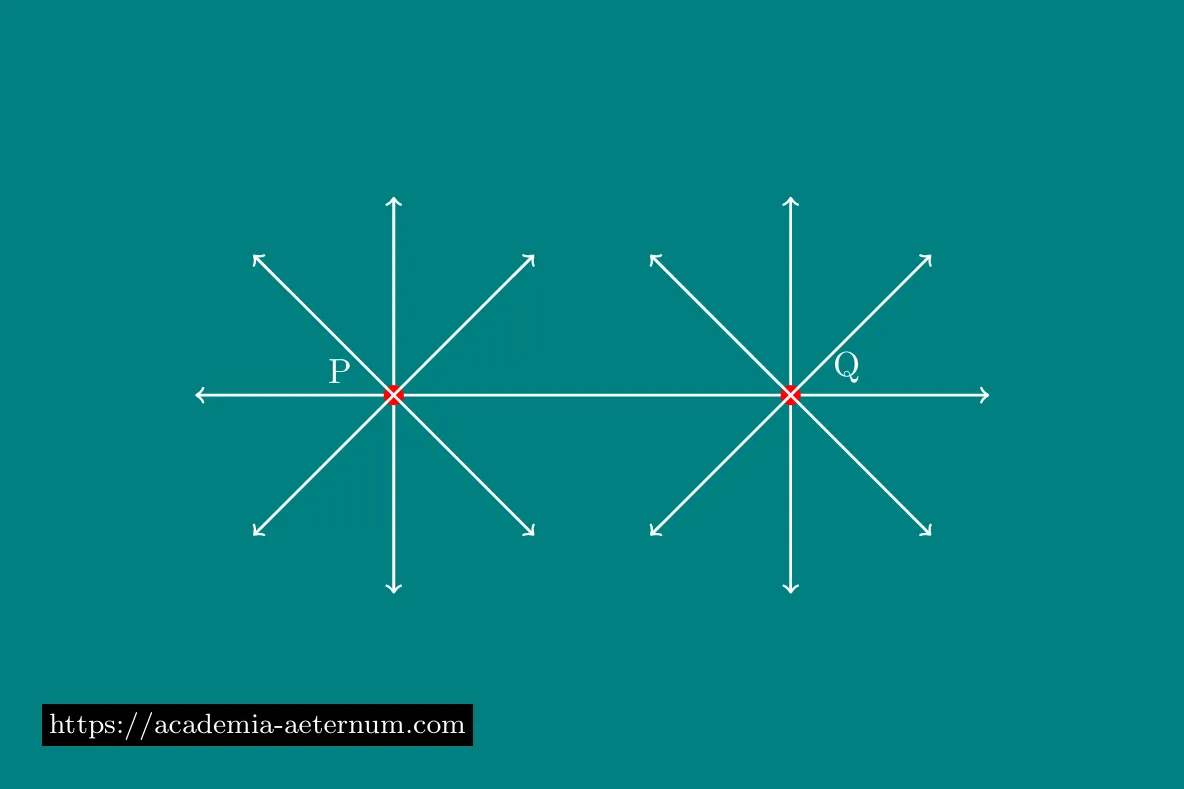
Example: If points \(A\) and \(B\) are given, then line \(AB\) can always be drawn.
Euclid First Postulate Straight Line Between Two Points
Euclid’s First Postulate

Second Postulate

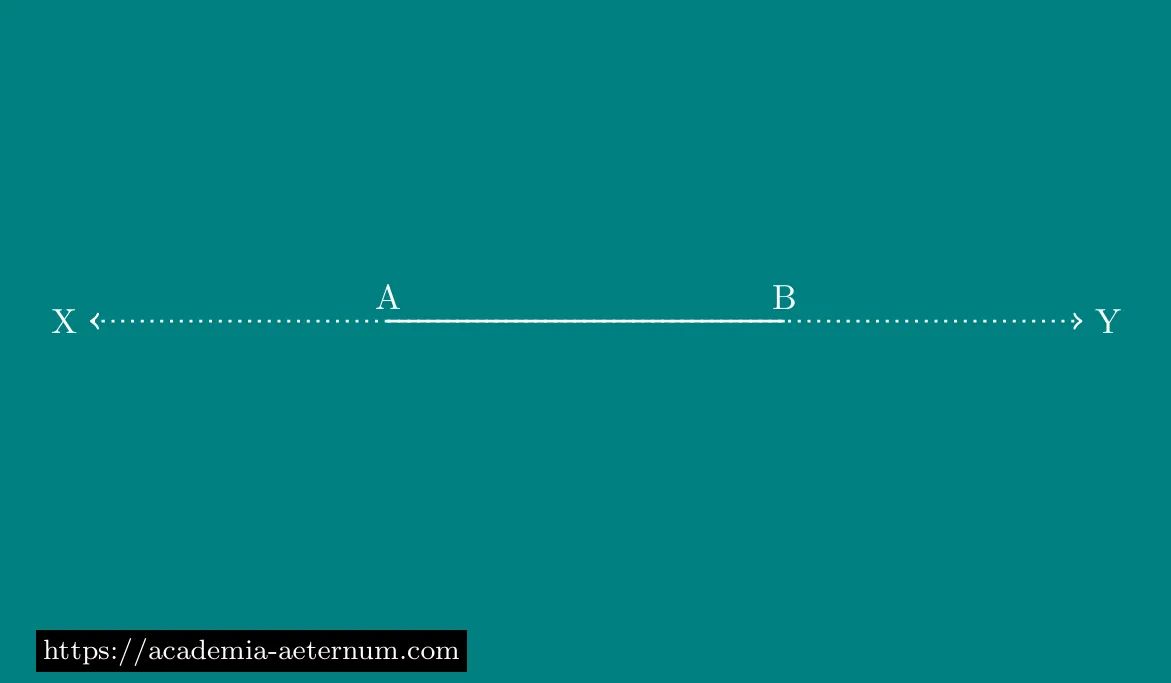
A terminated line can be produced indefinitely.

A finite line segment can be extended endlessly in both directions to form a complete straight line.

Concept Explanation
  • A line segment has fixed endpoints.
  • The segment can be extended without limit.
  • Infinite extension forms a complete line.
Example: Segment \(AB\) can be extended beyond \(A\) and \(B\).
Euclid Second Postulate Extension of Line Segment
Euclid’s Second Postulate

Third Postulate

A circle can be described with any centre and distance.

Given any point as centre and any distance as radius, a circle can always be drawn.

Mathematical Interpretation

If \(O\) is the centre and \(r\) is the radius, then every point \(P\) on the circle satisfies:

\[ OP = r \]
All points on a circle are equidistant from the centre.
O Radius P

Fourth Postulate

All right angles are equal to one another.

Every right angle has the same measure:

\[ 90^\circ \]
Importance of the Fourth Postulate
  • Ensures uniformity in geometrical measurements.
  • Forms the basis of perpendicular constructions.
  • Used in squares, rectangles and coordinate geometry.
\(90^\circ\)

Fifth Postulate (Parallel Postulate)

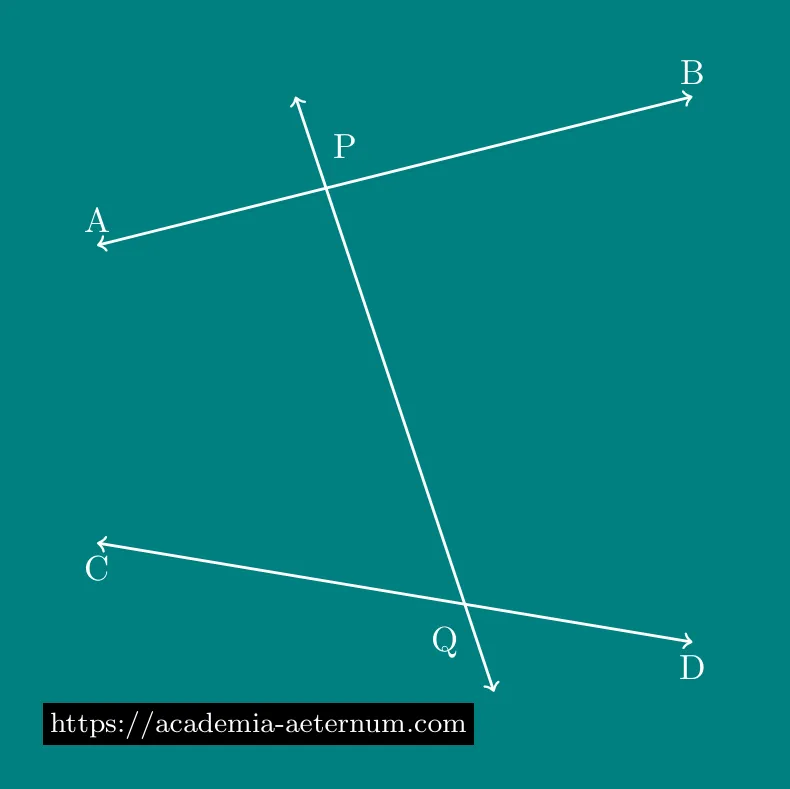
If a straight line falling on two straight lines makes the interior angles on the same side less than two right angles, then the two lines, if produced indefinitely, meet on that side.

This postulate explains the behavior of parallel and intersecting lines.

Playfair’s Form: Through a point not lying on a given line, only one line can be drawn parallel to the given line.
Conceptual Importance
  • Governs properties of parallel lines.
  • Forms the basis of Euclidean plane geometry.
  • Modification of this postulate led to non-Euclidean geometry.
  • Important for understanding transversal properties.
If interior angles are less than \(180^\circ\), the lines will intersect on that side.
Euclid Fifth Postulate Parallel Lines
Euclid’s Fifth Postulate
📝 Summary
Summary Table of Euclid’s Postulates
✏️ Example
Which postulate states that a line segment can be extended infinitely?
Euclid’s Second Postulate
Euclid’s Second Postulate states that a terminated line can be produced indefinitely.

Why is the fifth postulate called the parallel postulate?
It explains the behavior of parallel lines.
The fifth postulate determines when two lines intersect or remain parallel. Therefore, it is called the Parallel Postulate.
📋 Case Study
A road engineer designs two straight roads intersected by another road. The interior angles formed on one side are less than \(180^\circ\).

Answer the following:

  1. Which Euclid postulate applies here?
  2. What will happen to the two roads if extended?
Answers
  • Euclid’s Fifth Postulate applies.
  • The roads will intersect on that side.
⚡ Exam Tip
❌ Common Mistakes
  • Confusing axioms with postulates
  • Memorizing postulates without understanding applications
  • Misinterpreting the fifth postulate
  • Forgetting that right angles are always equal
  • Drawing incorrect geometrical diagrams
🗒️ Quick Summary
  • Euclid proposed five geometrical postulates.
  • Postulates are assumptions accepted without proof.
  • A straight line can join any two points.
  • A line segment can be extended infinitely.
  • All right angles are equal to \(90^\circ\).
  • The fifth postulate governs parallel lines.
📐
Example 1 — Segment Addition on a Straight Line
❓ Question
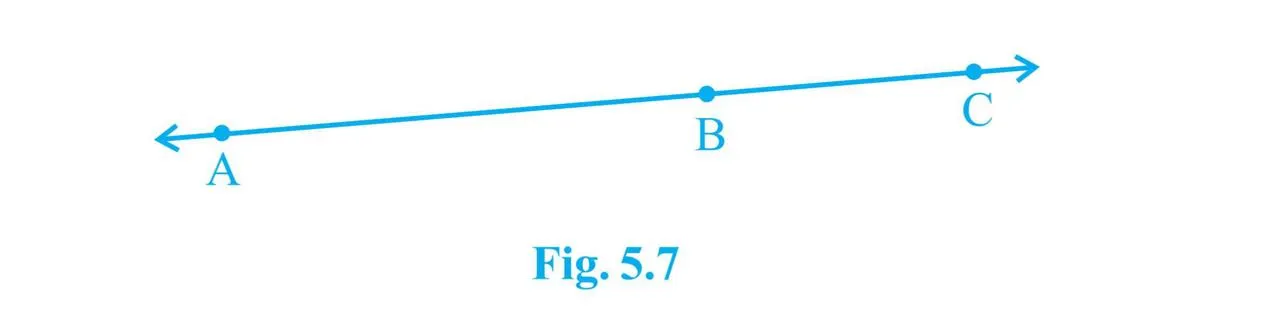
If \(A\), \(B\) and \(C\) are three points on a line, and \(B\) lies between \(A\) and \(C\), prove that:\[AB + BC = AC\]
🖼️ Figure
Segment Addition on a Straight Line AB plus BC equals AC
Fig. 5.7 — Point \(B\) lies between \(A\) and \(C\)
💡 Concept
👁️ Observation
Understanding the Problem
🔬 Proof

Given

Points \(A\), \(B\) and \(C\) are collinear and point \(B\) lies between \(A\) and \(C\).

To Prove\[ AB + BC = AC \]

Construction / Idea

Segment AC is composed of two adjoining segments AB and BC.

Logical Proof

  1. Since point \(B\) lies between \(A\) and \(C\), the segment \(AC\) is divided into two contiguous parts:
  2. \[ AB \text{ and } BC\]
  3. By Euclid’s Common Notion:
  4. “The whole is equal to the sum of its parts.”
  5. Therefore, the entire segment \(AC\) is obtained by combining segments \(AB\) and \(BC\).
  6. AB + BC = AC
  7. Hence Proved
⚡ Exam Tip
❌ Common Mistakes
  • Forgetting to mention that points are on the same line.
  • Writing \(AB + AC = BC\) incorrectly.
  • Drawing non-collinear diagrams.
  • Not identifying the segment addition concept.
  • Skipping conclusion statements in proofs.
📐
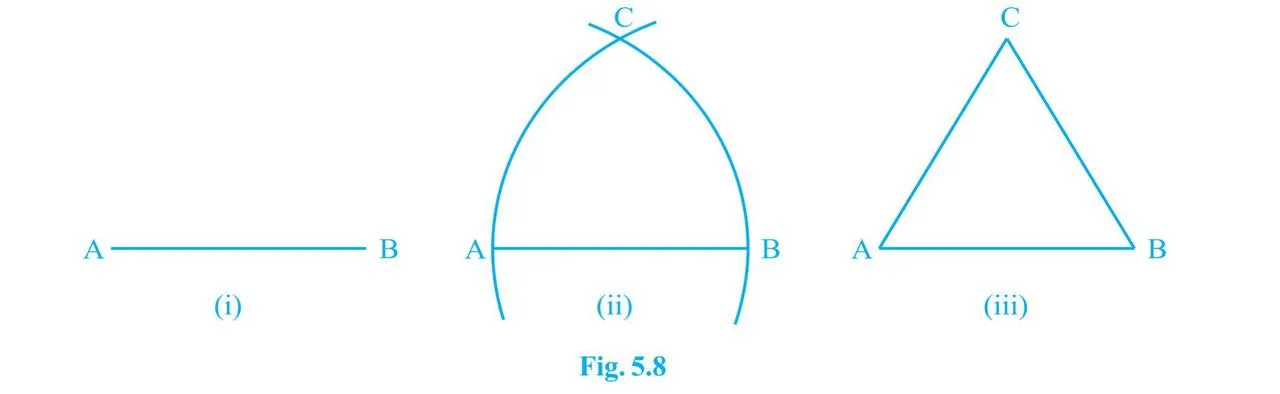
Example 2 — Construction of an Equilateral Triangle
❓ Question
Prove that an equilateral triangle can be constructed on any given line segment.
🖼️ Figure
Construction of Equilateral Triangle on a Given Line Segment
Fig. 5.8 — Construction of an Equilateral Triangle
💡 Concept
👁️ Observation
Understanding the Construction
🎨 SVG Diagram
Step-by-Step Construction
Given

A line segment \(AB\).

To Construct
Construct an equilateral triangle having \(AB\) as one side.
Construction Steps
  1. Draw the line segment \(AB\).
  2. With centre \(A\) and radius \(AB\), draw a circle.
  3. With centre \(B\) and the same radius \(AB\), draw another circle.
  4. Let the two circles intersect at point \(C\).
  5. Join \(AC\) and \(BC\).
  6. Triangle \(ABC\) is obtained.

Geometrical Construction Diagram

A B C AC BC Construction of Equilateral Triangle ABC
🔬 Proof
  1. Since point \(C\) lies on the circle with centre \(A\) and radius \(AB\),
  2. \[AC = AB\]
  3. Also, point \(C\) lies on the circle with centre \(B\) and radius \(AB\),
  4. \[BC = AB\]
  5. Therefore,
  6. \[AB = AC = BC\]
  7. Since all three sides of triangle \(ABC\) are equal, triangle \(ABC\) is an equilateral triangle.
  8. Hence proved, an equilateral triangle can be constructed on any given line segment.
⚡ Exam Tip
NCERT · Class IX · Chapter 5

Introduction to Euclid's Geometry

An immersive AI-powered learning engine — master axioms, postulates, theorems, and the foundations of geometry through interactive exploration.

7
Postulates
5
Axioms
40+
Practice Q's
8
Modules
🏛️

Historical Background

The origin story of Euclidean Geometry

~3000 BCE
Ancient Practical Geometry
Egyptians and Babylonians developed geometry for practical use — measuring land after Nile floods, constructing pyramids and temples. Geometry literally means "earth measurement" (geo = earth, metria = measurement).
~600 BCE
Greek Theoretical Revolution
Thales of Miletus introduced the idea of proving geometric results through logical reasoning rather than mere observation. Mathematics began evolving into a deductive science.
~300 BCE
Euclid's Elements
Euclid of Alexandria compiled the Elements — 13 books systematising all of Greek geometry. Starting from just 10 self-evident truths, he derived 465 propositions entirely through logic. It remains one of the most influential works in the history of mathematics.

Undefined Terms — The Foundation

Concepts so basic they cannot be defined further

Point
Euclid's description: A point is that which has no part — it has position but no dimensions (no length, width, or thickness). A point is an idealization; real marks always have some size.
Notation: Capital letters A, B, P, Q… A point is represented by a dot, but the dot itself is not a point in the strict sense.
Line
Euclid's description: A line is breadthless length — it has length but no width or thickness, and extends infinitely in both directions.
A line segment has two endpoints. A ray starts at one point and extends infinitely in one direction.
Surface
Euclid's description: A surface is that which has length and breadth only — two dimensions but no thickness.
Modern mathematics accepts these as primitive (undefined) terms whose meaning is understood intuitively.
Plane
A flat surface that extends infinitely in all directions. A plane contains infinitely many points and lines, and any two distinct points determine exactly one line lying in the plane.
ℹ️
All definitions in Euclid ultimately rely on undefined terms. If we tried to define everything, we would get into an infinite regress. This is why some terms are accepted as intuitively understood.
⚖️

Euclid's Common Notions (Axioms)

General truths accepted without proof — not specific to geometry

Axioms are self-evident universal truths applicable to mathematics in general, not just geometry. Euclid called them common notions.
CN1
Things equal to the same thing are equal to each other.
Logic: If A = C and B = C, then A = B. This is the foundation of transitive equality.
💡
Example: If a room is as long as a hallway, and a corridor is also as long as the hallway, then the room and corridor are equal in length.
CN2
If equals are added to equals, the wholes are equal.
Logic: If A = B and C = D, then A + C = B + D.
💡
Example: If two rods are equal in length, adding equal lengths to both still keeps them equal.
CN3
If equals are subtracted from equals, the remainders are equal.
Logic: If A = B and C = D, then A − C = B − D.
💡
Example: Removing equal masses from two equal scales keeps them balanced.
CN4
Things which coincide with one another are equal to one another.
Logic: Two geometric figures that can be superimposed are congruent.
💡
Example: Two triangles that fit perfectly over each other are congruent.
CN5
The whole is greater than the part.
Logic: If B is a part of A, then A > B.
💡
Example: A complete pizza is greater than any of its slices.
📐

Euclid's Five Postulates

Geometric axioms — accepted without proof, specific to geometry

Postulates differ from axioms in that they are specific to geometry. Euclid stated exactly five, believing the fifth was not as obvious as the others — a belief vindicated centuries later.
POSTULATE
1
One line, two points
Uniqueness
Statement: A straight line can be drawn from any one point to any other point.
Meaning: Through any two distinct points, there exists exactly one straight line. This uniqueness is crucial.
💡
Given points A(1,2) and B(3,5), exactly one line passes through both.
POSTULATE
2
Infinite extension
Extension
Statement: A terminated line (segment) can be produced indefinitely.
Meaning: A line segment can always be extended in either direction to form a longer segment or a full line. Lines have no endpoints.
💡
A road can always be extended — there is no geometrical reason for a line to stop.
POSTULATE
3
Circle from any point
Construction
Statement: A circle can be drawn with any centre and any radius.
Meaning: For any point O and any positive length r, a circle exists with centre O and radius r.
💡
On graph paper, fix a compass at origin (0,0) and draw a circle of radius 5 cm.
POSTULATE
4
90° everywhere
Universality
Statement: All right angles are equal to one another.
Meaning: A right angle is uniquely defined as 90°, regardless of position, orientation, or size of the figure. Right angles are congruent everywhere.
💡
The corner of any square sheet of paper equals the corner of any other — both are exactly 90°.
POSTULATE
5
The Parallel Postulate
Controversial
Statement: If a straight line falling on two straight lines makes the interior angles on the same side less than two right angles, then the two straight lines, if produced indefinitely, will meet on that side on which the angles are less than two right angles.
Meaning: This is the famous Parallel Postulate. Its equivalent (Playfair's version): Through a given point, exactly one line can be drawn parallel to a given line.
💡
Two train tracks (parallel lines) are crossed by a third line. If the interior angles on one side sum to less than 180°, the tracks will meet on that side if extended.
⚠️
The Fifth Postulate — A Historical Revolution: For 2000 years, mathematicians tried to prove the fifth postulate from the other four. In the 19th century, Bolyai and Lobachevsky showed that denying the fifth postulate yields consistent non-Euclidean geometries (hyperbolic, elliptic) used in Einstein's General Relativity.
🔗

Theorems, Propositions & Proofs

Results derived logically from axioms and postulates

A theorem is a statement that is proved using accepted truths (axioms, postulates) and previously proved theorems. Euclid derived 465 theorems from his 10 starting truths.
Key Theorem 1 — Uniqueness of a Line
Two distinct points A and B determine a unique line.
Given: Two distinct points A and B.
By Postulate 1, at least one line passes through A and B.
Suppose two distinct lines ℓ₁ and ℓ₂ both pass through A and B.
Then ℓ₁ and ℓ₂ both contain A and B, meaning they pass through the same two points.
But Postulate 1 guarantees only one such line exists — a contradiction. Therefore ℓ₁ = ℓ₂, and the line is unique. ∎
Key Theorem 2 — Intersecting Lines
Two distinct lines can intersect in at most one point.
Proof by contradiction: Assume lines ℓ₁ and ℓ₂ intersect at two distinct points P and Q.
Then both ℓ₁ and ℓ₂ pass through P and Q.
But by Theorem 1, exactly one line passes through any two distinct points.
Therefore ℓ₁ = ℓ₂ — they are the same line, contradicting the assumption that they are distinct. ∎
Equivalent Versions of the Fifth Postulate
Playfair's Axiom: For a given line ℓ and a point P not on it, there exists exactly one line through P parallel to ℓ.
Euclid's version: If a transversal makes interior angles summing to less than 180° on one side, the lines meet on that side.
ℹ️
Playfair's Axiom and Euclid's 5th Postulate are logically equivalent — each can be derived from the other using the other four postulates.

Key Definitions, Results & Formulae

All essential relationships at a glance

Collinear Points
They lie on the same straight line
Points A, B, C are collinear
Result
AB + BC = AC (B is between A and C)
Line Segment Length
Direct measurement
Length of segment AB
Result
Length(AB) = |B − A| (on number line)
Midpoint
AM = MB = AB/2
M is midpoint of AB
Result
AM = MB and AM + MB = AB
Angle — Straight Line
Linear pair
Angles on a straight line
Result
∠AOB = 180° (O on line AB)
Right Angle
Standard definition
One-fourth of full rotation
Result
∠ = 90° (perpendicular lines)
Complementary Angles
Definition
Two angles summing to 90°
Result
∠A + ∠B = 90°
Supplementary Angles
Definition
Two angles summing to 180°
Result
∠A + ∠B = 180°
Congruent Segments
Superposition
Equal length segments
Result
AB ≅ CD ⟺ Length(AB) = Length(CD)
Parallel Lines
Playfair
Lines that never meet
Result
Exactly one parallel through external point
Transversal Condition
From 5th Postulate
For lines to be parallel
Result
α + β = 180° (co-interior angles)
🗺️

Geometric Hierarchy

From undefined terms to proved theorems

LEVEL 0
Undefined Terms
Point · Line · Plane · Surface
LEVEL 1
Definitions
Defined using undefined terms and previously defined terms
LEVEL 2
Axioms / Common Notions
Accepted without proof — general mathematical truths
LEVEL 3
Postulates
Accepted without proof — specific to geometry
LEVEL 4
Theorems / Propositions
Proved rigorously from the above
🔍

Step-by-Step AI Solver

Select a problem type and get a full worked solution

Choose a problem category below, then select a problem to see a complete step-by-step solution with reasoning.
✏️

Concept-Based Questions & Full Solutions

Original questions — not from the textbook — organised by concept

💡

Exam Tips & Study Strategies

Always distinguish Axioms vs Postulates: Axioms are general mathematical truths; postulates are geometry-specific. In exams, using the wrong term loses marks. Remember: CN (Common Notions) = Axioms.
Memorise all 5 postulates word-for-word: Many 1-mark questions simply ask you to state a postulate. Memorise them exactly, especially P5 which is frequently examined.
Proof by contradiction is Euclid's favourite: When asked to prove uniqueness (e.g., 'a line through two points is unique'), always use contradiction: assume two such objects exist, then derive a contradiction.
The number 300 BCE: Euclid lived and worked around 300 BCE in Alexandria, Egypt. This date appears in 1-mark historical questions.
Understand, don't memorise, the 5th Postulate: The 5th postulate is hard to memorise word-for-word. Understand its geometric meaning: if co-interior angles < 180°, lines meet on that side.
Playfair is equivalent to Euclid's 5th: If a question asks about Playfair's Axiom, know it's simply a cleaner restatement of P5. They are logically equivalent.
'Elements' has 13 Books: Euclid's masterwork Elements has 13 books (not chapters). This detail appears in fill-in-the-blank questions.
Distinguish 'terminated' and 'produced': Post. 2 says a 'terminated line' (segment) can be 'produced' (extended). Know these old-fashioned terms.
⚠️

Common Mistakes to Avoid

Treating the 5th postulate as obvious: Unlike P1–P4, P5 is NOT self-evident. Mathematicians tried to prove it for 2000 years. Never say 'it is obvious' about P5 in an exam.
Remember: It's complicated enough to require 2000 years of failed proofs.
Confusing axioms with theorems: An axiom is ACCEPTED without proof. A theorem MUST be proved. Writing 'by this theorem (quoting an axiom)' is wrong.
Remember: Axioms: accepted | Theorems: proved
Saying lines have endpoints: A line extends infinitely in BOTH directions. A line SEGMENT has two endpoints. A RAY has one endpoint.
Remember: Line → no ends | Segment → two ends | Ray → one end
Claiming a point has size: A point has position but NO dimensions. Saying 'a point is very small' is incorrect — it has zero dimensions.
Remember: Zero dimensions = no length, width, or height
Forgetting the word 'distinct': Two distinct lines intersect in at most ONE point. Without 'distinct', the statement is meaningless (a line intersects itself everywhere).
Remember: Always qualify with 'distinct'
Misquoting the collinearity condition: Three points are collinear only if AB + BC = AC (B between A and C). Don't confuse with the triangle inequality AB + BC > AC.
Remember: Collinear: AB+BC=AC | Triangle: AB+BC>AC
🎯

Interactive MCQ Quiz

Test your understanding — immediate feedback on every answer

Score: 0 / 0
🃏

Flashcard Deck

Click a card to flip it — front: concept, back: definition/explanation

Loading...
Click to reveal →
Loading...
← Click to flip back
1 / 1
🔗

Match the Postulate

Match each postulate number to its meaning

🎯
Select a postulate from the left, then its meaning from the right.
Postulate
Postulate 1
Postulate 2
Postulate 3
Postulate 4
Postulate 5
Meaning
All right angles are equal
A segment can be extended indefinitely
The famous Parallel Postulate
A line joins any two points
A circle can be drawn anywhere

True or False

Fast-fire geometry statements

Score: 0
Loading statement...
🖊️

Fill in the Blank

Complete the definition or theorem

📚
ACADEMIA AETERNUM तमसो मा ज्योतिर्गमय · Est. 2025
Sharing this chapter
Euclid’s Geometry Class 9 Notes and Key Concepts
Euclid’s Geometry Class 9 Notes and Key Concepts — Complete Notes & Solutions · academia-aeternum.com
Chapter 5 of NCERT Class 9 Mathematics, Introduction to Euclid’s Geometry, provides students with the foundational concepts of geometry, tracing its historical evolution and real-life significance. This chapter explores Euclid’s definitions, axioms, and postulates, clarifying how logical reasoning forms the backbone of geometric thinking. Students learn essential terms like points, lines, and planes, how to distinguish between axioms and postulates, and the relevance of Euclidean geometry in…
🎓 Class 9 📐 Mathematics 📖 NCERT ✅ Free Access 🏆 CBSE · JEE
Share on
academia-aeternum.com/class-9/mathematics/introduction-to-euclids-geometry/notes/ Copy link
💡
Exam tip: Sharing chapter notes with your study group creates a reinforcement loop. Teaching a concept is the fastest path to mastering it.

Recent posts

    INTRODUCTION TO EUCLID’S GEOMETRY — Learning Resources

    📝 Exercises

    Get in Touch

    Let's Connect

    Questions, feedback, or suggestions?
    We'd love to hear from you.