Number Systems is the gateway chapter of Class IX Mathematics and directly contributes 3–4 marks in CBSE Boards. Representation of irrational numbers on the number line, laws of exponents, and rationalisation of denominators are standard questions. NTSE includes number system classification and properties of irrational numbers. Olympiad problems frequently involve surds and rational exponents.
Key Concept Highlights
Natural Numbers, Whole Numbers, Integers
Rational Numbers and their Decimal Expansion
Irrational Numbers
Real Numbers and the Number Line
Representing Real Numbers on Number Line (Successive Magnification)
Rationalisation is the highest-yield topic — practise multiplying by the conjugate (a−√b)/(a−√b). For the number line representation of √n, use Pythagoras to construct the required length geometrically. Laws of exponents: write out the rule before applying it to avoid sign errors. Time investment: 2–3 days.
Chapter 1 · CBSE · Class IX
🔢
Number System
NCERT Class 9 MathematicsChapter 1 Number SystemsReal NumbersRational NumbersIrrational NumbersIntegers and Whole NumbersNumber Line RepresentationDecimal ExpansionLaws of ExponentsSurds and RadicalsFundamental Theorem of ArithmeticClass 9 Maths NotesNCERT Solutions Class 9 MathsImportant Questions Number SystemsMaths Revision Class 9
📘 Definition
A Number System is a structured method of representing numbers using symbols and well-defined rules.
It forms the foundation of all mathematical operations, logical reasoning, algebra, and higher-level problem solving.
💡 Concept
Core Concept
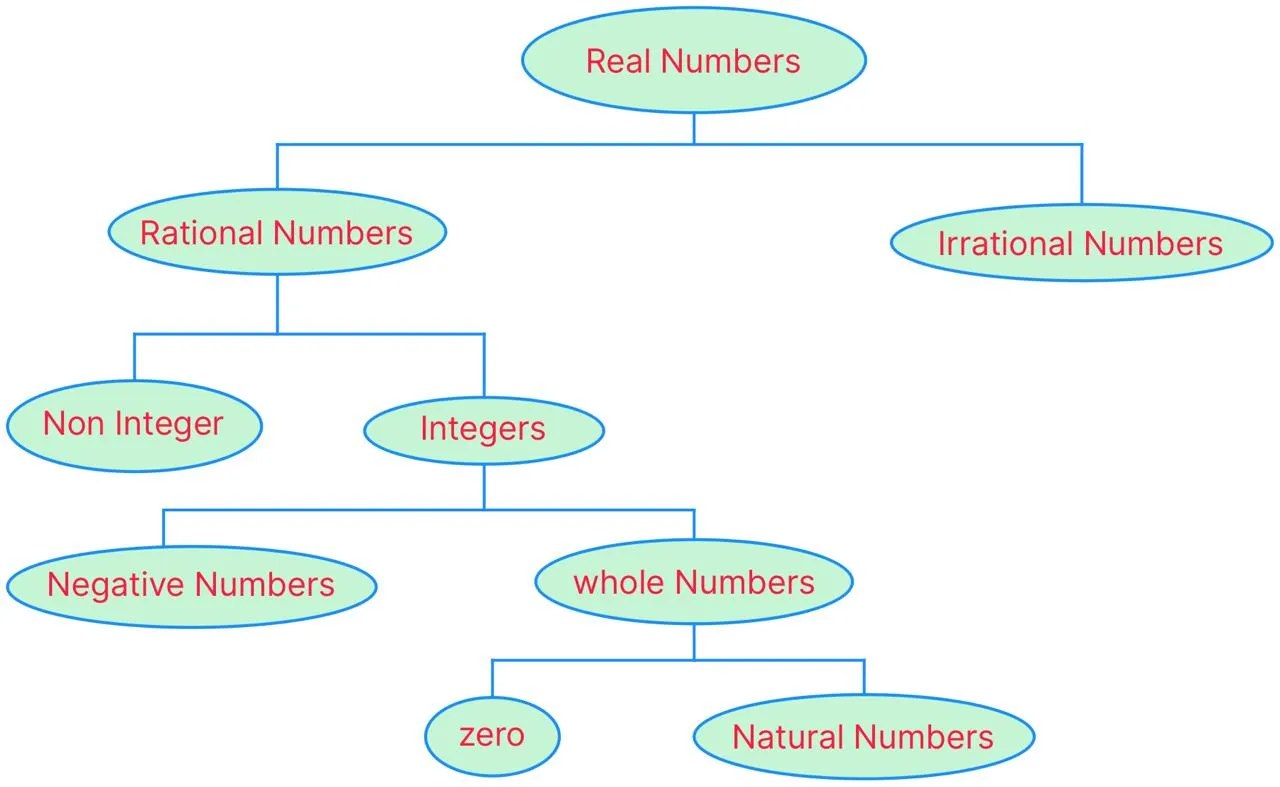
Numbers are classified into hierarchical sets where each larger set contains the smaller ones:
This inclusion chain is extremely important for board exams as many conceptual MCQs and case-study questions are based on it.
🗂️ Types / Category
Classification of Numbers
\(\mathbb{N}\)
Natural Numbers
Counting numbers used to count objects: \(\{1, 2, 3, \dots\}\). Example: \(7\), \(15\).
\(\mathbb{W}\)
Whole Numbers
Natural numbers along with zero: \(\{0, 1, 2, 3, \dots\}\). Example: \(0\), \(9\).
\(\mathbb{Z}\)
Integers
All whole numbers and their negative counterparts: \(\{\dots, -2, -1, 0, 1, 2, \dots\}\). Example: \(-5\), \(0\), \(12\).
\(\mathbb{Q}\)
Rational Numbers
Numbers that can be written in the form \(\frac{p}{q}\), where \(p, q \in \mathbb{Z}\) and \(q \neq 0\). Examples: \(\frac{3}{4}\), \(-2 = \frac{-2}{1}\), \(0.5 = \frac{1}{2}\).
\(\mathbb{\pi}\)
Irrational Numbers
Numbers that cannot be written as a fraction of two integers; their decimals are non-terminating and non-repeating. Examples: \(\sqrt{2}\), \(\pi\), \(\sqrt{5}\).
\(\mathbb{R}\)
Real Numbers
All numbers on the number line, including rational and irrational numbers. Examples: \(-3\), \(\frac{7}{8}\), \(\sqrt{2}\), \(\pi\).
🖼️ Figure
Hierarchical Structure of Number System
🎨 SVG Diagram
Conceptual Inclusion Diagram
🏷️ Properties
Important Properties
Important Properties
Closure property holds for \(\mathbb{Z}, \mathbb{Q}, \mathbb{R}\) under addition and multiplication.
Division is not closed in integers.
Irrational + Rational = Irrational (generally)
Product of two irrational numbers can be rational (e.g., \(\sqrt{2} \times \sqrt{2} = 2\))
💡 Concept
Decimal Expansion Concept
Terminating decimal: \(\frac{1}{4} = 0.25\)
Recurring decimal: \(\frac{1}{3} = 0.333...\)
Non-terminating non-recurring: Irrational numbers
📐 Derivation
Derivation: Rational Form from Recurring Decimal
Convert \(0.333...\) into fraction:
Let \(x = 0.333...\)
\[
10x = 3.333...
\]
Subtract:
\[
\begin{aligned}
10x - x &= 3.333... - 0.333...\\
9x &= 3 \\\Rightarrow x &= \frac{1}{3}
\end{aligned}
\]
\[
\begin{aligned}
a + b &= b + a, \\ a \times b &= b \times a
\end{aligned}
\]
Associative
\[
(a + b) + c = a + (b + c)
\]
🎨 SVG Diagram
Representation on Number Line
Natural numbers are represented as equally spaced points on the number line, starting from 1 and extending towards infinity.
✏️ Example
Identify whether 7, 0, -3 are natural numbers.
Natural numbers start from 1
7 ∈ \(\mathbb{N}\)
0 ∉ \(\mathbb{N}\)
-3 ∉ \(\mathbb{N}\)
✏️ Example
Find the successor and predecessor of 25.
Apply formulas
Successor = \(25 + 1 = 26\)
Predecessor = \(25 - 1 = 24\)
🔢 Formula
\[\text{Successor of } n = n + 1\]
\[\text{Predecessor of } n = n - 1\]
📐 Derivation
Conceptual Insight (Peano Axioms - Simplified)
Natural numbers are formally defined using axioms:
1 is a natural number.
Every natural number has a successor.
No two natural numbers have the same successor.
1 is not the successor of any natural number.
These axioms ensure a consistent and logical structure of counting numbers.
⚡ Exam Tip
Always remember: 0 is excluded (very common MCQ trap).
Be careful in closure property questions.
Practice number line representation questions.
❌ Common Mistakes
Including 0 in natural numbers.
Assuming subtraction always gives a natural number.
Confusing natural numbers with whole numbers.
📋 Case Study
A student claims that natural numbers are closed under all arithmetic operations. Analyze.
Analysis:
Natural numbers are closed only under addition and multiplication, not under subtraction and division.
Hence, the claim is incorrect.
🌟 Importance
Foundation for all number systems
Used in algebra, sequences, and counting problems
Frequently appears in MCQs and reasoning-based questions
🔢
Whole Numbers \((\mathbb{W})\)
📘 Definition
A Whole Number is any non-negative integer. It includes 0 along with all natural numbers.
Whole numbers do not include fractions, decimals, or negative numbers.
Numbers written in the form \(\frac{p}{q}\), where \(p\) and \(q\) are integers and \(q \neq 0\). Examples: \(\frac{1}{2}\), \(\frac{-3}{4}\), \(\frac{7}{5}\).
Integers
Whole numbers, their negatives, and zero. Examples: \(-3\), \(0\), \(8\).
Terminating Decimals
Decimals that end after a finite number of digits. Examples: \(0.5\), \(1.25\), \(3.75\).
Recurring Decimals
Decimals in which one or more digits repeat forever. Examples: \(0.333\dots = \frac{1}{3}\), \(0.121212\dots\).
Closed under addition, subtraction, multiplication, and division
(except division by zero), which means the result of these operations on rational numbers is always another rational number.
Dense property: there are infinitely many rational numbers between any two rational numbers.
\[
\text{Between any two rational numbers, infinitely many rational numbers exist}
\]
For example, between \(\frac{1}{2}\) and \(1\), we can find \(\frac{3}{4}\), \(\frac{2}{3}\), \(\frac{5}{6}\), and many more.
✏️ Example
Is 0.75 rational?
Yes, \(0.75 = \frac{3}{4}\)
✏️ Example
Find a rational number between 2 and 3
\(\frac{2+3}{2} = 2.5\)
⚡ Exam Tip
Always check denominator ≠ 0
Use decimal-to-fraction conversion in MCQs
❌ Common Mistakes
Confusing irrational with non-terminating decimals
Ignoring repeating pattern
📋 Case Study
A student claims that all decimals are irrational. Analyze.
Incorrect — only non-terminating, non-repeating decimals are irrational.
🌟 Importance
Foundation for algebra and real numbers
Frequently asked in proofs and decimal conversion
Essential for understanding irrational numbers
🔢
Irrational Numbers
📘 Definition
An Irrational Number is a real number that cannot be expressed in the form
Irrational numbers can be represented geometrically on the number line using constructions.
🔬 Proof
Classic Proof: \(\sqrt{2}\) is Irrational
Concept: Proof by contradiction
To prove that \(\sqrt{2}\) is irrational, we assume the opposite, namely that \(\sqrt{2}\) is rational.
Then it can be written in the form \(\frac{p}{q}\), where \(p\) and \(q\) are coprime integers and \(q \neq 0\).
So, let
\[
\sqrt{2} = \frac{p}{q}
\]
where \(\frac{p}{q}\) is in lowest terms.
Squaring both sides gives
\[
2 = \frac{p^2}{q^2}
\]
which implies
\[
p^2 = 2q^2.
\]
This shows that \(p^2\) is even, so \(p\) must also be even.
Therefore, we can write \(p = 2k\) for some integer \(k\).
Substituting \(p = 2k\) into \(p^2 = 2q^2\), we get
\[
(2k)^2 = 2q^2
\]
\[
4k^2 = 2q^2
\]
\[
q^2 = 2k^2.
\]
This shows that \(q^2\) is even, so \(q\) must also be even.
Hence, both \(p\) and \(q\) are divisible by 2.
But this is a contradiction, because we assumed that \(p\) and \(q\) are coprime, meaning they have no common factor other than 1.
Therefore, our assumption is false. Hence, \(\sqrt{2}\) is irrational.
🏷️ Properties
Important Properties
Important Properties
Sum of rational + irrational = irrational (generally)
Product of non-zero rational × irrational = irrational
Between any two rational numbers, irrational numbers exist
✏️ Example
Is \(0.1010010001...\) irrational?
Non-repeating decimal
Yes, because there is no repeating pattern.
✏️ Example
Is \(\sqrt{9}\) irrational?
o, \(\sqrt{9} = 3\), which is rational.
⚡ Exam Tip
Focus on identifying repeating vs non-repeating decimals
Memorize proofs like \(\sqrt{2}\) irrational
Recognize perfect squares quickly
❌ Common Mistakes
Assuming all square roots are irrational
Confusing long decimals with irrational numbers
Ignoring repeating patterns
📋 Case Study
A student claims that \(\frac{22}{7}\) is irrational because its decimal expansion is non-terminating.
Analyze.
Incorrect — \(\frac{22}{7}\) is rational because it can be written as a fraction, even though its decimal expansion is repeating.
🌟 Importance
Key concept for understanding real numbers
Frequently tested in proofs and classification questions
Essential for algebra and coordinate geometry
🔢
Important Results & Identities (Rational, Irrational & Real Numbers)
📘 Definition
Fundamental Definitions
A number \(r\) is called a rational number if it can be written as:
For \(a > 0\), \(a, b \in \mathbb{R}\), and \(p, q \in \mathbb{Q}\):
\[
a^p \cdot a^q = a^{p+q}
\]
\[
(a^p)^q = a^{pq}
\]
\[
\frac{a^p}{a^q} = a^{p-q}, \quad a \ne 0
\]
\[
a^p \cdot b^p = (ab)^p
\]
📐 Rule
Decimal Expansion Rules
A rational number has decimal expansion that is:
Terminating OR
Non-terminating recurring
An irrational number has decimal expansion that is:
Non-terminating AND
Non-recurring
⚡ Exam Tip
Always check decimal pattern carefully (recurring vs non-recurring)
Memorize identities for rationalisation questions
Practice exponent laws — frequently asked in MCQs
🔢
Mathematical Contributions – Pioneers of Number Systems
🏛️ Historical Note
ArchimedesAryabhata
The development of the number system is deeply rooted in the contributions of great mathematicians.
Their work laid the foundation for modern mathematics, especially in understanding irrational numbers,
decimals, and constants like \(\pi\).
Archimedes
Archimedes, the Greek mathematician, made one of the earliest accurate
estimations of the value of \(\pi\).
He used the method of inscribed and circumscribed polygons to bound the value of \(\pi\):
\[
3.140845 < \pi < 3.142857
\]
This method is considered an early form of limit approximation, a concept
later formalized in calculus.
Why It Matters
First systematic approximation of irrational numbers
Foundation for numerical methods
Important for geometry and circle calculations
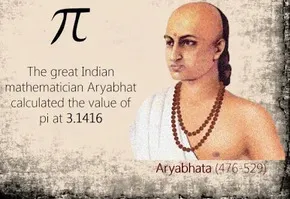
Aryabhata
Aryabhata (476–550 CE), the renowned Indian mathematician and astronomer,
provided a highly accurate approximation of \(\pi\).
\[
\pi \approx 3.1416
\]
His work appeared in the famous text Aryabhatiya, where he also introduced
advanced concepts in algebra and trigonometry.
Why It Matters
Accurate decimal expansion of \(\pi\)
Major contribution to Indian mathematics
Foundation for trigonometry and astronomy
NCERT · Class IX · Chapter 1
Number Systems
A complete AI-powered learning engine — concepts, formulas, solver, interactive modules, and deep-dive questions — all in one place.
Natural NumbersIntegersRational NumbersIrrational NumbersReal NumbersDecimal ExpansionsLaws of RadicalsRationalisation
Core Concepts
Build a solid foundation — each concept explained with clarity and depth.
Concept 01
ℕ Natural Numbers & Whole Numbers
The counting numbers 1, 2, 3, 4, … form the set of Natural Numbers (ℕ). When we include 0, we get Whole Numbers (𝕎).
Every natural number is a whole number, but 0 is a whole number that is not a natural number. These are the simplest number systems — built purely from counting.
Sets
ℕ = {1, 2, 3, 4, …}
𝕎 = {0, 1, 2, 3, …}
All natural numbers are whole numbers, but the converse is false — 0 is in 𝕎 but not in ℕ.
Concept 02
ℤ Integers
Integers (ℤ) extend whole numbers by including all negative counting numbers: …, −3, −2, −1, 0, 1, 2, 3, …
Integers arise naturally when we need to measure debt, temperature below zero, elevation below sea level, and so on. The symbol ℤ comes from the German word Zahlen (numbers).
Set
ℤ = {…, −3, −2, −1, 0, 1, 2, 3, …}
Whole numbers ⊂ Integers. Every whole number is an integer, but −1 is an integer that is not a whole number.
Concept 03
ℚ Rational Numbers
A number of the form p/q, where p and q are integers and q ≠ 0, is called a Rational Number (ℚ).
Examples: 1/2, −3/7, 0 (= 0/1), 5 (= 5/1), −11/4. Every integer is rational (set q = 1). The decimal expansion of a rational number is either terminating (e.g., 3/4 = 0.75) or non-terminating repeating (e.g., 1/3 = 0.333…).
Definition
ℚ = { p/q | p, q ∈ ℤ, q ≠ 0 }
Between any two rational numbers, there are infinitely many rational numbers — this property is called density.
To find a rational between a and b: compute (a + b)/2. Repeat to find more.
Concept 04
𝕀 Irrational Numbers
Numbers that cannot be expressed as p/q (p, q ∈ ℤ, q ≠ 0) are called Irrational Numbers. Their decimal expansions are non-terminating and non-repeating.
Famous examples: √2, √3, √5, π, e, ∛7. The proof that √2 is irrational is one of the great classical proofs — assume √2 = p/q in lowest terms, square both sides, and derive a contradiction about even/odd parity.
√4 = 2 is rational! Not every square root is irrational — only square roots of non-perfect squares are irrational.
To check: √n is irrational if and only if n is not a perfect square.
Concept 05
ℝ Real Numbers & the Number Line
Real Numbers (ℝ) = Rational Numbers ∪ Irrational Numbers. Every point on the number line corresponds to exactly one real number, and vice versa — this is the Real Number Line.
The hierarchy: ℕ ⊂ 𝕎 ⊂ ℤ ⊂ ℚ ⊂ ℝ, with irrational numbers filling the "gaps" between rationals.
Concept 06
· Decimal Expansions
The decimal expansion of a real number falls into one of three categories:
Terminating: Ends after finite digits — e.g., 7/4 = 1.75. Occurs when denominator (in lowest terms) has only 2s and 5s as prime factors.
Non-terminating Repeating (Recurring): Digits repeat in a block — e.g., 1/7 = 0.142857142857… → rational number.
Let x = 0.̄6̄ (= 0.666…)
Then 10x = 6.666…
10x − x = 6 → 9x = 6 → x = 6/9 = 2/3
For p̄/q̄ repeating block of length n: multiply by 10ⁿ and subtract original.
Concept 07
📏 Locating √n on the Number Line
To plot √2 geometrically: Draw OA = 1 unit on the number line. At A erect a perpendicular AB = 1 unit. Then OB = √2 (by Pythagoras). Swing an arc of radius OB from O to mark √2 on the number line.
Generalisation (Spiral of Theodorus): Once √n is marked, erect a perpendicular of 1 unit from its tip to get √(n+1). This spiral generates all √2, √3, √4, √5…
This construction proves that irrational numbers do have a definite location on the number line — they are real in the geometric sense.
Concept 08
⊕ Operations on Real Numbers
The real numbers are closed under addition, subtraction, multiplication, and division (÷ non-zero). Important identities:
Rational + Rational = Rational
Irrational + Irrational may be rational (e.g., √2 + (−√2) = 0) or irrational.
To simplify expressions with surds in the denominator, multiply numerator and denominator by the conjugate (or appropriate surd) to make the denominator rational.
Key Conjugate Identities
(a + √b)(a − √b) = a² − b
(√a + √b)(√a − √b) = a − b
(a + b)(a² − ab + b²) = a³ + b³ ← (for cube roots)
Pattern for 0.abc̄ (non-repeating prefix + repeating)
x = 0.abc̄̄̄ → multiply by 10^(total digits) and 10^(non-repeating digits), subtract
Tips, Tricks & Common Mistakes
Sharp insights that separate top scorers from the rest.
⚡ Quick Tips
To find n rational numbers between a and b: use the formula a + k·(b−a)/(n+1) for k = 1, 2, …, n. This always works.
A number p/q terminates if and only if the denominator in lowest terms has no prime factors other than 2 and 5. Check the denominator, not the numerator.
To simplify √(a²b): pull out a first — √(a²b) = a√b (when a > 0). Don't leave perfect square factors under the radical.
π ≠ 22/7. The fraction 22/7 is a rational approximation; π is genuinely irrational. Do not confuse them in proofs.
When rationalising: always multiply by the conjugate. For 1/(a + √b), conjugate is (a − √b); for 1/(√a + √b), conjugate is (√a − √b).
a^(m/n) can be computed as either (a^m)^(1/n) or (a^(1/n))^m. Choose the order that gives smaller intermediate numbers.
If asked to compare surds: square them! √5 vs √6 — 5 < 6, so √5 < √6. Squaring preserves order for positive quantities.
✕ Common Mistakes to Avoid
Mistake: Writing √(a + b) = √a + √b. This is WRONG. √(9+16) = √25 = 5 ≠ √9 + √16 = 3 + 4 = 7.
Mistake: Treating every square root as irrational. √9 = 3, √16 = 4 — these are rational.
Mistake: Writing a^m × b^n = (ab)^(mn). The correct rule is a^m × b^m = (ab)^m. The exponents must be the same.
Mistake: Assuming (−2)^(1/2) = −√2. Fractional exponents with even denominators are not defined for negative bases in real numbers.
Mistake: Saying 0.999… ≠ 1. In fact 0.999… = 1 exactly (proof: let x = 0.999…, then 10x = 9.999…, so 9x = 9, x = 1).
Mistake: Forgetting that every integer is also rational. When asked "is −5 rational?", the answer is YES (= −5/1).
📌 Memory Anchors
NICE acronym for number hierarchy:
N = Natural → I = Integer → C = (raCional = Rational) → E = Everything (Real)
Surd multiplication: "Same index, multiply inside; different index, convert to fractional exponents first."
Rationalisation: Think of it as using the difference-of-squares identity (a+b)(a−b) = a²−b² to "destroy" the surd in the denominator.
📋 Exam Strategy
Questions on finding rationals between two numbers: simply average the two numbers repeatedly.
Questions on decimal expansion type: perform the division or factorise the denominator.
Questions on simplification of surds: always look for perfect-square factors first.
Questions on exponent evaluation: convert to fractional exponent form, simplify step by step.
Questions proving √p is irrational: use contradiction — assume rational in lowest terms, then show both p and q must have a common factor.
Concept-Building Questions
Original, non-textbook questions — each with full step-by-step solutions. Click a question to reveal the solution.
Group A — Classification
Q1. Classify each number as rational or irrational, and justify your answer: (a) 0.1̄0̄1̄0̄0̄1̄… (b) (√5 − 2)(√5 + 2) (c) π − 3
Medium
+
a
0.101001000100001…
The decimal has a pattern of increasing zeros between 1s — it never repeats a fixed block. Therefore it is non-terminating and non-repeating → Irrational.
b
(√5 − 2)(√5 + 2)
Apply the identity (a − b)(a + b) = a² − b².
= (√5)² − (2)² = 5 − 4 = 1
Result is 1, which is rational (= 1/1).
c
π − 3
π is irrational. Subtracting a rational number (3) from an irrational number always yields an irrational number (if π − 3 were rational r, then π = r + 3 would be rational — contradiction). So π − 3 is Irrational.
Q2. Prove that √3 is irrational using the method of contradiction.
Hard
+
1
Assume the opposite
Suppose √3 is rational. Then √3 = p/q where p, q are integers with no common factor (lowest terms), and q ≠ 0.
2
Square both sides
3 = p²/q² → p² = 3q²
So 3 divides p². Since 3 is prime, 3 must divide p (if a prime divides a², it divides a).
3
Let p = 3k
p² = 9k² → 3q² = 9k² → q² = 3k²
So 3 divides q² → 3 divides q.
4
Contradiction
Both p and q are divisible by 3, contradicting the assumption that p/q is in lowest terms. Therefore √3 cannot be rational. √3 is irrational. ∎
Group B — Decimal Expansions
Q3. Convert 2.3̄1̄6̄ (i.e., 2.316316316…) to a fraction in lowest terms.
Q10. Insert 4 irrational numbers between 2 and 3. Justify that each is irrational.
Easy
+
1
Strategy
We need irrational numbers strictly between 2 and 3. Square the bounds: 2² = 4, 3² = 9. So √n is between 2 and 3 whenever 4 < n < 9 and n is not a perfect square.
2
Choose values
√5 ≈ 2.236, √6 ≈ 2.449, √7 ≈ 2.646, √8 ≈ 2.828
3
Justify
5, 6, 7, 8 are not perfect squares, so their square roots are irrational. Each lies strictly between 2 and 3. ✓
Q11. The sum of two irrational numbers is 8. Their product is 15. Find the numbers and classify them.
Hard
+
1
Set up equations
Let the numbers be α and β.
α + β = 8, αβ = 15
2
Quadratic with roots α, β
t² − 8t + 15 = 0 (t − 3)(t − 5) = 0 → t = 3 or 5
3
Reconcile with "irrational" condition
3 and 5 are rational integers. So as real numbers, no solution exists with both irrational — the problem as literally stated has no solution with both numbers irrational. However, we can reinterpret: perhaps the numbers are (4 + √1) type. The intended answer is 3 and 5 — this is a classic gotcha showing irrational constraints must be verified.
This question tests critical thinking: always verify that found values actually satisfy all given conditions — here both 3 and 5 are rational, contradicting the premise.
Step-by-Step AI Solver
Select a problem type and enter values — the engine will solve it with complete working.
🔍 Problem Selector
Interactive Learning Modules
Hands-on activities to build deep conceptual intuition.
📏 Module 1 — Number Line Explorer
Type any number (integer, fraction, or surd like √2, √5) and see it plotted on the number line. Explore where irrationals sit relative to rationals.
🧠 Module 2 — Rapid Classification Quiz
Is the number rational or irrational? Answer 10 questions. Track your score.
🔢 Module 3 — Decimal Expansion Builder
Enter any integer p and q (p/q), and see long-division steps with the recurring decimal expansion computed live.
/
√ Module 4 — Surd Simplifier
Enter a number n and get √n simplified to the form a√b, showing the factorisation step.
⭕ Module 5 — Number Set Sorter
Drag each number card into the smallest set it belongs to (ℕ, 𝕎, ℤ, ℚ, or Irrational). Train your classification instinct.
▲ scroll up to switch modules · made with ♥ for Class IX learners
📚
ACADEMIA AETERNUMतमसो मा ज्योतिर्गमय · Est. 2025
Sharing this chapter
NCERT Class 9 Maths Chapter 1 Number Systems Notes & Formulas
NCERT Class 9 Maths Chapter 1 Number Systems Notes & Formulas — Complete Notes & Solutions · academia-aeternum.com
Numbers are everywhere — from counting objects to measuring distances, temperatures, and even scientific calculations. In this chapter, students explore the fascinating world of number systems and learn how mathematics extends beyond natural numbers to include integers, rational numbers, and irrational numbers. The chapter introduces real numbers, their representation on the number line, and important concepts such as decimal expansions and laws of exponents. Through clear explanations and…
🎓 Class 9📐 Mathematics📖 NCERT✅ Free Access🏆 CBSE · JEE
A number system is a way of expressing numbers using symbols and rules. It includes natural numbers, whole numbers, integers, rational, and irrational numbers.
Real numbers include both rational and irrational numbers that can be represented on the number line.
Rational numbers are numbers that can be expressed as a fraction p/q, where p and q are integers and \(q \neq 0.\)
Irrational numbers cannot be written as a simple fraction and have non-terminating, non-repeating decimals, like v2 or p.
Rational numbers can be expressed as p/q, while irrational numbers cannot. Rational decimals terminate or repeat; irrational decimals do not.
Natural numbers are counting numbers starting from 1, 2, 3, and so on.
Whole numbers include all natural numbers and 0, i.e., 0, 1, 2, 3, 4, ...
Integers include all whole numbers and their negatives, such as … -3, -2, -1, 0, 1, 2, 3 …
The decimal expansion of rational numbers is either terminating or non-terminating repeating.
The decimal expansion of irrational numbers is non-terminating and non-repeating.
Yes, every real number, whether rational or irrational, can be represented on the number line.
All rational numbers are real, but not all real numbers are rational. Real numbers include both rational and irrational types.
Construct a right-angled triangle with both legs of 1 unit each; the hypotenuse represents v2 when plotted on the number line.
A non-terminating decimal continues infinitely without ending, like 0.333... or 0.142857142857...
A repeating decimal has digits that repeat in a pattern, for example, 0.666… or 0.142857142857…
Get in Touch
Let's Connect
Questions, feedback, or suggestions? We'd love to hear from you.