
Force and Laws of Motion — NCERT Solutions | Class 9 Science | Academia Aeternum
Ch 8  ·  Q–
0%
Class 9 Science Exercise NCERT Solutions Olympiad Board Exam
Chapter 8

Force and Laws of Motion

Step-by-step NCERT solutions with stress–strain analysis and exam-oriented hints for Boards, JEE & NEET.

17 Questions
40–55 min Ideal time
Q1 Now at
Q1
NUMERIC3 marks
An object experiences a net zero external unbalanced force. Is it possible for the object to be travelling with a non-zero velocity? If yes, state the conditions that must be placed on the magnitude and direction of the velocity.
📘 Concept & Theory Concept Used

This question is based on Newton's First Law of Motion (Law of Inertia) and Newton's Second Law of Motion.

According to Newton's First Law, if the resultant (net) external force acting on an object is zero, the object does not change its state of motion. Therefore:

  • If the object is initially at rest, it remains at rest.
  • If the object is already moving, it continues to move with a constant velocity.

Newton's Second Law mathematically explains this relationship:

\[ F=ma \]

If the net external force is zero,

\[ F=0 \]

Therefore,

\[ ma=0 \]

Since the mass of an object can never be zero,

\[ a=0 \]

Zero acceleration means that the object's velocity does not change with time. It does not imply that the velocity itself must be zero.

🗺️ Solution Roadmap Step-by-step Plan
  1. Use Newton's Second Law to relate force and acceleration.

  2. Show that zero net force gives zero acceleration.

  3. Interpret the physical meaning of zero acceleration.

  4. Conclude the condition under which an object can move with non-zero velocity.

📊 Graph / Figure Graph / Figure
Constant Velocity Net Force = 0 Acceleration = 0 Motion continues with uniform velocity in a straight line
✏️ Solution Complete Solution
Step-by-step Solution  ·  9 steps
  1. Yes. An object can travel with a non-zero velocity even when the net external unbalanced force acting on it is zero.
  2. According to Newton's Second Law of Motion,\[F=ma\]
  3. Since the net external force is zero,\[F=0\]
  4. Therefore, \[ \begin{aligned} F &= ma\\ 0 &= ma \end{aligned} \]
  5. As the mass of the object is non-zero,\[a=0\]
  6. Zero acceleration means that there is no change in velocity. Hence, the object can continue moving with the same velocity.
  7. Therefore, an object can have a non-zero velocity provided that:
    • The magnitude of its velocity remains constant.
    • The direction of its velocity also remains constant.
  8. In other words, the object must move with uniform velocity in a straight line. If either the magnitude or the direction of velocity changes, acceleration is produced, which requires a non-zero net external force.
  9. Thus, the object can keep moving with a constant non-zero velocity in the absence of any net external unbalanced force, as stated by Newton's First Law of Motion.
🎯 Exam Significance Exam Significance
  • It tests the fundamental understanding of Newton's First and Second Laws of Motion.
  • Students often confuse zero velocity with zero acceleration; this question removes that misconception.
  • Frequently asked in CBSE board examinations as conceptual short-answer questions.
  • Important for competitive examinations such as NTSE, Olympiads, JEE Foundation, and NEET Foundation where conceptual reasoning is tested.
🔑 Key Takeaways Key Takeaways
Key Takeaways  ·  6 points
  1. Net external force is related to acceleration, not directly to velocity.

  2. If the net force is zero, acceleration is zero.

  3. Zero acceleration means velocity remains constant.

  4. An object may have zero velocity or a constant non-zero velocity when the net force is zero.

  5. For constant velocity, both the magnitude and the direction of velocity must remain unchanged.

  6. Uniform straight-line motion is possible without any external unbalanced force.
↑ Top
1 / 17  ·  6%
Q2 →
Q2
NUMERIC3 marks
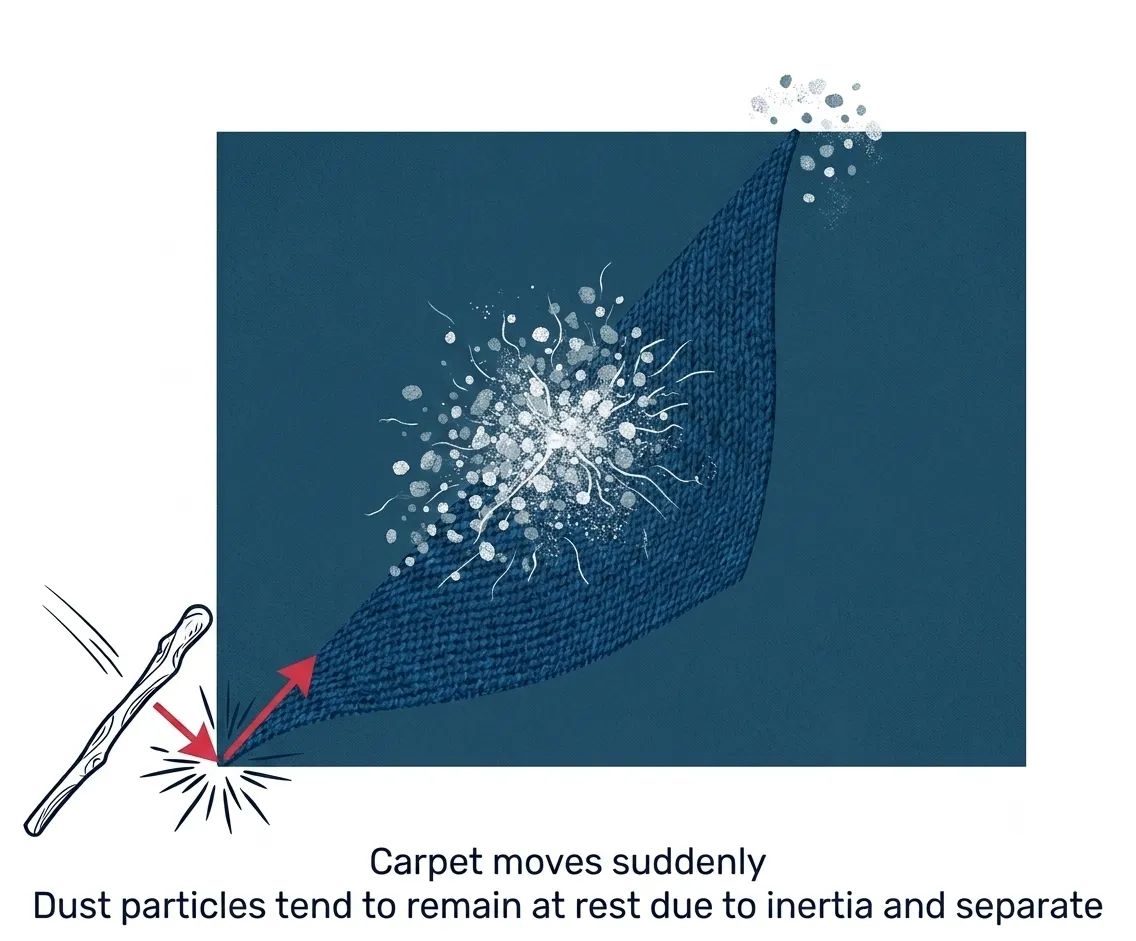
When a carpet is beaten with a stick, dust comes out of it. Explain.
📘 Concept & Theory
This question is based on the Law of Inertia (Newton's First Law of Motion). Every object tends to maintain its current state of rest or uniform motion unless acted upon by an external unbalanced force.

Dust particles resting on a carpet also possess inertia. When the carpet is struck suddenly, the carpet receives an external force and begins to move. However, the dust particles tend to remain in their original state of rest due to inertia.

Since the carpet moves but the dust particles momentarily do not, the dust loses contact with the carpet and falls away under the action of gravity.
🗺️ Solution Roadmap Step-by-step Plan
  1. Identify the scientific principle involved.

  2. Explain how the carpet behaves when struck.

  3. Describe the behaviour of the dust particles due to inertia.

  4. State why the dust separates from the carpet.

📊 Graph / Figure Graph / Figure
Dust Removal from Carpet
✏️ Solution Complete Solution
Step-by-step Solution  ·  5 steps
  1. When a carpet is beaten with a stick, a sudden external force acts on the carpet. As a result, the carpet starts moving almost instantly.
  2. The dust particles lying on the carpet possess inertia of rest. Due to this property, they tend to remain in their original state of rest and do not start moving immediately along with the carpet.
  3. Because the carpet moves suddenly while the dust particles momentarily remain at rest, the dust particles become detached from the carpet.
  4. Once detached, gravity pulls the dust particles downward, causing them to fall away from the carpet.
  5. Therefore, dust comes out of a carpet when it is beaten because of the inertia of rest, which is explained by Newton's First Law of Motion.
🎯 Exam Significance Exam Significance
  • This is one of the most frequently asked conceptual questions on the application of inertia.
  • It helps students distinguish between inertia and force.
  • It is commonly asked in CBSE board examinations as a short-answer or competency-based question.
  • Similar examples are frequently used in Olympiads, NTSE, JEE Foundation, and NEET Foundation examinations.
  • Understanding this concept helps explain many everyday phenomena involving sudden motion.
🔑 Key Takeaways Key Takeaways
Key Takeaways  ·  6 points
  1. Dust particles possess inertia of rest.

  2. A sudden force acts on the carpet, not directly on the dust.

  3. The carpet moves immediately, whereas the dust tends to remain at rest.

  4. The relative motion between the carpet and dust causes the dust to separate.

  5. Gravity then causes the detached dust particles to fall down.

  6. This phenomenon is a practical application of Newton's First Law of Motion.

← Q1
2 / 17  ·  12%
Q3 →
Q3
NUMERIC3 marks
Why is it advised to tie any luggage kept on the roof of a bus with a rope?
📘 Concept & Theory

This question is based on the concept of inertia, which is explained by Newton's First Law of Motion.

Every object tends to resist any change in its state of rest or state of uniform motion. This property is called inertia. The greater the mass of an object, the greater is its inertia.

When a bus starts suddenly, stops suddenly, or changes direction while taking a turn, the luggage on its roof tends to maintain its previous state of motion. As a result, the luggage may slide or topple off the roof if it is not properly secured.

🗺️ Solution Roadmap Step-by-step Plan
  1. Identify the physical principle involved.

  2. Explain what happens when the bus starts, stops, or turns suddenly.

  3. Describe the role of inertia of the luggage.

  4. Conclude why tying the luggage with a rope is necessary.

📊 Graph / Figure Graph / Figure
BUS MOTION Rope prevents luggage from slipping due to inertia Safe transportation during sudden starts, stops, and turns
Fig. 1 — Free body diagram
✏️ Solution Complete Solution
Step-by-step Solution  ·  5 steps
  1. It is advised to tie the luggage kept on the roof of a bus with a rope because of the inertia of the luggage.
  2. When the bus starts moving suddenly, the luggage tends to remain at rest due to inertia of rest. This may cause the luggage to slide backward relative to the bus.
  3. Similarly, when the bus stops suddenly, the luggage tends to continue moving forward due to inertia of motion. During a sharp turn, the luggage also tends to continue moving in its original direction, which may cause it to slide sideways.
  4. If the luggage is not tied securely, these effects may cause it to slip or fall off the roof, leading to damage to the luggage and posing a danger to pedestrians and other vehicles.
  5. Therefore, the luggage is tied firmly with a rope so that it remains fixed to the roof of the bus even when the bus undergoes sudden changes in its motion.
🎯 Exam Significance Exam Significance
  • This is a standard application of Newton's First Law of Motion in everyday life.
  • It tests the understanding of both inertia of rest and inertia of motion.
  • Frequently asked in CBSE board examinations as a short conceptual question.
  • Important for NTSE, Olympiads, JEE Foundation, and NEET Foundation examinations, where real-life applications of physics are tested.
  • Helps students understand the importance of safety measures during transportation.
🔑 Key Takeaways Key Takeaways
Key Takeaways  ·  6 points
  1. Inertia causes an object to resist changes in its state of motion.

  2. Luggage tends to remain at rest when the bus starts suddenly.

  3. Luggage tends to keep moving forward when the bus stops suddenly.

  4. During a turn, luggage tends to continue in its original direction.

  5. A rope provides the necessary external force to prevent the luggage from slipping.

  6. Tying luggage improves safety and prevents accidents.

← Q2
3 / 17  ·  18%
Q4 →
Q4
NUMERIC3 marks

A batsman hits a cricket ball, which then rolls on a level ground. After covering a short distance, the ball comes to rest. The ball slows to a stop because:

(a) The batsman did not hit the ball hard enough.
(b) Velocity is proportional to the force exerted on the ball.
(c) There is a force on the ball opposing the motion.
(d) There is no unbalanced force on the ball, so the ball would want to come to rest.

📘 Concept & Theory

This question is based on Newton's First Law of Motion and the concept of friction.

According to Newton's First Law, an object in motion continues to move with uniform velocity unless acted upon by an external unbalanced force.

If no opposing force acted on the cricket ball, it would continue rolling with constant speed. However, while rolling on the ground, the ball experiences external forces such as:

  • Friction between the ball and the ground.
  • Air resistance (drag).

These forces act opposite to the direction of motion, producing a negative acceleration (retardation). Consequently, the speed of the ball gradually decreases until it comes to rest.

🗺️ Solution Roadmap Step-by-step Plan
  1. Identify the external forces acting on the rolling ball.

  2. Apply Newton's First Law of Motion.

  3. Determine which option correctly explains why the ball stops.

  4. Eliminate the incorrect options with logical reasoning.

📊 Graph / Figure Graph / Figure
MOTION FRICTION Friction and air resistance oppose the motion The ball gradually slows down and finally comes to rest
Fig. 1 — Free body diagram
✏️ Solution Complete Solution
Step-by-step Solution  ·  6 steps
  1. The correct answer is: (c) There is a force on the ball opposing the motion.
  2. As the cricket ball rolls on the ground, it is acted upon by two opposing forces:
    • Friction between the ball and the ground.
    • Air resistance offered by the surrounding air.
  3. Both these forces act opposite to the direction of motion. Therefore, the ball experiences a retarding force that gradually decreases its velocity.
  4. Eventually, the velocity becomes zero and the ball comes to rest.
  5. Therefore, option (c) is correct.
🎯 Exam Significance Exam Significance
  • This is one of the most frequently asked MCQs on Newton's First Law of Motion.
  • It reinforces the concept that force is required to change the state of motion, not to maintain motion.
  • It helps students understand the role of friction in everyday situations.
  • Frequently asked in CBSE board examinations as a competency-based and multiple-choice question.
  • Important for Olympiads, NTSE, JEE Foundation, and NEET Foundation examinations.
🔑 Key Takeaways Key Takeaways
Key Takeaways  ·  6 points
  1. A moving object continues to move unless acted upon by an external unbalanced force.

  2. Friction always acts opposite to the direction of motion.

  3. Air resistance also opposes the motion of moving objects.

  4. Opposing forces produce retardation and reduce the speed of the object.

  5. Force is related to acceleration, not velocity.

  6. The cricket ball stops because friction and air resistance act continuously against its motion.

← Q3
4 / 17  ·  24%
Q5 →
Q5
NUMERIC3 marks
A truck starts from rest and rolls down a hill with a constant acceleration. It travels a distance of 400 m in 20 s. Find its acceleration. Find the force acting on it if its mass is 7 tonnes.
📘 Concept & Theory

This problem combines the concepts of equations of uniformly accelerated motion and Newton's Second Law of Motion.

Since the truck starts from rest and moves with constant acceleration, the equations of motion can be used to determine its acceleration. Once the acceleration is known, the force acting on the truck is calculated using Newton's Second Law:

\[ F=ma \]

The given data are:

  • Initial velocity, \(\;u=0~\text{m/s}\)
  • Distance travelled, \(\;s=400~\text{m}\)
  • Time taken, \(\;t=20~\text{s}\)
  • Mass of truck, \(\;m=7~\text{tonnes}=7000~\text{kg}\)
🗺️ Solution Roadmap Step-by-step Plan
  1. Write the given quantities.

  2. Determine the acceleration using the equations of motion.

  3. Convert the truck's mass from tonnes to kilograms.

  4. Apply Newton's Second Law to calculate the force.

  5. Write the final answers with proper SI units.

📊 Graph / Figure Graph / Figure
MOTION Truck accelerates uniformly down the hill Use equations of motion to find acceleration, then apply $F = ma$
✏️ Solution Complete Solution
Step-by-step Solution  ·  10 steps
  1. Given
  2. \[ \begin{aligned} u &=0~\text{m/s}\\ s &=400~\text{m}\\ t &=20~\text{s}\\ m &=7~\text{tonnes}=7000~\text{kg} \end{aligned} \]
  3. Since the truck starts from rest and moves with uniform acceleration, we use the First Equation of Motion.\[v=u+at\]
  4. Substituting the known values, \[ \begin{align} v&=0+a(20)\\ v&=20a\tag{1} \end{align} \]
  5. Now apply the Third Equation of Motion.\[v^2-u^2=2as\]
  6. Substituting the values, \[ \begin{align} v^2-0^2&=2\times a\times400\\ v^2&=800a\tag{2} \end{align} \]
  7. Substitute the value of \(v\) from Equation (1) into Equation (2). \[ \begin{aligned} (20a)^2&=800a\\ 400a^2&=800a \end{aligned} \]
  8. Dividing both sides by \(400\), \[ \begin{aligned} a^2&=2a \end{aligned} \]
  9. Since acceleration cannot be zero (the truck is accelerating), \[a=2~\text{m/s}^2\]
  10. Now calculate the force using Newton's Second Law. \[F=ma\]
  11. \[ \begin{aligned} F&=7000\times2\\ &=14000~\text{N} \end{aligned} \]
💡 Answer Final Answer

\[ \boxed{a=2~\text{m/s}^2} \]

\[ \boxed{F=14000~\text{N}} \]

🎯 Exam Significance Exam Significance
  • It integrates kinematics with Newton's Second Law of Motion.
  • Students learn to connect acceleration obtained from equations of motion with the calculation of force.
  • It reinforces correct unit conversion from tonnes to kilograms.
  • Frequently asked in CBSE board examinations as a numerical problem.
  • Highly relevant for NTSE, Olympiads, JEE Foundation, and NEET Foundation, where multi-concept numerical problems are common.
🔑 Key Takeaways Key Takeaways
Key Takeaways  ·  6 points
  1. Always write the given data before starting the solution.

  2. Choose the equation of motion based on the known quantities.

  3. Convert mass into SI units before applying Newton's Second Law.

  4. Force depends on both mass and acceleration.

  5. The SI unit of force is the newton (N).

  6. More than one equation of motion may lead to the same correct answer.

← Q4
5 / 17  ·  29%
Q6 →
Q6
NUMERIC3 marks
A stone of 1 kg is thrown with a velocity of 20 m s–1 across the frozen surface of a lake, and comes to rest after travelling a distance of 50 m. What is the force of friction between the stone and the ice?
📘 Concept & Theory

This problem is based on the equations of uniformly accelerated motion and Newton's Second Law of Motion.

As the stone slides over the ice, the only horizontal force acting on it is the force of friction. Friction acts opposite to the direction of motion, causing the stone to slow down gradually until it comes to rest.

First, the retardation (negative acceleration) is calculated using the third equation of motion. Then, Newton's Second Law is applied to determine the frictional force.

🗺️ Solution Roadmap Step-by-step Plan
  1. Write the given quantities.

  2. Use the third equation of motion to calculate the acceleration.

  3. Identify the negative sign as retardation due to friction.

  4. Apply Newton's Second Law to calculate the frictional force.

  5. State both the magnitude and direction of the force.

📊 Graph / Figure Graph / Figure
INITIAL MOTION FRICTION Friction opposes motion and brings the stone to rest Retardation = 4 m s−2 | Friction = 4 N
✏️ Solution Complete Solution
Step-by-step Solution  ·  9 steps
  1. Given
  2. \[ \begin{aligned} m&=1~\text{kg}\\ u&=20~\text{m s}^{-1}\\ v&=0~\text{m s}^{-1}\\ s&=50~\text{m} \end{aligned} \]
  3. SStep-by-step Solution
  4. Using the Third Equation of Motion,\[v^2=u^2+2as\]
  5. Substituting the given values, \[ \begin{aligned} 0^2&=(20)^2+2\times a\times50\\ 0&=400+100a\\ 100a&=-400\\ a&=-4~\text{m s}^{-2} \end{aligned} \]
  6. The negative sign indicates that the acceleration is opposite to the direction of motion. Therefore, the stone experiences a retardation of \[a=-4~\text{m s}^{-2}\]
  7. Now apply Newton's Second Law of Motion. \[F=ma\]
  8. Substituting the values, \[ \begin{aligned} F&=1\times(-4)\\ F&=-4~\text{N} \end{aligned} \]
  9. The negative sign shows that the force acts opposite to the direction of motion, which is the characteristic of friction.
  10. Hence, the magnitude of the force of friction is\[\boxed{4~\text{N}}\]
  11. The frictional force acts opposite to the direction of motion.
🎯 Exam Significance Exam Significance
  • This question combines equations of motion with Newton's Second Law.
  • It develops the understanding that friction always opposes motion.
  • It reinforces the physical meaning of negative acceleration (retardation).
  • Frequently asked in CBSE board examinations as a numerical question.
  • Important for Olympiads, NTSE, JEE Foundation, and NEET Foundation because it tests conceptual understanding along with numerical skills.
Common Mistakes to Avoid
  • Using the wrong sign for acceleration.
  • Ignoring the negative sign while interpreting the direction of friction.
  • Writing the final answer as −4 N without mentioning that the negative sign only indicates direction.
  • Forgetting to state that the magnitude of friction is 4 N.
🔑 Key Takeaways Key Takeaways
Key Takeaways  ·  6 points
  1. Friction is the only horizontal force acting on the sliding stone.

  2. Friction always acts opposite to the direction of motion.

  3. A negative acceleration indicates retardation.

  4. Newton's Second Law relates force to acceleration through \(\;F=ma\).

  5. The magnitude of the frictional force is 4 N.

  6. The direction of the frictional force is opposite to the motion of the stone.

← Q5
6 / 17  ·  35%
Q7 →
Q7
NUMERIC3 marks
An 8000 kg engine pulls a train of 5 wagons, each of 2000 kg, along a horizontal track. If the engine exerts a force of 40000 N, and the track offers a friction force of 5000 N, then calculate:
(a) the net accelerating force, and
(b) the acceleration of the train.
📘 Concept & Theory

This problem is based on Newton's Second Law of Motion. According to this law, the acceleration produced in a body depends on the net external force acting on it and its total mass.

\[ F_{\text{net}}=ma \]

Since the train moves on a horizontal track, two horizontal forces act on it:

  • The pulling force exerted by the engine (forward).
  • The frictional force offered by the track (backward).

The train accelerates due to the net (unbalanced) force, which is the difference between the engine's pulling force and the frictional force.

🗺️ Solution Roadmap Step-by-step Plan
  1. Calculate the total mass of the train.

  2. Determine the net accelerating force by subtracting friction from the engine force.

  3. Apply Newton's Second Law to calculate the acceleration.

  4. Write the final answers with SI units.

📊 Graph / Figure Graph / Figure
ENGINE FORCE = 40,000 N FRICTION = 5,000 N Net Force = 35,000 N ➔ Acceleration = 1.94 m s−2 Only the unbalanced force accelerates the entire train system
✏️ Solution Complete Solution
Step-by-step Solution  ·  10 steps
  1. Given
  2. \[ \begin{aligned} \text{Mass of engine} &=8000~\text{kg}\\ \text{Mass of one wagon} &=2000~\text{kg}\\ \text{Number of wagons} &=5\\ \text{Force exerted by engine} &=40000~\text{N}\\ \text{Frictional force} &=5000~\text{N} \end{aligned} \]
  3. Calculate the total mass of the train.
  4. \[ \begin{aligned} \text{Mass of 5 wagons} &=5\times2000\\ &=10000~\text{kg} \end{aligned} \]
  5. \[ \begin{aligned} \text{Total mass} &=8000+10000\\ &=18000~\text{kg} \end{aligned} \]
  6. Calculate the net accelerating force.
  7. \[ \begin{aligned} F_{\text{net}} &=\text{Engine force}-\text{Frictional force}\\ &=40000-5000\\ &=35000~\text{N} \end{aligned} \]
  8. Therefore,
  9. \[\boxed{F_{\text{net}}=35000~\text{N}}\]
  10. Calculate the acceleration of the train.
  11. According to Newton's Second Law,\[F=ma\]
  12. Therefore,\[a=\frac{F}{m}\]
  13. Substituting the known values, \[ \begin{aligned} a&=\frac{35000}{18000}\\ &=\frac{35}{18}\\ &\approx1.94~\text{m s}^{-2} \end{aligned} \]
  14. Hence,\[\boxed{a\approx1.94~\text{m s}^{-2}}\]
💡 Answer Final Answer
  • (a) Net accelerating force \(=35000~\text{N}\)
  • (b) Acceleration of the train \(\approx1.94~\text{m s}^{-2}\)
🎯 Exam Significance Exam Significance
  • It demonstrates the practical application of Newton's Second Law of Motion.
  • It teaches students to calculate the net force by considering opposing forces.
  • It reinforces the relationship between force, mass, and acceleration.
  • Frequently asked in CBSE board examinations as a numerical problem.
  • Important for Olympiads, NTSE, JEE Foundation, and NEET Foundation because it combines multiple concepts in a single question.
Common Mistakes to Avoid
  • Using only the engine's force instead of the net force.
  • Forgetting to include the mass of the engine while calculating the total mass.
  • Adding the frictional force instead of subtracting it.
  • Using the mass of only the wagons while calculating acceleration.
  • Writing the answer without SI units.
🔑 Key Takeaways Key Takeaways
Key Takeaways  ·  6 points
  1. Only the unbalanced (net) force produces acceleration.

  2. Net force equals the applied force minus the opposing frictional force.

  3. The total mass of the system includes both the engine and all the wagons.

  4. Newton's Second Law is expressed as \(\;F=ma\).

  5. A larger net force produces greater acceleration for the same mass.

  6. A larger mass produces smaller acceleration for the same net force.

← Q6
7 / 17  ·  41%
Q8 →
Q8
NUMERIC3 marks
An automobile vehicle has a mass of 1500 kg. What must be the force between the vehicle and the road if the vehicle is to be stopped with a negative acceleration of \(\;1.7~\text{m s}^{-2}\)?
📘 Concept & Theory

This question is based on Newton's Second Law of Motion, which states that the net force acting on an object is equal to the product of its mass and acceleration.

\[ F=ma \]

When a moving vehicle is brought to rest, it experiences a negative acceleration (retardation). The force responsible for this retardation is mainly the frictional force between the tyres and the road.

The negative sign of acceleration indicates that the force acts opposite to the direction of motion.

🗺️ Solution Roadmap Step-by-step Plan
  1. Write the given values.

  2. Use Newton's Second Law of Motion.

  3. Substitute the values of mass and acceleration.

  4. Interpret the negative sign correctly.

  5. State the magnitude and direction of the force.

📊 Graph / Figure Graph / Figure
MOTION Initial Speed FRICTION (Stopping Force) Friction produces a retarding force opposite to the motion FORCE = 2,550 N | RETARDATION = 1.7 m s−2
✏️ Solution Complete Solution
Step-by-step Solution  ·  7 steps
  1. Given
  2. \[ \begin{aligned} m&=1500~\text{kg}\\ a&=-1.7~\text{m s}^{-2} \end{aligned} \]
  3. Step-by-step Solution
  4. The negative sign indicates that the acceleration is opposite to the direction of motion, i.e., it is a retardation.
  5. According to Newton's Second Law,\[F=ma\]
  6. Substituting the given values, \[ \begin{aligned} F&=1500\times(-1.7)\\ F&=-2550~\text{N} \end{aligned} \]
  7. The negative sign indicates that the force acts opposite to the direction of motion of the vehicle.
  8. Therefore, the magnitude of the force between the vehicle and the road is \[\boxed{2550~\text{N}}\]
  9. This force acts opposite to the direction of motion, thereby bringing the vehicle to rest.
💡 Answer Final Answer
\[\boxed{F=-2550~\text{N}}\] or equivalently,

Force = 2550 N (opposite to the direction of motion).

🎯 Exam Significance Exam Significance
  • It is a direct application of Newton's Second Law of Motion.
  • It helps students understand the physical meaning of negative acceleration.
  • It explains the role of friction between tyres and the road during braking.
  • Frequently asked in CBSE board examinations as a short numerical question.
  • Important for Olympiads, NTSE, JEE Foundation, and NEET Foundation because it tests conceptual understanding of force and retardation.
Common Mistakes to Avoid
  • Ignoring the negative sign of acceleration.
  • Writing only 2550 N without mentioning its direction.
  • Confusing acceleration with speed.
  • Using the wrong unit for force.
  • Assuming that a stopping force acts in the direction of motion.
🔑 Key Takeaways Key Takeaways
Key Takeaways  ·  6 points
  1. Retardation is represented by negative acceleration.

  2. The stopping force is mainly the frictional force between the tyres and the road.

  3. According to Newton's Second Law, \(\;F=ma\).

  4. The negative sign of force indicates its direction opposite to motion.

  5. The magnitude of the stopping force is 2550 N.

  6. Force changes the state of motion of an object.

← Q7
8 / 17  ·  47%
Q9 →
Q9
NUMERIC3 marks
What is the momentum of an object of mass \(m\), moving with a velocity \(v\)? (a) \((mv)^2\)
(b) \(mv^2\)
(c) \(\dfrac{1}{2}mv^2\)
(d) \(mv\)
📘 Concept & Theory

This question is based on the concept of linear momentum, one of the most important quantities in mechanics.

Momentum is defined as the quantity of motion possessed by a moving object. It depends on two factors:

  • The mass of the object.
  • The velocity of the object.

Momentum is a vector quantity, which means it has both magnitude and direction. Its direction is always the same as the direction of the object's velocity.

🗺️ Solution Roadmap Step-by-step Plan
  1. Recall the definition of momentum.

  2. Write the mathematical expression for momentum.

  3. Compare the expression with the given options.

  4. Select the correct answer.

📊 Graph / Figure Graph / Figure
Mass = m Velocity = v Momentum = Mass × Velocity p = mv
✏️ Solution Complete Solution
Step-by-step Solution  ·  5 steps
  1. The momentum of an object is given by the relation:\[p=mv\]
  2. Therefore,\[p=mv\]
  3. where,
    • \(p\) = momentum
    • \(m\) = mass of the object
    • \(v\) = velocity of the object
  4. Comparing this expression with the given options,
  5. (d) \(mv\) is the correct answer.
🎯 Exam Significance Exam Significance
  • Momentum is the foundation for understanding Newton's Second Law of Motion.
  • It is essential for studying the law of conservation of momentum and collisions.
  • Frequently asked as an MCQ in CBSE board examinations.
  • Important for Olympiads, NTSE, JEE Foundation, and NEET Foundation examinations.
  • Students should clearly distinguish between the formulae for momentum and kinetic energy.
🔑 Key Takeaways Key Takeaways
Key Takeaways  ·  6 points
  1. Momentum is the product of mass and velocity.

  2. Momentum is a vector quantity.

  3. The SI unit of momentum is \(\text{kg m s}^{-1}\).

  4. The direction of momentum is the same as the direction of velocity.

  5. The correct expression for momentum is \(\;p=mv\).

  6. \(\dfrac{1}{2}mv^2\) represents kinetic energy, not momentum.

← Q8
9 / 17  ·  53%
Q10 →
Q10
NUMERIC2 marks
Using a horizontal force of 200 N, we intend to move a wooden cabinet across a floor at a constant velocity. What is the friction force that will be exerted on the cabinet?
📘 Concept & Theory

This question is based on Newton's First Law of Motion and the concept of balanced forces.

An object moving with constant velocity has zero acceleration. According to Newton's Second Law,

\[ F_{\text{net}}=ma \]

Since the acceleration is zero,

\[ F_{\text{net}}=0 \]

This means that all the forces acting on the cabinet are balanced. Therefore, the applied force and the frictional force must be equal in magnitude and opposite in direction.

🗺️ Solution Roadmap Step-by-step Plan
  1. Identify the type of motion.

  2. Relate constant velocity to zero acceleration.

  3. Apply Newton's Second Law.

  4. Determine the frictional force by balancing the applied force.

📊 Graph / Figure Graph / Figure
APPLIED FORCE = 200 N FRICTION = 200 N Equal and opposite forces keep the cabinet moving with constant velocity Net Force = 0 ➔ Acceleration = 0
✏️ Solution Complete Solution
Step-by-step Solution  ·  8 steps
  1. Given
  2. \[ \text{Applied horizontal force}=200~\text{N}\]
  3. The cabinet moves with constant velocity. Hence, \(a=0\)
  4. Step-by-step Solution
  5. According to Newton's Second Law, \[F_{\text{net}}=ma\]
  6. Therefore, \[F_{\text{net}}=0\]
  7. Since the resultant force is zero, the frictional force must exactly balance the applied force. \[ \begin{aligned} F_{\text{friction}} &=200~\text{N} \end{aligned} \]
  8. The frictional force acts opposite to the direction of motion.
  9. Therefore, \[\boxed{\text{Frictional force}=200~\text{N}}\]
  10. acting in the direction opposite to the applied force.
🎯 Exam Significance Exam Significance
  • It demonstrates the application of Newton's First and Second Laws of Motion.
  • It helps students understand the meaning of balanced forces.
  • It reinforces that constant velocity implies zero net force.
  • Frequently asked in CBSE board examinations as a conceptual question.
  • Important for Olympiads, NTSE, JEE Foundation, and NEET Foundation examinations.
Common Mistakes to Avoid
  • Assuming that friction is zero because the object is moving.
  • Confusing constant velocity with constant acceleration.
  • Adding the applied force and friction instead of recognizing that they balance each other.
  • Ignoring the direction of the frictional force.
🔑 Key Takeaways Key Takeaways
Key Takeaways  ·  6 points
  1. Constant velocity means zero acceleration.

  2. Zero acceleration implies zero net external force.

  3. Friction always opposes the direction of motion.

  4. For balanced forces, the applied force and frictional force are equal in magnitude.

  5. The frictional force acting on the cabinet is 200 N.

  6. Balanced forces do not change the state of motion of an object.

← Q9
10 / 17  ·  59%
Q11 →
Q11
NUMERIC2 marks
According to the Third Law of Motion, when we push on an object, the object pushes back on us with an equal and opposite force. If the object is a massive truck parked along the roadside, it will probably not move. A student justifies this by answering that the two opposite and equal forces cancel each other. Comment on this logic and explain why the truck does not move.
📘 Concept & Theory

This question is based on Newton's Third Law of Motion, which states:

For every action, there is an equal and opposite reaction.

According to this law, forces always occur in pairs known as action-reaction pairs. These two forces:

  • Are equal in magnitude.
  • Act in opposite directions.
  • Act on different objects.
  • Do not cancel each other because they never act on the same object.

An object moves only when the net external force acting on it is not zero. Therefore, to determine whether the truck moves or not, we must consider all the forces acting on the truck alone.

🗺️ Solution Roadmap Step-by-step Plan
  1. Examine the student's statement.

  2. Identify the action-reaction force pair.

  3. Explain why these forces do not cancel each other.

  4. State the actual reason why the truck remains at rest.

📊 Graph / Figure Graph / Figure
Action and reaction act on different bodies The truck remains at rest because the net external force on it is zero. ACTION REACTION Static Friction
✏️ Solution Complete Solution
Step-by-step Solution  ·  8 steps
  1. The student's reasoning is incorrect.
  2. When a person pushes the truck, the following action-reaction pair is produced:
    • The person exerts a force on the truck (action).
    • The truck exerts an equal and opposite force on the person (reaction).
  3. These two forces are equal in magnitude and opposite in direction, but they act on different bodies. One acts on the truck, while the other acts on the person. Therefore, they cannot cancel each other.
  4. The truck remains at rest because the force applied by the person is not sufficient to overcome the opposing static friction between the truck's tyres and the road.
  5. Thus, the horizontal forces acting on the truck are balanced.\[F_{\text{applied}}=F_{\text{static friction}}\]
  6. Hence, \[F_{\text{net}}=0\]
  7. Since the net force acting on the truck is zero, according to Newton's First Law of Motion, the truck remains at rest and does not accelerate.
  8. Therefore, the truck does not remain stationary because the action and reaction forces cancel each other. It remains at rest because the net force acting on the truck is zero.
🎯 Exam Significance Exam Significance
  • This is one of the most frequently asked conceptual questions on Newton's Third Law.
  • It helps students distinguish between action-reaction pairs and balanced forces.
  • It removes the common misconception that action and reaction cancel each other.
  • Frequently asked in CBSE board examinations as a competency-based or long-answer question.
  • Important for Olympiads, NTSE, JEE Foundation, and NEET Foundation because conceptual clarity is essential.
Common Misconceptions
  • Action and reaction forces cancel each other. Incorrect—they act on different objects.
  • A heavy object cannot move because it has a large mass. Incorrect—it moves whenever the net external force becomes non-zero.
  • Equal forces always produce no motion. Incorrect—only equal and opposite forces acting on the same object balance each other.
🔑 Key Takeaways Key Takeaways
Key Takeaways  ·  6 points
  1. Action and reaction forces always act on different bodies.

  2. Action-reaction forces never cancel each other.

  3. The motion of an object depends on the net force acting on that object.

  4. The truck remains stationary because the applied force is balanced by static friction.

  5. Newton's Third Law and Newton's First Law work together to explain this situation.

  6. Balanced forces produce zero acceleration.

← Q10
11 / 17  ·  65%
Q12 →
Q12
NUMERIC3 marks
A hockey ball of mass 200 g travelling at 10 m s–1 is struck by a hockey stick so as to return it along its original path with a velocity of 5 m s–1. Calculate the magnitude of the change in momentum of the hockey ball due to the force applied by the hockey stick.
📘 Concept & Theory

This question is based on the concept of linear momentum. Momentum is the product of mass and velocity.

\[ p=mv \]

When an object changes its velocity, its momentum also changes. Since the hockey ball returns along its original path, its final velocity is in the opposite direction to its initial velocity. Therefore, the final velocity must be taken as negative.

The change in momentum is calculated using

\[ \Delta p=p_f-p_i=m(v-u) \]

The question asks for the magnitude of the change in momentum, so the final answer is expressed as a positive value.

🗺️ Solution Roadmap Step-by-step Plan
  1. Convert the mass from grams to kilograms.

  2. Assign the correct sign to the final velocity.

  3. Apply the formula for change in momentum.

  4. Calculate the magnitude of the result.

📊 Graph / Figure Graph / Figure
u = 10 m s⁻¹ v = −5 m s⁻¹ Direction reverses after being struck by the hockey stick Magnitude of Change in Momentum = 3 kg m s⁻¹
Fig. 1 — Free body diagram
✏️ Solution Complete Solution
Step-by-step Solution  ·  8 steps
  1. Given
  2. \[ \begin{aligned} m&=200~\text{g}=0.2~\text{kg}\\ u&=10~\text{m s}^{-1}\\ v&=-5~\text{m s}^{-1} \end{aligned} \]
  3. Step-by-step Solution
  4. The negative sign of the final velocity indicates that the ball moves in the direction opposite to its initial motion.
  5. The change in momentum is\[\Delta p=m(v-u)\]
  6. Substituting the given values, \[ \begin{aligned} \Delta p &=0.2\left(-5-10\right)\\ &=0.2(-15)\\ &=-3~\text{kg m s}^{-1} \end{aligned} \]
  7. The negative sign indicates that the change in momentum is opposite to the initial direction of motion.
  8. Therefore, the magnitude of the change in momentum is \[\boxed{3~\text{kg m s}^{-1}}\]
  9. Since \[1~\text{kg m s}^{-1}=1~\text{N s}\]
  10. the answer may also be written as \[\boxed{3~\text{N s}}\]
🎯 Exam Significance Exam Significance
  • It develops the understanding of momentum as a vector quantity.
  • It teaches students to assign the correct sign to velocity when the direction changes.
  • It reinforces the concept of change in momentum, which is the basis of impulse.
  • Frequently asked in CBSE board examinations as a numerical question.
  • Important for Olympiads, NTSE, JEE Foundation, and NEET Foundation examinations.
Common Mistakes to Avoid
  • Not converting 200 g into 0.2 kg.
  • Taking the final velocity as +5 m s–1 instead of −5 m s–1.
  • Using \(u-v\) instead of \(v-u\).
  • Writing the unit as newton (N) instead of kg m s–1 or N s.
  • Ignoring that the question asks for the magnitude of the change in momentum.
🔑 Key Takeaways Key Takeaways
Key Takeaways  ·  6 points
  1. Momentum is a vector quantity.

  2. Always assign signs to velocities according to their directions.

  3. Change in momentum is calculated using \(\Delta p=m(v-u)\).

  4. When an object reverses its direction, the change in momentum is larger than the simple difference in speeds.

  5. The SI unit of momentum is kg m s–1 (or N s).

  6. The magnitude of the change in momentum is 3 kg m s–1.

← Q11
12 / 17  ·  71%
Q13 →
Q13
NUMERIC3 marks
A bullet of mass 10 g travelling horizontally with a velocity of 150 m s–1 strikes a stationary wooden block and comes to rest in 0.03 s. Calculate:
  1. The distance of penetration of the bullet into the block.
  2. The magnitude of the force exerted by the wooden block on the bullet.
📘 Concept & Theory

This problem combines the concepts of uniformly accelerated motion and Newton's Second Law of Motion.

When the bullet enters the wooden block, the block exerts a force opposite to the bullet's motion. This produces a large retardation (negative acceleration), causing the bullet to come to rest.

The solution involves three steps:

  • Calculate the retardation using the first equation of motion.
  • Calculate the resisting force using Newton's Second Law.
  • Calculate the penetration distance using an equation of motion.
🗺️ Solution Roadmap Step-by-step Plan
  1. Convert the mass from grams to kilograms.

  2. Find the acceleration using the first equation of motion.

  3. Use Newton's Second Law to calculate the force.

  4. Calculate the penetration distance using the third equation of motion.

📊 Graph / Figure Graph / Figure
WOODEN BLOCK u = 150 m s⁻¹ Force by Block (F) Bullet slows down due to the resisting force of the wooden block Retardation = 5000 m s⁻² | Force = 50 N | Penetration = 2.25 m
✏️ Solution Complete Solution
Step-by-step Solution  ·  10 steps
  1. Given
  2. \[ \begin{aligned} m&=10~\text{g}=0.01~\text{kg}\\ u&=150~\text{m s}^{-1}\\ v&=0~\text{m s}^{-1}\\ t&=0.03~\text{s} \end{aligned} \]
  3. Calculate the acceleration.
  4. Using the first equation of motion,\[v=u+at\]
  5. Substituting the values, \[ \begin{aligned} 0&=150+a(0.03)\\ 0.03a&=-150\\ a&=\frac{-150}{0.03}\\ a&=-5000~\text{m s}^{-2} \end{aligned} \]
  6. The negative sign indicates that the bullet experiences a retardation.
  7. Calculate the force exerted by the wooden block.
  8. ccording to Newton's Second Law,\[F=ma\]
  9. Substituting the values, \[ \begin{aligned} F&=0.01\times(-5000)\\ F&=-50~\text{N} \end{aligned} \]
  10. The negative sign indicates that the force acts opposite to the direction of motion. Therefore, the magnitude of the force is \[\boxed{50~\text{N}}\]
  11. Calculate the penetration distance.
  12. Using the third equation of motion,\[v^2=u^2+2as\]
  13. Substituting the known values, \[ \begin{aligned} 0^2&=(150)^2+2(-5000)s\\ 0&=22500-10000s\\ 10000s&=22500\\ s&=\frac{22500}{10000}\\ s&=2.25~\text{m} \end{aligned} \]
  14. Therefore,\[\boxed{\text{Distance of penetration}=2.25~\text{m}}\]
    \[\boxed{\text{Magnitude of force}=50~\text{N}}\]
🎯 Exam Significance Exam Significance
  • It combines equations of motion with Newton's Second Law.
  • It demonstrates how force produces retardation.
  • It reinforces the importance of SI unit conversion.
  • Frequently asked in CBSE board examinations as a numerical question.
  • Important for Olympiads, NTSE, JEE Foundation, and NEET Foundation examinations.
Common Mistakes to Avoid
  • Not converting 10 g into 0.01 kg.
  • Ignoring the negative sign of acceleration.
  • Using the force value as 50 N without mentioning that it acts opposite to the motion.
  • Making calculation mistakes while dividing by 0.03.
  • Writing incorrect units for acceleration, force, or distance.
🔑 Key Takeaways Key Takeaways
Key Takeaways  ·  6 points
  1. Retardation is represented by negative acceleration.

  2. The wooden block exerts a force opposite to the bullet's motion.

  3. Newton's Second Law gives the resisting force.

  4. The magnitude of the resisting force is 50 N.

  5. The penetration distance of the bullet is 2.25 m.

  6. The same result can be obtained using different equations of motion.

← Q12
13 / 17  ·  76%
Q14 →
Q14
NUMERIC3 marks

An object of mass 1 kg travelling in a straight line with a velocity of 10 m s–1 collides with, and sticks to, a stationary wooden block of mass 5 kg. They then move together in the same straight line. Calculate:

  1. The total momentum just before the impact.
  2. The total momentum just after the impact.
  3. The velocity of the combined object.
📘 Concept & Theory

This problem is based on the Law of Conservation of Momentum.

According to this law, if no external force acts on a system, the total momentum of the system remains constant.

\[ \text{Total Momentum Before Collision} = \text{Total Momentum After Collision} \]

Since the object sticks to the wooden block after collision, this is an perfectly inelastic collision. After the collision, both bodies move together with a common velocity.

🗺️ Solution Roadmap Step-by-step Plan
  1. Calculate the total momentum before the collision.

  2. Apply the law of conservation of momentum.

  3. Find the common velocity after collision.

  4. Verify the momentum after collision.

📊 Graph / Figure Graph / Figure
BLOCK u = 10 m s⁻¹ COMBINED Move Together Conservation of Linear Momentum: Momentum Before = Momentum After Common Velocity (v) = 1.67 m s⁻¹
✏️ Solution Complete Solution
Step-by-step Solution  ·  12 steps
  1. Given
  2. \[ \begin{aligned} m_1&=1~\text{kg}\ u_1&=10~\text{m s}^{-1}\ m_2&=5~\text{kg}\ u_2&=0~\text{m s}^{-1} \end{aligned} \]
  3. Calculate the total momentum before collision.
  4. The wooden block is initially at rest. \[ \begin{aligned} p_{\text{before}} &=m_1u_1+m_2u_2\\ &=(1)(10)+(5)(0)\\ &=10~\text{kg m s}^{-1} \end{aligned} \]
  5. Therefore,\[\boxed{p_{\text{before}}=10~\text{kg m s}^{-1}}\]
  6. Calculate the common velocity after collision.
  7. According to the law of conservation of momentum,\[p_{\text{before}}=p_{\text{after}}\]
  8. \[ \begin{aligned} m_1u_1+m_2u_2 &=(m_1+m_2)v \end{aligned} \]
  9. Substituting the known values, \[ \begin{aligned} (1)(10)+(5)(0) &=(1+5)v\\ 10&=6v\\ v&=\frac{10}{6}\\ &=\frac{5}{3}\\ &\approx1.67~\text{m s}^{-1} \end{aligned} \]
  10. Therefore,\[\boxed{v\approx1.67~\text{m s}^{-1}}\]
  11. Calculate the momentum after collision.
  12. Total mass after collision:
  13. \[ \begin{aligned} m_{\text{total}} &=1+5\\ &=6~\text{kg} \end{aligned} \]
  14. Therefore, \[ \begin{aligned} p_{\text{after}} &=m_{\text{total}}v\\ &=6\times\frac{5}{3}\\ &=10~\text{kg m s}^{-1} \end{aligned} \]
  15. Hence,\[\boxed{p_{\text{after}}=10~\text{kg m s}^{-1}}\]
  16. Thus, the total momentum before and after the collision remains the same, verifying the Law of Conservation of Momentum.
💡 Answer Final Answer
  • Total momentum before collision = \(10~\text{kg m s}^{-1}\)
  • Total momentum after collision = \(10~\text{kg m s}^{-1}\)
  • Velocity of the combined object = \(\dfrac{5}{3}\approx1.67~\text{m s}^{-1}\)
🎯 Exam Significance Exam Significance
  • This is a standard application of the Law of Conservation of Momentum.
  • It introduces perfectly inelastic collisions.
  • It demonstrates that momentum is conserved even though kinetic energy is not.
  • Frequently asked in CBSE board examinations as a numerical question.
  • Important for Olympiads, NTSE, JEE Foundation, and NEET Foundation examinations.
Common Mistakes to Avoid
  • Ignoring the momentum of the stationary block.
  • Using only the mass of the moving object after collision instead of the combined mass.
  • Confusing conservation of momentum with conservation of kinetic energy.
  • Writing "moment" instead of momentum.
  • Using incorrect SI units for momentum.
🔑 Key Takeaways Key Takeaways
Key Takeaways  ·  6 points
  1. Momentum is conserved when no external force acts on a system.

  2. Objects sticking together indicate a perfectly inelastic collision.

  3. The combined mass moves with a common velocity after collision.

  4. Total momentum before collision equals total momentum after collision.

  5. The common velocity after collision is 1.67 m s–1.

  6. The momentum before and after collision is 10 kg m s–1.

← Q13
14 / 17  ·  82%
Q15 →
Q15
NUMERIC3 marks
An object of mass 100 kg is accelerated uniformly from a velocity of \(5~\text{m s}^{-1}\) to \(8~\text{m s}^{-1}\) in \(6~\text{s}\). Calculate:
  1. The initial momentum of the object.
  2. The final momentum of the object.
  3. The magnitude of the force exerted on the object.
📘 Concept & Theory

This question is based on two important concepts:

  • Linear Momentum, which is the product of mass and velocity.
  • Newton's Second Law of Motion, which relates force to the rate of change of momentum. For constant mass, it is written as:

\[ F=ma \]

Since the object moves with uniform acceleration, we first calculate the acceleration using the first equation of motion and then determine the force.

🗺️ Solution Roadmap Step-by-step Plan
  1. Write the given quantities.

  2. Calculate the acceleration using the first equation of motion.

  3. Calculate the initial momentum.

  4. Calculate the final momentum.

📊 Graph / Figure Graph / Figure
m = 100 kg Initial u = 5 m s⁻¹ Acceleration Zone Final v = 8 m s⁻¹ Momentum increases as the object's velocity increases Pinitial = 500 kg m s⁻¹ | Pfinal = 800 kg m s⁻¹ | Applied Force = 50 N
✏️ Solution Complete Solution
Step-by-step Solution  ·  11 steps
  1. Given
  2. \[ \begin{aligned} m&=100~\text{kg}\\ u&=5~\text{m s}^{-1}\\ v&=8~\text{m s}^{-1}\\ t&=6~\text{s} \end{aligned} \]
  3. Calculate the acceleration.
  4. Using the first equation of motion,\[v=u+at\]
  5. Substituting the given values, \[ \begin{aligned} 8&=5+6a\\ 8-5&=6a\\ 3&=6a\\ a&=\frac{3}{6}\\ a&=0.5~\text{m s}^{-2} \end{aligned} \]
  6. Calculate the initial momentum.
  7. Momentum is given by\[p=mv\]
  8. Initially, \[ \begin{aligned} p_{\text{initial}} &=mu\\ &=100\times5\\ &=500~\text{kg m s}^{-1} \end{aligned} \]
  9. Therefore,\[\boxed{p_{\text{initial}}=500~\text{kg m s}^{-1}}\]
  10. Calculate the final momentum.
  11. \[ \begin{aligned} p_{\text{final}} &=mv\\ &=100\times8\\ &=800~\text{kg m s}^{-1} \end{aligned} \]
  12. Therefore,\[\boxed{p_{\text{final}}=800~\text{kg m s}^{-1}}\]
  13. Calculate the force exerted on the object.
  14. According to Newton's Second Law,\[F=ma\]
  15. Substituting the known values, \[ \begin{aligned} F &=100\times0.5\\ &=50~\text{N} \end{aligned} \]
  16. Therefore,\[\boxed{F=50~\text{N}}\]
💡 Answer Final Answer
  • Initial momentum = \(500~\text{kg m s}^{-1}\)
  • Final momentum = \(800~\text{kg m s}^{-1}\)
  • Force exerted = \(50~\text{N}\)
🎯 Exam Significance Exam Significance
  • It combines the concepts of momentum and Newton's Second Law.
  • It demonstrates how acceleration changes momentum.
  • It reinforces the relationship between force, mass, and acceleration.
  • Frequently asked in CBSE board examinations as a numerical question.
  • Important for Olympiads, NTSE, JEE Foundation, and NEET Foundation examinations.
Common Mistakes to Avoid
  • Using velocity instead of acceleration while calculating force.
  • Writing the unit of momentum incorrectly.
  • Confusing initial momentum with final momentum.
  • Using \(F=mv\) instead of \(F=ma\).
  • Skipping the calculation of acceleration before finding the force.
🔑 Key Takeaways Key Takeaways
Key Takeaways  ·  6 points
  1. Momentum is directly proportional to mass and velocity.

  2. Uniform acceleration is calculated using the equations of motion.

  3. Newton's Second Law relates force to acceleration.

  4. The object's momentum increases from 500 to 800 kg m s–1.

  5. The force required to produce this acceleration is 50 N.

  6. The SI unit of momentum is kg m s–1.

← Q14
15 / 17  ·  88%
Q16 →
Q16
NUMERIC3 marks
Akhtar, Kiran and Rahul were riding in a motorcar that was moving with a high velocity on an expressway when an insect hit the windshield and got stuck on the windscreen. Akhtar and Kiran started pondering over the situation. Kiran suggested that the insect suffered a greater change in momentum as compared to the change in momentum of the motorcar (because the change in the velocity of the insect was much more than that of the motorcar). Akhtar said that since the motorcar was moving with a larger velocity, it exerted a larger force on the insect. And as a result the insect died. Rahul, while putting an entirely new explanation, said that both the motorcar and the insect experienced the same force and a change in their momentum. Comment on these suggestions.
📘 Concept & Theory

This question is based on Newton's Third Law of Motion and the Law of Conservation of Momentum.

According to Newton's Third Law,

For every action, there is an equal and opposite reaction.

Thus, during a collision:

  • Both bodies exert equal and opposite forces on each other.
  • The forces act for the same interval of time.
  • Hence, both bodies experience equal and opposite impulses.
  • Therefore, the magnitude of the change in momentum of both bodies is equal.

However, because the motorcar has a very large mass while the insect has a very small mass, the same force produces a negligible change in the velocity of the motorcar but a very large change in the velocity of the insect.

🗺️ Solution Roadmap Step-by-step Plan
  1. Examine Kiran's statement.

  2. Evaluate Akhtar's explanation using Newton's Third Law.

  3. Assess Rahul's explanation.

  4. State the correct scientific conclusion.

📊 Graph / Figure Graph / Figure
FAction FReaction Equal and opposite forces act during collision (|F1| = |F2|) Same Change in Momentum (Δp) | Different Change in Velocity (Δv)
✏️ Solution Complete Solution
Step-by-step Solution  ·  5 steps
  1. Kiran's suggestion is incorrect.
  2. Although the insect undergoes a much larger change in velocity than the motorcar, the change in momentum of the insect and the motorcar is equal in magnitude and opposite in direction. This follows from Newton's Third Law and the principle of conservation of momentum.
  3. Akhtar's suggestion is also incorrect.
  4. According to Newton's Third Law, the motorcar and the insect exert equal and opposite forces on each other during the collision. The motorcar does not exert a larger force simply because it has a greater velocity or mass.
  5. The insect is fatally injured because its mass is extremely small. The same force produces a very large acceleration\[a=\frac{F}{m}\] resulting in a very large change in its velocity within a very short time.
  6. Rahul's explanation is correct.
  7. During the collision:
    • Both the insect and the motorcar experience equal and opposite forces.
    • Both undergo equal and opposite changes in momentum.
    • Their changes in velocity are different because their masses are very different.
  8. Therefore, Rahul has correctly explained the situation.
🎯 Exam Significance Exam Significance
  • This is one of the most important conceptual questions based on Newton's Third Law.
  • It helps distinguish between force, momentum and acceleration.
  • It removes the misconception that a heavier object always exerts a larger force.
  • Frequently asked in CBSE board examinations as a competency-based question.
  • Important for Olympiads, NTSE, JEE Foundation and NEET Foundation examinations.
🔑 Key Takeaways Key Takeaways
Key Takeaways  ·  5 points
  1. Action and reaction forces are always equal and opposite.

  2. Both bodies experience equal magnitude of change in momentum.

  3. Different masses produce different accelerations for the same force.

  4. The insect undergoes a much larger change in velocity because of its small mass.

  5. Rahul's explanation is scientifically correct.

← Q15
16 / 17  ·  94%
Q17 →
Q17
NUMERIC3 marks
How much momentum will a dumbbell of mass 10 kg transfer to the floor if it falls from a height of 80 cm? Take its downward acceleration to be \(10~\text{m s}^{-2}\).
📘 Concept & Theory

This question combines the concepts of equations of motion and linear momentum.

As the dumbbell falls freely under gravity, it accelerates uniformly. We first calculate its velocity just before it strikes the floor using the third equation of motion. The momentum just before impact is then calculated using the momentum formula. \[p=mv\]

p> If the dumbbell comes to rest immediately after striking the floor, the momentum transferred to the floor is equal to the momentum possessed by the dumbbell just before impact.

🗺️ Solution Roadmap Step-by-step Plan
  1. Write the given quantities.

  2. Calculate the velocity just before the dumbbell reaches the floor.

  3. Calculate the momentum using the momentum formula.

  4. State the momentum transferred to the floor.

📊 Graph / Figure Graph / Figure
10 kg v = 4 m s⁻¹ Momentum Transferred = 40 kg m s⁻¹ Equivalent Impulse (J) = 40 N s
✏️ Solution Complete Solution
Step-by-step Solution  ·  8 steps
  1. \[ \begin{aligned} m&=10~\text{kg}\\ u&=0~\text{m s}^{-1}\\ a&=10~\text{m s}^{-2}\\ s&=80~\text{cm}=0.8~\text{m} \end{aligned} \]
  2. Calculate the velocity just before impact.
  3. Using the third equation of motion, \[ \begin{aligned} v^2&=u^2+2as\\ &=0^2+2\times10\times0.8\\ &=16\\ v&=\sqrt{16}\\ v&=4~\text{m s}^{-1} \end{aligned} \]
  4. Calculate the momentum of the dumbbell.
  5. Using the relation\[p=mv\]
  6. \[ \begin{aligned} p &=10\times4\\ &=40~\text{kg m s}^{-1} \end{aligned} \]
  7. Assuming that the dumbbell comes to rest immediately after striking the floor, the entire momentum is transferred to the floor.\[\boxed{\text{Momentum transferred}=40~\text{kg m s}^{-1}}\]
  8. Since\[1~\text{kg m s}^{-1}=1~\text{N s},\]
  9. the momentum transferred may also be written as\[\boxed{40~\text{N s}}\]
🎯 Exam Significance Exam Significance
  • It combines the equations of motion with the concept of momentum.
  • It demonstrates how velocity before impact is calculated using kinematics.
  • It introduces the relationship between momentum and impulse.
  • Frequently asked in CBSE board examinations as a numerical question.
  • Important for Olympiads, NTSE, JEE Foundation, and NEET Foundation examinations.
Common Mistakes to Avoid
  • Not converting 80 cm into 0.8 m.
  • Using the momentum formula before calculating the final velocity.
  • Using the wrong unit for momentum.
  • Confusing momentum (kg m s–1) with force (N).
  • Forgetting that the momentum transferred equals the momentum lost by the dumbbell if it comes to rest.
🔑 Key Takeaways Key Takeaways
Key Takeaways  ·  5 points
  1. Velocity before impact is calculated using the equations of motion.

  2. Momentum is the product of mass and velocity.

  3. Momentum transferred equals the loss of momentum of the dumbbell.

  4. The SI unit of momentum is kg m s–1 (or N s).

  5. The momentum transferred to the floor is 40 kg m s–1.

← Q16
17 / 17  ·  100%
↑ Back to top
🎓

Chapter Complete!

All 17 solutions for Force and Laws of Motion covered.

↑ Review from the top
📚
ACADEMIA AETERNUM तमसो मा ज्योतिर्गमय · Est. 2025
Sharing this chapter
Force And Laws Of Motion | Science Class 9 | Academia Aeternum
Force And Laws Of Motion | Science Class 9 | Academia Aeternum — Complete Notes & Solutions · academia-aeternum.com
The exercises of Chapter 8: Force and Laws of Motion are designed to strengthen your understanding of the key concepts introduced in the chapter. These questions encourage students to apply Newton’s three laws of motion to real-life situations and problem-solving. The exercises cover important topics such as: Identifying balanced and unbalanced forces Explaining the concept of inertia and its practical applications Using Newton’s Second Law to calculate force, mass, and…
🎓 Class 9 📐 Science 📖 NCERT ✅ Free Access 🏆 CBSE · JEE
Share on
academia-aeternum.com/class-9/science/force-and-laws-of-motion/exercises/ Copy link
💡
Exam tip: Sharing chapter notes with your study group creates a reinforcement loop. Teaching a concept is the fastest path to mastering it.

Recent posts

    Force and Laws of Motion — Learning Resources

    📄 Detailed Notes
    🧠 Practice MCQs
    ✔️ True / False

    Frequently Asked Questions

    Momentum depends on mass and velocity of the object.

    A large force acting for a short time, such as in collisions or explosions.

    Impulse is the product of force and time, equal to the change in momentum.

    The SI unit of impulse is newton-second (N·s).

    Momentum is zero when either mass or velocity is zero.

    By increasing its velocity or mass.

    A lighter body has less mass and hence less inertia.

    Motion in which an object covers equal distances in equal time intervals in a straight line.

    Acceleration decreases as mass increases (a?1/ma ? 1/ma?1/m).

    It is also known as the Law of Acceleration.

    Retardation or negative acceleration occurs when velocity decreases with time.

    Due to opposing frictional force between the object and the surface.

    Get in Touch

    Let's Connect

    Questions, feedback, or suggestions?
    We'd love to hear from you.