- 1 Kanad's Atomic Theory – The Earliest Concept of Atoms ›
- 2 Historical Background ›
- 3 Definition of Parmanu ›
- 4 Major Postulates Of Kanad's Atomic Theory ›
- 5 Six Fundamental Categories (Padarthas) ›
- 6 How Did Kanad Explain Formation of Matter? ›
- 7 Comparison with Modern Atomic Theory ›
- 8 Democritus and Leucippus ›
- 9 Kanad and Democritus: Similarities ›
- 10 Importance of Kanad's Atomic Theory ›
- 11 Exam Tip ›
- 12 Common Mistakes ›
- 13 Concept Check Question ›
- 14 CBSE Competency-Based Case Study Question ›
- 15 Quick Revision ›
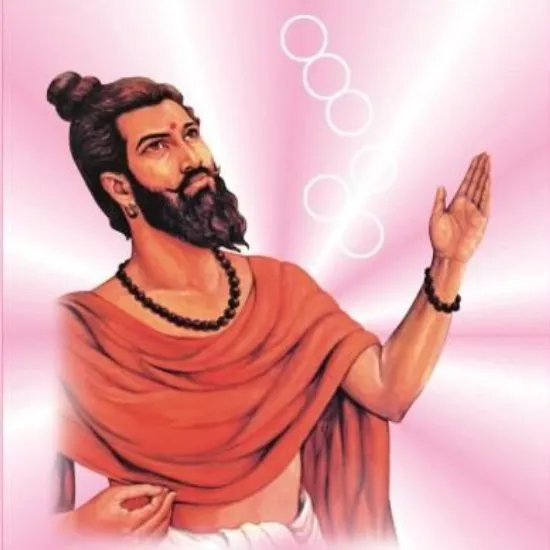
During ancient times, philosophers observed that substances could be broken into smaller pieces. Kanad questioned whether this process could continue indefinitely. He concluded that a stage must eventually be reached where further division is impossible. The smallest indivisible particle obtained was called a Parmanu.
This idea emerged nearly two thousand years before modern scientists such as John Dalton proposed scientific atomic theory based on experimental evidence.
- All matter is composed of extremely small particles called Parmanu.
- Parmanu are indivisible and cannot be further broken down.
- Atoms are eternal and cannot be created or destroyed.
- Different substances are formed by different combinations of atoms.
- Atoms remain unchanged during physical and chemical transformations.
- Changes in matter occur because atoms combine, separate, or rearrange themselves.
- Atoms may exist in two states: motion and rest.
- The properties of substances depend upon the arrangement and combination of atoms.
According to Kanad, atoms combine in different ways to form larger particles and eventually visible matter.
For example:
- Single atoms combine to form small clusters.
- Several clusters combine to form larger particles.
- Large numbers of particles produce observable matter.
Thus, different arrangements of the same basic particles can produce different substances.
| Kanad's View | Modern Scientific View |
|---|---|
| Matter consists of tiny particles called Parmanu. | Matter consists of atoms. |
| Atoms are indivisible. | Atoms contain electrons, protons, and neutrons. |
| Atoms combine to form substances. | Atoms combine to form molecules and compounds. |
| Atoms are eternal. | Atoms can undergo nuclear changes. |
| Based mainly on philosophical reasoning. | Based on experimental evidence. |
Around the same period, Greek philosophers Democritus and Leucippus proposed a similar idea. They suggested that matter could not be divided endlessly. Eventually, a smallest indivisible particle would be obtained.
Democritus called these particles Atomos, meaning indivisible. The modern term atom is derived from this Greek word.
- Both believed matter is composed of tiny particles.
- Both considered these particles indivisible.
- Both proposed that different substances arise from different combinations of particles.
- Neither theory was supported by experimental evidence.
- Confusing Parmanu with the modern atom.
- Assuming Kanad's theory was experimentally proven.
- Writing Democritus as the founder of modern atomic theory instead of Dalton.
- Believing ancient atomic theories explained subatomic particles.
-
1Identify the main idea proposed by Kanad.
-
2Connect it with modern atomic theory.
-
3Explain its historical significance.
A student reads that ancient Indian philosopher Kanad proposed that matter consists of tiny indivisible particles called Parmanu. He also learns that modern atoms contain electrons, protons, and neutrons.
Question 1: Which feature of Kanad's theory matches modern atomic theory?
Answer: Matter is composed of tiny particles.
Question 2: Which feature is not accepted today?
Answer: The idea that atoms are indivisible.
Question 3: Why is Kanad still remembered in science?
Answer: He introduced one of the earliest atomic concepts in history.
- Maharishi Kanad proposed the concept of Parmanu around 500 BCE.
- Parmanu was considered the smallest indivisible particle.
- Atoms combine to form different substances.
- Kanad's theory was philosophical rather than experimental.
- Democritus used the term Atomos meaning indivisible.
- Modern atomic theory developed much later through scientific experiments.
2SO4-atoms-molecules-original.webp)