⚛ Chapter 4 · NCERT Science IX

STRUCTURE OFTHE ATOM

Trace the evolution of atomic models — from Dalton's sphere to Bohr's quantised orbits — and master electron configuration.

1803 · Dalton 1904 · Thomson 1911 · Rutherford 1913 · Bohr 1803 · Dalton 1904 · Thomson 1911 · Rutherford 1913 · Bohr
3Particles
4Models
2n²Shell Capacity
★★★★★Exam Weight
1803
Dalton
Solid sphere — no internal structure
1904
Thomson
Plum pudding — electrons in positive mass
1911
Rutherford
Nuclear model — dense +ve nucleus
1913
Bohr
Quantised orbits — electrons in shells
📌 Bohr model diagrams with electron distribution are mandatory for 3-mark questions.
📌 Valency from electronic configuration — a formula used in Class 10 and beyond.
📌 Isotopes and isobars distinctions appear in objective questions every year.
📌 Rutherford's gold foil experiment with labelled diagram — classic 5-mark question.
ParticleSymbolChargeMass (u)Location
Electrone⁻−1≈ 0Orbits (shells)
Protonp⁺+11Nucleus
Neutronn⁰01Nucleus
Atomic NumberZ = number of protons
Mass NumberA = P + N
Shell Capacity2n²electrons
Valency8 − outermost electrons (if >4)
Atomic Number (Z)Mass Number (A)Electron ConfigurationValencyIsotopesIsobarsRutherford's ModelBohr's ModelK L M N ShellsNucleonsCathode Rays
  • 1Discovery and properties of subatomic particles (electron, proton, neutron)
  • 2Atomic models and limitations of each model
  • 3Bohr's model and distribution of electrons in shells
  • 4Valency from electronic configuration
  • 5Isotopes, Isobars, and Isotones — definitions and examples
01
Draw Bohr's Model
Practice drawing circular shells with electron counts for 10 common elements.
02
Compare Models
Prepare a table comparing Thomson, Rutherford, Bohr — with limitations of each.
03
Isotope Examples
¹H, ²H (Deuterium), ³H (Tritium) — know at least 3 isotope sets by heart.
04
Gold Foil Diagram
Rutherford's experiment diagram with observations must be drawn with α-particle deflection angles.
Chapter 1 · CBSE · Class IX
⚛️

Exploring the Internal Structure of the Atom

Structure of the Atom Subatomic Particles Electrons Protons Neutrons Charged Particles Cathode Rays Canal Rays Thomson’s Model of Atom Plum Pudding Model Rutherford’s Model of Atom Alpha-particle Scattering Experiment Discovery of Nucleus Bohr’s Model of Atom Orbits Energy Levels Discrete Orbits Shells K L M N Shells Bohr-Bury Scheme Electron Distribution Valency Valence Electrons Octet Rule Atomic Number Mass Number Nucleons Isotopes Isobars
🗺️ Overview
Matter exists in many forms around us—air, water, metals, rocks, plants, and living organisms. Although these substances appear very different, all of them are made up of tiny particles called atoms. Understanding the structure of atoms is one of the greatest achievements in science because it explains why different elements have different properties and how chemical reactions occur.
📖 Introduction
🤔 Did You Know?
Why Was Dalton's Theory Not Completely Correct?

Dalton proposed that atoms are indivisible particles. This idea successfully explained many chemical laws such as the Law of Conservation of Mass and the Law of Constant Proportions. However, later experiments showed that atoms can be broken down into smaller particles.

The discovery of:

  • Electrons by J.J. Thomson (1897)
  • Protons by Eugen Goldstein and later studies
  • Neutrons by James Chadwick (1932)

proved that atoms are not indivisible. Instead, they possess an internal structure consisting of charged and neutral particles.

💡 Concept
Important Concept
🏛️ Historical Note
Historical Background of Atomic Structure
The journey of understanding the atom spans more than two thousand years.
Scientist Contribution
Democritus (Ancient Greece) Suggested that matter is made of tiny indivisible particles called atomos.
John Dalton Proposed modern atomic theory.
J.J. Thomson Discovered electron and proposed Plum Pudding Model.
Ernest Rutherford Discovered atomic nucleus through alpha-particle scattering experiment.
Niels Bohr Explained arrangement of electrons in fixed energy levels.
James Chadwick Discovered neutron.
🤔 Why Scientists Studied Electricity to Understand Atoms?
Scientists observed that electricity could pass through gases under certain conditions. During these experiments, mysterious rays were produced inside discharge tubes. The study of these rays eventually led to the discovery of electrons, which provided the first direct evidence that atoms contain smaller particles.
Thus, the study of electricity became a powerful tool for investigating the internal structure of atoms.
🧠 Key Terms
🗒️ Exam-Oriented Notes for CBSE
Frequently Asked Theory Question:
Why did scientists reject Dalton's idea that atoms are indivisible?

Scientists rejected Dalton's idea because experiments led to the discovery of electrons, protons, and neutrons, proving that atoms contain smaller particles and are therefore divisible.

Common Mistakes Made by Students

  • Thinking that Dalton's theory is completely incorrect.
  • Assuming atoms can be seen directly with ordinary microscopes.
  • Confusing atoms with molecules.
  • Believing electrons were discovered before experiments on electricity.
  • Ignoring the historical development of atomic models.
Remember:
The development of atomic theory was gradual. Each scientist added new evidence, leading to a more accurate picture of the atom.
✏️ Example
CBSE Competency-Based Question
A student says that atoms are indivisible because Dalton proposed so. Another student argues that atoms contain smaller particles. Who is correct? Justify your answer.
  • Dalton's Atomic Theory
  • Discovery of subatomic particles
  1. 1
    Recall Dalton's statement.
  2. 2
    Consider later discoveries.
  3. 3
    Compare both viewpoints.
  4. 4
    Reach a scientific conclusion.
The second student is correct. Dalton initially proposed that atoms are indivisible. However, later discoveries of electrons, protons, and neutrons showed that atoms contain smaller particles. Therefore, atoms are divisible and possess an internal structure.
If atoms were truly indivisible as Dalton proposed, would the discovery of electricity, radioactivity, and nuclear energy be possible? Explain.
No. These phenomena involve the movement or interaction of subatomic particles. If atoms were indivisible, electrons, protons, neutrons, radioactivity, and nuclear reactions could not be explained. Therefore, the existence of subatomic particles is essential for understanding these phenomena.
🗒️ Key Takeaway
  • Atoms are the basic building blocks of matter.
  • Dalton considered atoms indivisible.
  • Later discoveries proved that atoms contain subatomic particles.
  • Electrons, protons, and neutrons are the fundamental particles of an atom.
  • Atomic structure explains the properties and behavior of elements.
  • The study of atomic structure forms the foundation of modern chemistry.
🎨 SVG Diagram
Visual Summary
Journey Towards Understanding Atomic Structure Democritus Atomos Ancient Concept Atomic Theory Dalton Law of Mass Cons. J.J. Thomson Electron Plum Pudding Rutherford Nucleus Empty Space Atoms Are Not Indivisible — They Have an Internal Structure
⚛️

Charged Particles in Matter

🗺️ Overview

The study of atomic structure began when scientists observed that matter exhibits electrical properties. Everyday phenomena such as attraction between rubbed objects suggested that matter contains particles carrying electric charges. These observations eventually led to the discovery of subatomic particles and revolutionized our understanding of the atom.

Learning Outcome: In this section, you will learn how the discovery of electric charges provided evidence that atoms are divisible and contain smaller particles called electrons and protons.
📖 Introduction to Electrically Charged Matter
🗒️ Activity: Attraction Due to Electric Charges

Materials Required:

  • A plastic comb
  • Dry hair
  • Small pieces of paper

Procedure:

  1. Comb dry hair several times.
  2. Bring the comb near small paper pieces.
  3. Observe the behavior of the paper pieces.

Observation:

The paper pieces are attracted towards the comb.

Conclusion:

Rubbing causes the comb to become electrically charged. Charged objects can exert forces on nearby objects, demonstrating the existence of electric charges in matter.

🤔 What is Electric Charge?

Electric charge is a fundamental property of matter responsible for electrical attraction and repulsion.

There are two types of charges:

  • Positive Charge (+)
  • Negative Charge (−)
Important Rule: Like charges repel each other, whereas unlike charges attract each other.
🗒️ Evidence that Atoms are Divisible

Dalton's Atomic Theory considered atoms to be indivisible particles. However, experiments involving electricity revealed that atoms contain smaller charged particles.

The discovery of electrons and protons proved that atoms have an internal structure and are therefore divisible.

📌 Discovery of the Electron
🔎 Exam Fact
📌 Discovery of the Proton
⚖️ Comparison Between Electron and Proton
Property Electron Proton
Symbol \(e^-\) \(p^+\)
Charge \(-1\) \(+1\)
Nature Negative Positive
Relative Mass \(\frac{1}{1836}\) 1
Location Outside nucleus Inside nucleus
🔎 Actual Charges of Electron and Proton
✏️ Example

A carbon atom contains:

  • 6 protons = +6 charge
  • 6 electrons = −6 charge

Therefore,

\[ (+6)+(-6)=0 \]

Hence a carbon atom is electrically neutral.

💡 Concept
Concept of Ion Formation
ℹ️ Arrangement of Charged Particles in the Atom

Once electrons and protons had been discovered, scientists faced a new challenge: How are these particles arranged inside the atom?

Scientists knew that:

  • Electrons carry negative charge.
  • Protons carry positive charge.
  • An atom is electrically neutral.

Therefore, a suitable atomic model was needed to explain how these particles are organized within the atom. This led to the development of Thomson's Atomic Model, Rutherford's Atomic Model, and Bohr's Atomic Model.

✏️ Example
CBSE Competency-Based Question
A student rubs a plastic scale with dry hair and notices that it attracts tiny paper pieces. Explain why this attraction occurs and what it suggests about the structure of matter.
  • Electric charge
  • Transfer of electrons
  • Subatomic particles
  1. 1
    Identify the charging process.
  2. 2
    Explain electron transfer.
  3. 3
    Discuss attraction due to charge.
  4. 4
    Relate observation to atomic structure.
Rubbing the scale transfers electrons between the scale and hair. As a result, the scale becomes electrically charged and attracts paper pieces. This demonstrates that matter contains charged particles and provides evidence that atoms are made up of smaller subatomic particles.
❌ Common Mistakes
  • Writing Goldstein as the discoverer of proton directly.
  • Confusing cathode rays with canal rays.
  • Writing electron mass as zero instead of negligible.
  • Assuming protons can move easily outside the atom.
  • Forgetting that an atom is electrically neutral.
⚡ Quick Revision
  • Rubbing objects can produce electric charges.
  • Electron was discovered by J. J. Thomson in 1897.
  • Canal rays were discovered by Eugen Goldstein in 1886.
  • Electrons carry negative charge.
  • Protons carry positive charge.
  • Magnitude of charge on proton and electron is equal.
  • Atoms remain electrically neutral because positive and negative charges balance each other.
  • The discovery of charged particles proved that atoms are divisible.
🎨 SVG Diagram
Visual Representation of Charged Particles
Discovery of Charged Particles Inside the Atom Electron (e⁻) + Proton (p⁺) Equal Magnitude of Charge Discovery of Electrons and Protons Proved that Atoms are Divisible
⚛️

The Structure of an Atom

🗺️ Overview
The discovery of subatomic particles completely transformed our understanding of matter. Earlier, atoms were believed to be indivisible particles as proposed by Dalton's Atomic Theory. However, the discovery of electrons and protons demonstrated that atoms possess an internal structure. This raised an important scientific question:
🤔 Did You Know?
Hoq smaller particles are arranged inside the atom?
To answer this question, scientists proposed various atomic models based on experimental evidence. These models gradually improved our understanding of atomic structure and laid the foundation for modern atomic theory.

Need for Atomic Models

The discovery of charged particles created several unanswered questions:

  • How are electrons and protons arranged inside an atom?
  • Why does an atom remain electrically neutral?
  • What keeps negatively charged electrons from collapsing into positively charged regions?
  • How is most of the mass of an atom distributed?
  • Why do different elements show different chemical properties?

Scientists developed atomic models to explain these questions. Each model was based on experimental observations available at that time.

Evolution of Atomic Models

Scientific understanding of the atom evolved gradually through a series of discoveries.

Scientist Year Major Contribution
John Dalton 1808 Proposed Atomic Theory and considered atoms indivisible.
J. J. Thomson 1904 Proposed the first model of atomic structure.
Ernest Rutherford 1911 Discovered the atomic nucleus.
Niels Bohr 1913 Explained electron arrangement in fixed energy levels.
James Chadwick 1932 Discovered the neutron.
📘 Definition
Atomic Model
🔷 Characteristics of a Good Atomic Model
🔷 Characteristics

An acceptable atomic model should be able to explain:

  • The presence of positively and negatively charged particles.
  • The electrical neutrality of atoms.
  • The distribution of mass within an atom.
  • The stability of atoms.
  • The chemical behavior of elements.
🗒️ J. J. Thomson's Contribution

J. J. Thomson was the first scientist to propose a detailed model describing how charged particles are arranged inside an atom.

After discovering electrons through cathode ray experiments, Thomson realized that atoms contain negatively charged particles. Since atoms are electrically neutral, he proposed that positive charge must also be present inside the atom.

This idea led to the development of Thomson's Atomic Model, popularly known as the Plum Pudding Model or Watermelon Model.

⚡ Exam Tip
🛠️ Real-Life Applications of Atomic Structure
  • Design of semiconductors and microchips.
  • Medical imaging techniques such as X-rays and MRI.
  • Nuclear power generation.
  • Radiotherapy for cancer treatment.
  • Manufacture of electronic devices.
  • Development of modern materials and nanotechnology.
Remember: The discovery of electrons and protons proved that atoms are divisible. Once this fact was established, scientists needed to explain how these particles were arranged. This necessity gave birth to various atomic models.
✏️ Example
Why was there a need to propose models of atomic structure after the discovery of electrons and protons?
  • Dalton's Atomic Theory
  • Discovery of subatomic particles
  • Arrangement of charged particles
  1. 1
    Mention Dalton's view of the atom.
  2. 2
    State the discovery of electrons and protons.
  3. 3
    Explain why atoms could no longer be considered indivisible.
  4. 4
    Conclude the need for atomic models.
Dalton considered atoms indivisible. However, the discovery of electrons and protons showed that atoms contain smaller particles. Scientists therefore needed to explain how these particles were arranged inside the atom. This led to the development of various atomic models.
📋 Case Study
CBSE Case Study Based Question

A group of students is discussing atomic structure. One student says that atoms are solid, indivisible particles as suggested by Dalton. Another student argues that atoms contain electrons and protons and therefore must have an internal structure.

Question:

  1. Which student's statement is scientifically more accurate?
  2. What discovery led to this conclusion?
  3. Why were atomic models proposed?

Answer:

  1. The second student's statement is more accurate.
  2. The discoveries of electrons and protons revealed the internal structure of atoms.
  3. Atomic models were proposed to explain the arrangement of subatomic particles within the atom.
❌ Common Mistakes
  • Discovery of electrons disproved the indivisibility of atoms.
  • Atoms contain subatomic particles.
  • Scientists proposed atomic models to explain particle arrangement.
  • J. J. Thomson proposed the first atomic model.
  • Atomic models evolved with new experimental evidence.
  • Modern atomic theory is based on contributions from many scientists.
🎨 SVG Diagram
Visual Timeline of Atomic Models
Evolution of Atomic Structure Dalton 1808 Thomson 1904 Rutherford 1911 Bohr 1913 Each Model Improved Our Understanding of the Atom
⚛️

Thomson's Model of an Atom (Plum Pudding Model)

🖼️ Figure
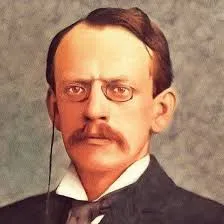
Sir J J Thomson - Discoverer of Electron
Sir J. J. Thomson (1856–1940), Discoverer of the Electron and Proposer of the First Atomic Model
🏛️ Historical Note

The discovery of the electron in 1897 raised an important question among scientists: How are negatively charged electrons arranged inside an atom? Since atoms are electrically neutral, there must also be a positive charge present within the atom to balance the negative charge of electrons.

To explain this arrangement, Sir Joseph John Thomson proposed the first scientific model of the atom in 1904. His model is popularly known as the Plum Pudding Model, Watermelon Model, or Christmas Cake Model.

📘 Definition
🤔 Did You Know?
Why Did Thomson Propose This Model?

Thomson had already discovered electrons through cathode ray experiments. He knew that:

  • Electrons carry negative charge.
  • Atoms are electrically neutral.
  • Some positive charge must exist inside atoms to balance electrons.

Based on these observations, he proposed that positive charge is spread uniformly throughout the atom, while electrons remain embedded within this positively charged sphere.

🔗 Analogy of Plum Pudding Model

Thomson compared the atom to a traditional English dessert called plum pudding.

  • The pudding represents the positively charged sphere.
  • The plums represent negatively charged electrons.
  • The plums are distributed throughout the pudding.

In India, the model is often compared to a watermelon:

  • The red edible portion represents positive charge.
  • The black seeds represent electrons.
Exam Memory Trick: Positive charge = Pudding or Watermelon pulp
Electrons = Plums or Watermelon seeds
⚖️ Main Postulates of Thomson's Atomic Model
Thomson proposed the following assumptions:
  • An atom consists of a sphere of uniformly distributed positive charge.
  • Negatively charged electrons are embedded throughout the positively charged sphere.
  • The total positive charge equals the total negative charge.
  • Therefore, the atom as a whole is electrically neutral.
  • The positive charge occupies most of the volume of the atom.
  • Electrons remain fixed within the positively charged sphere.
🎨 SVG Diagram
Diagrammatic Representation of Thomson's Model
Thomson's Atomic Model The "Plum Pudding" Model (1904) Positive Charge Sphere The "Pudding" Embedded Electrons The "Plums" (-ve Charge) Negatively charged electrons are distributed within a uniform sphere of positive charge.
🤔 Did You Know?
How Does the Atom Remain Neutral?

According to Thomson, every electron carries one unit of negative charge. The positive sphere contains an equal amount of positive charge.

Therefore:

\[ \text{Total Positive Charge} = \text{Total Negative Charge} \]

Hence,

\[ \text{Net Charge on Atom} = 0 \]

This successfully explained why atoms are electrically neutral.

🔍 Achievements of Thomson's Atomic Model
Although later found to be incomplete, Thomson's model was revolutionary because it was the first model to incorporate subatomic particles.
  • First model to describe internal structure of atoms.
  • Successfully explained electrical neutrality of atoms.
  • Confirmed that atoms are divisible.
  • Included electrons as constituents of atoms.
  • Provided a foundation for future atomic models.
⚠️ Limitations of Thomson's Atomic Model

Despite its success, Thomson's model could not explain several experimental observations.

  1. It could not explain how positive charge is actually distributed inside the atom.
  2. It could not explain the existence of a nucleus.
  3. It failed to explain Rutherford's alpha-particle scattering experiment.
  4. It could not explain the stability of atoms.
  5. It did not describe the arrangement or movement of electrons accurately.
🗒️ Comparison Between Dalton's and Thomson's Models
Feature Dalton's Model Thomson's Model
Nature of Atom Indivisible particle Contains electrons
Internal Structure Absent Present
Positive Charge Not explained Uniformly distributed
Electrons Not included Embedded in positive sphere
Electrical Neutrality Not explained Explained
💡 Concept Builder
✏️ CBSE Competency-Based Question
A student compares an atom to a watermelon where seeds are embedded inside the red edible part. Which atomic model does this analogy represent? Explain.
  • Thomson's Atomic Model
  • Distribution of positive and negative charges
  1. 1
    Identify the analogy.
  2. 2
    Relate seeds to electrons.
  3. 3
    Relate pulp to positive charge.
  4. 4
    Name the model.
The analogy represents Thomson's Atomic Model. The watermelon pulp corresponds to the uniformly distributed positive charge, while the seeds represent negatively charged electrons embedded within the atom.
🗒️ Higher Order Thinking Skill (HOTS)
Higher Order Thinking Skill (HOTS)
Thomson's model successfully explained electrical neutrality. Why then was it eventually rejected?
Although Thomson's model explained electrical neutrality, it failed to explain experimental results obtained by Rutherford's alpha-particle scattering experiment. It could not account for the existence of a dense nucleus or the observed large-angle deflections of alpha particles.
❌ Common Mistakes
  • Writing "Plum Cake Model" instead of Plum Pudding Model.
  • Confusing Thomson's model with Rutherford's model.
  • Stating that electrons revolve around the nucleus in Thomson's model.
  • Forgetting that Thomson proposed a positively charged sphere.
  • Ignoring the limitations of the model in board answers.
⚡ Quick Revision
  • Proposed by J. J. Thomson in 1904.
  • Also known as Plum Pudding Model.
  • Atom is a positively charged sphere.
  • Electrons are embedded inside the positive sphere.
  • Atom remains electrically neutral.
  • First scientific model of atomic structure.
  • Could not explain Rutherford's experimental observations.
📝 Summary
Board Examination Summary
⚛️

Rutherford's Model of an Atom (Nuclear Model of Atom)

🖼️ Figure
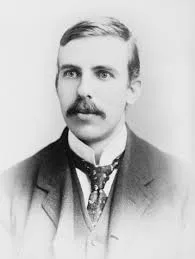
Ernest Rutherford - Father of Nuclear Physics
Ernest Rutherford (1871–1937), Discoverer of the Atomic Nucleus
🏛️ Historical Note

Thomson's Plum Pudding Model successfully explained the presence of electrons inside atoms and the electrical neutrality of matter. However, scientists wanted experimental proof of how positive charge was distributed inside an atom.

To investigate this question, Ernest Rutherford conducted one of the most important experiments in the history of science—the famous Alpha Particle Scattering Experiment, commonly known as the Gold Foil Experiment.

🌟 Historical Significance
Rutherford's experiment completely changed the understanding of atomic structure and led to the discovery of the atomic nucleus.

Background: Why Was Rutherford's Experiment Necessary?

According to Thomson's model, positive charge was spread uniformly throughout the atom. If this were true, positively charged alpha particles passing through an atom should experience only very small deflections.

Rutherford decided to test this prediction experimentally.

What are Alpha Particles?

Definition: Alpha particles (\(\alpha\)-particles) are fast-moving positively charged particles emitted by certain radioactive substances.

Alpha particles are relatively heavy and possess a positive charge of +2. Because of their high speed and large mass, they are ideal probes for investigating atomic structure.

Rutherford's Alpha Particle Scattering Experiment

Experimental Setup

Rutherford, along with his students Hans Geiger and Ernest Marsden, bombarded a very thin sheet of gold foil with a beam of high-speed alpha particles.

The gold foil used was extremely thin, only a few hundred atoms thick.

A fluorescent zinc sulphide screen surrounded the foil to detect the path of alpha particles after collision.

Components of the Experiment

  • Radioactive source emitting alpha particles.
  • Lead block with narrow slit to produce a fine beam.
  • Thin gold foil.
  • Rotating fluorescent screen for detecting scattered particles.
🗒️ 
α-particles Gold atoms Most particles pass through, while some are repelled by the tiny, dense nuclei.
🗒️ Rutherford's Expectations

Based on Thomson's model, Rutherford expected:

    Most alpha particles would pass straight through the foil. A few particles might undergo slight deflection. No particle would be reflected backward. Positive charge was expected to be spread uniformly throughout the atom.
🗒️ Actual Observations
Rutherford was surprised because the experimental results were very different from his expectations.
    About 99% of alpha particles passed straight through the gold foil. Some alpha particles were deflected through small angles. A very small number of alpha particles were deflected through large angles. Approximately one out of every twenty thousand alpha particles bounced back almost along the same path.
Rutherford's Famous Remark:
It was almost as incredible as if you fired a 15-inch shell at a piece of tissue paper and it came back and hit you.
🔍 Interpretation of Observations
Observation Inference
Most particles passed straight through. Most of the atom is empty space.
Few particles were slightly deflected. Positive charge occupies a very small region.
Very few particles bounced back. Mass and positive charge are concentrated in a tiny dense region.
🗒️ Conclusions of Rutherford's Experiment
  • Most of the space inside an atom is empty.
  • Positive charge is not uniformly distributed.
  • Nearly all the mass of the atom is concentrated in a tiny central region.
  • This central region is called the nucleus.
Most Important Discovery: Rutherford discovered the atomic nucleus.
Rutherford's Nuclear Model of Atom

Based on the results of the gold foil experiment, Rutherford proposed a new atomic model called the Nuclear Model of Atom.

⚖️ Main Postulates of Rutherford's Model
  • There is a tiny positively charged centre called the nucleus.
  • Nearly all the mass of the atom resides in the nucleus.
  • Electrons revolve around the nucleus in circular paths.
  • Most of the atom consists of empty space.
  • The nucleus is extremely small compared to the size of the atom.
🎨 SVG Diagram
Structure of Atom According to Rutherford
2 3 4 5 6 7 8 9 10 11 12 13 14 15 16 17 18 19 20 21 22 23 24 25 26 27 28 29 30 31 32 33 34 35 36 37 38 39 40 41 42 43 44 45 46 47 48 49 50 51 52 53 54 55 56 57 58 59 60 61 62 63 64 65 66 67 68 RUTHERFORD NUCLEAR MODEL PLANETARY ATOMIC STRUCTURE (1911) 74 75 76 77 NUCLEUS 78 DENSE POSITIVE CENTER 79 80 81 82 ELECTRON 83 NEGATIVE POINT CHARGE 84 85 86 87 88 EXPERIMENTAL BASIS: 89 90 • Gold Foil Experiment 91 • Alpha Particle Deflection 92 • Mostly Empty Space 93 94
Size of Nucleus Compared to Atom

Rutherford's experiment showed that the nucleus is extremely small compared to the atom.

Typical sizes are:

  • Radius of atom ≈ \(10^{-10}\) m
  • Radius of nucleus ≈ \(10^{-15}\) m

Thus, the nucleus is approximately 100,000 times smaller than the atom.

📎 Successes of Rutherford's Model
  • Discovered the atomic nucleus.
  • Explained the scattering experiment successfully.
  • Established that most of the atom is empty space.
  • Showed that positive charge is concentrated at the centre.
  • Provided the foundation for modern atomic theory.
🗒️ Drawbacks of Rutherford's Model
  • Could not explain atomic stability.
    According to classical electromagnetic theory, a charged particle moving in a circular path should continuously lose energy.
  • Therefore, electrons should gradually spiral inward and fall into the nucleus.
  • If this happened, atoms would collapse within a fraction of a second. However, atoms are actually stable.
  • The model could not explain line spectra of atoms.
  • It did not explain fixed energy levels of electrons.
  • It could not explain the distribution of electrons around the nucleus.
Why Rutherford's Model Failed: Simplified Explanation

Imagine a satellite orbiting Earth. If it continuously lost energy, it would eventually crash into Earth.

Similarly, according to classical physics, revolving electrons should lose energy and collapse into the nucleus. Since atoms do not collapse, Rutherford's model was incomplete.

This problem was later solved by Niels Bohr.

✏️ CBSE Competency-Based Question
During Rutherford's experiment, most alpha particles passed straight through the gold foil while a few were deflected. What does this indicate about atomic structure?
  1. 1
    Interpret the straight path of most particles.
  2. 2
    Interpret the deflection of a few particles.
  3. 3
    Relate observations to atomic structure.
Since most alpha particles passed straight through, most of the atom must be empty space. The deflection of a few particles indicates that positive charge and mass are concentrated in a small central nucleus.
🗒️ Higher Order Thinking Skill (HOTS)<
Higher Order Thinking Skill (HOTS)<
Why was gold chosen instead of thicker metal sheets for Rutherford's experiment?
Gold is highly malleable and can be beaten into extremely thin foils containing only a few layers of atoms. This allowed alpha particles to pass through and interact with individual atoms.
⚖️ Comparison Between Thomson and Rutherford Models
Feature Thomson's Model Rutherford's Model
Positive Charge Uniformly distributed Concentrated in nucleus
Electrons Embedded in positive sphere Revolve around nucleus
Empty Space Not explained Most of atom is empty
Nucleus Absent Present
Experimental Basis Electron discovery Alpha scattering experiment
⚡ Quick Revision
  • Rutherford conducted the Gold Foil Experiment.
  • Most alpha particles passed through undeflected.
  • Atom contains a tiny dense nucleus.
  • Most of the atom is empty space.
  • Electrons revolve around the nucleus.
  • Nucleus contains almost all the mass of the atom.
  • Model failed to explain atomic stability.
  • Bohr later modified Rutherford's model.
📝 Summary
⚛️

Bohr's Model of Atom

🖼️ Figure
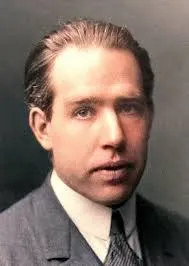
Niels Bohr - Developer of Bohr's Atomic Model
Niels Bohr (1885–1962), Nobel Prize-Winning Physicist and Developer of Bohr's Atomic Model
🗺️ Overview

Rutherford's Nuclear Model successfully explained the existence of a tiny positively charged nucleus at the centre of the atom. However, it failed to explain one of the most important questions:

If electrons continuously revolve around the nucleus, why do they not lose energy and fall into the nucleus?

According to classical physics, a charged particle moving in a circular path should continuously radiate energy. As a result, electrons should gradually lose energy, spiral inward, and collapse into the nucleus. If this happened, atoms would be unstable and matter as we know it could not exist.

To solve this problem, the Danish physicist Niels Bohr proposed a revolutionary atomic model in 1913. His theory introduced the concept of fixed energy levels and explained the stability of atoms.

🏛️ Historical Importance
Bohr's model was the first atomic model that successfully explained why atoms remain stable.

Need for Bohr's Atomic Model

Rutherford's model had several limitations:

  • Could not explain atomic stability.
  • Could not explain why electrons do not fall into the nucleus.
  • Could not explain atomic spectra.
  • Could not explain the arrangement of electrons around the nucleus.

Bohr attempted to overcome these limitations by introducing the concept of quantized energy levels.

⚖️ Bohr's Fundamental Postulates
📘 Definition
Bohr proposed that electrons revolve around the nucleus only in certain permitted circular paths called shells, energy levels, or stationary orbits.

Postulates

  • Postulate 1: Fixed Circular Orbits

    Electrons can revolve around the nucleus only in certain special circular paths known as discrete orbits.

    These orbits have fixed energies and are called:

    • K-shell (First shell)
    • L-shell (Second shell)
    • M-shell (Third shell)
    • N-shell (Fourth shell)

    Electrons cannot exist between these shells.

  • Postulate 2: No Energy Radiation in Allowed Orbits

    While revolving in these fixed orbits, electrons do not radiate energy.

    Therefore:

    \[ \text{Energy of Electron Remains Constant} \]

    This explains why atoms remain stable and do not collapse.

  • Postulate 3: Energy is Absorbed or Emitted During Transition

    An electron can move from one orbit to another only by absorbing or emitting a fixed amount of energy.

    • Energy is absorbed when an electron moves to a higher energy level.
    • Energy is emitted when an electron moves to a lower energy level.

    This emitted energy appears as light of specific wavelengths.

💡 Energy Level Concept

According to Bohr, each orbit possesses a definite amount of energy.

Shell Principal Quantum Number (n) Relative Energy
K 1 Lowest
L 2 Higher than K
M 3 Higher than L
N 4 Higher than M
K L M Bohr's Energy Levels (n=1, 2, 3)
⚖️ Important Rule:

Energy increases as the distance from the nucleus increases.

Energy Transition Between Shells

Electrons can jump from one shell to another by exchanging energy.

When an electron moves from a lower energy level to a higher energy level:

\[ \text{Electron} + \text{Energy} \rightarrow \text{Excited State} \]

When an electron returns to a lower energy level:

\[ \text{Excited State} \rightarrow \text{Ground State} + \text{Energy} \]

This emitted energy is observed as electromagnetic radiation.

Explanation of Atomic Stability

Bohr's greatest achievement was explaining why atoms remain stable.

Since electrons do not lose energy while revolving in permitted orbits, they do not spiral into the nucleus.

Therefore:

\[ \text{Atom Remains Stable} \]

This successfully solved the major drawback of Rutherford's model.

Maximum Number of Electrons in a Shell

Bohr proposed that the maximum number of electrons that can be accommodated in a shell is given by:

\[ \text{Maximum Electrons} = 2n^2 \]

where:

  • \(n\) = shell number or principal quantum number

Derivation of Electron Capacity Using the Formula

For K-shell:

\[ n = 1 \] \[ 2n^2 = 2(1)^2 = 2 \]

Therefore K-shell can hold a maximum of 2 electrons.

For L-shell:

\[ n = 2 \] \[ 2n^2 = 2(2)^2 = 8 \]

Therefore L-shell can hold a maximum of 8 electrons.

For M-shell:

\[ n = 3 \] \[ 2n^2 = 2(3)^2 = 18 \]

Therefore M-shell can hold a maximum of 18 electrons.

For N-shell:

\[ n = 4 \] \[ 2n^2 = 2(4)^2 = 32 \]

Therefore N-shell can hold a maximum of 32 electrons.

Electron Distribution Table

Shell Value of n Maximum Electrons
K 1 2
L 2 8
M 3 18
N 4 32
🗒️ Successes Of Bohr's Model
  • Explained atomic stability.
  • Introduced the concept of energy levels.
  • Explained hydrogen atomic spectrum.
  • Explained electron arrangement around the nucleus.
  • Successfully modified Rutherford's model.
⚠️ Limitations of Bohr's Model
  • Could explain only hydrogen and hydrogen-like atoms.
  • Could not explain spectra of multi-electron atoms.
  • Could not explain fine details of spectral lines.
  • Failed to explain the dual nature of electrons.
  • Does not fully agree with modern quantum mechanics.
⚖️ Comparison Between Rutherford and Bohr Models
Feature Rutherford Model Bohr Model
Atomic Stability Not Explained Explained
Electron Paths Any orbit Fixed orbits only
Energy Levels Absent Present
Energy Radiation Continuous No radiation in stationary orbits
Atomic Spectrum Not Explained Explained for hydrogen
✏️ CBSE Competency-Based Question
A student claims that electrons can revolve around the nucleus at any distance. Is this statement consistent with Bohr's theory? Explain.
  1. 1
    Recall Bohr's postulates.
  2. 2
    Identify allowed orbits.
  3. 3
    Apply the concept to the statement.
No. According to Bohr's theory, electrons can revolve only in specific permitted orbits having fixed energies. Electrons cannot exist between these energy levels.
🗒️ Higher Order Thinking Skill (HOTS)
Why do electrons not continuously emit energy while revolving around the nucleus according to Bohr?
Bohr proposed that electrons move in stationary orbits having fixed energies. While revolving in these permitted orbits, electrons do not radiate energy. Energy exchange occurs only when electrons jump between different energy levels.
❌ Common Mistakes
  • Writing Neil Bohr instead of Niels Bohr.
  • Confusing shells with subshells.
  • Using \(2n\) instead of \(2n^2\).
  • Writing K-shell capacity as 8 instead of 2.
  • Assuming electrons can exist between shells.
⚡ Quick Revision
  • Bohr proposed fixed energy levels around the nucleus.
  • Electrons do not radiate energy in stationary orbits.
  • Energy is emitted or absorbed during transitions.
  • K, L, M and N are principal shells.
  • Maximum electrons in a shell = \(2n^2\).
  • Bohr explained atomic stability.
  • Model successfully explained hydrogen spectrum.
📝 Board Examination Summary
⚛️

Energy Levels in an Atom

🗺️ Overview
One of the most important contributions of Niels Bohr was the introduction of energy levels within an atom. Before Bohr's theory, scientists believed that electrons could revolve around the nucleus in any orbit. Bohr proposed that electrons can exist only in certain fixed energy states called energy levels or shells.
📘 Definition
🤔 What are Energy Levels?

Every electron in an atom possesses energy. However, electrons are not allowed to have arbitrary amounts of energy. Instead, they occupy specific energy levels around the nucleus.

Each energy level corresponds to a fixed amount of energy. The farther an energy level is from the nucleus, the greater is its energy.

💡 Key Concept
🗒️ Ground State And Excited State

Electrons normally occupy the lowest possible energy level available. This condition is known as the ground state.

Ground State: The lowest energy state of an atom in which electrons occupy the lowest possible shells.

When an electron absorbs energy, it can jump to a higher energy level. The atom then enters an excited state.

Excited State: A temporary state in which one or more electrons occupy higher energy levels after absorbing energy.

Electron Transition Between Energy Levels

Electrons can move from one energy level to another by absorbing or emitting energy.

Energy Absorption

When an electron gains energy:

\[ \text{Electron in Lower Shell} + \text{Energy} \rightarrow \text{Electron in Higher Shell} \]

The atom enters an excited state.

Energy Emission

Excited states are unstable. Therefore, electrons quickly return to lower energy levels by releasing energy.

\[ \text{Electron in Higher Shell} \rightarrow \text{Electron in Lower Shell} + \text{Energy} \]

This released energy appears as light, heat, or other forms of electromagnetic radiation.

🎨 SVG Diagram
Energy Level Transition Diagram
Quantum Electron Transition: Absorption and Emission Quantum Electron Transition n=3 (M Shell) n=2 (L Shell) n=1 (K Shell) Absorption: K → M Emission: M → L High Energy Photon (λ small) Low Energy Photon (λ large)
🌟 Why Are Energy Levels Important?
🛠️ Real-Life Applications of Energy Levels
Application Role of Energy Levels
Neon Signs Emission of coloured light due to electron transitions.
Lasers Controlled emission of photons.
Fireworks Different colours arise from excited electrons.
Spectroscopy Identification of elements using spectral lines.
Astronomy Determining composition of stars and galaxies.
📋 Case Study
An electron in an atom absorbs energy and moves from the K-shell to the M-shell. What change occurs in its energy and state?
  • Energy levels
  • Ground state
  • Excited state
  1. 1
    Identify initial shell.
  2. 2
    Compare energies of K and M shells.
  3. 3
    Determine the new state of the atom.
Since the M-shell has higher energy than the K-shell, the electron gains energy and moves to a higher energy level. The atom enters an excited state.
🗒️ Higher Order Thinking Skill (HOTS)
Why does an excited atom emit light after some time?
Excited states are unstable. Therefore, electrons return to lower energy levels and release excess energy in the form of electromagnetic radiation, often visible as light.
❌ Common Mistakes
  • Confusing shells with energy values.
  • Assuming electrons can exist between two shells.
  • Writing outer shells as lower-energy shells.
  • Confusing ground state with excited state.
  • Forgetting that energy increases away from the nucleus.
⚡ Quick Revision
  • Energy levels are fixed regions around the nucleus.
  • Each shell possesses definite energy.
  • K-shell has minimum energy.
  • Energy increases with distance from the nucleus.
  • Ground state is the lowest-energy state.
  • Excited state is formed when electrons absorb energy.
  • Electrons emit energy while returning to lower shells.
  • Energy levels explain atomic stability and spectra.
📝 Board Examination Summary
⚛️

Neutrons

🗺️ Overview

The discovery of electrons and protons helped scientists understand much of the atom's structure. However, an important problem still remained unanswered. Scientists observed that the mass of many atoms was greater than what could be explained by protons alone. This suggested the presence of another subatomic particle inside the nucleus.

This mystery was solved in 1932 when the British physicist James Chadwick discovered the neutron, one of the most important constituents of atomic nuclei.

📘 Definition
🗒️ Discovery Of The Neutron

Before the discovery of the neutron, scientists believed that atomic nuclei contained only protons. However, calculations showed that the masses of many atoms were significantly greater than expected.

In 1932, James Chadwick bombarded beryllium with alpha particles and observed the emission of a new type of radiation consisting of neutral particles. These particles were later identified as neutrons.

🔎 Important Board Fact
🏛️ Symbol and Representation

A neutron is represented by the symbol:

\[ n^{0} \]

where:

  • \(n\) represents neutron.
  • \(0\) indicates that it carries no electric charge.
⚖️ Properties of Neutrons
Property Neutron
Symbol \(n^{0}\)
Charge 0 (Neutral)
Relative Mass 1 u
Actual Mass \(1.675 \times 10^{-27}\) kg
Location Inside the nucleus
Discoverer James Chadwick
Year of Discovery 1932
⚖️ Comparison of Electron, Proton and Neutron
Property Electron Proton Neutron
Symbol \(e^{-}\) \(p^{+}\) \(n^{0}\)
Charge -1 +1 0
Relative Mass \(\frac{1}{1836}\) 1 1
Location Outside nucleus Inside nucleus Inside nucleus
🌟 Why Are Neutrons Important?
💡 Key Concept
🗒️ Neutrons And Isotopes

The number of neutrons in atoms of the same element can vary.

This variation gives rise to isotopes.

Since isotopes have the same number of protons but different numbers of neutrons, they possess the same chemical properties but different masses.

✏️ Example
Isotope Protons Neutrons
Hydrogen-1 (Protium) 1 0
Hydrogen-2 (Deuterium) 1 1
Hydrogen-3 (Tritium) 1 2
🎨 SVG Diagram
Visual Representation of a Neutron
Model of the Atom Protons, Neutrons, and Electron Energy Levels n⁰ p+ p+ n⁰ n⁰ p+ e- e- e- Proton (+ Charge) Neutron (0 Charge) Electron (- Charge) Note: The planetary model is a simplified visual representation.
🛠️ Applications of Neutrons
  • Used in nuclear reactors for controlled nuclear fission.
  • Used in the production of radioactive isotopes.
  • Used in neutron scattering techniques to study crystal structures.
  • Used in medical research and cancer treatment.
  • Used in nuclear energy generation.
📋 CBSE Competency-Based Question
Two atoms of the same element contain equal numbers of protons but different numbers of neutrons. What will these atoms be called?
  1. 1
    Identify what remains constant.
  2. 2
    Identify what changes.
  3. 3
    Recall the definition of isotopes.
Such atoms are called isotopes because they have the same number of protons but different numbers of neutrons.
🗒️ Higher Order Thinking Skill (HOTS)
Why do neutrons contribute to the mass of an atom but not to its charge?
Neutrons possess mass almost equal to that of protons, but they carry no electric charge. Therefore, they increase the mass of an atom without affecting its electrical neutrality.
❌ Common Mistakes
  • Writing neutron charge as +1.
  • Confusing neutrons with electrons.
  • Assuming neutrons are present outside the nucleus.
  • Writing Chadwick's discovery year incorrectly.
  • Ignoring the role of neutrons in isotopes.
⚡ Quick Revision
  • Neutron was discovered by James Chadwick in 1932.
  • Neutron is represented by \(n^{0}\).
  • Neutron carries no electric charge.
  • Neutron is located inside the nucleus.
  • Mass of neutron is nearly equal to that of proton.
  • Neutrons contribute significantly to atomic mass.
  • Different numbers of neutrons produce isotopes.
  • Neutrons help stabilize the atomic nucleus.
📝 Board Examination Summary
⚛️

Electron Distribution in Different Orbits (Shells)

🗺️ Overview

One of the most important questions in atomic structure is: How are electrons arranged around the nucleus?

Electrons do not revolve randomly around the nucleus. According to Bohr's Atomic Model, electrons occupy specific energy levels called shells or orbits. The arrangement of electrons in these shells is known as the electronic configuration of an atom.

📘 Definition
🗒️ Bohr Bury Scheme Of Electron Distribution

To explain the arrangement of electrons in shells, scientists Niels Bohr and Charles Bury proposed a set of rules known as the Bohr-Bury Scheme.

Rule 1: Maximum Number of Electrons in a Shell

The maximum number of electrons that can be accommodated in a shell is given by: \[2n^2\]

where:

  • \(n\) = shell number or principal quantum number.

Derivation of Maximum Electron Capacity

For K-shell:

\[ n = 1 \] \[ 2n^2 = 2(1)^2 = 2 \]

Therefore, K-shell can hold a maximum of 2 electrons.

For L-shell:

\[ n = 2 \] \[ 2n^2 = 2(2)^2 = 8 \]

Therefore, L-shell can hold a maximum of 8 electrons.

For M-shell:

\[ n = 3 \] \[ 2n^2 = 2(3)^2 = 18 \]

Therefore, M-shell can hold a maximum of 18 electrons.

For N-shell:

\[ n = 4 \] \[ 2n^2 = 2(4)^2 = 32 \]

Therefore, N-shell can hold a maximum of 32 electrons.

Maximum Electron Capacity of Different Shells
Shell Value of n Maximum Electrons
K 1 2
L 2 8
M 3 18
N 4 32

Rule 2: Maximum Electrons in the Outermost Shell

The outermost shell of an atom can never contain more than 8 electrons.

Even if the shell has a higher capacity according to \(2n^2\), the outermost shell is limited to a maximum of 8 electrons.

Example
  • M-shell can hold 18 electrons.
  • However, if M is the outermost shell, it cannot contain more than 8 electrons.

Rule 3: Shell Filling Occurs Step-by-Step

Electrons fill shells progressively from lower energy levels to higher energy levels.

Therefore:

  • K-shell fills first.
  • Then L-shell.
  • Then M-shell.
  • Then N-shell.
Simple Principle: Electrons always occupy the lowest available energy level first.

Bohr-Bury Rules Summary

  1. Maximum electrons in a shell = \(2n^2\).
  2. Outermost shell cannot have more than 8 electrons.
  3. Electrons fill lower energy shells before entering higher shells.

Visual Representation of Shell Capacities

CORE K L M N ELECTRON CAPACITY OF ATOMIC SHELLS MAX CAPACITY K-Shell (n=1): → 2 L-Shell (n=2): → 8 M-Shell (n=3): → 18 N-Shell (n=4): → 32 Formula: 2n² electrons per shell
✏️ Example
Worked Examples of Electronic Configuration
1
Example
Hydrogen (Atomic Number = 1)
Atomic number represents the number of electrons in a neutral atom.
  1. 1
    Determine total electrons.
  2. 2
    Fill K-shell first.
  1. \[ \text{Hydrogen} = 1 \]
  2. Electronic configuration:
    \[K = 1\]
2
Example
Helium (Atomic Number = 2)
  1. \[K = 2\]
    The K-shell becomes completely filled.
3
Example
Lithium (Atomic Number = 3)
    • K-shell can hold only 2 electrons.
    • Remaining 1 electron enters L-shell.
  1. \[ K = 2,\quad L = 1 \]
4
Example
Carbon (Atomic Number = 6)
  1. \[K = 2,\quad L = 4\]
5
Example
Oxygen (Atomic Number = 8)
  1. \[ K = 2,\quad L = 6\]
6
Example
Sodium (Atomic Number = 11)
K-shell fills first, then L-shell.
    • K-shell = 2 electrons
    • L-shell = 8 electrons
    • Remaining = 1 electron
  1. \[2,8,1\]
7
Example
Calcium (Atomic Number = 20)
  1. \[2,8,8,2\]
  2. This is one of the most important electronic configurations for board examinations.

Electronic Configuration Chart of Common Elements

Element Atomic Number Electronic Configuration
Hydrogen 1 1
Helium 2 2
Lithium 3 2,1
Carbon 6 2,4
Oxygen 8 2,6
Neon 10 2,8
Sodium 11 2,8,1
Magnesium 12 2,8,2
Calcium 20 2,8,8,2
🌟 Importance of Electronic Configuration
📋 CBSE Competency-Based Question

Question:

An element has atomic number 17. Write its electronic configuration using the Bohr-Bury scheme.

Roadmap:

  1. Total electrons = 17.
  2. Fill K-shell.
  3. Fill L-shell.
  4. Place remaining electrons in M-shell.

Solution:

  • K = 2
  • L = 8
  • M = 7
\[ 2,8,7 \]
🗒️ Higher Order Thinking Skill (HOTS)

Question:

Why do sodium (2,8,1) and potassium (2,8,8,1) show similar chemical properties?

Answer:

Both elements contain one electron in their outermost shell. Since chemical properties depend mainly on valence electrons, sodium and potassium exhibit similar chemical behavior.

❌ Common Mistakes
  • Using \(2n\) instead of \(2n^2\).
  • Placing more than 8 electrons in the outermost shell.
  • Ignoring shell-filling order.
  • Writing incorrect configuration of calcium as 2,8,10.
  • Confusing atomic number with mass number.
⚡ Quick Revision
  • Electronic configuration is the arrangement of electrons in shells.
  • Maximum electrons in a shell = \(2n^2\).
  • K-shell = 2 electrons.
  • L-shell = 8 electrons.
  • M-shell = 18 electrons.
  • N-shell = 32 electrons.
  • Outermost shell cannot contain more than 8 electrons.
  • Electrons fill lower-energy shells first.
  • Electronic configuration determines chemical properties.
📝 Board Examination Summary
⚛️

Valency

🗺️ Overview

The arrangement of electrons in shells determines how atoms interact with one another. Some atoms readily combine with other atoms, while others remain almost completely unreactive. This behavior depends largely on the number of electrons present in the outermost shell.

To understand how atoms form molecules and compounds, we must first understand the concept of valency.

📘 Definition
🤔 Did You Know?
Why Do Atoms Need to Become Stable?

Atoms naturally tend to achieve a stable electronic arrangement similar to that of noble gases such as helium, neon, and argon.

Noble gases are chemically inert because their outermost shells are completely filled.

Noble Gas Electronic Configuration Reason for Stability
Helium (He) 2 Duplet complete
Neon (Ne) 2,8 Octet complete
Argon (Ar) 2,8,8 Octet complete
Octet Rule: Most atoms become stable when they have 8 electrons in their outermost shell.
⚖️ Valence Electrons
Most atoms become stable when they have 8 electrons in their outermost shell.

The electrons present in the outermost shell of an atom are called valence electrons.

Definition: Valence electrons are the electrons present in the outermost shell of an atom and are responsible for chemical bonding.

Since these electrons participate in chemical reactions, they determine the valency and chemical properties of an element.

Relationship Between Valence Electrons and Valency

The valency of an atom depends upon the number of electrons in its outermost shell.

Valence Electrons Valency
1 1
2 2
3 3
4 4
5 8 − 5 = 3
6 8 − 6 = 2
7 8 − 7 = 1
8 0
Formula for Determining Valency

For elements having 1 to 4 valence electrons:

\[ \text{Valency} = \text{Number of Valence Electrons} \]

For elements having 5 to 7 valence electrons:

\[ \text{Valency} = 8 - \text{Valence Electrons} \]

For noble gases:

\[ \text{Valency}=0 \]
✏️ Example
Calculate Valency
Board Exam Shortcut: First write the electronic configuration, then count the valence electrons.
1
Example
Hydrogen
Hydrogen has one electron and requires one more electron to complete its duplet.
  1. Electronic Configuration
    \[1\]
  2. Valence Electrons
    \[1\]
  3. Valency
    \[1\]
2
Example
Oxygen
  1. Electronic Configuration
    \[2,6\]
  2. Valence Electrons
    \[6\]
  3. Valency
    \[8-6=2\]
  4. Therefore, oxygen has valency 2.
3
Example
Sodium
  1. Electronic Configuration
    \[2,8,1\]
  2. Sodium can lose one electron to attain a stable octet.
  3. Valency
    \[1\]
4
Example
Chlorine
  1. Electronic Configuration
    \[2,8,7\]
  2. Chlorine requires one electron to complete its octet.
  3. Valency
    \[8-7=1\]
Valency Concept Diagram A Bohr model comparison of Sodium and Chlorine atoms to explain valency. Valency: Outermost Electrons The combining capacity of an atom to achieve a stable electronic configuration. Na Sodium (2, 8, 1) Valency = 1 (Loses 1 electron to be stable) Cl Chlorine (2, 8, 7) Valency = 1 (Gains 1 electron to be stable) Inner Electron Valence Electron
📌 Note
Methods by Which Atoms Attain Stability
📋 CBSE Competency-Based Question

Question:

An element has electronic configuration \(2,8,6\). Determine its valency.

Concept Required:

  • Valence electrons
  • Octet rule

Roadmap:

  1. Identify outermost shell electrons.
  2. Apply octet rule.
  3. Calculate valency.

Solution:

Outermost shell contains 6 electrons.

\[ \text{Valency} = 8-6 = 2 \]

Therefore, the valency of the element is 2.

📋 Case Study
Case Study Based Question

Sodium has electronic configuration \(2,8,1\), while chlorine has electronic configuration \(2,8,7\).

  1. What is the valency of sodium?
  2. What is the valency of chlorine?
  3. Why do sodium and chlorine combine easily?

Answer:

  1. Valency of sodium = 1.
  2. Valency of chlorine = 1.
  3. Sodium loses one electron while chlorine gains one electron, helping both attain stable octets.
❌ Common Mistakes
  • Confusing valency with atomic number.
  • Using total electrons instead of valence electrons.
  • Writing valency of noble gases as 8 instead of 0.
  • Ignoring the octet rule.
  • Confusing valence electrons with valency.
⚡ Quick Revision
  • Valency is the combining capacity of an atom.
  • Valence electrons determine valency.
  • Atoms seek stable duplet or octet configurations.
  • Valency for 1–4 valence electrons equals the number of valence electrons.
  • Valency for 5–7 valence electrons equals \(8-\text{valence electrons}\).
  • Noble gases have valency zero.
  • Valency helps in writing chemical formulae.
  • Valency determines chemical behavior and bonding.
📝 Summary
Board Examination Summary:
⚛️

Atomic Number (Z)

🗺️ Overview

After the discovery of subatomic particles such as electrons, protons, and neutrons, scientists needed a reliable method to identify different elements. Since every element contains a unique number of protons in its nucleus, the concept of atomic number was introduced.

Atomic number is one of the most fundamental concepts in chemistry because it uniquely identifies an element and determines its position in the modern periodic table.

📘 Definition
🔎 Key Fact
🌟 Important Board Point
🎨 SVG Diagram
Visual Representation of Atomic Number
Atomic Number = Number of Protons p+ p+ p+ n n Number of Protons = 3 Atomic Number (Z) = 3 (Lithium Nucleus Example)
📌 Atomic Number and Electronic Configuration
⚖️ Laws
Modern Periodic Law
The physical and chemical properties of elements are periodic functions of their atomic numbers.

Therefore, the atomic number determines:

  • Position of an element in the periodic table.
  • Electronic configuration.
  • Chemical properties.
  • Valency.

Atomic Number vs Mass Number

Atomic Number Mass Number
Represented by Z Represented by A
Number of protons Number of protons + neutrons
Determines identity of element Determines atomic mass
Always fixed for an element May vary in isotopes
🗒️ Atomic Number And Isotopes

Isotopes of an element have:

  • Same atomic number.
  • Different mass numbers.

Example:

Isotope Atomic Number Mass Number
Hydrogen-1 1 1
Hydrogen-2 1 2
Hydrogen-3 1 3
💡 Important Concept
✏️ CBSE Competency-Based Question

Question:

An atom contains 13 protons and 13 electrons. Determine its atomic number and identify the element.

Concept Required:

  • Atomic number
  • Protons and electrons

Roadmap:

  1. Identify number of protons.
  2. Apply definition of atomic number.
  3. Match atomic number with periodic table.

Solution:

\[ Z = 13 \]

Therefore, the element is Aluminium (Al).

📋 Case Study Based Question (CBSE Pattern)

Three atoms have the following numbers of protons:

  • Atom A = 6 protons
  • Atom B = 8 protons
  • Atom C = 11 protons

Answer the following questions:

  1. Which atom represents carbon?
  2. Which atom represents oxygen?
  3. Which atom represents sodium?

Answer:

  1. Atom A (Z = 6) → Carbon
  2. Atom B (Z = 8) → Oxygen
  3. Atom C (Z = 11) → Sodium
❌ Common Mistakes
  • Confusing atomic number with mass number.
  • Writing atomic number as protons + neutrons.
  • Using neutrons to identify an element.
  • Forgetting that atomic number remains constant for isotopes.
  • Not recognizing that in neutral atoms, electrons = protons.
⚡ Quick Revision
  • Atomic number is represented by Z.
  • Atomic number = Number of protons.
  • In neutral atoms, atomic number = number of electrons.
  • Atomic number identifies an element.
  • No two elements have the same atomic number.
  • Atomic number determines electronic configuration.
  • Modern periodic table is arranged according to atomic numbers.
  • Isotopes have the same atomic number but different mass numbers.
📝 Board Examination Summary
⚛️

Mass Number (A)

🗺️ Overview

After understanding atomic number, the next important concept in atomic structure is the mass number. While the atomic number identifies an element by counting its protons, the mass number tells us about the total number of heavy particles present inside the nucleus.

Since almost the entire mass of an atom is concentrated in the nucleus, scientists use the total number of protons and neutrons to determine the mass number of an atom.

📘 Definition
🤔 Why is Mass Number Important?

The nucleus contains protons and neutrons, both of which have nearly equal masses of approximately 1 atomic mass unit (u). Electrons contribute very little to the total mass of an atom.

Therefore, the mass number provides a convenient way to estimate the mass of an atom.

Key Concept: Nearly all the mass of an atom is concentrated in its nucleus.

Formula for Mass Number

Mass number is calculated by adding the number of protons and neutrons present in the nucleus.

\[A=p+n\]

where:

  • \(A\) = Mass Number
  • \(p\) = Number of Protons
  • \(n\) = Number of Neutrons
🗒️ Relationship Between Atomic Number and Mass Number

We already know:

\[ Z = \text{Number of Protons} \]

Therefore:

\[ A = Z + n \]

Rearranging:

\[ n = A - Z \]
🔢 Most Important Formula:
✏️ Understanding Mass Number Through Examples
1
Example
Carbon-12

Given

  • Protons = 6
  • Neutrons = 6
  1. 1
    Write the formula.
  2. 2
    Add protons and neutrons.
  1. \[ \begin{aligned} A &= p+n\\ A &= 6+6\\ A&=12 \end{aligned} \]
  2. Therefore, the mass number of carbon is 12.
2
Example
Nitrogen-14

Given

  • Protons = 7
  • Neutrons = 7
  1. \[7+7+=14\]
  2. Therefore, the mass number of nitrogen is 14.
3
Example
Sodium-23

Given

  • Atomic Number = 11
  • Neutrons = 12
  1. \[11+12\=23]
  2. Therefore, the mass number of sodium is 23.
✏️ Finding Number of Neutrons from Mass Number
4
Example
Chlorine-35

Given:

  • Mass Number = 35
  • Atomic Number = 17
\[n=A-Z\]
  1. \[n=35-17=18\]
  2. Therefore, chlorine-35 contains 18 neutrons.
5
Example
Calcium-40

Given:

  • Mass Number = 40
  • Atomic Number = 20
  1. \[n=40-20=20\]
  2. Therefore, calcium-40 contains 20 neutrons.
ℹ️ Standard Atomic Representation
\[ ^A_ZX \]

where:

  • \(A\) = Mass Number
  • \(Z\) = Atomic Number
  • \(X\) = Symbol of the element
Examples of Atomic Notation
Element Atomic Notation
Hydrogen \(^{1}_{1}\mathrm{H}\)
Carbon \(^{12}_{6}\mathrm{C}\)
Nitrogen \(^{14}_{7}\mathrm{N}\)
Oxygen \(^{16}_{8}\mathrm{O}\)
Sodium \(^{23}_{11}\mathrm{Na}\)
🎨 SVG Diagram
Visual Representation of Mass Number
Mass Number = Protons + Neutrons p+ p+ p+ n⁰ n⁰ n⁰ Protons 3 + Neutrons 3 Mass Number (A) = 6 (Lithium-6 Nucleus Example)
📌 Mass Number vs Atomic Number
ℹ️ Mass Number and Isotopes

Atoms of the same element have the same atomic number but may possess different numbers of neutrons. Such atoms are called isotopes.

Example: Isotopes of Hydrogen

Isotope Atomic Number Mass Number Neutrons
Protium 1 1 0
Deuterium 1 2 1
Tritium 1 3 2
👁️ Important Observation
✏️ CBSE Competency-Based Question
An atom contains 17 protons and 18 neutrons. Calculate its mass number.
  • Mass Number Formula
  • Subatomic Particles
  1. 1
    Identify protons and neutrons.
  2. 2
    Apply \(A = p + n\).
  3. 3
    Calculate the result.
  1. \[A=17+18=35\]
  2. Therefore, the mass number of the atom is 35.
📋 Case Study Based Question (CBSE Pattern)
An atom is represented as:\[ ^{23}_{11}\mathrm{Na}\]
  1. What is its atomic number?
  2. What is its mass number?
  3. How many neutrons does it contain?

Answer:

  1. Atomic Number = 11
  2. Mass Number = 23
  3. Neutrons = \(23-11=12\)
❌ Common Mistakes
  • Confusing mass number with atomic mass.
  • Writing mass number as only the number of neutrons.
  • Interchanging symbols A and Z.
  • Forgetting the neutron formula \(n=A-Z\).
  • Writing atomic notation incorrectly.
⚡ Quick Revision
  • Mass number is represented by A.
  • Mass number = Protons + Neutrons.
  • \(A = p + n\)
  • \(n = A - Z\)
  • Mass number is always a whole number.
  • Atomic notation is written as \(^{A}_{Z}X\).
  • Isotopes have different mass numbers.
  • Mass number helps determine neutron count.
📝 Board Examination Summary
⚛️

Isotopes

🗺️ Overview

One of the most interesting discoveries in atomic structure is that all atoms of an element are not always identical in mass. Scientists observed that certain atoms of the same element possessed different masses, even though they behaved similarly in chemical reactions.

This observation led to the discovery of isotopes, which helped explain why some atoms of the same element have different mass numbers while retaining the same chemical identity.

📘 Definition
📌 Meaning of the Term "Isotope"
🤔 How Are Isotopes Formed?

Atomic number depends upon the number of protons present in the nucleus.

If the number of protons remains unchanged, the element remains the same.

However, the number of neutrons can vary. This changes the mass number without changing the identity of the element.

Therefore:

  • Same number of protons → Same element
  • Different number of neutrons → Different mass number
  • Result → Isotopes
⚖️ Characteristics of Isotopes
Property Isotopes
Atomic Number Same
Number of Protons Same
Number of Electrons Same (neutral atoms)
Number of Neutrons Different
Mass Number Different
Chemical Properties Nearly Same
Physical Properties Different
🤔 Why Do Isotopes Have Similar Chemical Properties?

Chemical properties depend primarily on the number of electrons and electronic configuration.

Since isotopes possess the same atomic number, they contain the same number of electrons and therefore have identical electronic configurations.

Important Board Point: Isotopes have similar chemical properties because they have identical electronic configurations.
📌 Why Do Isotopes Have Different Physical Properties?
🎨 SVG Diagram
Visual Representation of Hydrogen Isotopes
Isotopes of Hydrogen p+ Protium 1 Proton, 0 Neutron ¹H p+ n⁰ Deuterium 1 Proton, 1 Neutron ²H (or D) p+ n⁰ n⁰ Tritium 1 Proton, 2 Neutrons ³H (or T)
✏️ Examples of Other Isotopes
Element Isotopes
Carbon \(^{12}_{6}\mathrm{C}\), \(^{13}_{6}\mathrm{C}\), \(^{14}_{6}\mathrm{C}\)
Chlorine \(^{35}_{17}\mathrm{Cl}\), \(^{37}_{17}\mathrm{Cl}\)
Uranium \(^{235}_{92}\mathrm{U}\), \(^{238}_{92}\mathrm{U}\)
⚖️ Comparison
Comparison Between Isotopes and Isobars
Isotopes Isobars
Same atomic number Same mass number
Different mass numbers Different atomic numbers
Same element Different elements
Example: \(^{35}_{17}Cl\), \(^{37}_{17}Cl\) Example: \(^{40}_{18}Ar\), \(^{40}_{20}Ca\)
🗒️ Applications of Isotopes
Applications of Isotopes

Isotopes have numerous applications in medicine, agriculture, industry, scientific research, and nuclear energy.

1. Nuclear Energy Production

Uranium-235 is used as fuel in nuclear reactors because it undergoes controlled nuclear fission and releases enormous amounts of energy.

Example: \(^{235}_{92}\mathrm{U}\) is widely used in nuclear power plants.
2. Cancer Treatment

Radioactive cobalt isotopes emit high-energy gamma rays that can destroy cancerous cells.

Example: \(^{60}_{27}\mathrm{Co}\) (Cobalt-60) is used in radiotherapy.
3. Treatment of Thyroid Disorders and Goitre

Radioactive iodine isotopes are used to diagnose and treat thyroid gland disorders.

Example: \(^{131}_{53}\mathrm{I}\) (Iodine-131) is used in the treatment of goitre and thyroid diseases.
4. Scientific Research

Radioactive isotopes act as tracers to study chemical reactions, biological processes, and environmental systems.

5. Archaeology and Carbon Dating

Carbon-14 is used to determine the age of ancient fossils, archaeological remains, and historical artifacts.

Example: \(^{14}_{6}\mathrm{C}\) helps estimate the age of fossils thousands of years old.
✅ Advantages of Studying Isotopes
  • Helps explain variations in atomic masses.
  • Provides evidence for nuclear structure.
  • Useful in medicine and diagnostics.
  • Supports nuclear energy production.
  • Assists in age determination of ancient objects.
  • Used extensively in scientific research.
✏️ CBSE Competency-Based Question
Two atoms have atomic number 17. One has mass number 35 and the other has mass number 37. Are they different elements? Justify your answer.
  • Atomic number
  • Mass number
  • Isotopes
  1. 1
    Compare atomic numbers.
  2. 2
    Compare mass numbers.
  3. 3
    Apply isotope definition.
No. They are not different elements because both have the same atomic number (17).
📋 Case Study Based Question (CBSE Pattern)

Hydrogen exists in three isotopic forms: protium, deuterium, and tritium.

  1. Which isotope contains no neutrons?
  2. Which isotope contains one neutron?
  3. Which isotope is radioactive?

Answer:

  1. Protium
  2. Deuterium
  3. Tritium
❌ Common Mistakes
  • Confusing isotopes with isobars.
  • Thinking isotopes have different atomic numbers.
  • Writing different chemical properties for isotopes.
  • Forgetting that isotopes differ only in neutron count.
  • Using mass number instead of atomic number to identify an element.
⚡ Quick Revision
  • Isotopes have the same atomic number but different mass numbers.
  • They contain different numbers of neutrons.
  • Chemical properties are nearly identical.
  • Physical properties may differ.
  • Hydrogen has three isotopes: protium, deuterium, and tritium.
  • Uranium-235 is used as nuclear fuel.
  • Cobalt-60 is used in cancer treatment.
  • Iodine-131 is used for thyroid disorders.
  • Carbon-14 is used in carbon dating.
📝 Board Examination Summary
⚛️

Isobars

🗺️ Overview

While studying isotopes, we learned that atoms of the same element can have different mass numbers. However, nature also presents another fascinating situation where atoms of entirely different elements possess the same mass number. Such atoms are called isobars.

Isobars demonstrate that the mass number alone cannot determine the identity of an element. The true identity of an element depends upon its atomic number, which is determined by the number of protons present in the nucleus.

📘 Definition
⚖️ Characteristics of Isobars
Property Isobars
Mass Number (A) Same
Atomic Number (Z) Different
Number of Protons Different
Number of Electrons Different
Number of Neutrons Different
Electronic Configuration Different
Chemical Properties Different
🤔 How Can Different Elements Have the Same Mass Number?

Recall that:

\[ \text{Mass Number} = \text{Protons} + \text{Neutrons} \]

Different combinations of protons and neutrons may produce the same mass number.

For example:

Element Protons Neutrons Mass Number
Sodium 11 12 23
Magnesium 12 11 23

Both atoms have mass number 23 but belong to different elements because their atomic numbers are different.

Most Important Example of Isobars

Board Examination Favourite: Sodium-23 and Magnesium-23 are the most commonly asked examples of isobars.
Element Atomic Notation Atomic Number (Z) Mass Number (A)
Sodium \(^{23}_{11}\mathrm{Na}\) 11 23
Magnesium \(^{23}_{12}\mathrm{Mg}\) 12 23
🔢 Calculation of Neutrons in Isobars
🎨 SVG Diagram
Visual Representation of Isobars
Isobars: Same Mass (A), Different Atomic (Z) p+ p+ n⁰ 23Na 11 A=23, Z=11 p+ p+ p+ n⁰ 23Mg 12 A=23, Z=12 Same Mass Number (A), Different Proton Counts (Z)
🤔 Why Do Isobars Have Different Chemical Properties?

Chemical properties depend upon the electronic configuration of an atom.

Since isobars have different atomic numbers, they contain different numbers of electrons and therefore different electronic configurations.

Consequently, their chemical properties are entirely different.

Important Difference: Isotopes have similar chemical properties, whereas isobars have different chemical properties.
Difference Between Isotopes and Isobars
Isotopes Isobars
Same atomic number Same mass number
Different mass numbers Different atomic numbers
Same element Different elements
Same electronic configuration Different electronic configurations
Similar chemical properties Different chemical properties
Example: \(^{35}_{17}Cl\), \(^{37}_{17}Cl\) Example: \(^{23}_{11}Na\), \(^{23}_{12}Mg\)
✏️ Examples of Isobars<
Isobar Pair Mass Number
\(^{23}_{11}Na\) and \(^{23}_{12}Mg\) 23
\(^{40}_{18}Ar\) and \(^{40}_{20}Ca\) 40
\(^{58}_{26}Fe\) and \(^{58}_{28}Ni\) 58
🌟 Importance of Studying Isobars
✏️ CBSE Competency-Based Question
Two atoms have mass number 40. One atom has atomic number 18 and the other has atomic number 20. What are these atoms called?
  • Mass Number
  • Atomic Number
  • Isobars
  1. 1
    Compare mass numbers.
  2. 2
    Compare atomic numbers.
  3. 3
    Apply definition of isobars.
Since both atoms have the same mass number but different atomic numbers, they are isobars.
📋 Case Study Based Question (CBSE Pattern)

Consider the following atoms:

\[ ^{23}_{11}\mathrm{Na} \qquad ^{23}_{12}\mathrm{Mg} \]
  1. Which property is common in both atoms?
  2. Which property differs in both atoms?
  3. What are these atoms called?

Answer:

  1. Mass Number (23)
  2. Atomic Number
  3. Isobars
❌ Common Mistakes
  • Confusing isobars with isotopes.
  • Assuming same mass number means same element.
  • Forgetting that isobars have different atomic numbers.
  • Using isotopic examples while explaining isobars.
  • Assuming isobars have similar chemical properties.
⚡ Exam Tip
⚡ Quick Revision
  • Isobars have the same mass number.
  • Isobars have different atomic numbers.
  • They belong to different elements.
  • They have different electronic configurations.
  • They exhibit different chemical properties.
  • \(^{23}_{11}Na\) and \(^{23}_{12}Mg\) are common examples.
  • Mass number alone cannot identify an element.
  • Atomic number determines the identity of an element.
📝 Board Examination Summary
⚛️

Important Points & Chapter Summary

📝 Chapter Snapshot
🌟 Importance
⚖️ Atomic Models at a Glance
Scientist Model Major Contribution Limitation
J. J. Thomson Plum Pudding Model Electrons embedded in positively charged sphere. Could not explain Rutherford's observations.
Ernest Rutherford Nuclear Model Discovered nucleus through alpha-particle scattering experiment. Could not explain atomic stability.
Niels Bohr Bohr Model Electrons revolve in fixed energy levels. Applicable mainly to simple atoms.
🧠 Rutherford's Alpha Particle Scattering Experiment
⚡ One-Page Ultimate Revision Sheet
  • Electron → J.J. Thomson
  • Proton → E. Goldstein
  • Neutron → James Chadwick
  • Rutherford discovered nucleus.
  • Bohr introduced shells and energy levels.
  • \(2n^2\) gives maximum electrons in a shell.
  • Valency = Combining capacity of atom.
  • \(Z = \text{Protons}\)
  • \(A = \text{Protons + Neutrons}\)
  • \(n = A - Z\)
  • Isotopes → Same Z, Different A.
  • Isobars → Same A, Different Z.
  • Atomic number determines element identity.
  • Nucleus contains almost entire mass of atom.
  • Atoms are electrically neutral because protons = electrons.
· Updated
NCERT Science · Class IX · Chapter 4

Structure of the Atom

An interactive AI engine covering every concept, formula, model, and problem-type from Dalton to Bohr — with step-by-step solutions, quizzes, and visual tools.

📖 Concept Explanations ⚗️ Formulas & Notation 🧮 Step-by-Step Solver ✅ Quiz & Flashcards 💡 Tips & Mistakes

Core Concepts

Foundational ideas in the structure of the atom — from sub-atomic particles to Bohr's quantum shells.

C-01
What is an Atom?
An atom is the smallest particle of an element that retains the chemical identity of that element. The word "atom" comes from the Greek atomos meaning indivisible — though we now know atoms contain smaller particles: protons, neutrons, and electrons.
Key Fact Atoms are mostly empty space. If the nucleus were the size of a cricket ball, the atom would be roughly the size of a cricket stadium.
C-02
Sub-atomic Particles
Three fundamental particles make up an atom:
  • Proton — positive charge (+1), mass ≈ 1 u, located in nucleus
  • Neutronno charge (0), mass ≈ 1 u, located in nucleus
  • Electron — negative charge (−1), mass ≈ 1/1836 u, revolves around nucleus
C-03
Atomic Number (Z)
The atomic number Z is the count of protons in the nucleus. It defines the identity of the element. In a neutral atom, the number of electrons equals the number of protons.
Z = number of protons = number of electrons (neutral atom)
C-04
Mass Number (A)
The mass number A is the total count of protons and neutrons (collectively called nucleons) in the nucleus.
A = Z + N  ⟹  N = A − Z
where N = number of neutrons
C-05
Isotopes
Isotopes are atoms of the same element that have the same atomic number but different mass numbers (different number of neutrons).
Examples from NCERT:
  • Hydrogen isotopes: Protium ¹H, Deuterium ²H, Tritium ³H
  • Carbon isotopes: ¹²C, ¹³C, ¹⁴C
  • Chlorine isotopes: ³⁵Cl (75%), ³⁷Cl (25%)
C-06
Isobars
Isobars are atoms of different elements that have the same mass number but different atomic numbers (and hence different numbers of protons and neutrons).
Example: Calcium (²⁰Ca, Z=20) and Argon (⁴⁰Ar, Z=18) are isobars — both have A = 40, but different Z.
C-07
Electron Shell Configuration
Electrons are arranged in shells (orbits) around the nucleus. Each shell can hold a maximum number of electrons given by 2n², where n is the shell number.
  • K shell (n=1): max 2 electrons
  • L shell (n=2): max 8 electrons
  • M shell (n=3): max 18 electrons
  • Outermost shell: max 8 electrons (octet rule)
C-08
Valency
Valency is the combining capacity of an atom. It equals the number of valence electrons (electrons in the outermost shell) if ≤ 4, or 8 minus valence electrons if > 4.
Example: Oxygen has 6 valence electrons → valency = 8 − 6 = 2. Nitrogen has 5 → valency = 3.
C-09
Bohr's Model — Key Postulates
Niels Bohr (1913) proposed:
  • Electrons revolve in fixed circular orbits (energy levels) around the nucleus.
  • Each orbit has a fixed energy — electrons do not emit energy while in an orbit.
  • Energy is absorbed when an electron jumps to a higher orbit; emitted when it falls to a lower orbit.
  • Orbits are designated K, L, M, N… or n = 1, 2, 3, 4…
C-10
Nucleons & Nuclear Mass
Both protons and neutrons are called nucleons since they reside in the nucleus. The mass of an atom is concentrated almost entirely in the nucleus. The atomic mass unit (u) is defined as 1/12th the mass of a carbon-12 atom ≈ 1.66 × 10⁻²⁷ kg.
Remember Electron mass is negligible: 1 electron ≈ 9.1 × 10⁻³¹ kg — about 1/1836 of a proton's mass.
C-11
Nucleus Discovery
Rutherford's gold foil experiment (1911) revealed:
  • Most of the atom is empty space (most α-particles passed through).
  • All positive charge is concentrated in a tiny, dense nucleus (some particles deflected at large angles).
  • A few particles bounced straight back (nucleus ≪ atom in size).
C-12
Electron Discovery — Thomson
J.J. Thomson (1897) discovered the electron using cathode ray tubes. He showed that cathode rays were deflected by electric and magnetic fields, proving they carried negative charge. He also measured the charge-to-mass ratio (e/m) of the electron. Thomson's model: the "plum pudding" — electrons embedded in a uniform positive sphere.

Symbolic Notation Reference

Z
Atomic Number
Number of protons in nucleus. Defines the element.
A
Mass Number
Protons + neutrons. Not always equal to atomic mass.
N
Neutron Number
N = A − Z. Varies in isotopes of the same element.
e⁻
Electron
Charge = −1.6×10⁻¹⁹ C, mass ≈ 9.1×10⁻³¹ kg
p⁺
Proton
Charge = +1.6×10⁻¹⁹ C, mass ≈ 1.67×10⁻²⁷ kg ≈ 1 u
n⁰
Neutron
Charge = 0, mass ≈ 1.67×10⁻²⁷ kg ≈ 1 u
u
Atomic Mass Unit
1 u = 1/12 mass of C-12 = 1.66×10⁻²⁷ kg
²n²
Shell Capacity
Max electrons in nth shell = 2n². E.g., n=2 → 8.

Atomic Models — Historical Timeline

Scientists progressively refined the model of the atom. Each model built on — or overturned — the previous one.

1808
Dalton's Atomic Theory
All matter is made of indivisible atoms. Atoms of the same element are identical. Atoms combine in fixed ratios to form compounds. Limitation: Could not explain sub-atomic particles or electrical properties of matter.
1897
Thomson's Plum Pudding Model
Atom is a sphere of uniform positive charge with electrons embedded like plums in a pudding. First model to include sub-atomic particles. Limitation: Could not explain Rutherford's scattering results or spectral lines.
1911
Rutherford's Nuclear Model
Positive charge and most mass concentrated in a tiny nucleus; electrons orbit at large distances. Limitation: A revolving electron should radiate energy and spiral into the nucleus (classically). Could not explain atomic stability or line spectra.
1913
Bohr's Quantum Model ★
Electrons occupy fixed energy orbits; energy is quantised. Successfully explained hydrogen's line spectrum and atomic stability. Limitation: Only accurate for hydrogen-like (single-electron) atoms.
Model Comparison
Model Nucleus Electrons Explains
Dalton No concept No concept Chemical reactions
Thomson Diffuse (+) Embedded Neutral atom
Rutherford Tiny, dense (+) Orbiting Gold foil exp.
Bohr Dense nucleus Fixed shells H spectrum ✓
Rutherford's Gold Foil — Observations
  • Most α-particles passed straight through → atom is mostly empty
  • Some deflected at small angles → small positive core exists
  • Very few bounced back (1 in 20,000) → nucleus is tiny and dense
Bohr's Model — Electron Shell Diagram
11p+ 12n K L M Sodium — Na (Z=11) 2 , 8 , 1
Shell Filling Rules
  • 2n² Max electrons in nth shell
  • ≤8 Max electrons in any outermost shell
  • ≤18 Max in penultimate shell before outermost fills
  • K→L→M Shells fill in order from inside out
Valency of Na Outermost shell has 1 electron → Valency = 1. Na readily loses this electron to form Na⁺.

Formulas & Relationships

Every important formula and relationship you need for this chapter, with worked examples.

Mass Number
A = Z + N
A = mass number  |  Z = atomic number (protons)  |  N = neutrons
Example: Chlorine-35: A=35, Z=17 → N = 35−17 = 18 neutrons
Neutron Count
N = A − Z
Rearrangement of the mass number formula. Neutrons can be found when A and Z are known.
Example: Oxygen-16 (Z=8): N = 16−8 = 8 neutrons
Max Electrons per Shell
Max = 2n²
n = shell number (1, 2, 3…)
K: 2(1)²=2  |  L: 2(2)²=8  |  M: 2(3)²=18
Note: outermost shell ≤ 8 regardless
Valency (≤4 valence e⁻)
Valency = valence e⁻
When outermost shell has 1–4 electrons, valency = that count.
C has 4 valence e⁻ → Valency = 4
Valency (>4 valence e⁻)
Valency = 8 − valence e⁻
When outermost shell has 5–7 electrons.
N has 5 valence e⁻ → Valency = 8−5 = 3
O has 6 valence e⁻ → Valency = 8−6 = 2
Neutral Atom Condition
electrons = protons = Z
In a neutral atom, the negative charge (electrons) exactly balances the positive charge (protons). If electrons ≠ protons, the atom is an ion.
Cation: e⁻ < p⁺  |  Anion: e⁻ > p⁺
Atomic Mass Unit
1 u = 1.66 × 10⁻²⁷ kg
1 u = (1/12) × mass of one C-12 atom.
Proton mass ≈ Neutron mass ≈ 1 u
Electron mass ≈ 0.000549 u ≈ (1/1836) u
Average Atomic Mass
Ā = Σ (fᵢ × Aᵢ)
fᵢ = fractional abundance of isotope i  |  Aᵢ = mass number
Cl: 0.75×35 + 0.25×37 = 26.25+9.25 = 35.5 u
Sub-Atomic Particle Properties
Particle Symbol Charge Relative Mass Absolute Mass Location
Proton p⁺ +1 1 u 1.67 × 10⁻²⁷ kg Nucleus
Neutron n⁰ 0 1 u 1.67 × 10⁻²⁷ kg Nucleus
Electron e⁻ −1 1/1836 u 9.1 × 10⁻³¹ kg Shells (orbits)

Step-by-Step Solver

Enter atomic details and instantly get full worked solutions for electron configuration, valency, isotope analysis, and ion formation.

⚗️ Atom Profile Solver
Enter atomic number (Z) and mass number (A) to get a complete atomic profile.
Enter atomic number and mass number, or click an element shortcut above.
⚖️ Average Atomic Mass Calculator (Isotope Mix)
Calculate the average atomic mass from two isotopes and their natural abundances.
Result will appear here.

Concept Questions with Full Solutions

Original questions (not from NCERT textbook) organised by concept, with complete step-by-step answers. Click any question to reveal the solution.

1
Sub-atomic Particles · Calculation
An element X has atomic number 15 and mass number 31. How many protons, neutrons, and electrons does a neutral atom of X contain? Also identify the element.
+
1
Identify given data: Z = 15, A = 31
2
Protons: Number of protons = Z = 15
3
Electrons (neutral atom): electrons = protons = 15
4
Neutrons: N = A − Z = 31 − 15 = 16 neutrons
5
Identify: Z = 15 → element is Phosphorus (P)
✦ Phosphorus: 15 protons, 15 electrons, 16 neutrons
2
Electron Configuration · Multi-step
Write the electron shell configuration of Magnesium (Z=12, A=24). Determine its valency and predict whether it will form a cation or anion.
+
1
Total electrons in Mg = Z = 12
2
Fill K shell: max = 2(1)² = 2 → place 2 electrons. Remaining: 12−2 = 10
3
Fill L shell: max = 2(2)² = 8 → place 8 electrons. Remaining: 10−8 = 2
4
Fill M shell: place remaining 2 electrons. Configuration: K=2, L=8, M=2
5
Valence electrons: M shell has 2 electrons → valence electrons = 2. Since 2 ≤ 4, valency = 2
6
Ion type: With only 2 valence electrons, Mg will lose 2 electrons to achieve a stable L shell (8 electrons). It forms a cation: Mg²⁺
✦ Mg: 2,8,2 | Valency = 2 | Forms Mg²⁺ (cation)
3
Isotopes · Analysis
Two species are given: ³⁵Cl and ³⁷Cl. Are they isotopes or isobars? Show the complete sub-atomic composition of each and explain why their chemical properties are identical.
+
1
For ³⁵Cl: Z = 17, A = 35, N = 35−17 = 18 neutrons, 17 electrons
2
For ³⁷Cl: Z = 17, A = 37, N = 37−17 = 20 neutrons, 17 electrons
3
Comparison: Same Z (17) = same element → These are isotopes. They have different A (35 vs 37) due to different neutron counts.
4
Why same chemical properties: Chemical properties depend on the number and arrangement of electrons. Both have 17 electrons with the same configuration (2, 8, 7). Neutrons do not affect chemical behaviour.
5
Average atomic mass of Cl: (0.75×35) + (0.25×37) = 26.25 + 9.25 = 35.5 u
✦ Isotopes (same Z=17, different A). Identical electron config → identical chemistry.
4
Isobars · Identification
Atom A has Z=18 and A=40. Atom B has Z=20 and A=40. Are these isotopes or isobars? Justify by writing the sub-atomic composition of each.
+
1
Atom A (Argon, Ar): Z=18, A=40 → 18 protons, 18 electrons, N=40−18=22 neutrons
2
Atom B (Calcium, Ca): Z=20, A=40 → 20 protons, 20 electrons, N=40−20=20 neutrons
3
Check: Same A (40) but different Z (18 vs 20) → different elements → these are Isobars
4
Note: Isobars have different chemical properties because they have different numbers of electrons (and hence different electron configurations).
✦ Isobars: same A=40, different Z. Ar has 22n, Ca has 20n.
5
Atomic Models · Critical Thinking
Rutherford's model predicted that atoms should be unstable and collapse within 10⁻⁸ seconds. What flaw in classical physics caused this prediction, and how did Bohr resolve it?
+
1
The classical flaw: According to Maxwell's electromagnetic theory, any accelerating charged particle radiates energy. An electron in a circular orbit is always accelerating (centripetal acceleration).
2
Consequence: The electron would continuously lose energy → radius of orbit would shrink → electron would spiral into the nucleus in ~10⁻⁸ s.
3
Bohr's Resolution — Postulate 1: Electrons can only exist in certain allowed orbits (stationary states). While in these orbits, they do NOT radiate energy — contrary to classical physics.
4
Bohr's Resolution — Postulate 2: Energy is only emitted or absorbed when an electron transitions between orbits: ΔE = E₂ − E₁ = hν. This explained the discrete spectral lines of hydrogen.
✦ Bohr introduced quantised orbits, forbidding continuous energy loss → atoms are stable.
6
Valency · Reasoning
Determine the valency of: (a) Aluminium (Z=13), (b) Sulfur (Z=16), (c) Neon (Z=10). Explain why neon is chemically inert.
+
1
Al (Z=13): Config = 2, 8, 3. Valence electrons = 3. Since 3 ≤ 4, Valency = 3. Al will lose 3 electrons to form Al³⁺.
2
S (Z=16): Config = 2, 8, 6. Valence electrons = 6. Since 6 > 4, Valency = 8 − 6 = 2. S will gain 2 electrons to form S²⁻.
3
Ne (Z=10): Config = 2, 8. Outermost shell (L) has 8 electrons — it is completely filled.
4
Neon's inertness: A filled outermost shell is the most stable state. Ne neither needs to gain nor lose electrons → it does not form chemical bonds → valency = 0. It belongs to the noble gas group.
✦ Al: valency 3 | S: valency 2 | Ne: valency 0 (chemically inert)
7
Ions · Calculation
An oxide ion (O²⁻) has 10 electrons. Find the number of protons, neutrons, and electrons in O²⁻. Also write the electron configuration of the oxide ion.
+
1
Identify Oxygen: Z = 8, standard A = 16 → N = 16−8 = 8 neutrons
2
Protons: The element is still Oxygen → protons = Z = 8 (charge does not change number of protons)
3
Electrons in O²⁻: The −2 charge means the ion has gained 2 extra electrons → 8 + 2 = 10 electrons
4
Electron configuration of O²⁻: 10 electrons → K=2, L=8. This is the same as Neon's configuration — a stable octet.
✦ O²⁻: 8 protons, 8 neutrons, 10 electrons | Config: 2, 8 (isoelectronic with Ne)
8
Electron Configuration · Tricky
Argon has Z=18. Write its electron configuration using the 2n² rule. Explain why the M shell appears to have only 8 electrons when 2(3)² = 18.
+
1
Total electrons = 18. Start filling from innermost shell.
2
K shell: max = 2(1)² = 2 → fill 2. Remaining: 16
3
L shell: max = 2(2)² = 8 → fill 8. Remaining: 8
4
M shell: max capacity is 18, but the outermost shell rule says no more than 8 electrons in the outermost shell. Since M is the outermost shell for Ar, only 8 electrons go here. Config: 2, 8, 8
5
Key insight: The 2n² formula gives the theoretical maximum for a non-outermost shell. The 8-electron limit for the outermost shell is a separate, additional constraint from quantum mechanics. Ar has a complete outer octet → noble gas, valency = 0.
✦ Ar: 2, 8, 8 (not 2, 8, 18) — outermost shell capped at 8.

Knowledge Quiz

Test your understanding with multiple-choice, true/false, and numerical questions. Instant feedback on every answer.

0
Correct
0
Attempted
Score
Progress
MCQ Q1
Which sub-atomic particle was discovered by J.J. Thomson using cathode ray tubes?
MCQ Q2
The maximum number of electrons that can be accommodated in the M shell (n=3) is:
TRUE/FALSE Q3
Isotopes of an element have the same number of neutrons but different numbers of protons. — TRUE or FALSE?
NUMERICAL Q4
An atom of Phosphorus (P) has Z = 15 and A = 31. How many neutrons does it contain?
MCQ Q5
Which of the following correctly describes a pair of isobars?
MCQ Q6
In Rutherford's gold foil experiment, why did a small fraction of alpha particles bounce back at very large angles?
NUMERICAL Q7
Chlorine has two isotopes: ³⁵Cl (75% abundance) and ³⁷Cl (25% abundance). What is the average atomic mass of chlorine? (Enter as a decimal, e.g. 35.5)
MCQ Q8
The valency of Nitrogen (Z=7) is:

Flashcards

Click a card to flip it and reveal the answer. Use the arrows to navigate.

CLICK TO FLIP
Loading…
ANSWER
1 / 12

Tips, Tricks & Common Mistakes

Exam-tested strategies and the mistakes students most commonly make — so you don't repeat them.

Smart Study Tips
  • Memorise the shell filling order as a chant: "2, 8, 8, 18, 18…" — works for the first 20 elements.
  • For valency: ≤4 valence e⁻ → valency equals that number; >4 → valency = 8 minus that number. Neon/Argon → valency = 0.
  • Always write notation as AZX — superscript A (mass), subscript Z (atomic number).
  • Use atomic number to identify an element, not atomic mass — mass can vary (isotopes).
  • Remember the mnemonic for models: Dull Things Ruin Boys = Dalton → Thomson → Rutherford → Bohr.
  • The nucleus diameter is ≈ 10⁻¹⁵ m; the atom is ≈ 10⁻¹⁰ m — the nucleus is 100,000 times smaller than the atom.
Common Mistakes to Avoid
  • Confusing isotopes with isobars. Isotopes = same Z, different A. Isobars = same A, different Z. A simple check: if they're the same element → isotopes; different elements → isobars (if same A).
  • Applying the 2n² rule to the outermost shell. The M shell of Argon is 8, NOT 18, because it's the outermost shell and the 8-electron cap applies.
  • Forgetting that neutrons have no charge. Students sometimes add neutrons when computing ionic charge. Only electrons and protons contribute to charge.
  • Saying atomic mass = mass number. Atomic mass is the weighted average over all isotopes (e.g. Cl = 35.5 u); mass number is always a whole integer for a specific isotope.
  • Confusing valence electrons with valency. Valence electrons are the electrons in the outermost shell. Valency is the combining capacity — it is 8 minus valence electrons when valence electrons > 4.
  • Mixing up electron gain/loss for ions. Metals (Na, Mg, Al) lose electrons → cations (+). Non-metals (Cl, O, N) gain electrons → anions (−).
Quick Reference — First 20 Elements
ElementZAConfigValence e⁻Valency
Hydrogen (H)11111
Helium (He)24220
Lithium (Li)372,111
Beryllium (Be)492,222
Boron (B)5112,333
Carbon (C)6122,444
Nitrogen (N)7142,553
Oxygen (O)8162,662
Fluorine (F)9192,771
Neon (Ne)10202,880
Sodium (Na)11232,8,111
Magnesium (Mg)12242,8,222
Aluminium (Al)13272,8,333
Silicon (Si)14282,8,444
Phosphorus (P)15312,8,553
Sulfur (S)16322,8,662
Chlorine (Cl)17352,8,771
Argon (Ar)18402,8,880
Potassium (K)19392,8,8,111
Calcium (Ca)20402,8,8,222

Interactive Learning Modules

Build intuition through hands-on tools — electron configuration builder, isotope analyser, and atom comparison.

🔮 Electron Configuration Builder
Enter the atomic number (Z) of any element (1–20) to visualise its electron shell distribution.
Enter an atomic number above.
⚖️ Isotope / Isobar Detector
Enter two atoms (Z and A for each) to determine if they are isotopes, isobars, both, or neither.
Atom 1
Atom 2
Fill in both atoms and click Detect.
⚡ Valency & Ion Predictor
Enter an element's atomic number (Z) to predict its valency, likely ion, and electron configuration.
Result will appear here.
🌌 Atomic Shell Visualiser
See a real-time SVG diagram of the electron shells for any element (Z = 1–18).
Atom diagram will appear here.
📚
ACADEMIA AETERNUM तमसो मा ज्योतिर्गमय · Est. 2025
Sharing this chapter
Structure Of The Atom | Science Class 9 | Academia Aeternum
Structure Of The Atom | Science Class 9 | Academia Aeternum — Complete Notes & Solutions · academia-aeternum.com
The “Structure of the Atom” marks a major milestone in our scientific journey through chemistry. This chapter unveils how scientists gradually discovered that atoms, once thought to be tiny, indivisible spheres, actually contain even smaller particles—protons, neutrons, and electrons. You’ll learn how early atomic models evolved, how electrons are arranged in shells, and how unique concepts like isotopes and isobars help us understand the diversity of elements in nature. By exploring atomic…
🎓 Class 9 📐 Science 📖 NCERT ✅ Free Access 🏆 CBSE · JEE
Share on
academia-aeternum.com/class-9/science/structure-of-the-atom/notes/ Copy link
💡
Exam tip: Sharing chapter notes with your study group creates a reinforcement loop. Teaching a concept is the fastest path to mastering it.

Recent posts

    Structure of the Atom — Learning Resources

    🧠 Practice MCQs
    ✔️ True / False
    📌 Exercise
    💬 Q&A Discussion
    📝 Exercises
    STRUCTURE OF THE ATOM-Exercise

    Frequently Asked Questions

    Electrons fill shells in order, with each shell holding up to \(2n^2\) electrons.

    J.J. Thomson.

    The gold foil experiment.

    Electrons in the outermost shell of an atom.

    They have the same number of protons and electrons.

    It explains element properties and reactions.

    The outer electrons decide bonding and reactivity.

    They add mass and stability to the nucleus.

    Mass number is top left, atomic number is bottom left of the symbol (e.g.,\(^{14}_{7}\mathrm{N}\)).

    Used in imaging and treatments, like radioactive iodine.

    Get in Touch

    Let's Connect

    Questions, feedback, or suggestions?
    We'd love to hear from you.