🔊 Chapter 10 · NCERT Science IX

SOUND

Vibrations, longitudinal waves, echoes, ultrasound — master the physics of every sound from a whisper to a thunderclap.

332 m/sSpeed in Air
20–20k HzAudible Range
★★★★Exam Weight
λ
Wavelength
metres (m)
f
Frequency
Hertz (Hz)
A
Amplitude
metres (m)
v
Speed
m/s
Infrasonic
< 20 Hz
Audible
20–20,000 Hz
Ultrasonic
> 20,000 Hz
📌 Numericals on echo (minimum distance = 17.2 m) appear almost every board exam year.
📌 Characteristics of sound (loudness, pitch, quality) are tested as short-answer theory questions.
📌 Speed of sound in different media (solid > liquid > gas) is a common MCQ trap.
📌 SONAR and ultrasound applications appear in 3-mark applied questions.
Wave Equationv = fλm/s
Echo Distanced = v × t / 2m
Min. Echo Distance≥ 17.2 mat 22°C
Speed (air, 0°C)332 m/sm/s
Longitudinal WaveCompressionRarefactionEchoReverberationUltrasoundSONARAudible RangePitchLoudnessTimbre
  • 1How sound is produced and propagated as a longitudinal wave
  • 2Characteristics of sound: amplitude, frequency, wavelength, speed
  • 3Reflection of sound — echo, reverberation, and their applications
  • 4Infrasonic, audible, and ultrasonic ranges with examples
  • 5Applications of sound — SONAR, medical ultrasound, musical instruments
01
Echo Formula
d = v×t/2 is the most-tested formula. The "÷2" catches students every year — commit it.
02
Speed Ordering
Speed in solid > liquid > gas. This ordering is a recurring 1-mark MCQ — never reverse it.
03
Wave Diagram
Draw a longitudinal wave showing compressions and rarefactions with λ marked clearly.
04
Ultrasound Uses
List 4 uses of ultrasound: cleaning, sonar, echocardiography, detecting flaws in metals.
Chapter 11 · CBSE · Class IX
🔊

Sound

Sound Vibration Wave Motion Amplitude Frequency Time Period Pitch Loudness Speed of Sound Propagation of Sound Medium of Sound Human Ear Audible Range Ultrasound Infrasound NCERT Class 9 Science
📘 Definition
📌 Sound is a Form of Energy
🗒️ Production Of Sound
Sound is produced whenever an object vibrates. A vibrating object moves rapidly to and fro about its mean position. This motion pushes and pulls the particles of the surrounding medium, creating alternate regions of high pressure and low pressure.

These pressure variations move outward as a wave and finally reach the listener's ear.
✏️ Examples of Vibrating Object
  • Plucked guitar string
  • Vibrating tuning fork
  • Drum membrane
  • Human vocal cords
  • Bell after striking
  • Loudspeaker diaphragm
  • Mobile phone speaker
🌟 Sound Requires a Material Medium
🔎 Nature of Sound Waves
💡 Concept
Concept Flow
📐 Derivation
Derivation of the Wave Speed Formula
In one complete vibration, the wave advances by one wavelength. Therefore,\[\text{Speed}=\frac{\text{Distance}}{\text{Time}}\] Distance travelled in one vibration\[=\lambda\] Time taken for one vibration is the time period \(T\). \[v=\frac{\lambda}{T}\] Since,\[f=\frac{1}{T}\] Therefore,\[\boxed{\bbox[yellow,3pt]{\color{red}v=\lambda f}}\]
✏️ Example
Solved Example
Why cannot astronauts communicate directly on the Moon without radio devices?
  1. 1
    Recall the requirement for sound propagation.
  2. 2
    Identify the condition on the Moon.
  3. 3
    Draw the conclusion.
Sound requires a material medium to travel. The Moon has almost no atmosphere, so there are practically no particles to transmit sound waves. Therefore, astronauts use radio waves, which can travel through vacuum.
A sound wave has wavelength \(2\;m\) and frequency \(170\;Hz\). Find its speed.
Given: \[\lambda=2\,m\] \[f=170\,Hz\]
  1. Using Formula
    \[v=\lambda f\]
  2. Substituting known Values
    \[\begin{aligned}v&=2\times170\\&=340\;m\,s^{-1}\end{aligned}\]
Answer: The speed of sound is \(340\;m\,s^{-1}\).
🛠️ Real-Life Applications
  • Human speech and hearing.
  • Medical ultrasonography.
  • SONAR used in ships and submarines.
  • Musical instruments.
  • Industrial crack detection.
  • Animal communication.
  • Earthquake studies using seismic waves.
⚡ Exam Tip
❌ Common Mistakes
  • Confusing sound waves with electromagnetic waves.
  • Thinking that air particles travel from the source to the listener.
  • Writing that sound travels fastest in gases.
  • Forgetting that vacuum does not support sound propagation.
  • Interchanging compression and rarefaction.
📋 CBSE Case Study (HOTS)

During a science exhibition, two students place an electric bell inside a glass jar connected to a vacuum pump. Initially the bell is heard clearly. As air is gradually removed, the sound becomes weaker and finally cannot be heard, although the hammer continues striking the bell.

Questions
  1. Why does the sound gradually become faint?
  2. Why does the bell still vibrate?
  3. Which property of sound is demonstrated?
Answers
  1. The number of air particles decreases, so sound transmission becomes weaker.
  2. The electric bell continues vibrating because electrical energy is still supplied.
  3. Sound requires a material medium and cannot travel through vacuum.
⚡ Quick Revision
  • Sound is produced due to vibration.
  • Sound is a mechanical form of energy.
  • Sound needs a material medium.
  • Sound cannot travel through vacuum.
  • Sound waves are longitudinal.
  • Compressions and rarefactions are formed during propagation.
  • Energy is transferred, not matter.
  • \[ v=\lambda f \]
🎨 SVG Diagram
Illustration: Propagation of Sound
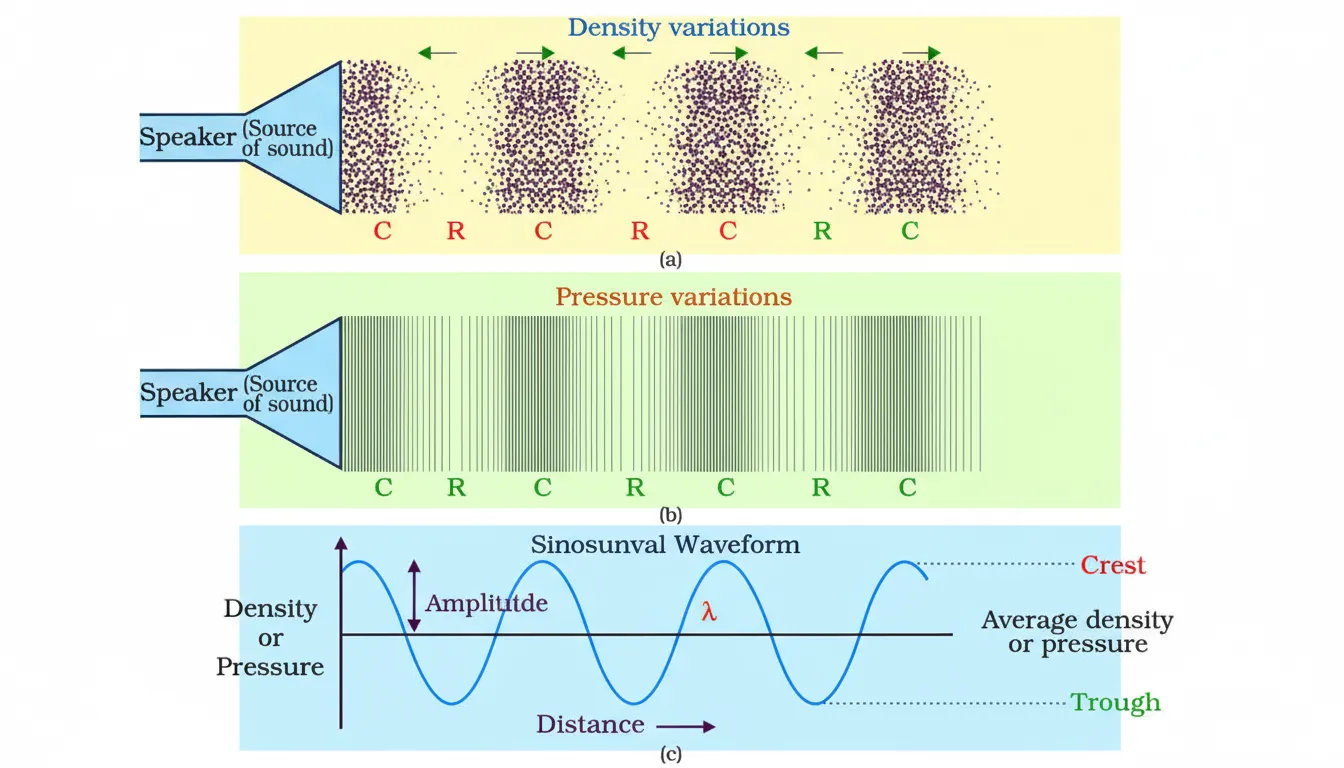
PROPAGATION OF SOUND LONGITUDINAL WAVE IN A MEDIUM Vibrating Source (Tuning Fork) C C R R C C R R C C R R C C R R C = COMPRESSION Region of high pressure & high density R = RAREFACTION Region of low pressure & low density Direction of Wave Propagation Particle motion (Back & Forth) DENSITY & PRESSURE VARIATION GRAPH Density / Pressure (High) Density / Pressure (Low) Mean Value Distance Crest (Peak) Trough Wavelength (λ)
🔊

Production of Sound

📘 Definition
💡 Concept
Basic Concept
🔢 Important Formulae
🔗 Relationship Between Vibrations and Sound
Property of Vibration Effect on Sound
Higher Frequency Higher Pitch
Lower Frequency Lower Pitch
Greater Amplitude Louder Sound
Smaller Amplitude Softer Sound
✏️ Example
Solved Example
Why does a bell stop producing sound after some time?
  1. 1
    Identify the source of sound.
  2. 2
    Determine what happens to vibrations.
  3. 3
    Draw the conclusion.
A bell produces sound because it vibrates after being struck. Due to air resistance and internal friction, the vibrations gradually decrease and finally stop. Once the vibrations stop, no sound is produced.
A tuning fork completes 512 vibrations every second. Find its frequency.
  1. Number of vibrations in one second
    \[f=512\;Hz\]
  2. Therefore, the frequency of the tuning fork is
    \[\boxed{512\;Hz}\]
🌟 Board Exam Important Points
⚡ Exam Tip
❌ Common Mistakes
  • Writing that sound is produced without vibration.
  • Confusing loudness with pitch.
  • Assuming particles travel from the source to the listener.
  • Ignoring the requirement of a material medium.
  • Using frequency and time period interchangeably without formulas.
📋 CBSE Case Study (HOTS)

During a laboratory activity, a student strikes a tuning fork and brings it close to a suspended lightweight ball. The ball repeatedly moves away from the tuning fork. After a few seconds, the ball stops moving.

Questions
  1. Why does the ball move away initially?
  2. Why does the movement stop after some time?
  3. Which property of sound is demonstrated?
Answers
  1. The vibrating tuning fork transfers energy to the ball through its vibrations.
  2. The vibrations gradually die out because of damping caused by air resistance and internal friction.
  3. Sound is produced only by vibrating bodies.
🔊

Propagation of Sound

📘 Definition
💡 Basic Concept
📌 How Does Sound Propagate?
🗂️ Types / Category
Compression and Rarefaction
Compression
  • Region of high pressure.
  • Particles are closer together.
  • Density of the medium is higher.
  • Pressure is maximum.
Rarefaction
  • Region of low pressure.
  • Particles are farther apart.
  • Density of the medium is lower.
  • Pressure is minimum.
A sound wave consists of alternate compressions and rarefactions moving through the medium.
📌 Motion of Particles During Propagation
🔎 Why Does Sound Need a Material Medium?
🗒️ Propagation In Different Media
Medium Particle Arrangement Relative Speed of Sound
Solid Very closely packed Fastest
Liquid Moderately packed Moderate
Gas Loosely packed Slowest
Vacuum No particles Sound cannot propagate

Since particles in solids are packed more closely than in liquids and gases, collisions occur more quickly, making sound travel fastest in solids.

✏️ Example
Solved Example
Why is sound not heard in outer space?
  1. 1
    Identify the requirement for sound propagation.
  2. 2
    Check whether space satisfies this condition.
  3. 3
    Conclude accordingly.
Sound requires a material medium containing particles. Outer space is nearly a vacuum and contains almost no particles to transmit vibrations. Therefore, sound cannot propagate through outer space.
A sound wave has frequency \(500\,Hz\) and wavelength \(0.68\,m\). Find its speed.
Given: \[f=500\,Hz\] \[\lambda=0.68\,m\]
  1. Using Formula
    \[v=f\lambda\]
  2. Substituing Values
    \[\begin{aligned}v&=500\times0.68\\&=340\,m\,s^{-1}\end{aligned}\]
Answer: The speed of the sound wave is \(340\,m\,s^{-1}\)
⚡ Exam Tip
❌ Common Mistakes
  • Writing that particles travel along with the wave.
  • Confusing compression with rarefaction.
  • Stating that sound can travel through vacuum.
  • Using amplitude instead of wavelength while calculating wave speed.
  • Forgetting that sound is longitudinal.
📋 CBSE Case Study (HOTS)

Two students are standing on opposite sides of a long railway track. One student gently strikes the track with a hammer. The other student places one ear on the track and also keeps the other ear open to the air. He notices that the sound through the track reaches earlier than the sound through the air.

Questions
  1. Why is the sound heard earlier through the railway track?
  2. Which medium carries sound faster?
  3. What property of sound is demonstrated?
Answers
  1. Particles in solids are closely packed, allowing faster transfer of vibrations.
  2. Sound travels faster through solids than through gases.
  3. The speed of sound depends on the nature of the medium.
⚡ Quick Revision
  • Sound propagates through vibrations of particles.
  • Propagation requires a material medium.
  • Particles oscillate but do not travel with the wave.
  • Compressions and rarefactions form a longitudinal wave.
  • Sound travels fastest in solids and slowest in gases.
  • Sound cannot propagate through vacuum.
  • \[ v=f\lambda \]
🔊

How Sound Travels

📖 Introduction
🗒️ How Does Sound Travel? (Ringing Bell Example)

Consider a bell that has just been struck with a hammer.

  1. The metal surface of the bell begins to vibrate rapidly.
  2. The vibrating bell pushes the nearby air particles, producing a compression.
  3. When the bell moves backward, the air particles spread apart, creating a rarefaction.
  4. These compressed particles collide with the next layer of particles and transfer their energy.
  5. The neighbouring particles repeat the same process.
  6. The sound wave finally reaches the listener's ear, causing the eardrum to vibrate.
  7. The brain interprets these vibrations as the sound of the bell.

Although the sound wave travels from the bell to the listener, the air particles themselves only move back and forth through very small distances.

🗒️ Motion Of Particles During Sound Propagation

A common misconception is that air particles travel from the source to our ears. This is incorrect.

Each particle simply oscillates around its mean position and transfers energy to the adjacent particle. This is similar to a line of dominoes where energy moves forward even though each domino falls only in its own place.

Wave Particles
Moves from source to listener Oscillate about equilibrium position
Transfers energy Do not travel with the wave
Travels long distances Move only a very small distance
📌 Energy Transfer During Sound Propagation
🗒️ Why Does Sound Need A Material Medium?

Sound travels because particles collide with one another and transfer vibrations. Without particles, this transfer becomes impossible.

Hence, sound can travel through:

  • Air
  • Water
  • Wood
  • Iron
  • Glass
  • Human body tissues

Since vacuum contains no particles, sound cannot propagate through it.

🗒️ Why Can't Sound Travel In Vacuum?

A vacuum is a region where there are practically no particles. Since sound depends on collisions between particles, it cannot travel through empty space.

This is why astronauts cannot hear each other directly in outer space. They communicate using radio waves, which are electromagnetic waves and do not require a material medium.

⚖️ Sound versus Light
Property Sound Light
Nature Mechanical wave Electromagnetic wave
Needs Medium Yes No
Travels in Vacuum No Yes
Examples Speech, music, thunder Sunlight, laser, bulb
✏️ Everyday Examples
  • Hearing the ringing of a school bell.
  • Listening to music through loudspeakers.
  • Talking over a telephone.
  • Hearing thunder after lightning.
  • Listening to a train whistle from a distance.
  • Doctors using a stethoscope to hear heartbeats.
✏️ Example
Solved Example
Why do astronauts communicate using radio waves instead of sound waves?
  1. 1
    Recall the requirement for sound transmission
  2. 2
    Consider the conditions in outer space.
  3. 3
    State the conclusion.
Sound requires a material medium for propagation, whereas outer space is nearly a vacuum. Therefore, sound cannot travel between astronauts. Radio waves are electromagnetic waves that can travel through vacuum, so they are used for communication.
Explain why the air particles do not reach our ears even though sound does.
Each air particle vibrates about its mean position and transfers energy to the next particle. Thus, only the sound energy propagates while the particles remain near their original positions.
🌟 Board Examination Important Points
⚡ Exam Tip
❌ Common Mistakes
  • Confusing particle motion with wave motion.
  • Writing that sound travels in vacuum.
  • Assuming sound carries matter.
  • Confusing sound waves with light waves.
  • Ignoring the role of compressions and rarefactions.
📋 CBSE Case Study (HOTS)

During a space documentary, two astronauts are shown working outside their spacecraft. One astronaut accidentally drops a metal tool, which collides with another object. Although the collision produces vibrations, the second astronaut cannot hear the sound directly.

Questions
  1. Why is the collision not heard directly?
  2. Which type of wave is used for communication in space?
  3. What important property of sound is illustrated?
Answers
  1. Space is nearly a vacuum, so sound cannot propagate.
  2. Radio waves (electromagnetic waves).
  3. Sound requires a material medium for transmission.
⚡ Quick Revision
  • Sound is produced by vibrating objects.
  • Sound travels through a material medium only.
  • Particles oscillate but do not travel with the wave.
  • Energy is transferred from one particle to another.
  • Compressions and rarefactions form the sound wave.
  • Vacuum cannot transmit sound.
🎨 SVG Diagram
How Sound Travels from a Ringing Bell to the Human Ear
BELL (Source) DIRECTION OF ENERGY TRAVEL Compression Rarefaction Compression Rarefaction Compression EAR (Receiver)
🔊

Types of Sound Waves

📖 Introduction
⚖️ Classification of Mechanical Waves
Type of Wave Particle Motion Example
Longitudinal Wave Parallel to the direction of wave propagation Sound in air
Transverse Wave Perpendicular to the direction of wave propagation Waves on a stretched string
Since sound in air travels through successive compressions and rarefactions, it belongs to the longitudinal wave category.
🗒️ Longitudinal Sound Waves

Longitudinal Sound Waves

📘 Definition
A longitudinal wave is a wave in which the particles of the medium vibrate parallel to the direction in which the wave travels.

As the particles move to and fro, alternate regions of compression and rarefaction are formed. These regions move through the medium and carry sound energy.
🔷 Characteristics
  • Requires a material medium.

  • Particle motion is parallel to wave motion.

  • Consists of compressions and rarefactions.

  • Transfers energy without transferring matter.

  • Cannot travel through vacuum.

Compression
Definition
A compression is the region of a longitudinal wave where particles of the medium are crowded together.
Characteristics
  • Particles are very close together.
  • Pressure is maximum.
  • Density is high.
  • Energy concentration is greater.
Rarefaction
Definition
A rarefaction is the region of a longitudinal wave where particles of the medium are farther apart.
Characteristics
  • Particles are widely spaced.
  • Pressure is minimum.
  • Density is low.
  • Energy concentration is comparatively lower.
🗒️ Compression Versus Rarefaction
Property Compression Rarefaction
Particle Spacing Very close Far apart
Pressure High Low
Density High Low
Particle Arrangement Crowded Spread apart
🤔 Did You Know?
How are Compressions and Rarefactions Formed?
  1. A vibrating object moves forward.
  2. Nearby particles are pushed closer together, producing a compression.
  3. The object then moves backward.
  4. The particles spread apart, producing a rarefaction.
  5. This process repeats continuously, forming a longitudinal sound wave.
✏️ Example
Solved Example
Why are sound waves in air called longitudinal waves?
  1. 1
    Observe the direction of particle vibration.
  2. 2
    Compare it with the direction of wave propagation.
  3. 3
    Draw the conclusion.
In air, the particles vibrate back and forth in the same direction as the wave propagates. Therefore, sound waves in air are longitudinal waves.
Distinguish between compression and rarefaction.
  • Compression is a region of high pressure and high density.
  • Rarefaction is a region of low pressure and low density.
  • Compression contains closely packed particles, whereas rarefaction contains particles that are farther apart.
⚡ Exam Tip
❌ Common Mistakes
  • Writing that sound waves in air are transverse.
  • Confusing compression with crest.
  • Confusing rarefaction with trough.
  • Writing that particles travel along with the sound wave.
  • Ignoring the difference between wave motion and particle motion.
📋 CBSE Case Study (HOTS)

A student observes a vibrating tuning fork placed near small suspended thermocol balls. The balls move periodically as the sound wave passes through air.

Questions
  1. Which type of wave is produced by the tuning fork in air?
  2. What causes the thermocol balls to move?
  3. Name the two regions formed during propagation of sound.
Answers
  1. Longitudinal wave.
  2. The oscillating air particles transfer energy to the balls.
  3. Compression and rarefaction.
⚡ Quick Revision
  • Sound is a mechanical longitudinal wave.
  • Particle motion is parallel to wave propagation.
  • Compression is a region of high pressure.
  • Rarefaction is a region of low pressure.
  • Longitudinal waves contain compressions and rarefactions.
  • Transverse waves contain crests and troughs.
  • Sound cannot travel through vacuum.
🔊

Characteristics of a Sound Wave

📖 Introduction
🖼️ Figure
Characteristics of a Sound Wave
Important physical quantities associated with a longitudinal sound wave.
🗂️ Types / Category
Fundamental characteristics of a sound wave are
Amplitude (\(A\))
Definition
Amplitude is the maximum displacement of the particles of a medium from their mean (equilibrium) position during vibration.
Concept
The amplitude indicates the strength of vibration. A larger amplitude means the particles vibrate farther from their mean positions and the sound wave carries more energy.
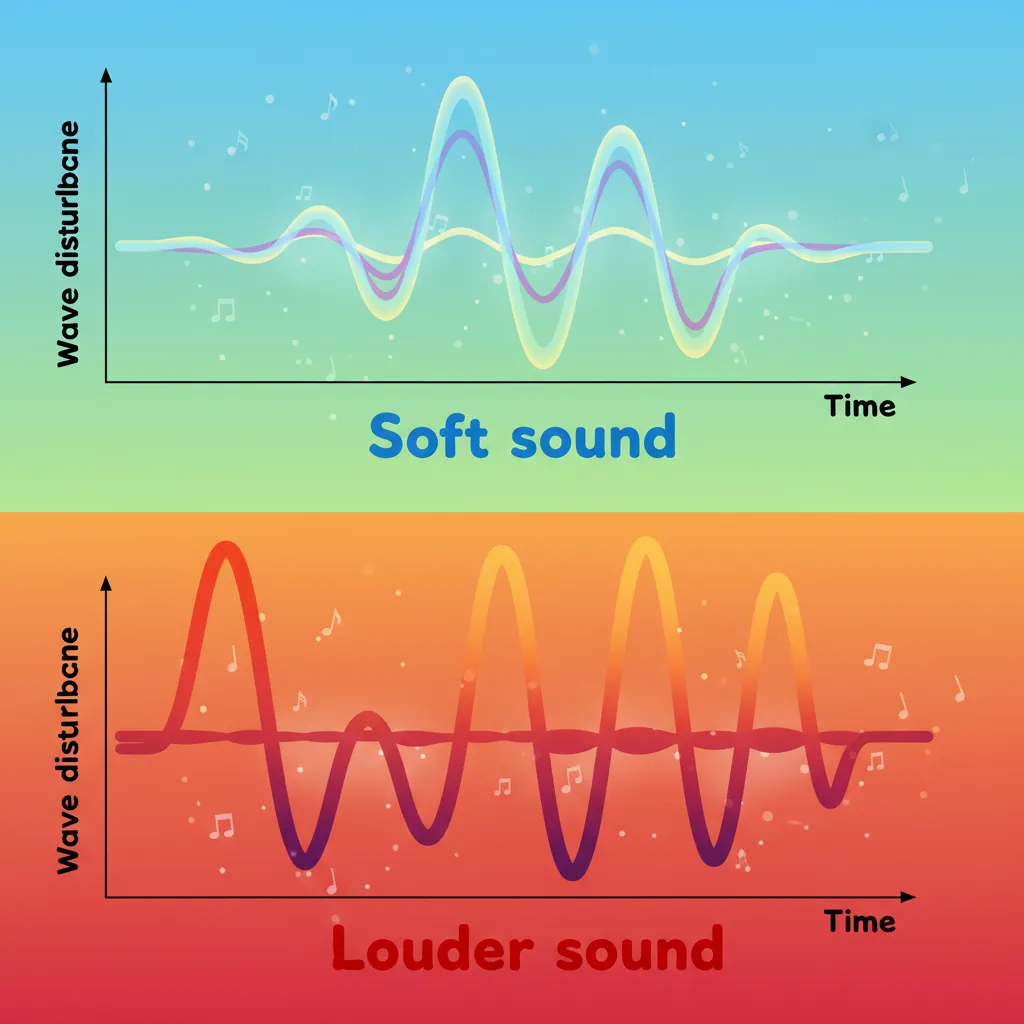
Effect on Sound
  • Greater amplitude → Louder sound
  • Smaller amplitude → Softer sound
  • Energy carried by a sound wave increases with amplitude.
SI Unit
Metre (m)
Example
A person speaking softly produces sound waves of small amplitude, whereas shouting produces sound waves of much larger amplitude.
Soft and Loud Sound
Greater amplitude produces louder sound.
Frequency (\(f\) or \(\nu\))
Definition
Frequency is the number of complete vibrations or oscillations produced in one second.
Formula
\[f=\frac{\text{Number of Vibrations}}{\text{Time}}\] \[f=\frac{N}{t}\]
SI Unit
Hertz (Hz)
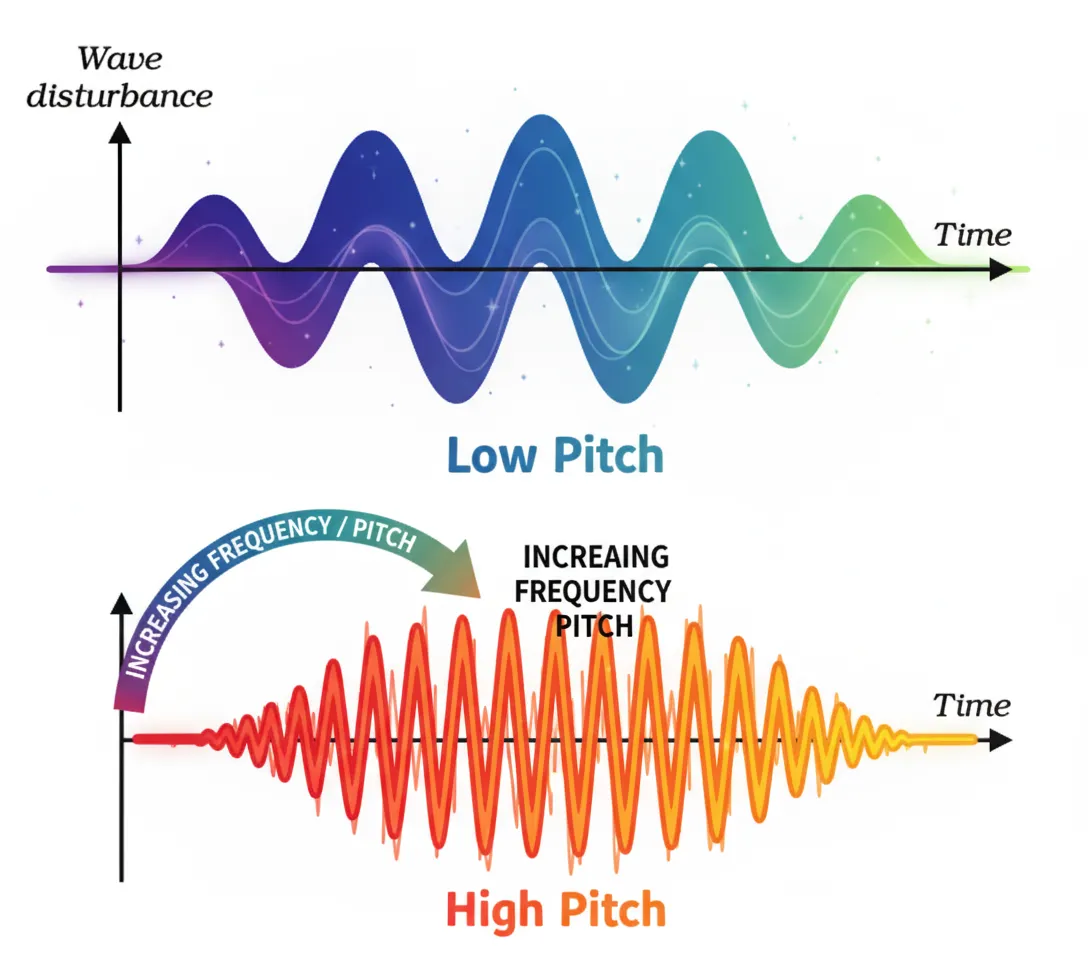
Effect on Sound
  • Higher frequency → Higher pitch.
  • Lower frequency → Lower pitch.
  • Frequency does not affect loudness.
Examples
  • A child's voice generally has a higher frequency than an adult man's voice.
  • A whistle produces a higher frequency than a drum.
Low and High Pitch
Higher frequency corresponds to higher pitch.
Time Period (\(T\))
Definition
The time required to complete one full vibration is called the time period.
SI Unit
Second (s)
Formula
\[T=\frac{1}{f}\] or \[f=\frac{1}{T}\]
Relationship
  • Higher frequency → Smaller time period.
  • Lower frequency → Larger time period.
Example
If a sound has frequency \(500\;Hz\), \[T=\frac{1}{500}=0.002\;s\]
Wavelength (\(\lambda\))
Definition
Wavelength is the distance between two successive compressions or two successive rarefactions of a longitudinal sound wave.
SI Unit
Metre (m)
Characteristics
  • Denoted by the Greek letter \(\lambda\).
  • Longer wavelength corresponds to lower frequency.
  • Shorter wavelength corresponds to higher frequency.
Relation with Frequency
Since\[v=f\lambda\] for a fixed speed,\[\lambda\propto\frac{1}{f}\]
Audible Frequency Range
Type of Sound Frequency Range
Infrasonic Sound Less than 20 Hz
Audible Sound 20 Hz to 20,000 Hz
Ultrasonic Sound More than 20,000 Hz
📘 Definition

Speed of Sound (\(v\))

📐 Derivation
Derivation of Wave Speed Formula
Speed is defined as \[v=\frac{\text{Distance}}{\text{Time}}\] During one complete vibration, the sound wave travels one wavelength.
Distance \(=\lambda\)
Time \(=T\) \[v=\frac{\lambda}{T}\] Since \[f=\frac{1}{T}\] Therefore,\[\boxed{v=f\lambda}\]
⚖️ Comparison
Comparison of Characteristics
Characteristic Determines SI Unit
Amplitude Loudness m
Frequency Pitch Hz
Time Period Duration of one vibration s
Wavelength Distance between successive compressions m
Speed Rate of propagation \(m\,s^{-1}\)
✏️ Example
Solved Examples
A sound wave has frequency \(250\;Hz\). Find its time period.
  1. 1
    Write the given quantity.
  2. 2
    Use the relation \(T=\frac{1}{f}\).
  3. 3
    Calculate the answer.
Given: \[f=250\;Hz\]
  1. Using Formula
    \[T=\frac{1}{f}\]
  2. Substituting Value
    \[\begin{aligned} T&=\frac{1}{250}\\&=0.004\;s\end{aligned}\]
Answer: \(0.004\;s\)
A sound wave has wavelength \(1.5\;m\) and frequency \(240\;Hz\). Find its speed.
Given: \[\lambda=1.5\;m\] \[f=240\;Hz\]
  1. Using Formula
    \[v=f\lambda\]
  2. Substituting Value
    \[\begin{aligned} v&=240\times1.5\\&=360\;m\,s^{-1}\end{aligned}\]
Answer: \(360\;m\,s^{-1}\)
⚡ Exam Tip
❌ Common Mistakes
  • Confusing amplitude with frequency.
  • Writing that frequency determines loudness.
  • Using incorrect SI units.
  • Forgetting the inverse relation between frequency and time period.
  • Using wavelength instead of amplitude to explain loudness.
📋 CBSE Case Study (HOTS)

A music teacher strikes two tuning forks. The first tuning fork produces a frequency of \(256\;Hz\), while the second produces \(512\;Hz\). Both are struck with the same force.

Questions
  1. Which tuning fork produces a higher-pitched sound?
  2. If both are struck equally hard, what can you say about their amplitudes?
  3. Which characteristic determines pitch?
Answers
  1. The tuning fork of \(512\;Hz\).
  2. Their amplitudes may be nearly equal.
  3. Frequency determines pitch.
⚡ Quick Revision
  • Amplitude → Loudness
  • Frequency → Pitch
  • Time Period → Time for one vibration
  • Wavelength → Distance between two consecutive compressions or rarefactions
  • Speed → Distance travelled in one second
  • \[ T=\frac{1}{f} \]
  • \[ v=f\lambda \]
🔊

Example 1

❓ Question
Solved Example: Time Taken by a Sound Wave
A sound wave has a frequency of 2 kHz and a wavelength of 35 cm. How long will it take to travel a distance of 1.5 km?
💡 Concept
Concept Used
🗺️ Roadmap
  1. Convert all quantities into SI units.
  2. Calculate the speed of sound using \(v=f\lambda\).
  3. Use \(t=\dfrac{d}{v}\) to determine the time taken.
🧩 Solution
Given: Frequency, \[ f=2\,kHz=2\times10^{3}\,Hz \] Wavelength, \[ \lambda=35\,cm=0.35\,m \] Distance travelled, \[ d=1.5\,km=1.5\times10^{3}\,m \]
Part (a)
Calculate the Speed of Sound
  1. Using Formula
    \[v=f\lambda\]
  2. Substituting Values
    \[\begin{aligned} v&=2\times10^{3}\times0.35\\ &700\,m\,s^{-1} \end{aligned} \]
Part (b)
Calculate the Time Taken
  1. Using Formual
    \[\begin{aligned}v&=\frac{\text{Distance}}{\text{Time}}\\\Rightarrow t&=\frac{d}{v}\end{aligned}\]
  2. Substituting Values
    \[ \begin{aligned} t&=\frac{1.5\times10^{3}}{700}\\ &=2.14\,s \end{aligned} \]
Answer: The sound wave will take approximately \(2.1\,\text{s}\) to travel a distance of 1.5 km.
⚡ Exam Tip
❌ Common Mistakes
  • Using wavelength as 35 m instead of 0.35 m.
  • Using 2 instead of \(2\times10^3\) Hz.
  • Forgetting to convert 1.5 km into 1500 m.
  • Using \(v=\dfrac{t}{d}\) instead of \(v=\dfrac{d}{t}\).
🔊

Reflection of Sound

📘 Definition
💡 Concept
🤔 Did You Know?
How Does Reflection of Sound Occur?
  1. A sound source produces sound waves.
  2. The waves travel through a material medium.
  3. The waves strike a rigid surface.
  4. The surface reflects a major portion of the sound energy.
  5. The reflected waves travel back through the same medium.
  6. If these reflected waves reach our ears, we hear the reflected sound.
⚖️ Laws of Reflection of Sound
Reflection of sound follows the same laws as the reflection of light.
First Law
The angle of incidence is equal to the angle of reflection. \[\boxed{i=r}\] where,
  • \(i\) = angle of incidence
  • \(r\) = angle of reflection
Second Law
The incident sound wave, the reflected sound wave and the normal at the point of incidence all lie in the same plane.
Term Meaning
Incident Sound Wave Sound wave striking the reflecting surface.
Reflected Sound Wave Sound wave returning after striking the surface.
Normal An imaginary line drawn perpendicular to the reflecting surface.
Angle of Incidence Angle between the incident wave and the normal.
Angle of Reflection Angle between the reflected wave and the normal.

Conditions for Reflection of Sound

  • The reflecting surface should be sufficiently large compared to the wavelength of the sound.
  • The surface should be hard, rigid and smooth to produce clear reflection.
  • Soft materials such as curtains, carpets, foam and sponge absorb sound instead of reflecting it.
  • For a distinct echo in air at room temperature, the reflector should be at least 17.2 m away from the listener.
  • The surrounding medium should allow sound to travel with minimum obstruction.
🛠️ Applications of Reflection of Sound
  • Echo formation.
  • SONAR (Sound Navigation and Ranging).
  • Stethoscope used by doctors.
  • Megaphones and loudhailers.
  • Hearing aids.
  • Sound boards in auditoriums.
  • Ultrasonic imaging.
  • Detection of underwater objects.
⚖️ Reflection versus Absorption
Reflection Absorption Sound returns to the same medium. Sound energy is absorbed by the material. Occurs on hard surfaces. Occurs on soft and porous surfaces. Produces echo. Reduces echo.
🤔 Did You Know?
Why Must the Reflector be at Least 17.2 m Away for an Echo?
The human ear can distinguish two separate sounds only if they are heard at least 0.1 s apart.

Speed of sound in air, \[v=344\,m\,s^{-1}\] Distance travelled by sound in 0.1 s is \[\begin{aligned}d&=vt\\&=344\times0.1\\&=34.4\,m\end{aligned}\] Since sound travels to the reflector and then returns, \[ \begin{aligned} \text{Distance to reflector} &=\frac{34.4}{2}\\ &=17.2\,m \end{aligned} \] Hence, the reflector should be at least 17.2 m away for a distinct echo.
✏️ Example
Solved Example
Why are carpets and curtains used in cinema halls?
  1. 1
    Identify the property of carpets.
  2. 2
    Relate it to reflection of sound.
  3. 3
    State the purpose.
Carpets and curtains are soft and porous materials that absorb sound. They reduce multiple reflections and prevent echoes, thereby improving the clarity of speech and music inside the hall.
State the two laws of reflection of sound.
  1. The angle of incidence is equal to the angle of reflection.
  2. The incident wave, reflected wave and the normal lie in the same plane.
🌟 Board Examination Important Points
⚡ Exam Tip
❌ Common Mistakes
  • Writing that sound reflects only from metal surfaces.
  • Confusing reflection with absorption.
  • Forgetting that the reflector should be sufficiently large.
  • Using 17.2 m as the total distance travelled instead of the one-way distance.
  • Writing incorrect laws of reflection.
📋 CBSE Case Study (HOTS)

During the renovation of a school auditorium, engineers install thick curtains, upholstered seats and acoustic panels on the walls. After renovation, speeches become much clearer and echoes are greatly reduced.

Questions
  1. Why were thick curtains installed?
  2. Which property of sound is involved?
  3. Would polished marble walls increase or decrease echoes?
Answers
  1. They absorb reflected sound and reduce echoes.
  2. Reflection and absorption of sound.
  3. They would increase echoes because marble is a hard reflecting surface.
⚡ Quick Revision
  • Reflection is the bouncing back of sound into the same medium.
  • Hard surfaces are good reflectors.
  • Soft surfaces absorb sound.
  • \[ i=r \]
  • Incident wave, reflected wave and normal lie in the same plane.
  • Minimum distance for a distinct echo = 17.2 m.
🎨 SVG Diagram
Illustration - Reflection of Sound
REFLECTION OF SOUND NCERT CLASS 9 • SCIENCE • CHAPTER 11 LAWS OF REFLECTION 1. Angle of Incidence (i) = Angle of Reflection (r) 2. Incident wave, reflected wave and normal all lie in the same plane. REFLECTING SURFACE (HARD WALL) NORMAL WOODEN SHIELD / BARRIER LISTENER / RECEIVER (Ear / Sound Detector) TUBE A TUBE B INCIDENT SOUND WAVE ➔ ➔ REFLECTED SOUND WAVE i Angle of Incidence r Angle of Reflection ∠i = ∠r
🔊

Echo

📘 Definition
💡 Concept
🤔 Did You Know?
How is an Echo Produced?
  1. A person produces a sound.
  2. The sound wave travels through air.
  3. It strikes a distant hard surface.
  4. The sound wave is reflected.
  5. The reflected wave travels back to the listener.
  6. If the reflected sound arrives after at least 0.1 second, it is heard as a separate sound called an echo.
📌 Conditions Necessary for Hearing an Echo
🛠️ Applications of Echo
  • SONAR for measuring the depth of oceans.
  • Detecting underwater submarines and rocks.
  • Medical ultrasonography.
  • Locating fish beneath water.
  • Echolocation by bats and dolphins.
  • Measuring the distance of distant obstacles.
  • Geological surveys.
ℹ️ Animals that Use Echo (Echolocation)
Animal Purpose
Bat Navigation and hunting insects.
Dolphin Finding prey and avoiding obstacles.
Whale Communication and underwater navigation.
✏️ Example
Solved Example
A person standing 100 m from a cliff shouts loudly. If the speed of sound is \(340\,m\,s^{-1}\), after how much time will the echo be heard?
  1. 1
    Remember that sound travels to the cliff and back.
  2. 2
    Calculate the total distance.
  3. 3
    Use \(t=\dfrac{d}{v}\).
Given: Distance = 100 m
Speen of Sound = \(340\,m\,s^{-1}\)
  1. Distance travelled by sound
    \[d=2\times100=200\,m\]
  2. Time taken
    \[t=\frac{d}{v}\]
  3. Substituting Values
    \[\begin{aligned}t&=\frac{200}{340}\\&=0.59\,s\end{aligned}\]
Answer: \(0.59\,s\)
✏️ Examples from Daily Life
  • Shouting near a mountain valley.
  • Calling out near a large empty building.
  • Echo heard inside deep wells.
  • Sound reflected from tunnels.
  • Voice heard repeatedly near large cliffs.
⚡ Exam Tip
❌ Common Mistakes
  • Using only the one-way distance instead of the total distance.
  • Writing that echo occurs after any reflection.
  • Confusing echo with repeated shouting.
  • Ignoring the minimum time interval of 0.1 s.
  • Using the wrong speed of sound in calculations.
📋 Case Study

During a trekking expedition, a group of students shouted toward a nearby mountain and heard their voices repeated after a short interval. Their teacher explained that the repeated sound was caused by reflection from the mountain.

Questions
  1. What is this repeated sound called?
  2. Why is the mountain able to produce an echo?
  3. What minimum time interval is required for hearing a distinct echo?
  4. What should be the approximate minimum distance between the students and the mountain?
Answers
  1. Echo.
  2. The mountain is a large, hard reflecting surface.
  3. 0.1 second.
  4. Approximately 17.2 m.
⚡ Quick Revision
  • Echo is the repetition of sound due to reflection.
  • Reflecting surface should be hard, smooth and large.
  • Minimum time interval = 0.1 s.
  • Minimum reflector distance ≈ 17.2 m.
  • Total distance travelled by sound = To reflector + Back to listener.
  • Echo is used in SONAR and echolocation.
🔊

Example 2

❓ Question
Finding the Distance of a Cliff Using Echo
A person clapped his hands near a cliff and heard the echo after \(2\,s\). Find the distance of the cliff from the person if the speed of sound is \(346\,m\,s^{-1}\).
💡 Concept
🗺️ Roadmap
  1. Understand that the given time includes the forward and return journeys.
  2. Calculate the one-way travel time.
  3. Apply the formula \(d=vt\).

🧩 Solution
Given: Speed of sound,\[v=346\,m\,s^{-1}\] Total time for hearing the echo,\[T=2\,s\]
Calculate the Time Taken to Reach the Cliff
  1. using Formula
    \[t=\frac{T}{2}\]
  2. Substituting Value
    \[t=\frac{2}{2} = 1\,s\]
Calculate the Distance
  1. Using Formula
    \[\text{Distance}=v\times t\]
  2. Substituting Values
    \[d=346\times1=346\;m\]
  3. Therefore, the distance between the person and the cliff is
    \[\boxed{346\,m}\]
Answer: The cliff is \(346\,m\) away from the person.
⚡ Exam Tip
❌ Common Mistakes
  • Using the total time directly instead of halving it.
  • Calculating 692 m as the distance of the cliff instead of the total distance travelled by sound.
  • Forgetting that the sound travels to the cliff and back.
  • Using incorrect units for speed or time.
🔊

Reverberation

📘 Definition
💡 Concept
🤔 Did You Know?
How Does Reverberation Occur?
  1. A sound source produces sound waves.
  2. The waves strike walls, ceiling and floor.
  3. The sound is reflected repeatedly from these surfaces.
  4. Several reflected waves overlap with the original sound.
  5. The sound continues to be heard for a short time after the source stops.
Causes of Reverberation
  • Large enclosed rooms.
  • Hard and smooth reflecting surfaces.
  • Marble or concrete walls.
  • Glass windows.
  • High ceilings.
  • Absence of sound-absorbing materials.
Effects of Reverberation
Positive Effects Negative Effects
Makes music richer in concert halls. Speech becomes unclear.
Improves the fullness of musical notes. Words overlap with one another.
Enhances the listening experience when properly controlled. Causes noise and listening discomfort.
📌 Methods to Reduce Reverberation
ℹ️ Common Sound-Absorbing Materials
Material Use
Foam Panels Recording studios
Heavy Curtains Auditoriums
Carpets Conference halls
Acoustic Fibre Boards Theatres
Wood Fibre Panels Music rooms
⚖️ Difference Between Echo and Reverberation
Echo Reverberation
Single reflected sound. Multiple reflected sounds.
Heard as a separate sound. Overlaps with the original sound.
Time gap is at least 0.1 s. Time gap is less than 0.1 s.
Occurs in open places such as valleys. Occurs inside enclosed rooms.
Usually caused by one reflection. Caused by many successive reflections.
✏️ Examples from Daily Life
  • Large school auditorium.
  • Railway station announcements.
  • Temple halls.
  • Churches and mosques.
  • Indoor sports stadiums.
  • Empty classrooms.
🛠️ Applications of Controlled Reverberation
  • Concert halls.
  • Music recording studios.
  • Theatres.
  • Cinema halls.
  • Conference rooms.
In these places, a small amount of reverberation is desirable because it improves the quality of music, but excessive reverberation reduces speech intelligibility.
✏️ Example
Solved Examples
Why are thick curtains installed in theatres and auditoriums?
  1. 1
    Identify the property of curtains.
  2. 2
    Relate it to reflection of sound.
  3. 3
    Draw the conclusion.
Thick curtains absorb a large portion of incident sound instead of reflecting it. This reduces multiple reflections inside the hall, thereby minimizing reverberation and improving the clarity of speech and music.
Why does speech become unclear in an empty hall?
Empty halls contain many hard reflecting surfaces. Sound undergoes repeated reflections and overlaps with the original sound, producing reverberation. As a result, speech becomes unclear.
🌟 Board Examination Important Points
⚡ Exam Tip
❌ Common Mistakes
  • Writing that reverberation and echo are the same phenomenon.
  • Ignoring the role of multiple reflections.
  • Writing that curtains reflect sound.
  • Assuming reverberation occurs only outdoors.
  • Forgetting that reverberation affects speech clarity.
📋 CBSE Case Study (HOTS)

A newly constructed auditorium has polished marble walls and floor. During the inauguration, the audience finds it difficult to understand the speaker because the sound appears to continue even after each word is spoken. Later, acoustic panels and thick curtains are installed, and the sound quality improves significantly.

Questions
  1. Which phenomenon caused the unclear speech?
  2. Why did installing acoustic panels improve the sound quality?
  3. Name two materials commonly used to reduce reverberation.
Answers
  1. Reverberation.
  2. They absorbed reflected sound and reduced multiple reflections.
  3. Foam panels and thick curtains (or carpets).
⚡ Quick Revision
  • Reverberation is the persistence of sound.
  • It is caused by multiple reflections.
  • Occurs mainly in enclosed halls and rooms.
  • Speech becomes unclear due to overlapping sounds.
  • Foam, curtains and carpets reduce reverberation.
  • A controlled amount of reverberation improves musical quality.
🎨 SVG Diagram
Illustration - Reverberstion
REVERBERATION OF SOUND NCERT CLASS 9 • SCIENCE • CHAPTER 11 WHAT IS REVERBERATION? The persistence of sound in a big hall due to repeated reflections off walls, ceiling, and floor is called reverberation. LARGE AUDITORIUM / CONCERT HALL Source Listener Direct Path 1st Reflection (Ceiling) Multiple Reflections Reflection (Floor) SOUND INTENSITY DECAY PROFILE Time (t) ➔ Intensity (I) Direct Reverberation (Overlapping Echoes)
🔊

Uses of Multiple Reflection of Sound

📖 Introduction
📌 Working Principle
🗂️ Types / Category
Applications
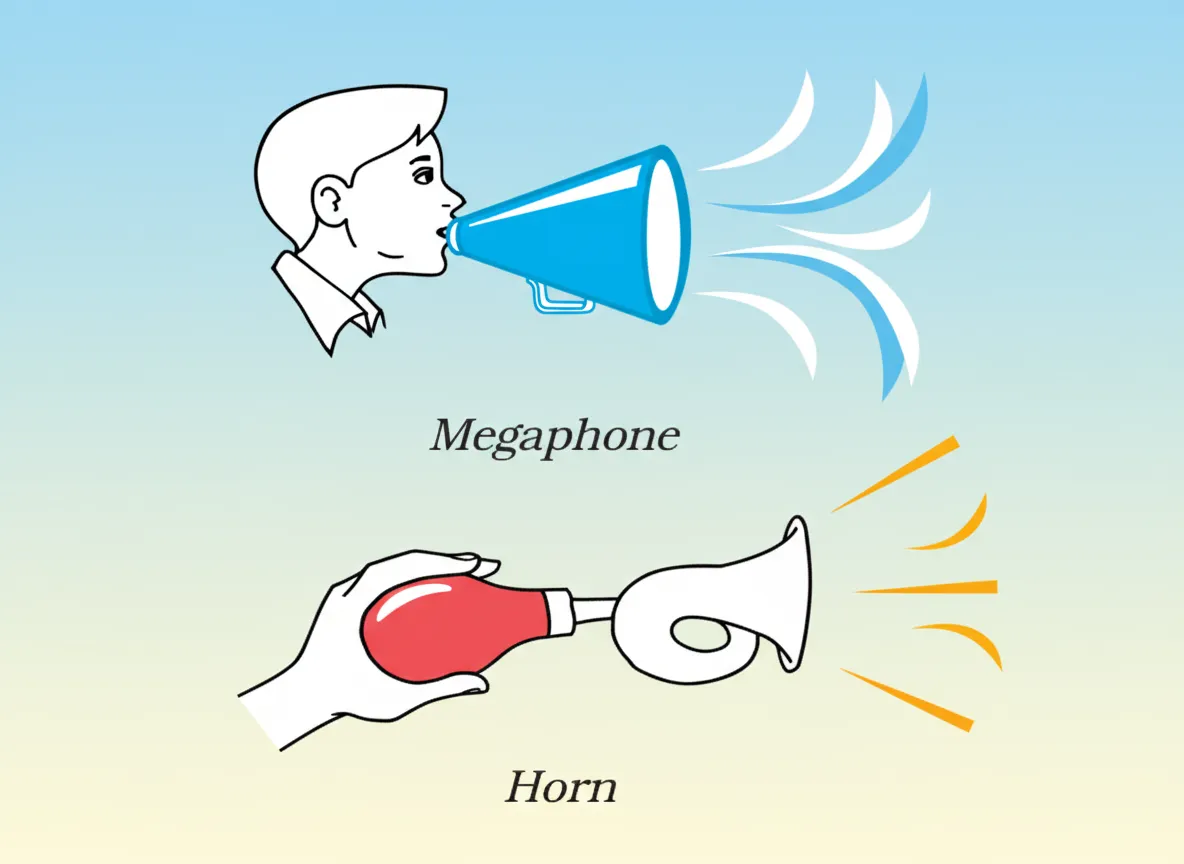
Sound Magnifiers (Megaphones, Horns and Musical Instruments)
Concept
Megaphones, loudhailers, horns, trumpets, bugles and shehnais are designed so that sound undergoes multiple reflections inside their gradually widening tubes.

These repeated reflections prevent sound from spreading in all directions and concentrate it into a narrow beam, making it travel farther.
Applicatins
  • Public announcements.
  • Emergency rescue operations.
  • Sports events.
  • Political rallies.
  • Military bugles and horns.
Megaphone and Horn
Multiple reflections inside a megaphone direct sound in one preferred direction.
Echo Sounding
Echo sounding is a technique used to measure the depth of oceans, seas, lakes and rivers by using reflected sound waves.
Working Principle
  1. A sound pulse is sent downward into water.
  2. The pulse strikes the seabed.
  3. The reflected sound returns to the ship.
  4. The time taken is measured.
  5. The depth is calculated using the speed of sound in water.
Formula
\[\boxed{d=\frac{vt}{2}}\] where
  • \(d\) = depth of water
  • \(v\) = speed of sound in water
  • \(t\) = total time for the echo
SONAR (Sound Navigation and Ranging)
SONAR is an instrument that uses ultrasonic waves and their reflections to detect, locate and measure the distance of underwater objects.
Working Principle
  1. Ultrasonic waves are emitted into water.
  2. They strike an underwater object.
  3. The reflected waves are received back.
  4. The time interval is measured.
  5. The distance is calculated.
Applicatins
  • Locating submarines.
  • Detecting underwater rocks.
  • Finding shoals of fish.
  • Oceanographic surveys.
  • Navigation of ships.
Sound Boards
Sound boards are specially designed curved reflecting surfaces installed behind speakers or performers to direct sound uniformly throughout an auditorium.

They prevent excessive loss of sound energy and improve speech clarity for every listener.
Sound Board
Sound boards distribute reflected sound uniformly across the audience.
Medical Applications (Ultrasonography)
Doctors use ultrasonic waves to examine internal organs of the human body. Ultrasonic waves are reflected differently by different tissues and organs.

A computer analyses these reflected waves and produces detailed images of internal body structures.
Applicatins
  • Pregnancy scanning.
  • Examination of kidneys.
  • Heart imaging (Echocardiography).
  • Detection of gallstones.
  • Examination of liver and pancreas.
Architectural Design
Engineers use the principles of reflection while designing auditoriums, lecture halls, theatres, conference rooms and cinema halls.

Proper placement of reflecting and sound-absorbing materials ensures that every listener hears clear speech without excessive reverberation or echoes.
Common Design Features
  • Curved ceilings.
  • Acoustic wall panels.
  • Sound boards.
  • False ceilings.
  • Curtains and carpets.
🛠️ Other Important Applications
Application Purpose
Stethoscope Guides body sounds to the doctor's ears.
Hearing Aid Improves sound transmission.
Whispering Gallery Transfers sound through multiple reflections.
Acoustic Shell Projects music towards the audience.
📝 Summary
Summary of Uses
✏️ Example
Solved Example
Why is the mouthpiece of a megaphone made wide at one end?
  1. 1
    Recall the principle of multiple reflection.
  2. 2
    Explain the direction of sound.
  3. 3
    State the conclusion.
The gradually widening tube causes sound waves to undergo multiple reflections, directing them in one preferred direction. This reduces spreading of sound and makes it audible over larger distances.
⚡ Exam Tip
❌ Common Mistakes
  • Confusing SONAR with RADAR.
  • Writing that megaphones amplify sound electrically.
  • Forgetting that echo sounding uses reflected sound.
  • Ignoring the role of ultrasonic waves in medical imaging.
  • Confusing reflection with reverberation.
📋 CBSE Case Study (HOTS)

During a naval exercise, a ship uses SONAR to detect an underwater submarine. At the same time, a nearby auditorium is renovated by installing curved sound boards and acoustic panels to improve sound quality during public lectures.

Questions
  1. Which principle is common to both SONAR and sound boards?
  2. Why are ultrasonic waves preferred in SONAR?
  3. What is the purpose of installing sound boards?
Answers
  1. Reflection of sound.
  2. Ultrasonic waves are highly directional and produce sharp reflections.
  3. To distribute sound uniformly throughout the auditorium.
⚡ Quick Revision
  • Multiple reflection directs sound efficiently.
  • Megaphones, horns and shehnais work on this principle.
  • Echo sounding measures the depth of water.
  • SONAR detects underwater objects.
  • Sound boards improve sound distribution.
  • Ultrasonography uses reflected ultrasonic waves.
  • Architectural acoustics relies on controlled reflection and absorption.
🔊

Range of Hearing

📘 Definition
📌 Human Hearing Range
📌 Infrasonic Sound
📘 Definition
Sound waves having frequencies \(<20\,Hz\] are called infrasonic waves.
🔷 Characteristics
  • Cannot be heard by humans.
  • Have very long wavelengths.
  • Can travel long distances.
  • Produced naturally during earthquakes, volcanic eruptions and storms.
Animals That Use Infrasonic Sound
  • Elephants
  • Whales
  • Rhinoceroses
📌 Ultrasonic Sound
📘 Definition
Sound waves having frequencies \(>20,000\,Hz\) are called ultrasonic waves.
🔷 Characteristics
  • Cannot be heard by humans.
  • Have very short wavelengths.
  • Can be reflected easily from small objects.
  • Useful in medical and industrial applications.
🛠️ Applications
  • SONAR
  • Ultrasonography
  • Cleaning delicate electronic components
  • Detection of cracks in metals
  • Measurement of distances underwater
ℹ️ Hearing Range of Different Animals
Animal Approximate Hearing Range (Hz) Special Ability
Human 20 – 20,000 Normal hearing
Dog 40 – 60,000 Can hear ultrasonic sounds
Cat 60 – 65,000 Excellent high-frequency hearing
Bat 20,000 – 100,000 Uses echolocation
Dolphin 20 – 150,000 Uses ultrasonic echolocation
Elephant 1 – 20,000 Detects infrasonic sounds
⚖️ Comparison of Different Frequency Ranges
Property Infrasonic Audible Ultrasonic
Frequency <20 Hz 20–20,000 Hz >20,000 Hz
Human Hearing No Yes No
Examples Elephant communication Speech and music SONAR, ultrasonography
✏️ Real-Life Applications
  • Dogs detect ultrasonic whistles used by trainers.
  • Bats navigate in darkness using ultrasonic waves.
  • Dolphins locate fish through echolocation.
  • Elephants communicate over long distances using infrasonic waves.
  • Doctors use ultrasound to examine internal organs.
🔎 Interesting Facts
✏️ Example
Solved Examples
A sound has a frequency of \(15\,Hz\). Can a normal human hear it? Name the type of sound.
  1. 1
    Compare the frequency with the audible range.
  2. 2
    Identify the category.
Since \[15\,Hz<20\,Hz\] the sound is infrasonic and cannot be heard by a normal human ear.
A sound wave has a frequency of \(50,000\,Hz\). Name the type of sound and mention one practical application.
Since \[50,000\,Hz>20,000\,Hz\] it is an ultrasonic wave. One important application is medical ultrasonography.
⚡ Exam Tip
❌ Common Mistakes
  • Writing 20 Hz – 2,000 Hz as the audible range.
  • Confusing infrasonic with ultrasonic.
  • Assuming humans can hear ultrasonic waves.
  • Confusing frequency with loudness.
  • Writing bats use infrasonic waves instead of ultrasonic waves.
📋 CBSE Case Study (HOTS)

During a visit to a wildlife park, students learn that bats can fly safely in complete darkness without colliding with obstacles. They also observe that elephants communicate over long distances even when no audible sound is heard.

Questions
  1. Which type of sound do bats use?
  2. Which type of sound do elephants use for communication?
  3. Can humans hear either of these sounds?
Answers
  1. Ultrasonic sound.
  2. Infrasonic sound.
  3. No. Both lie outside the normal audible range of humans.
⚡ Quick Revision
  • Human hearing range = 20 Hz – 20 kHz.
  • Infrasonic frequency < 20 Hz.
  • Ultrasonic frequency > 20 kHz.
  • Bats and dolphins use ultrasonic waves.
  • Elephants use infrasonic waves.
  • Ultrasonic waves are used in SONAR and ultrasonography.
🎨 SVG Diagram
Frequency Spectrum
SOUND FREQUENCY SPECTRUM NCERT CLASS 9 • SCIENCE • CHAPTER 11 RANGE OF HEARING
INFRASONIC (< 20 Hz): Inaudible to humans. Produced by earthquakes and volcanic eruptions. Used by whales, rhinos, and elephants.
AUDIBLE RANGE (20 Hz - 20 kHz): Frequencies perceived by human ears. Sensitivity to higher frequencies typically decreases with age.
ULTRASONIC (> 20 kHz): Inaudible to humans. Utilized by bats for echolocation, dolphins, and in medical diagnostic imaging.
20 Hz 20,000 Hz (20 kHz) INFRASOUND (Sub-audible) Elephants • Rhinos AUDIBLE RANGE (Human Hearing) Humans • Music • Speech ULTRASOUND (Super-audible) Bats • Dolphins
🔊

Applications of Ultrasound

📖 Introduction
🏷️ Important Properties of Ultrasound
Properties
Frequency
Greater than 20 kHz (20,000 Hz)
Audibility
Cannot be heard by the human ear
Wavelength
Very short wavelength
Medium of Propagation
Travels through solids, liquids and gases
Reflection
Reflects from tiny objects and small cracks
Directionality
Can be focused into a narrow beam
Energy
Carries a large amount of energy
🗂️ Applications
Medical Imaging (Ultrasonography / Sonography)
Concept
Ultrasonography is a medical imaging technique in which ultrasonic waves are sent into the body. The waves are reflected by different tissues and organs. A computer processes these reflected waves to produce images of internal body structures.
Applications
  • Monitoring the growth of a baby during pregnancy.
  • Examining the liver, kidneys and gall bladder.
  • Studying the heart (Echocardiography).
  • Detecting cysts and tumours.
  • Examining muscles and tendons.
Advantages
  • Non-invasive technique.
  • No harmful ionising radiation.
  • Safe for pregnant women.
  • Produces real-time images.
Cleaning Delicate Objects
Ultrasonic cleaners use high-frequency sound waves to remove dirt, grease and dust from objects that cannot be cleaned effectively by hand.
Working Principle
  1. The object is immersed in a cleaning liquid.
  2. Ultrasonic waves produce millions of tiny bubbles in the liquid.
  3. The bubbles collapse rapidly (cavitation).
  4. The collapsing bubbles remove dirt even from tiny holes and narrow gaps.
Examples
  • Jewellery.
  • Electronic circuit boards.
  • Watches.
  • Surgical instruments.
  • Coins and antique artefacts.
Detecting Internal Cracks and Defects
Industries use ultrasonic testing (UT) to detect hidden cracks and defects inside metals and machine parts without damaging them.
Working Principle
  1. Ultrasonic waves are sent into the material.
  2. If the material is perfect, the waves travel normally.
  3. Cracks reflect the waves back earlier than expected.
  4. The reflected waves reveal the location of the defect.
Applications
  • Aircraft components.
  • Railway tracks.
  • Bridges.
  • Pipelines.
  • Industrial machines.
Breaking Kidney Stones (Lithotripsy)
Doctors use focused ultrasonic waves to break kidney stones into very small fragments without performing major surgery.
Process
  • Ultrasonic waves are focused on the kidney stone.
  • The concentrated energy breaks the stone into tiny pieces.
  • The fragments are removed naturally through urine.
Advantages
  • Non-surgical treatment.
  • Less pain.
  • Faster recovery.
SONAR (Sound Navigation and Ranging)
SONAR uses ultrasonic waves to detect underwater objects and measure the depth of oceans and seas.
Working Principle
  1. A ship sends ultrasonic pulses into water.
  2. The waves strike an underwater object.
  3. The reflected waves return to the ship.
  4. The time taken is measured.
  5. The distance is calculated.
Formula

\[ \boxed{d=\frac{vt}{2}} \]

where

  • \(d\) = distance of the object
  • \(v\) = speed of sound in water
  • \(t\) = total travel time
Applications
  • Submarines.
  • Ships.
  • Ocean exploration.
  • Locating shoals of fish.
  • Finding underwater rocks.
Blood Flow Measurement (Doppler Ultrasound)
Doppler ultrasound is used to measure the speed and direction of blood flow inside arteries and veins.
Applications
  • Detecting blocked arteries.
  • Checking blood circulation.
  • Studying heart function.
  • Monitoring blood flow during pregnancy.
🛠️ Other Important Applications
Application Purpose
Ultrasonic Welding Joining plastic components.
Dental Cleaning Removing plaque and tartar.
Industrial Thickness Measurement Measuring thickness of metal sheets.
Fish Finders Locating fish underwater.
Security Sensors Motion detection systems.
✏️ Example
Solved Example
Why are ultrasonic waves preferred for medical imaging instead of ordinary audible sound?
  1. 1
    Recall the properties of ultrasound.
  2. 2
    Relate them to image formation.
  3. 3
    State the advantages.
Ultrasonic waves have very high frequencies and short wavelengths. They can penetrate body tissues and produce clear reflections from internal organs. These reflected waves are used to form detailed images. Moreover, ultrasound does not involve harmful ionising radiation, making it safe for medical diagnosis.
🌟 Board Examination Important Points
⚡ Exam Tip
❌ Common Mistakes
  • Writing that ultrasound uses electromagnetic waves.
  • Confusing SONAR with RADAR.
  • Writing that ultrasound is harmful like X-rays.
  • Using audible sound instead of ultrasonic sound in medical applications.
  • Confusing lithotripsy with surgery.
📋 CBSE Case Study (HOTS)

A patient undergoes ultrasonography to examine the liver. Another patient receives lithotripsy to remove kidney stones without surgery. Meanwhile, a ship sailing in the ocean uses SONAR to detect underwater rocks.

Questions
  1. Which type of sound wave is common to all three situations?
  2. Why is ultrasonography considered safer than X-ray imaging during pregnancy?
  3. What principle is used by SONAR?
Answers
  1. Ultrasonic waves.
  2. It does not use harmful ionising radiation.
  3. Reflection of ultrasonic waves.
⚡ Quick Revision
  • Ultrasound frequency > 20,000 Hz.
  • Cannot be heard by humans.
  • Used in ultrasonography and Doppler imaging.
  • Used for breaking kidney stones.
  • Used in SONAR and echo sounding.
  • Used to detect internal cracks in metals.
  • Used for cleaning delicate instruments and jewellery.
🔊

Important Points (Quick Revision)

📝 Summary
⚡ Last Minute Board Revision
  • Sound is a mechanical longitudinal wave.
  • Sound cannot travel through vacuum.
  • Amplitude → Loudness.
  • Frequency → Pitch.
  • Human hearing range = 20 Hz – 20 kHz.
  • Echo requires a minimum time gap of 0.1 s.
  • Minimum reflector distance ≈ 17.2 m.
  • Remember the formula \[ v=f\lambda \]
  • SONAR and ultrasonography use ultrasonic waves.
  • Reverberation is caused by multiple reflections.
· Updated
NCERT · Class IX · Science · Chapter 11

Sound

Vibrations, waves, echoes, and the physics behind everything you hear

Production of Sound

Sound is produced whenever an object vibrates — a rapid, to-and-fro motion about a fixed (mean) position. A plucked guitar string, a struck tuning fork, and vibrating vocal cords are all sources of sound. Stop the vibration and the sound stops instantly.

  • The vibrating object disturbs the particles of the medium next to it.
  • Those particles pass the disturbance to their neighbours, and so on — the disturbance travels, but the particles themselves only oscillate about their mean positions.

Propagation — Sound Needs a Medium

Sound travels through solids, liquids, and gases, but it cannot travel through vacuum. This is famously shown by suspending a ringing bell inside a bell jar and pumping the air out — the sound fades and eventually vanishes even though the bell is still visibly ringing.

Key idea: Sound is a mechanical wave — it needs material particles to travel, unlike light, which is an electromagnetic wave and can cross a vacuum.

Sound is a Longitudinal Wave

In a sound wave, particles of the medium vibrate parallel to the direction in which the wave travels. This creates alternating regions of:

Compression

Particles crowd together — region of high pressure and high density.

Rarefaction

Particles spread apart — region of low pressure and low density.

C R C R C

Wavelength, Frequency, Time Period, Amplitude

Wavelength (λ)

Distance between two consecutive compressions (or two consecutive rarefactions). Measured in metres (m).

Frequency (f)

Number of complete oscillations per second. Measured in hertz (Hz). Frequency decides the pitch.

Time Period (T)

Time taken to complete one full oscillation. Measured in seconds. T and f are reciprocals of each other.

Amplitude (A)

Maximum displacement of a particle from its mean position. Amplitude decides the loudness.

Pitch vs Loudness — Do Not Mix Them Up

These are the two most confused ideas in this chapter, so keep them cleanly separate:

  • Pitch (shrillness) ← controlled by frequency. Higher frequency → higher pitch.
  • Loudness ← controlled by amplitude. Larger amplitude → louder sound, measured in decibel (dB).

The Wave Equation

The three quantities are tied together by one central relationship, which you will use constantly in numericals:

v = f × λ

Speed of the wave = Frequency × Wavelength

Why Speed Varies With the Medium

Speed of sound depends on the elasticity and density of the medium. As a general rule for the medium's rigidity:

v(solid) > v(liquid) > v(gas)

Approximate Speeds (at room conditions)

MediumApprox. Speed
Air (0 °C)331 m/s
Air (25 °C)346 m/s
Water1480 m/s
Steel≈ 5960 m/s

Temperature and Frequency Effects

  • Speed of sound in a gas increases with temperature.
  • Speed of sound in a given medium (at a fixed temperature) does not depend on the frequency or loudness of the sound — every note travels at the same speed through the same air.

Laws of Reflection of Sound

Sound reflects off hard, large surfaces exactly like light reflects off a mirror:

  • The angle of incidence equals the angle of reflection.
  • The incident sound, the reflected sound, and the normal all lie in the same plane.

Echo & Persistence of Hearing

An echo is the distinctly heard repetition of a sound caused by reflection from a hard surface (cliff, wall, building). For the brain to register the reflected sound as separate from the original, the gap between them must exceed the persistence of hearing — about 0.1 s for the human ear.

d(min) = (v × 0.1) / 2

With v ≈ 344 m/s, the reflecting surface must be at least ≈ 17.2 m away for a distinct echo.

Reverberation

In a large hall, sound reflects again and again off walls, ceiling, and floor before dying out, so the original sound seems to persist and blur together. This is reverberation. Excessive reverberation makes speech hard to follow, so auditoriums line their walls and ceilings with sound-absorbent materials (heavy curtains, carpets, rough plaster, perforated boards) to control it.

Uses of Multiple Reflection

Megaphones, horns, and stethoscopes all use repeated reflection to direct or amplify sound in a chosen direction; curved soundboards behind a stage reflect sound evenly toward the audience.

The Audible Range

A healthy young human ear can detect sound frequencies roughly between:

20 Hz  —  20,000 Hz (20 kHz)

Infrasonic and Ultrasonic Sound

Infrasound

Frequency below 20 Hz. Produced during earthquakes, and used by elephants and whales to communicate over long distances.

Ultrasound

Frequency above 20,000 Hz. Used by bats and dolphins for echolocation, and by us for SONAR and medical imaging.

How the Human Ear Works

Pinna (outer ear) funnels sound down the auditory canal → strikes the eardrum, making it vibrate → three tiny middle-ear bones (hammer, anvil, stirrup) amplify the vibration → passed to the fluid-filled cochlea in the inner ear → hair cells convert the vibration into electrical signals → carried by the auditory nerve to the brain, which interprets them as sound.

What Makes Ultrasound Special

Because of its very high frequency, ultrasound carries a lot of energy, travels in a narrow directional beam, and can be reflected sharply off small objects — properties that make it extremely useful in both navigation and medicine.

SONAR — SOund NAvigation And Ranging

A ship sends an ultrasonic pulse toward the sea bed. The pulse reflects off the bed (or an object like a submarine or shoal of fish) and returns to a detector on the ship. Knowing the speed of sound in water and the time taken, the depth or distance can be calculated:

Depth = (v(water) × t) / 2

Medical & Industrial Applications

  • Ultrasonography: imaging internal organs and monitoring a foetus during pregnancy.
  • Lithotripsy: breaking kidney stones into fine grains without surgery, using focused ultrasonic waves.
  • Industrial flaw detection: locating cracks and defects inside metal blocks that are invisible from outside.
  • Cleaning: reaching narrow crevices of delicate components (jewellery, watch parts, electronic circuits).

Rule-Based Step-by-Step Sound Solver

Pick the kind of problem you're facing, fill in what you know, and the solver will work through it one step at a time — entirely offline, no external AI service involved.

Wave Equation

v = f × λ

Speed = Frequency × Wavelength

Time Period

T = 1 / f

Time period is the reciprocal of frequency

Frequency

f = 1 / T

Frequency is the reciprocal of time period

Round-Trip Echo Distance

d = v × t

Total distance sound covers going out and coming back

One-Way Distance to Obstacle

d = (v × t) / 2

Divide the round trip by 2 to get distance to the reflecting surface

Minimum Echo Distance

d(min) = (v × 0.1) / 2

Based on 0.1 s persistence of hearing

SONAR Depth

Depth = (v(water) × t) / 2

Same idea as echo, applied under water

Oscillations in Time t

N = f × t

Number of complete oscillations completed in time t

01

SONAR problems and ordinary echo problems use the exact same formula — only the medium (and therefore the speed value) changes.

02

Lock in the pairing early: Pitch → Frequency, Loudness → Amplitude. Almost every conceptual MCQ tests this pairing.

03

Whenever a question gives the total time for sound to "go and come back," divide by 2 before using it as one-way distance or time.

04

Remember the word association: COMPRESSION = crowded (high pressure), RAREFACTION = rare/spread out (low pressure).

05

Speed of sound depends only on the medium and temperature — never on the frequency, wavelength, or loudness of the particular sound.

06

To convert a speed given in km/h into m/s, divide by 3.6 — useful whenever a problem mixes vehicle speeds with sound speed.

07

If a distance given in an echo problem is less than the calculated minimum echo distance, the correct conclusion is "no distinct echo is heard," not an error in your working.

08

Solids generally carry sound fastest because their particles are closest together and most elastic — order to memorise: solid > liquid > gas.

✗ Mistake

Treating amplitude and wavelength as the same thing.

✓ Correct

Amplitude is the maximum displacement of a particle (linked to loudness); wavelength is the distance between two consecutive compressions (linked to the wave's spatial repeat).

✗ Mistake

Using the full echo time as the one-way distance calculation without dividing by 2.

✓ Correct

The time given for an echo usually covers the round trip. Distance to the obstacle = (speed × time) / 2.

✗ Mistake

Assuming sound can travel through a vacuum, like light does.

✓ Correct

Sound is a mechanical wave — it absolutely needs a material medium (solid, liquid, or gas) and cannot travel through vacuum.

✗ Mistake

Believing a higher-frequency sound is automatically louder.

✓ Correct

Frequency governs pitch (shrillness), not loudness. Loudness is governed by amplitude alone.

✗ Mistake

Assuming the speed of sound is identical in every medium.

✓ Correct

Speed depends on the medium's elasticity and density: generally v(solid) > v(liquid) > v(gas).

✗ Mistake

Using 0.1 s directly as an echo travel time in every problem.

✓ Correct

0.1 s is the ear's persistence of hearing, used only to find the minimum distance for a distinct echo — not a universal value to plug into every echo question.

Question 1 of 10 Score: 0

Click a card to flip it. Use the arrows to move through the deck.

1 / 10

Click a term, then click its matching definition. Matched pairs lock in gold.

Pairs matched: 0 / 6

Type the missing word for each sentence, then check your answers.

Drag the sliders to see how frequency and amplitude reshape the wave, and watch the live wave equation.

Set the distance to a cliff and fire a sound pulse — see whether a distinct echo would be heard.

📚
ACADEMIA AETERNUM तमसो मा ज्योतिर्गमय · Est. 2025
Sharing this chapter
NCERT Class 9 Sound Notes | Science Chapter 11
NCERT Class 9 Sound Notes | Science Chapter 11 — Complete Notes & Solutions · academia-aeternum.com
Sound is an essential part of our everyday life. Whether it’s the laughter of friends, music from your favourite song, or the honking of cars, sound constantly surrounds us and helps us communicate and understand our environment. In this chapter, you will explore what sound is, how it is produced, how it travels, and how we hear it. You will learn about the properties of sound waves, the differences between noise and musical notes, and important concepts like frequency, pitch, loudness, and the…
🎓 Class 9 📐 Science 📖 NCERT ✅ Free Access 🏆 CBSE · JEE
Share on
academia-aeternum.com/class-9/science/sound/notes/ Copy link
💡
Exam tip: Sharing chapter notes with your study group creates a reinforcement loop. Teaching a concept is the fastest path to mastering it.

Recent posts

    Sound — Learning Resources

    📝 Exercises

    Frequently Asked Questions

    Sound is a form of energy produced by vibrating objects. These vibrations create disturbances in air, which travel as sound waves to our ears.

    The main properties are amplitude, frequency, wavelength, speed, and timbre. These determine loudness, pitch, and quality of sound.

    Vibrations in an object set the surrounding air molecules in motion, creating waves of compressions and rarefactions that travel as sound.

    Frequency is the number of vibrations (oscillations) per second. Its unit is Hertz (Hz). It determines the pitch of the sound.

    Sound waves with greater amplitude carry more energy and sound louder to our ears; smaller amplitude means quieter sounds.

    Compressions are regions where air particles are close together, and rarefactions are where they are spread apart. Both travel as sound waves.

    The ear collects sound waves, which make the eardrum vibrate. These vibrations are converted into signals sent to the brain.

    Humans can typically hear frequencies from 20 Hz to 20,000 Hz.

    Ultrasound means sound waves with frequencies above 20,000 Hz. They're used in medical imaging, cleaning, detecting flaws in metals, and sonar.

    Sound needs a material medium like air, water, or solids. It travels fastest in solids, slower in liquids, and slowest in gases.

    At room temperature (25°C), sound travels at about 344 metres per second in air.

    Molecules in solids are packed closer together, allowing sound waves to transfer energy more rapidly.

    Get in Touch

    Let's Connect

    Questions, feedback, or suggestions?
    We'd love to hear from you.