KE
PE
⚡ Chapter 9 · NCERT Science IX

WORK& ENERGY

When force meets displacement — kinetic energy, potential energy, the work-energy theorem, and conservation of total mechanical energy.

W = FdWork
½mv²Kinetic Energy
mghPotential Energy
★★★★★Exam Weight
🏃
Kinetic Energy
KE = ½mv²
🪨
Potential Energy
PE = mgh
Mechanical Energy
ME = KE + PE
🔋
Power
P = W / t
Gravitational PE Kinetic Energy Heat / Sound
📌 Work-Energy theorem derivation is a high-probability 3–5 mark theory question.
📌 KE and PE numericals are asked in every board exam — sometimes combined in one problem.
📌 Conservation of energy during free fall — graphical representation tested in SA-II.
📌 Power and commercial unit of energy (kWh) appear in application-based questions.
Work DoneW = F·d·cosθJoule (J)
Kinetic EnergyKE = ½mv²J
Potential EnergyPE = mghJ
PowerP = W / tWatt (W)
1 kWh= 3.6 × 10⁶ JJ
  • 1Scientific definition of work and conditions for zero work
  • 2Kinetic energy and potential energy with derivations
  • 3Work-energy theorem and its proof
  • 4Law of conservation of energy with examples (pendulum, free fall)
  • 5Power, efficiency, and commercial unit of energy (kWh)
01
Zero Work Conditions
List all 3 cases: F=0, d=0, θ=90°. These are quick 1-mark setters.
02
Pendulum Diagram
Draw pendulum showing KE max at bottom, PE max at top — energy conservation in action.
03
Units Vigilance
Power = Watt, Energy = Joule, Work = Joule. Don't mix them up in numerical answers.
04
kWh Conversion
Always convert kWh to Joules in numericals: 1 kWh = 3.6 × 10⁶ J.
Chapter 10 · CBSE · Class IX

Work

Work Energy Force Kinetic Energy Potential Energy Power Mechanical Energy Work Formula Conservation of Energy NCERT Class 9 Science
📘 Definition
💡 Concept
Concept of Work
🗒️ Essential Conditions For Work To Be Done
  1. A force must act on the object.
  2. The object must undergo displacement.
  3. The displacement should have a component in the direction of the applied force.
If any one of these conditions is not satisfied, then the work done is zero.
📌 Scientific Meaning of Work
🔢 Formula
Formula for Work
🔢 Formula
General Formula of Work
🗂️ Types of Work
Positive Work Negative Work Zero Work
Positive Work
When force and displacement are in the same direction, the work done is positive.
Examples:
  • Pushing a trolley forward.
  • Pulling a suitcase.
  • A freely falling stone.
Formula:
\[W=Fs\]
Negative Work
When force acts opposite to the direction of displacement, work done is negative.
Examples:
  • Friction acting on a moving object.
  • Brakes applied to a moving vehicle.
  • Gravity acting while lifting an object upward.
Formula:
\[W=-Fs\]
Zero Work
Zero work is done when:
  • Displacement is zero.
  • Force is zero.
  • Force is perpendicular to displacement.
Examples:
  • Holding a bag while standing.
  • Pushing a wall.
  • Walking on a level road carrying a school bag.
  • Earth revolving around the Sun (centripetal force is perpendicular to motion).
🗒️ SI Unit Of Work
The SI unit of work is the Joule (J).

One joule is the work done when a force of one newton moves an object through one metre in the direction of the force. \[\mathrm{1\ J = 1\ Nm}\]
Larger Unit:
Commercial machines often perform very large amounts of work. Therefore, \[\mathrm{1\ kJ = 1000\ J}\]
📌 Dimensional Formula of Work
✏️ Real-Life Examples
Situation Is Work Done? Reason
Pushing a cart that moves. Yes Force produces displacement.
Pushing a wall. No No displacement.
Holding a suitcase. No No displacement.
Carrying a bag horizontally. No Force is vertical while displacement is horizontal.
Lifting a bucket. Yes Force and displacement are upward.
🎨 SVG Diagram
Illustration: Work Done by a Force
m Initial Position m Final Position Force F Displacement s
✏️ Example
Solved Example
A force of \(40N\) moves a box through a distance of \(6m\). Find the work done.
  1. 1
    Identify force.
  2. 2
    Identify displacement.
  3. 3
    Apply the formula.
Given: F=40N,
s=6m
  1. Using Formula
    \[W=Fs\]
  2. Substituting Values
    \[W=40\times6=240J\]
Answer: 240 Joule.
A person pushes a wall with a force of \(300N\), but the wall does not move. Calculate the work done.
Part (a)
  1. Since displacement is zero,
    \[s=0\]
  2. Therefore,
    \[W=Fs=300\times0=0J\]
Answer: Zero Joule.
🌟 Importance for CBSE Board Examination
⚡ Exam Tip
❌ Common Mistakes
  • Assuming that physical effort always means work.
  • Ignoring the direction of displacement.
  • Writing the unit as Newton instead of Joule.
  • Forgetting that work can be negative.
  • Believing that holding an object stationary involves mechanical work.
📋 CBSE Competency-Based Case Study (HOTS)

A labourer lifts bricks vertically to the roof of a building. Another labourer carries identical bricks horizontally across the roof without changing their height.

Questions

  1. Who performs mechanical work against gravity?
  2. Why is no work done against gravity while carrying the bricks horizontally?

Answer

  1. The labourer lifting the bricks performs positive work against gravity.
  2. While carrying horizontally, displacement is perpendicular to gravitational force; therefore, work done by gravity is zero.
⚡ Quick Revision
  • Work requires both force and displacement.
  • \[ W=Fs \]
  • General expression: \[ W=Fs\cos\theta \]
  • SI unit: Joule (J).
  • Positive work: Force and displacement in same direction.
  • Negative work: Force opposite to displacement.
  • Zero work: No displacement or force perpendicular to displacement.
  • Work is a scalar quantity.

Work Done by a Constant Force

📘 Definition
💡 Concept
📐 Derivation of the Formula
Consider a block placed on a smooth horizontal surface.
  • A constant force \(F\) acts on the block.
  • The block moves through a distance \(s\).
  • The force remains unchanged throughout the motion.
The work done is directly proportional to:
  1. The magnitude of the applied force.
  2. The displacement produced.
Therefore, \[W\propto F\] and \[ W\propto s\] Combining both, \[W\propto Fs\] Introducing the proportionality constant (equal to 1 in SI units), \[\boxed{\bbox[2pt]{W=Fs}}\]
📐 General Formula (For Advanced Understanding)
If the force makes an angle \(\theta\) with the direction of displacement, then only the component of force along the displacement performs work.

Hence, \[W=Fs\cos\theta\]
Angle Between Force and Displacement Work Done
\(0^\circ\) \(W=Fs\)
\(90^\circ\) \(W=0\)
\(180^\circ\) \(W=-Fs\)
🔷 Characteristics of Work Done by a Constant Force
🔷 Characteristics
  • Work is a scalar quantity; it has magnitude but no direction.

  • Work depends on both force and displacement.

  • If displacement doubles, work also doubles (provided force remains constant).

  • If force doubles while displacement remains constant, work also doubles.

  • The SI unit of work is Joule (J).

  • Work represents transfer of energy.

🔗 Relationship Between Force and Work
Force Displacement Work Done
Large Large Maximum
Large Small Moderate
Small Large Moderate
Zero Any Zero
Any Zero Zero
✏️ Example
Solved Example
A force of \(25N\) acts on a trolley and moves it through \(8m\). Calculate the work done.
  1. 1
    Write the given values.
  2. 2
    Apply the formula \(W=Fs\).
  3. 3
    Calculate the answer with SI unit.
Given: \[F=25N,\qquad s=8m\]
  1. Using Formula
    \[W=Fs\]
  2. Substituting Values
    \[W=25\times8=200J\]
Answer: \(200\,\mathrm{J}\)
A constant force of \(80N\) acts on a body, but the body does not move. Find the work done.
  1. Since
    \[s=0\]
  2. Therefore,
    \[W=Fs=80\times0=0J\]
🌟 Importance for Board Examination
❌ Common Mistakes
  • Writing work in Newton instead of Joule.
  • Ignoring the direction of displacement.
  • Assuming work is done whenever force is applied.
  • Forgetting that zero displacement means zero work.
  • Confusing force with energy.
📋 CBSE Competency-Based Case Study (HOTS)

During a warehouse operation, Worker A pushes a loaded trolley with a constant horizontal force of \(150N\), causing it to move \(12m\). Worker B applies the same force to another trolley, but it remains stationary because the brakes are engaged.

Questions

  1. Calculate the work done by Worker A.
  2. Calculate the work done by Worker B.
  3. Explain why both workers exert force but only one performs mechanical work.

Answer

Worker A:

\[ W=150\times12=1800J \]

Worker B:

\[ W=150\times0=0J \]

Mechanical work is done only when force produces displacement.

⚡ Quick Revision
  • \[ W=Fs \]
  • General formula: \[ W=Fs\cos\theta \]
  • \[ 1J=1Nm \]
  • Work is a scalar quantity.
  • Force and displacement together produce work.
  • Zero displacement means zero work.
  • Work represents transfer of energy.

Example 1

Work Energy Force Kinetic Energy Potential Energy Power Mechanical Energy Work Formula Conservation of Energy NCERT Class 9 Science
❓ Question
Solved Example: Work Done by a Constant Force
A constant force of \(7\,N\) acts on an object. The object moves through a displacement of \(8\,m\) in the direction of the applied force. Calculate the work done by the force.
💡 Concept
Concept Used
🗺️ Roadmap
  1. Write the given values.
  2. Identify the appropriate formula.
  3. Substitute the values.
  4. Write the answer with the correct SI unit.
🧩 Solution
Given: \[F=25N,\qquad s=8m\]
  1. Since the force and displacement are in the same direction,
    \[W=F\times s\]
  2. Substituting the given values,
    \[ \begin{aligned} W&=7\times8\\ &=56\,Nm \end{aligned} \]
  3. Since
    \[ 1\,Nm=1\,J \]
  4. Therefore,
    \[\boxed{W=56\,J}\]
Answer:The work done by the force is \(\boxed{56\,J}\)
🗒️ Result Analysis
  • The force and displacement are in the same direction.
  • Therefore, the work done is positive.
  • The object gains energy because positive work is performed on it.
⚡ Exam Tip
❌ Common Mistakes
  • Writing only \(56\) without the unit.
  • Using Newton (N) instead of Joule (J) as the unit of work.
  • Applying the formula without checking whether the displacement is in the direction of the force.

Example 2

Work Energy Force Kinetic Energy Potential Energy Power Mechanical Energy Work Formula Conservation of Energy NCERT Class 9 Science
❓ Question
Solved Example: Work Done in Lifting a Load
A porter lifts a luggage of mass \(15\,kg\) from the ground and places it on his head at a height of \(1.5\,m\). Calculate the work done by the porter on the luggage. Take \[ g=10\,m\,s^{-2}. \]
💡 Concept
Concept Used
🗺️ Roadmap
  1. Calculate the weight of the luggage.
  2. Use the weight as the applied force.
  3. Apply the work formula.
  4. Write the final answer in Joule.
🧩 Solution
Given:

Mass of luggage, \[ m=15\,kg \]

Height through which the luggage is lifted, \[ h=1.5\,m \]

Acceleration due to gravity, \[ g=10\,m\,s^{-2} \]

Solution 1
Calculate the weight of the luggage.
  1. \[ \begin{aligned} F&=mg\\ &=15\times10\\ &=150\,N \end{aligned} \]
Solution 2
Calculate the work done
  1. Since force and displacement are in the same direction,
    \[W=F\times h\]
  2. Substituting the values,
    \[ \begin{aligned} W&=150\times1.5\\ &=225\,Nm \end{aligned} \]
  3. Since
    \[1\,Nm=1\,J,\]
  4. therefore,
    \[\boxed{W=225\,J}\]
Answer:

The work done by the porter on the luggage is

\[ \boxed{225\,J} \]

🔍 Physical Interpretation
  • The porter performs positive work because the applied force and displacement are both upward.
  • The luggage gains gravitational potential energy equal to \[ 225\,J. \]
  • Ignoring air resistance, the work done by the porter is completely stored as potential energy of the luggage.
⚡ Exam Tip
❌ Common Mistakes
  • Using mass (\(15\,kg\)) directly as force.
  • Forgetting to calculate the weight using \[ F=mg. \]
  • Writing the answer in Newton instead of Joule.
  • Using an incorrect value of gravitational acceleration.

Forms of Energy

📘 Definition of Energy
💡 Concept
Concept of Energy
🔗 Relationship Between Work and Energy
Work and energy are two closely connected concepts.
  • If a body possesses energy, it can perform work.
  • Whenever work is done, energy is transferred or transformed.
  • More energy means greater ability to perform work.
Therefore, Energy = Capacity to do Work
📌 SI Unit of Energy
🔷 Characteristics of Energy
🔷 Characteristics
  • Energy is a scalar quantity.
  • Energy enables an object to perform work.
  • Energy exists in many different forms.
  • Energy can be transferred from one body to another.
  • Energy can be converted from one form into another.
  • The total energy of an isolated system remains constant.
📌 Different Forms of Energy
🗒️ Transformation Of Energy
Energy can neither be created nor destroyed, but it can change from one form to another.
Situation Energy Transformation
Electric bulb Electrical → Light + Heat
Electric fan Electrical → Mechanical
Hydroelectric power plant Potential → Kinetic → Electrical
Car engine Chemical → Mechanical + Heat
Human body Chemical (Food) → Mechanical + Heat
Solar panel Light → Electrical
🎨 SVG Diagram
Types of Energy
Energy Light Energy Electrical Mechanical Heat Energy Chemical Sound
✏️ Example
Solved Example
A machine performs \(500\,J\) of work. How much energy must it transfer to perform this work?
Energy transferred equals the work done.
Given: \[W=500\,J\]
  1. Work done
    \[W=500\,J\]
  2. Therefore,
    \[\text{Energy}=500\,J\]
🌟 Importance for CBSE Board Examination
⚡ Exam Tip
❌ Common Mistakes
  • Writing Newton (N) as the unit of energy.
  • Assuming energy has direction.
  • Confusing power with energy.
  • Believing that energy is created rather than transformed.
  • Forgetting that work and energy have identical SI units.
📋 CBSE Competency-Based Question (HOTS)

A hydroelectric power station stores water at a great height behind a dam. The water is allowed to fall onto turbines to generate electricity.

Questions

  1. Which form of energy does the stored water possess?
  2. Into which form is this energy converted while falling?
  3. What is the final useful form of energy produced?

Answer

  1. Gravitational Potential Energy.
  2. Kinetic Energy.
  3. Electrical Energy.
⚡ Quick Revision
  • Energy is the capacity to do work.
  • SI unit of energy is Joule (J).
  • \[ 1J=1Nm \]
  • \[ 1kJ=1000J \]
  • Energy can be transferred and transformed.
  • Mechanical energy consists of kinetic and potential energy.
  • Energy is a scalar quantity.

Major Forms of Energy

📖 Introduction
🗺️ Overview of Different Forms of Energy
Form of Energy Obtained Due To Common Examples
Kinetic Energy Motion of an object Moving car, flying bird
Potential Energy Position or shape Water in a dam, stretched spring
Mechanical Energy Motion and position together Pendulum, roller coaster
Chemical Energy Chemical bonds Food, petrol, batteries
Electrical Energy Movement of electric charges Electric fan, mobile charger
Heat (Thermal) Energy Random motion of particles Boiling water, steam
Light Energy Electromagnetic radiation Sunlight, LED lamp
Sound Energy Vibrations Loudspeaker, drum
Nuclear Energy Atomic nucleus Nuclear reactor, Sun
🗂️ Types of Energy (Class-9 Syllabus)
Kinetic Energy
Kinetic energy is the energy possessed by an object due to its motion. Every moving object, regardless of its size, possesses kinetic energy.

The amount of kinetic energy depends upon
  • The mass of the object.
  • The speed (velocity) of the object.
Examples
  • A moving cricket ball.
  • A running athlete.
  • A speeding train.
  • Flowing river water.
Potential Energy
Potential energy is the energy possessed by an object due to its position, shape, or configuration.

The object stores energy which can later be converted into kinetic energy.

Common types of potential energy include:
  • Gravitational Potential Energy — due to height above the ground.
  • Elastic Potential Energy — stored in stretched or compressed objects.
  • Chemical Potential Energy — stored in chemical substances.
Examples
  • Water stored behind a dam.
  • A stretched rubber band.
  • A compressed spring.
  • A book placed on a shelf.
⚡ Exam Tip
❌ Common Mistakes
  • Confusing mechanical energy with kinetic energy.
  • Assuming potential energy exists only because of height.
  • Forgetting that batteries store chemical energy, not electrical energy.
  • Thinking heat and temperature are the same physical quantity.
📋 CBSE Competency-Based Question (HOTS)

A hydroelectric power station stores water at a height. As the water falls, turbines rotate and an electric generator produces electricity.

Identify the sequence of energy transformations.

Answer:

Gravitational Potential Energy → Kinetic Energy → Mechanical Energy → Electrical Energy

Kinetic Energy

📘 Definition
💡 Concept of Kinetic Energy
🔎 Factors Affecting Kinetic Energy
🔢 Formula of Kinetic Energy
📐 Derivation of the Formula
Consider an object of mass \(m\) moving with an initial velocity \(u\). A constant force acts on it, causing its velocity to become \(v\) after travelling a distance \(s\).

From the third equation of motion, \[v^2-u^2=2as\] Rearranging, \[s=\frac{v^2-u^2}{2a}\tag{1}\] According to Newton's Second Law, \[F=ma\tag{2}\] Work done is \[W=Fs\tag{3}\] Substituting equations (1) and (2) into equation (3), \[ \require{cancel} \begin{aligned} W&=ma\left(\frac{v^2-u^2}{2a}\right)\\ &=m\cancel{a}\left(\frac{v^2-u^2}{2\cancel{a}}\right)\\ &=\frac12m(v^2-u^2) \end{aligned} \] If the object starts from rest,\[u=0\] Therefore, \[W=\frac12mv^2\] Since work done on the object is equal to the kinetic energy gained, \[\boxed{E_k=\frac12mv^2}\]
🔍 Physical Interpretation
  • A stationary object has zero kinetic energy.
  • Heavier objects possess more kinetic energy if they move with the same speed.
  • Fast-moving objects possess much greater kinetic energy because velocity is squared.
  • The energy required to stop a moving object equals its kinetic energy.
✏️ Real-Life Examples
Object Reason for Kinetic Energy
Running athlete Body is in motion.
Moving train Large mass and high speed.
Flying aeroplane Motion through air.
Rolling football Continuous motion.
Flowing river Moving water possesses kinetic energy.
🗒️ 
KINETIC ENERGY SIMULATOR NCERT Science Class-9 • Chapter 10: Work & Energy (Activity 10.6) KINETIC ENERGY FORMULA Ek = ½ m v² 10cm 20cm 30cm 40cm 50cm 60cm 70cm s = 12.5 cm BLOCK EXPERIMENTAL VARIABLES TROLLEY MASS (m) 2.0 kg INITIAL VELOCITY (v) 3.0 m/s ENERGY OUTPUT Calculation: Ek = ½ × 2.0 × 3.0² Kinetic Energy (Ek): 9.00 J RUN SIMULATION
✏️ Example
Solved Example
Calculate the kinetic energy of a body of mass \(5\,kg\) moving with a speed of \(4\,m/s\).
  1. 1
    Write the given values.
  2. 2
    Apply the kinetic energy formula.
  3. 3
    Calculate the numerical value.
Given: \[m=5\,kg,\qquad v=4\,m/s\]
  1. Using Formula
    \[E_k=\frac12mv^2\]
  2. Substituting Values
    \[ \begin{aligned} E_k&=\frac12\times5\times4^2\\ &=\frac12\times5\times16\\ &=40\,J \end{aligned} \]
Kinetic Energy = \boxed{40\,J}
A car moves with a speed of \(20\,m/s\). If its speed becomes \(40\,m/s\), how does its kinetic energy change?
  1. Since
    \[E_k\propto v^2\]
  2. Therefore,
    \[ \frac{E_2}{E_1} = \left(\frac{40}{20}\right)^2 = 4 \]
Answer: The kinetic energy becomes four times.
🌟 Importance for CBSE Board Examination
⚡ Exam Tip
❌ Common Mistakes
  • Using \[ mv^2 \] instead of \[ \frac12mv^2. \]
  • Squaring the mass instead of velocity.
  • Using km/h directly without converting into m/s.
  • Writing Newton instead of Joule as the unit.
📋 CBSE Competency-Based Question (HOTS)

Two motorcycles have identical masses. One travels at \(30\,km/h\) while the other travels at \(60\,km/h\).

Questions

  1. Which motorcycle possesses greater kinetic energy?
  2. How many times greater is its kinetic energy?

Answer

Since

\[ E_k\propto v^2 \]

\[ \left(\frac{60}{30}\right)^2=4 \]

Therefore, the second motorcycle possesses four times the kinetic energy of the first.

⚡ Quick Revision
  • Kinetic energy is the energy due to motion.
  • \[ E_k=\frac12mv^2 \]
  • SI unit: Joule (J).
  • Kinetic energy is directly proportional to mass.
  • Kinetic energy is directly proportional to the square of velocity.
  • A body at rest has zero kinetic energy.

Examle 3

Work Energy Force Kinetic Energy Potential Energy Power Mechanical Energy Work Formula Conservation of Energy NCERT Class 9 Science
❓ Question
Solved Example: Calculation of Kinetic Energy
An object of mass \(15\,kg\) is moving with a uniform velocity of \(4\,m\,s^{-1}\). Calculate the kinetic energy possessed by the object.
💡 Concept
Concept Used
🗺️ Roadmap
  1. Write the given values.
  2. Use the kinetic energy formula.
  3. Substitute the values.
  4. Write the answer in Joule (J).
🧩 Solution
Given: Mass of the object, \[ m=15\,kg \] Velocity of the object, \[ v=4\,m\,s^{-1} \]
  1. Using the formula,
    \[E_k=\frac12mv^2\]
  2. Substituting the given values,
    \[ \begin{aligned} E_k &=\frac12\times15\times4^2\\ &=\frac12\times15\times16\\ &=120\,J \end{aligned} \]
Answer: class="lead"> Therefore, the kinetic energy possessed by the object is\[ \boxed{120\,J} \]
🔍 Result Analysis
  • The object possesses kinetic energy because it is in motion.
  • If the object comes to rest, its kinetic energy becomes zero.
  • The calculated energy of \(120\,J\) represents the work required to bring the object from rest to a speed of \(4\,m\,s^{-1}\).
🗒️ Verification

Since

\[ v^2=4^2=16 \]

Therefore,

\[ E_k=\frac12\times15\times16=120\,J \]

The obtained answer is correct.

⚡ Exam Tip
❌ Common Mistakes
  • Using \[ E_k=mv^2 \] instead of \[ E_k=\frac12mv^2. \]
  • Multiplying by velocity instead of velocity squared.
  • Writing the final answer without the unit.
  • Using mass in grams instead of kilograms.

Example 4

❓ Question
Solved Example: Work Done in Increasing the Speed of a Car
What is the work required to increase the speed of a car from \(30\,km\,h^{-1}\) to \(60\,km\,h^{-1}\), if the mass of the car is \(1500\,kg\)?
💡 Concept
Concept Used
🗺️ Roadmap
  1. Convert both speeds into SI units (m/s).
  2. Write the mass of the car.
  3. Apply the change in kinetic energy formula.
  4. Simplify and write the answer in Joule.
🧩 Solution
Given: Initial Speed \(u=30\,km\,h^{-1}\)
Final Speed \(v=60\,km\,h^{-1}\)
Mas of the car \(m=1500\,kg\)
Convert the initial speed into m/s.
  1. \[ \begin{aligned} u &=30\,km\,h^{-1}\\ &=30\times\frac{5}{18}\\ &=\frac{25}{3}\,m\,s^{-1} \end{aligned} \]
Convert the final speed into m/s.
  1. \[ \begin{aligned} v &=60\,km\,h^{-1}\\ &=60\times\frac{5}{18}\\ &=\frac{50}{3}\,m\,s^{-1} \end{aligned} \]
Write the given mass.
  1. \[ m=1500\,kg \]
Apply the formula.
  1. W=\frac12m(v^2-u^2)
  2. Substituting the values,
    \[ \begin{aligned} W &=\frac12\times1500 \left[ \left(\frac{50}{3}\right)^2- \left(\frac{25}{3}\right)^2 \right] \\ &=750 \left( \frac{2500-625}{9} \right) \\ &=750\times\frac{1875}{9} \\ &=156250\,J \end{aligned} \]
Answer : Therefore, the work required to increase the speed of the car is \[\boxed{156250\,J}\] or \[\boxed{156.25\,kJ}\]
🔍 Result Analysis
  • The work done is positive because the speed of the car increases.
  • The additional work supplied by the engine is stored as extra kinetic energy.
  • Doubling the speed does not merely double the kinetic energy because kinetic energy depends on the square of velocity.
⚡ Exam Tip
🗒️ Common Mistake
  • Interchanging the initial and final velocities.
  • Using speeds in km/h without converting to m/s.
  • Using \[ \frac12mv^2 \] instead of \[ \frac12m(v^2-u^2). \]
  • Subtracting the velocities first and then squaring them.
  • Writing the answer without the SI unit.

Potential Energy

Work Energy Force Kinetic Energy Potential Energy Power Mechanical Energy Work Formula Conservation of Energy NCERT Class 9 Science
🗒️ Defiinition
Potential energy is the energy possessed by an object due to its position, shape, or configuration. It is called "stored energy" because it remains stored in the object until a change in its position or shape allows this energy to be converted into another form, usually kinetic energy.

Unlike kinetic energy, which depends on motion, potential energy can exist even when an object is completely at rest.
💡 Concept
Concept of Potential Energy
🔷 Characteristics of Potential Energy
🔷 Characteristics
  • It is a form of stored energy.

  • It depends upon the position or configuration of an object.

  • An object at rest may possess potential energy.

  • It can be converted into kinetic energy.

  • Potential energy is a scalar quantity.

  • Its SI unit is Joule (J).

📌 Major Types of Potential Energy
🗂️ Forms of Potential Energy
Gravitational Potential Energy
Gravitational potential energy is the energy possessed by an object due to its height above the ground.

The higher an object is lifted, the greater is its gravitational potential energy because more work is done against gravity. \[\boxed{PE=mgh}\] where
  • \(PE\) = Potential Energy (J)
  • \(m\) = Mass of the object (kg)
  • \(g\) = Acceleration due to gravity (\(9.8\,m\,s^{-2}\) or \(10\,m\,s^{-2}\))
  • \(h\) = Height above the reference level (m)
Important: If the height doubles, the gravitational potential energy also doubles, provided the mass remains constant.
Elastic Potential Energy
Elastic potential energy is the energy stored in an object when it is stretched or compressed.

When the deforming force is removed, the object regains its original shape and releases the stored energy.
Examples
  • A stretched rubber band.
  • A compressed spring.
  • A drawn bow before releasing the arrow.
  • A bent diving board.
📐 Derivation of the Formula for Gravitational Potential Energy
Consider an object of mass \(m\) lifted vertically through a height \(h\).
The force applied to lift the object equals its weight.
\[ F=mg \] Work done against gravity is\[W=F\times h\] Substituting the value of force, \[ \begin{aligned} W &=mgh \end{aligned} \] \[ \boxed{PE=mgh}\]
Factors Affecting Potential Energy
Factor Effect on Potential Energy
Mass Greater mass → Greater potential energy.
Height Greater height → Greater potential energy.
Acceleration due to gravity Larger value of \(g\) → Greater potential energy.
✏️ Real-Life Examples
Situation Stored Potential Energy
Water stored in a dam Gravitational Potential Energy
Book placed on a shelf Gravitational Potential Energy
Lifted suitcase Gravitational Potential Energy
Compressed spring Elastic Potential Energy
Drawn bow Elastic Potential Energy
🔎 Conversion of Potential Energy
🎨 SVG Diagram
Potential Energy
POTENTIAL ENERGY NCERT SCIENCE CLASS-9 • CHAPTER 10: WORK AND ENERGY 1. Gravitational Potential Energy Energy stored in an object due to its vertical position (height). Ep = mgh m = mass | g = acceleration due to gravity | h = height height (h) MASS (m) Work Done: W = F × s Force required: F = mg Distance: s = h Stored Energy: E = mgh POTENTIAL ENERGY (Ep) KINETIC ENERGY (Ek) Energy Transfer State: Lifting weight... 2. Elastic Potential Energy Energy stored due to deformation of an elastic object. Ep = Stored Work Work done on spring stores energy Work Done to Compress Released (KE) STORED ELASTIC ENERGY (Ep) KINETIC ENERGY OF SPEAR (Ek) Concept: Stretching, bending, or compressing changes shape, storing work done on the object as Elastic Potential Energy. i NCERT Chapter Key takeaway: The energy possessed by a body by virtue of its position or configuration is called its Potential Energy. When the diving bell falls or the spring releases, potential energy is converted continuously into Kinetic Energy, satisfying the Law of Conservation of Energy.
✏️ Example
Solved Example
Calculate the gravitational potential energy of a \(5\,kg\) object placed at a height of \(10\,m\). Take \[ g=10\,m\,s^{-2}. \]
  1. 1
    Write the given values.
  2. 2
    Apply the formula \[ PE=mgh. \]
  3. 3
    Calculate the answer.
Given: \[ m=5\,kg,\qquad h=10\,m,\qquad g=10\,m\,s^{-2} \]
  1. Using Formula
    \[PE=mgh\]
  2. Substituting Values
    \[ \begin{aligned} PE &=5\times10\times10\\ &=500\,J \end{aligned} \]
Answer \(\boxed{500\,J}\)
🌟 Importance for CBSE Board Examination
⚡ Exam Tip
❌ Common Mistakes
  • Using velocity in the formula for potential energy.
  • Confusing potential energy with kinetic energy.
  • Using mass in grams instead of kilograms.
  • Forgetting to multiply by the acceleration due to gravity.
📋 CBSE Competency-Based Question (HOTS)

Two objects have equal masses. One is placed at a height of \(5\,m\) and the other at a height of \(15\,m\).

Questions

  1. Which object possesses greater potential energy?
  2. How many times greater is its potential energy?

Answer

Since

\[ PE=mgh, \]

potential energy is directly proportional to height.

\[ \frac{15}{5}=3 \]

Therefore, the object placed at \(15\,m\) possesses three times the potential energy of the object placed at \(5\,m\).

⚡ Quick Revision
  • Potential energy is the energy due to position or configuration.
  • \[ PE=mgh \]
  • SI unit: Joule (J).
  • Potential energy increases with mass and height.
  • Potential energy can be converted into kinetic energy.
  • Elastic potential energy is stored in stretched or compressed objects.

Example 5

❓ Question
Solved Example: Calculation of Gravitational Potential Energy
Find the gravitational potential energy possessed by an object of mass \(10\,kg\) placed at a height of \(6\,m\) above the ground. Take \[ g=9.8\,m\,s^{-2}. \]
💡 Concept
Concept Used
🗺️ Roadmap
🧩 Solution
Given: Mass of the object, \[ m=10\,kg \] Height above the ground, \[ h=6\,m \]
  1. Acceleration due to gravity,
    \[g=9.8\,m\,s^{-2}\]
  2. Using the formula,
    \[PE=mgh\]
  3. Substituting the given values,
    \[ \begin{aligned} PE &=10\times9.8\times6\\ &=10\times58.8\\ &=588\,J \end{aligned} \]
Answer: Therefore, the gravitational potential energy possessed by the object is \[\boxed{588\,J}\]
🔍 Result Analysis
  • The object possesses potential energy because it is located above the ground.
  • The stored energy is equal to the work done in lifting the object to a height of \(6\,m\).
  • If the object is allowed to fall freely, this \(588\,J\) of potential energy is gradually converted into kinetic energy (neglecting air resistance).
🗒️ Verification
Since\[9.8\times6=58.8,\] therefore,\[10\times58.8=588\,J.\] Hence, the calculated answer is correct.
⚡ Exam Tip
❌ Common Mistakes
  • Using the kinetic energy formula instead of \[ PE=mgh. \]
  • Using the height in centimetres instead of metres.
  • Forgetting to include the value of gravitational acceleration.
  • Writing the answer without the SI unit.

Example 6

❓ Question
Solved Example: Finding Height from Potential Energy
An object of mass \(12\,kg\) is placed at a certain height above the ground. If its gravitational potential energy is \(480\,J\), find the height of the object above the ground. Take \[ g=10\,m\,s^{-2}. \]
💡 Concept
Concept Used
🗺️ Roadmap
🧩 Solution
Given: Mass of the object, \[m=12\,kg\] Potential energy, \[PE=480\,J\]
  1. Acceleration due to gravity,
    \[g=10\,m\,s^{-2}\]
  2. Let the height of the object above the ground be
    \[h\]
  3. Using the formula,
    \[PE=mgh\]
  4. Substituting the given values,
    \[ \begin{aligned} 480&=12\times10\times h\\ \Rightarrow h &=\frac{480}{12\times10}\\ &=\frac{480}{120}\\ &=4\,m \end{aligned} \]
Answer: Therefore, the object is placed at a height of \(4\,m\) above the ground.
🔍 Interpretation
Result Analysis
  • The object stores \(480\,J\) of gravitational potential energy because it is positioned \(4\,m\) above the ground.
  • If the object is allowed to fall freely, this stored potential energy gradually converts into kinetic energy.
  • The greater the height, the greater the gravitational potential energy of the object.
🗒️ Verification
Substitute the obtained height into the formula: \[ \begin{aligned} PE &=mgh\\ &=12\times10\times4\\ &=480\,J \end{aligned} \] Hence, the calculated height is correct.
⚡ Exam Tip
❌ Common Mistakes
  • Using the kinetic energy formula instead of \[PE=mgh\]
  • Dividing only by the mass instead of \[mg\]
  • Using the wrong value of gravitational acceleration.
  • Writing the answer without the unit of height.

Law of Conservation of Energy

📘 Definition
💡 Concept
📘 Mechanical Energ
📌 Energy Transformation During Free Fall
🗒️ Illustration
An object of mass \(20\,kg\) is dropped from a height of \(4\,m\). Fill in the table showing the variation of potential energy and kinetic energy at different heights.
  1. 1
    Calculate the initial potential energy.
  2. 2
    Use \[ PE=mgh \] at every height.
  3. 3
    Use \[ v^2=2gs \] to calculate the velocity after falling through a distance \(s\).
  4. 4
    Calculate kinetic energy using \[ KE=\frac12mv^2. \]
  5. 5
    Verify that \[ PE+KE \] remains constant
Given:

Mass of the object, \[ m=20\,kg \]

Initial height, \[ h=4\,m \]

Initial velocity, \[ u=0 \]

Acceleration due to gravity, \[ g=10\,m\,s^{-2} \]

Step 1: Initial Mechanical Energy
  1. Initially,

    \[ \begin{aligned} PE &=mgh\\ &=20\times10\times4\\ &=800\,J \end{aligned} \]

    Since the object starts from rest,

    \[ KE=0 \]

    Therefore,

    \[ \boxed{\text{Total Mechanical Energy}=800\,J} \]

Step 2: At Height \(3\,m\)
  1. Distance fallen, \[ s=1\,m \]

    Potential Energy:

    \[ PE=20\times10\times3=600\,J \]

    Velocity:

    \[ \begin{aligned} v^2 &=2gs\\ &=2\times10\times1\\ &=20 \end{aligned} \]

    Kinetic Energy:

    \[ KE=\frac12\times20\times20=200\,J \]

Step 3: At Height \(2\,m\)
  1. \[ PE=20\times10\times2=400\,J \]

    \[ v^2=2\times10\times2=40 \]

    \[ KE=\frac12\times20\times40=400\,J \]

Step 4: At Height \(1\,m\)
  1. \[ PE=20\times10\times1=200\,J \]

    \[ v^2=2\times10\times3=60 \]

    \[ KE=\frac12\times20\times60=600\,J \]

Step 5: Just Above the Ground
  1. \[ PE=0 \]

    \[ v^2=2\times10\times4=80 \]

    \[ KE=\frac12\times20\times80=800\,J \]

Summary Table

Height (m) Potential Energy (J) Kinetic Energy (J) Total Mechanical Energy (J)
4 800 0 800
3 600 200 800
2 400 400 800
1 200 600 800
0 (Just Above Ground) 0 800 800
Analysis of the Table
  • Potential energy decreases continuously during the fall.
  • Kinetic energy increases by exactly the same amount.
  • The total mechanical energy remains \(800\,J\) at every point.
  • This proves the Law of Conservation of Energy.
🎨 SVG Diagram
Conservation of Mechanical Energy
CONSERVATION OF MECHANICAL ENERGY Total Mechanical Energy (PE + KE) Remains Constant Height = h 0.75h 0.50h 0 PE = Maximum KE = Zero (Initial State) PE: 100% KE: 0% PE = 75% KE = 25% (Falling) PE: 75% KE: 25% PE = KE Midpoint (50% / 50%) PE: 50% KE: 50% PE = Zero KE = Maximum (Impact) PE: 0% KE: 100%
🛠️ Real-Life Applications
  • Roller coaster motion.
  • Pendulum movement.
  • Hydroelectric power generation.
  • Bungee jumping.
  • Waterfalls.
  • Satellite motion.
⚡ Exam Tip
❌ Common Mistakes
  • Assuming that potential energy disappears during free fall.
  • Ignoring kinetic energy while calculating total mechanical energy.
  • Using the wrong height in the potential energy formula.
  • Forgetting that the law applies to an isolated system.
📋 CBSE Competency-Based Question (HOTS)

A ball is dropped from a terrace. At one-third of the total height above the ground, which form of energy is greater—kinetic energy or potential energy? Explain your answer.

Hint:

At one-third of the original height, only one-third of the initial potential energy remains, while two-thirds has been converted into kinetic energy. Therefore, the kinetic energy is greater than the potential energy.

⚡ Quick Revision
  • Energy can neither be created nor destroyed.
  • \[ PE+KE=\text{Constant} \]
  • \[ mgh+\frac12mv^2=\text{Constant} \]
  • Mechanical Energy = Potential Energy + Kinetic Energy.
  • During free fall, potential energy decreases while kinetic energy increases.
  • Total mechanical energy remains constant in the absence of air resistance.

Rate of Doing Work (Power)

📘 Definition
💡 Concept
Concept of Power
🔢 Formula of Power
🔎 Factors Affecting Power
✏️ Real-Life Examples
Situation Explanation
Electric motor Higher power motors perform work faster.
Water pump A high-power pump lifts more water in less time.
Car engine More powerful engines accelerate vehicles more quickly.
Human beings A stronger athlete performs the same work in less time.
🎨 SVG Diagram
Rate of doing Work - Illustration
SAME WORK ½ THE TIME WORKER A 1000 J Work Done 20 s Time Taken (Slower) Power Rating: 50 W WORKER B 1000 J Work Done 10 s Time Taken (Faster!) Power Rating: 100 W Worker B has Greater Power because the same work is done in less time. (Power = Work ÷ Time)
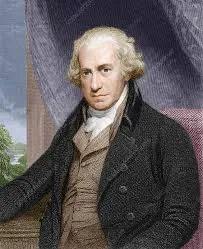
🖼️ James Watt
James Watt
James Watt (1736–1819)
Scottish inventor and mechanical engineer whose improvements to the steam engine played a crucial role in the Industrial Revolution. The SI unit of power, the watt (W), is named in his honour.
✏️ Example
Solved Example
A machine performs \(1500\,J\) of work in \(30\,s\). Calculate its power.
  1. 1
    Write the given values.
  2. 2
    Apply \[ P=\frac{W}{t}. \]
  3. 3
    Calculate the answer.
Given: \[ W=1500\,J,\qquad t=30\,s \]
  1. Using Formula
    \[P=\frac{W}{t}\]
  2. Substituting Values and Calculating
    \[ \begin{aligned} P &=\frac{1500}{30}\\ &=50\,W \end{aligned} \]
🌟 Importance for CBSE Board Examination
⚡ Exam Tip
❌ Common Mistakes
  • Confusing power with energy.
  • Using minutes instead of seconds in SI calculations.
  • Writing Joule instead of Watt as the unit of power.
  • Assuming a powerful machine always performs more work; it may simply perform the same work in less time.
📋 CBSE Competency-Based Question (HOTS)

Two electric motors each lift the same load through the same height. One motor completes the task in 15 seconds, while the other takes 30 seconds.

Questions

  1. Which motor performs greater work?
  2. Which motor develops greater power?
  3. How many times greater is its power?

Answer

  • Both motors perform the same amount of work.
  • The motor taking 15 seconds develops greater power.
  • Its power is \[ \frac{30}{15}=2 \] times greater.
⚡ Quick Revision
  • Power is the rate of doing work.
  • \[ P=\frac{W}{t} \]
  • SI unit: Watt (W).
  • \[ 1\,W=1\,J/s \]
  • Higher power means the same work is done in less time.
  • Power is a scalar quantity.

Example 7

❓ Question
Solved Example: Comparison of Power
Two girls, each having a weight of \(400\,N\), climb a rope to a height of \(8\,m\).

Girl A takes \(20\,s\), while Girl B takes \(50\,s\) to reach the top. Calculate the power developed by each girl.
💡 Concept
🗺️ Roadmap
  1. Calculate the work done by each girl.
  2. Apply the power formula separately for Girl A and Girl B.
  3. Compare the results.
🧩 Solution
Given: Weight of each girl, \[ F=400\,N \] Height climbed, \[ h=8\,m \] Time taken by Girl A, \[ t_A=20\,s \] Time taken by Girl B, \[ t_B=50\,s \]
Step 1: Calculate the work done.
  1. \[ \begin{aligned} W &=F\times h\ &=400\times8\ &=3200\,J \end{aligned} \] Both girls perform the same amount of work because they have the same weight and climb the same height.
Step 2: Calculate the power developed by Girl A.
  1. \[ \begin{aligned} P_A &=\frac{W}{t_A}\\ &=\frac{3200}{20}\\ &=160\,W \end{aligned} \]
Step 3: Calculate the power developed by Girl B.
  1. \[ \begin{aligned} P_B &=\frac{W}{t_B}\\ &=\frac{3200}{50}\\ &=64\,W \end{aligned} \]
Answer: Power developed by Girl A: \(160\,W\)
Power developed by Girl B: \(64\,W\)
🔍 Result Analysis
  • Both girls perform the same amount of work \[ (3200\,J). \]
  • Girl A develops greater power because she completes the work in less time.
  • Power depends on the rate of doing work, not merely on the amount of work done.
⚡ Exam Tip
❌ Common Mistakes
  • Multiplying the given weight by \(g\) again.
  • Using mass instead of weight when the weight is already provided.
  • Writing Joule instead of Watt as the unit of power.
  • Assuming the person doing more work always develops greater power.

Example 8

Work Energy Force Kinetic Energy Potential Energy Power Mechanical Energy Work Formula Conservation of Energy NCERT Class 9 Science
❓ Question
Solved Example: Power Developed While Climbing Stairs
A boy of mass \(50\,kg\) runs up a staircase having \(45\) steps in \(9\,s\). If the height of each step is \(15\,cm\), calculate the power developed by him. Take \[ g=10\,m\,s^{-2}. \]
💡 Concept
Concept Used
🗺️ Roadmap
  1. Calculate the total height climbed.

  2. Find the work done using \[ W=mgh. \]

  3. Apply the power formula \[ P=\frac{W}{t}. \]

🧩 Solution
Given: Mass of the boy, \[ m=50\,kg \] Acceleration due to gravity, \[ g=10\,m\,s^{-2} \] Number of steps, \[ 45 \] Height of each step, \[ 15\,cm=0.15\,m \] Time taken, \[ t=9\,s \]
Step 1: Calculate the total height climbed.
Step 2: Calculate the work done.
  1. \[ \begin{aligned} W &=mgh\\ &=50\times10\times6.75\\ &=3375\,J \end{aligned} \]
Step 3: Calculate the power.
  1. \[ \begin{aligned} P &=\frac{W}{t}\\ &=\frac{3375}{9}\\ &=375\,W \end{aligned} \]
Answer: Therefore, the power developed by the boy is \(375\,W\)
🔍 Result Analysis
  • The boy performs \(3375\,J\) of work against gravity.
  • Since this work is completed in only \(9\,s\), the power developed is \(375\,W\).
  • If the same work were completed in less time, the power would be greater.
⚡ Exam Tip
❌ Common Mistakes
  • Using \(67.5\,m\) instead of \(6.75\,m\).
  • Forgetting to convert \(15\,cm\) into \(0.15\,m\).
  • Using the horizontal distance instead of the vertical height.
  • Writing Joule instead of Watt as the unit of power.

Chapter Summary & Important Points

📝 Chapter Summary & Important Points
🔢 Formula Sheet
⚡ Exam Tip
Last Minute Board Examination Tips
· Updated
NCERT • Class IX • Science • Chapter 10
Work and Energy
Master the physics of force, displacement and the transformation of energy
The Three Big Ideas

Work, Energy and Power form one connected story — a force acting through a distance does work, work transfers energy, and the rate of doing work is power. Build these three pillars first; every numerical problem in this chapter is built on them.

Concept 01

Work — Force Meeting Displacement

Work is done only when a force produces a displacement in the direction of the force. No displacement, or a displacement perpendicular to the force, means zero work — even if great effort is exerted.

W = F · s · cos θ

θ is the angle between the force and displacement vectors. Work is a scalar; its SI unit is the joule (J), where 1 J = 1 N·m.

θ = 0° → Positive work θ = 180° → Negative work θ = 90° → Zero work
Concept 02

Energy — Kinetic & Potential

Energy is the capacity to do work. A moving body possesses kinetic energy; a body raised against gravity stores gravitational potential energy. The Work–Energy theorem links the two: work done on a body equals its change in kinetic energy.

KE = ½ m v²    PE = m g h

Energy, like work, is measured in joules. The total mechanical energy (KE + PE) of an isolated system free of friction stays constant — the Law of Conservation of Energy.

Concept 03

Power — The Rate of Working

Power measures how quickly work is done or energy is transferred. Two machines may do identical work, but the one finishing faster is more powerful.

P = W / t = Energy / time

SI unit: watt (W), where 1 W = 1 J/s. Larger unit: kilowatt (kW). The commercial unit of energy is the kilowatt-hour (kWh), where 1 kWh = 3.6 × 10⁶ J — this is the "unit" your electricity meter records.

AI Step-by-Step Solver

Pick a problem type, enter the known values, and the engine builds a full reasoned solution — entirely offline, rule-based, with no external AI calls.

Choose a problem type, fill in the values, and press “Solve” to see the worked-out steps here.
Formula Reference Sheet

Every relation you need for Chapter 10, in one place.

Work done by a constant force
W = F · s · cos θ
F = force (N), s = displacement (m), θ = angle between force and displacement. Unit: joule (J).
Kinetic energy
KE = ½ m v²
m = mass (kg), v = speed (m/s). KE always ≥ 0, regardless of direction of motion.
Gravitational potential energy
PE = m g h
h = height above a chosen reference level; g ≈ 9.8 m/s² on Earth. PE depends on the reference chosen.
Power
P = W / t
Average power over time t. Instantaneous power for constant force: P = F · v.
Work–energy theorem
W = ΔKE = ½mv² − ½mu²
Net work done on a body equals the change in its kinetic energy (u = initial speed, v = final speed).
Conservation of mechanical energy
KE + PE = constant
Valid only when no friction or air resistance acts — e.g. an ideal free fall or an ideal pendulum.
Commercial unit of energy
1 kWh = 3.6 × 10⁶ J
Energy consumed by a 1000 W appliance running for 1 hour. This is the "unit" billed by electricity providers.
SI units at a glance
J, W, kg, m, s
Work/Energy → joule (J); Power → watt (W); Mass → kg; Distance/height → m; Time → s.
Exam Tips & Common Mistakes

Small habits that protect marks — and the traps that quietly cost them.

✅ Smart Habits
💡Always check the angle between force and displacement before applying W = Fs cos θ — most "trick" questions hide here.
💡Convert all quantities to SI units (kg, m, s) before substituting into a formula, especially mass given in grams.
💡When a problem mentions "height fallen" vs "height above ground," draw a quick diagram to fix your reference level for PE.
💡For free-fall / pendulum problems, write the total mechanical energy once at the start — it stays constant throughout, simplifying every later step.
💡Remember g ≈ 9.8 m/s² unless the question specifies a rounded value like 10 m/s² — read the question carefully.
💡State units at every step of a numerical answer, not just the final line — many boards award step-wise marks.
💡When asked for power, double-check whether the question wants energy used per second (P = W/t) or average power over a full task.
⚠️ Common Mistakes
Forgetting the cos θ term — assuming W = Fs always, even when force and displacement are not in the same direction.
Treating "no motion" and "zero work" as different ideas — if s = 0, work is always zero, regardless of how large F is.
Plugging mass directly in grams into KE or PE formulas without converting to kilograms.
Confusing weight (mg, a force in newtons) with mass (m, in kilograms) inside the PE formula.
Assuming kinetic energy can be negative when velocity is negative — KE depends on v², so it is always non-negative.
Mixing up watt and kilowatt-hour — one is a unit of power, the other a unit of energy. They are not interchangeable.
Applying conservation of energy in situations with friction or air resistance without accounting for energy lost as heat/sound.
Concept-Building Practice

Original problems, organised by concept, each with a complete worked solution. Try every question yourself before revealing the answer.

Concept 01

Work Done by a Force

Question 1
A gardener pulls a lawn roller with a force of 70 N applied at an angle of 60° to the ground, moving it 8 m across the lawn. Calculate the work done by the gardener.
Step 1 — Identify knowns: F = 70 N, s = 8 m, θ = 60°
Step 2 — Apply formula: W = F s cos θ
Step 3 — Substitute: W = 70 × 8 × cos 60° = 560 × 0.5
W = 280 J
Question 2
A satellite moves in a perfectly circular orbit around the Earth at constant speed. Explain, with reasoning, how much work the gravitational force does on the satellite in one complete revolution.
Step 1 — Direction of force: Gravity always pulls the satellite toward the Earth's centre, i.e. radially inward.
Step 2 — Direction of displacement: In a circular orbit, the velocity (and hence displacement) is always tangential — perpendicular to the radius.
Step 3 — Angle between them: θ = 90° at every instant, so cos θ = 0.
Step 4 — Conclusion: W = F s cos 90° = 0 at every instant, hence total work over one revolution is also zero.
W = 0 J (gravity does no work on a circularly orbiting body)
Question 3
A porter lifts a 15 kg suitcase vertically through 1.6 m and then carries it horizontally for 12 m at constant velocity to a platform. Find the total work done by the porter against gravity during the entire trip. (Take g = 9.8 m/s²)
Step 1 — Vertical lift: Force needed = weight = mg = 15 × 9.8 = 147 N, displacement = 1.6 m, same direction (θ = 0°).
Step 2 — Work in lifting: W₁ = 147 × 1.6 × cos 0° = 235.2 J
Step 3 — Horizontal carry: The lifting force (vertical, supporting weight) is perpendicular to horizontal displacement, so θ = 90°, giving W₂ = 0 J against gravity.
Step 4 — Total: W = W₁ + W₂ = 235.2 + 0
W = 235.2 J
Concept 02

Kinetic, Potential Energy & Conservation

Question 4
A 0.5 kg ball is thrown so that its speed increases from 4 m/s to 10 m/s. Using the work–energy theorem, find the work done on the ball.
Step 1 — Initial KE: KEᵢ = ½ × 0.5 × 4² = ½ × 0.5 × 16 = 4 J
Step 2 — Final KE: KE_f = ½ × 0.5 × 10² = ½ × 0.5 × 100 = 25 J
Step 3 — Work–energy theorem: W = KE_f − KEᵢ = 25 − 4
W = 21 J
Question 5
A 2 kg stone is dropped from a height of 20 m. Using conservation of energy (ignore air resistance), find its speed when it has fallen 12 m. (Take g = 10 m/s²)
Step 1 — Total energy at top (taking ground as reference): E = mgh = 2 × 10 × 20 = 400 J (all potential, since it starts at rest)
Step 2 — Height remaining after falling 12 m: h′ = 20 − 12 = 8 m
Step 3 — PE remaining at that point: PE′ = mgh′ = 2 × 10 × 8 = 160 J
Step 4 — KE gained (by conservation): KE′ = E − PE′ = 400 − 160 = 240 J
Step 5 — Solve for speed: 240 = ½ × 2 × v² ⟹ v² = 240 ⟹ v = √240 ≈ 15.5 m/s
v ≈ 15.5 m/s
Question 6
A pendulum bob is pulled aside so it rises 0.05 m above its lowest point and released. Ignoring air resistance, find the bob's speed as it passes through the lowest point. (Take g = 9.8 m/s²)
Step 1 — Energy at the highest point: Bob is momentarily at rest, so all energy is potential: PE = mgh = m × 9.8 × 0.05
Step 2 — Energy at the lowest point: h = 0 here, so PE = 0; all energy has converted to kinetic energy: KE = ½mv²
Step 3 — Apply conservation (mass cancels): mgh = ½mv² ⟹ v² = 2gh = 2 × 9.8 × 0.05 = 0.98
Step 4 — Take square root: v = √0.98 ≈ 0.99 m/s
v ≈ 0.99 m/s (independent of the bob's mass)
Concept 03

Power & Commercial Energy Units

Question 7
A water pump lifts 300 kg of water through a height of 15 m in 25 seconds. Calculate the power of the pump. (Take g = 9.8 m/s²)
Step 1 — Work done against gravity: W = mgh = 300 × 9.8 × 15 = 44100 J
Step 2 — Apply power formula: P = W / t = 44100 / 25
P = 1764 W ≈ 1.76 kW
Question 8
A 1500 W electric heater runs for 4 hours every day. Calculate the energy it consumes in 30 days, in kWh, and the cost if electricity is billed at ₹6 per unit.
Step 1 — Power in kW: P = 1500 W = 1.5 kW
Step 2 — Daily energy used: E_day = P × t = 1.5 kW × 4 h = 6 kWh
Step 3 — Energy over 30 days: E_total = 6 × 30 = 180 kWh
Step 4 — Cost: Cost = 180 × ₹6 = ₹1080
Energy = 180 kWh, Cost = ₹1080
Question 9
Two students, A and B, each have a mass of 50 kg. Student A climbs a flight of stairs of height 4 m in 12 s; student B climbs the same stairs in 8 s. Compare their power outputs. (Take g = 10 m/s²)
Step 1 — Work done by each (identical, since same mass and height): W = mgh = 50 × 10 × 4 = 2000 J
Step 2 — Power of A: P_A = 2000 / 12 ≈ 166.7 W
Step 3 — Power of B: P_B = 2000 / 8 = 250 W
Step 4 — Comparison: Both do the same work, but B does it faster, so B's power output is greater even though neither does "more work."
P_A ≈ 166.7 W, P_B = 250 W — B is more powerful
Interactive Learning Modules

Five hands-on ways to test and sharpen your understanding.

Term
Definition
1 / 8
Tap the card to flip it

Tap one term on the left, then its matching formula/definition on the right.

0 of 6 pairs matched
drop height
1 kg
10 m
Potential
0 J
Kinetic
0 J
Total mechanical energy stays constant as the ball falls — potential energy converts into kinetic energy.
📚
ACADEMIA AETERNUM तमसो मा ज्योतिर्गमय · Est. 2025
Sharing this chapter
Work And Energy | Science Class 9 | Academia Aeternum
Work And Energy | Science Class 9 | Academia Aeternum — Complete Notes & Solutions · academia-aeternum.com
The chapter "Work and Energy" is a fundamental part of Class 9 Science that explores the relationship between work, energy, and power. It introduces students to the concept of work in physics, explaining how forces cause displacement and contribute to energy transfer. The chapter further delves into different forms of energy, mainly kinetic and potential energy, and explains the principle of conservation of energy, which states that energy cannot be created or destroyed but only transformed…
🎓 Class 9 📐 Science 📖 NCERT ✅ Free Access 🏆 CBSE · JEE
Share on
academia-aeternum.com/class-9/science/work-and-energy/notes/ Copy link
💡
Exam tip: Sharing chapter notes with your study group creates a reinforcement loop. Teaching a concept is the fastest path to mastering it.

Recent posts

    Work and Energy — Learning Resources

    🧠 Practice MCQs
    ✔️ True / False
    📌 Exercise
    💬 Q&A Discussion
    📝 Exercises
    WORK AND ENERGY-Exercise

    Frequently Asked Questions

    Work is done when a force causes displacement of an object in the direction of the force.

    Work done \((W) = Force (F) × Displacement (s) × cos\,\theta\), where \(\theta\) is the angle between force and direction of displacement.

    The SI unit of work is joule (J).

    A force must act on the object and the object must move in the direction of the force.

    Energy is the capacity to do work or cause change.

    The main forms are kinetic energy and potential energy; other forms include mechanical, chemical, electrical, heat, and nuclear energy.

    Kinetic energy is the energy possessed by a body due to its motion.

    Kinetic Energy \((KE) =\frac{1}{2} \times (\text{mass } m)\times (\text{velocity } v)^2\)

    Potential energy is the stored energy an object has due to its position or configuration.

    Gravitational Potential Energy (PE) = mass (m) × gravity (g) × height (h)

    Mechanical energy is the sum of kinetic and potential energy in a system.

    A moving car has kinetic energy.

    Get in Touch

    Let's Connect

    Questions, feedback, or suggestions?
    We'd love to hear from you.