- An apple falls towards Earth.
- Rainwater falls from clouds.
- A football thrown upward returns to the ground.
- The Moon revolves around Earth.
- Earth revolves around the Sun.
- Artificial satellites remain in orbit.
- Sea tides occur due to the gravitational pull of the Moon and Sun.
Chapter 9 · CBSE · Class IX
Table of Contents
15 sections
- 1 Definition ›
- 2 Introduction ›
- 3 Meaning of Gravity ›
- 4 Important Characteristics of Gravitation ›
- 5 Everyday Examples of Gravitation ›
- 6 Why Don't We Feel Gravitational Attraction Between Two Persons? ›
- 7 Concept Builder ›
- 8 Historical Background ›
- 9 Solved Concept Example ›
- 10 Think Beyond NCERT ›
- 11 Exam Tip ›
- 12 Common Mistale ›
- 13 Board Important Definitions ›
- 14 CBSE Competency-Based (HOTS) Case Study ›
- 15 Quick Reference ›
📘 Definition
📖 Introduction
📌 Meaning of Gravity
🔷 Characteristics
Important Characteristics of Gravitation
Important Characteristics of Gravitation
- Gravitation is always an attractive force. It never repels objects.
- It acts between every pair of objects having mass.
- It acts over very large distances and its range is considered infinite.
- No medium is required for gravitational force to act. It can act even through vacuum.
- The force becomes stronger when masses increase.
- The force becomes weaker as the distance between objects increases.
- Gravitational force obeys Newton's Third Law. If Earth attracts an apple, the apple also attracts Earth with an equal force in the opposite direction.
✏️ Everyday Examples of Gravitation
🤔 Did You Know?
Why Don't We Feel Gravitational Attraction Between Two Persons?
Every person attracts every other person gravitationally. However, since the masses of human beings are very
small, the force produced is extremely tiny and cannot be noticed in daily life.
Earth has an enormous mass
Earth has an enormous mass
\[
\left(5.97\times10^{24}\text{ kg}\right)
\]
therefore its gravitational pull on us is much larger than the pull between two people.
💡 Concept
Concept Builder
🏛️ Historical Background
Ancient astronomers observed that planets move in definite paths around the Sun, but the reason remained
unknown for centuries.
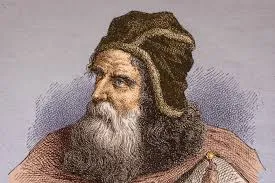
Sir Isaac Newton explained this mystery by proposing the Universal Law of Gravitation. According to a famous story, seeing an apple fall from a tree inspired him to think that the same force pulling the apple downward might also be responsible for keeping the Moon in its orbit around Earth.
Newton concluded that the same gravitational force acts everywhere in the universe.
Newton united them under one single law:
Sir Isaac Newton explained this mystery by proposing the Universal Law of Gravitation. According to a famous story, seeing an apple fall from a tree inspired him to think that the same force pulling the apple downward might also be responsible for keeping the Moon in its orbit around Earth.
Newton concluded that the same gravitational force acts everywhere in the universe.
Newton's Revolutionary Idea
Before Newton, falling objects and planetary motion were considered unrelated phenomena.Newton united them under one single law:
- The force that causes an apple to fall is the same force that keeps the Moon in orbit.
- The force that keeps planets revolving around the Sun is also gravitation.
This was one of the greatest scientific discoveries because it explained both earthly and celestial motions
using one universal law.
🎨 SVG Diagram
Simple Concept Map
✏️ Example
Solved Concept Example
Name three natural phenomena that occur due to gravitation.
-
1Recall common effects of gravitational force.
-
2Select any three correct examples.
- Falling of objects towards Earth.
- Revolution of planets around the Sun.
- Motion of the Moon around Earth.
🗒️ Think Beyond NCERT
Astronauts in orbit appear weightless not because there is no gravity. Gravity is still acting on them.
They experience continuous free fall along with their spacecraft, producing the sensation
of weightlessness.
⚡ Exam Tip
🗒️ Common Mistale
- Writing that gravity and gravitation are exactly the same.
- Thinking that only Earth exerts gravitational force.
- Believing that only large bodies possess gravity.
- Assuming gravitational force requires air or another medium.
- Ignoring that gravitational attraction is mutual.
🌟 Board Important Definitions
📋 CBSE Competency-Based (HOTS) Case Study
During a science exhibition, Riya drops a steel ball and a wooden ball simultaneously from the same height. Both fall towards Earth. Her friend asks why both move downward even though they are made of different materials.
Questions
- Which force causes both balls to move downward?
- Does Earth attract only heavy objects?
- Do the balls also attract Earth?
Answers
- Earth's gravitational force.
- No. Earth attracts every object having mass.
- Yes. According to gravitation, attraction is mutual, although Earth's motion is too small to notice.
🗒️ Quick Reference
- Every object having mass attracts every other object.
- Gravitation acts throughout the universe.
- Gravity is a special case of gravitation.
- Gravitational force is always attractive.
- It explains falling bodies, planetary motion, tides and satellite motion.
- Newton proposed the Universal Law of Gravitation.